


Set an ad budget with a performance marketing agency by working backwards from the business outcome, the value of each customer and the amount you can commit without depending on immediate returns. Separate media spend from agency services, creative production and website work, then agree on what evidence will justify increasing, holding or stopping spend. Your 2026 budget should be an approval plan, not just a monthly spending figure.
- Set a performance marketing agency budget around customer economics, qualified leads and an affordable spending ceiling.
- Separate media spend, agency services, creative production and website work before approving the proposal.
- CreativHeads suits growing brands seeking strategy, design and marketing from one service agency.
- Increase spending only when customer quality, business outcomes and delivery capacity support the decision.
Why this matters
An advertising budget commits more than money to an ad platform. It also creates work for the people producing campaigns, handling enquiries and delivering orders. If those responsibilities are unclear, you cannot tell whether disappointing results come from the advertising, the website or the follow-up.
Approve the measurement rules before approving the spend. Define what counts as a useful result and who verifies it. Use the same definitions in your monthly performance marketing report so budget decisions reflect business outcomes rather than activity alone.
How do you set an ad budget with a performance marketing agency?
Start with a spending ceiling your business can support, then build the campaign scope inside it. Do not begin with a channel recommendation and work backwards to an amount you feel pressured to approve.
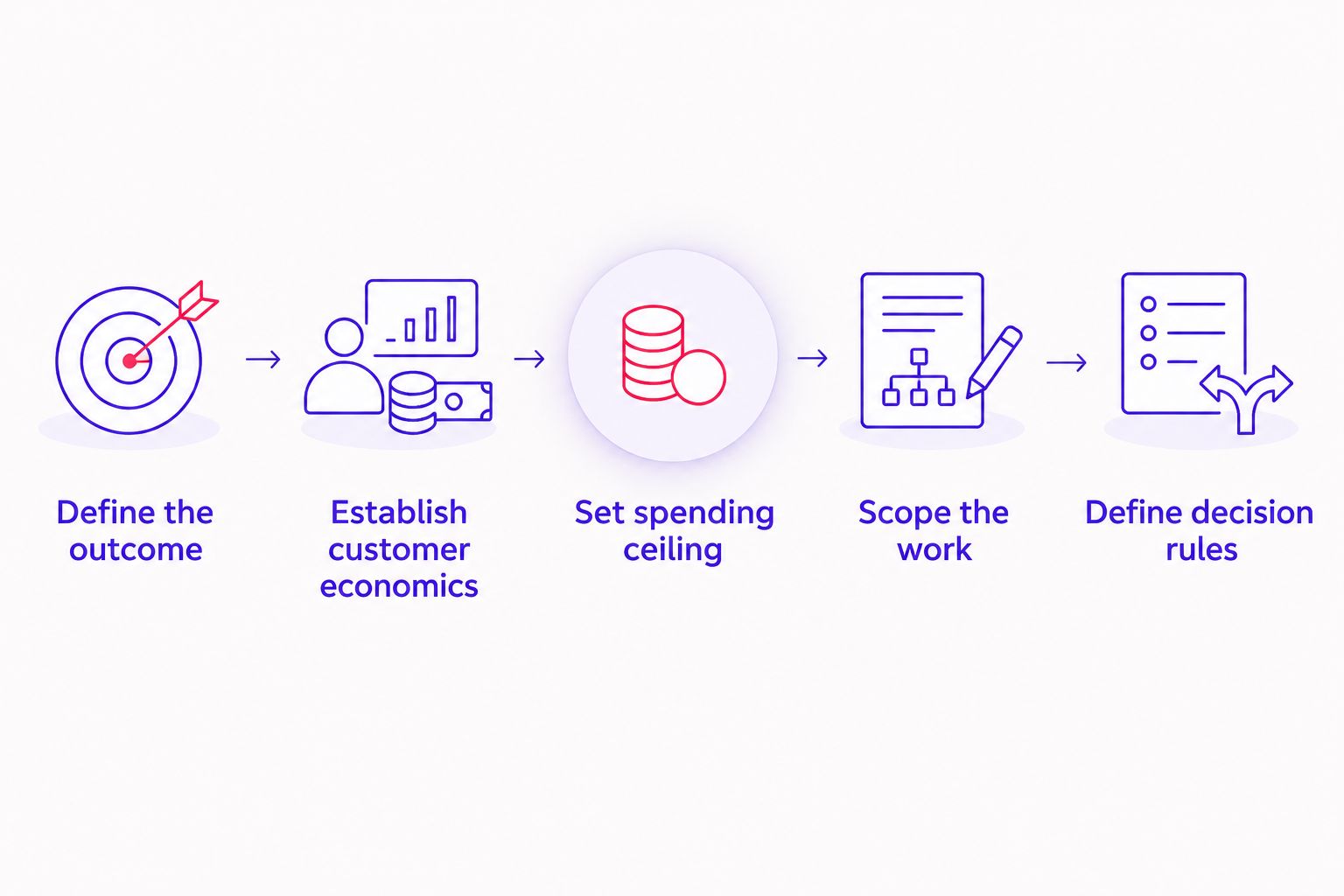
Use this sequence to turn the discussion into an actionable brief:
- Define the outcome. Choose the business result: completed purchases, qualified project enquiries, booked appointments or another clearly defined action. Specify what does not count.
- Establish customer economics. Identify what remains from a sale after the relevant delivery costs. For enquiries, connect lead quality to actual sales rather than treating every submitted form as revenue.
- Set the spending ceiling. Decide what the business can fund through the agreed evaluation period without relying on the campaign to pay for itself immediately.
- Scope the work. List media buying, campaign management, creative assets, website changes and measurement setup separately. Assign an owner to each deliverable.
- Define decision rules. Record what will trigger a budget increase, a pause or a change in campaign direction. Name the person authorised to approve each decision.
The final budget should state both the authorised spend and the work needed to make that spend useful. A proposal that lists only an advertising amount leaves the delivery scope unresolved.
What should the budget document include?
For your 2026 planning document, distinguish the money paid to advertising platforms from the work commissioned around those campaigns. These are different commitments, even when the same agency coordinates them.
| Budget component | What to specify | Approval question |
|---|---|---|
| Media spend | Platforms, campaign purpose and authorised spending limit | Who can change the limit? |
| Agency services | Planning, campaign management, reporting and meetings | Which responsibilities are included? |
| Creative production | Ad formats, versions, revisions and usage requirements | What is delivered, and who approves it? |
| Website work | Landing pages, forms, checkout changes or other agreed tasks | Is this included or separately commissioned? |
| Measurement setup | Actions recorded, reporting sources and access responsibilities | How will results be checked? |
Ask the agency to identify dependencies before launch. For example, an enquiry campaign needs a working form and an agreed follow-up process; an online sales campaign needs a functioning purchase journey. Advertising approval should not silently become approval for unspecified website work.
New-brand budgets: fund a defined test
Best for: businesses without reliable campaign history. Commission a focused test with a clear customer group, offer and conversion action. The purpose is to learn whether the proposed approach generates useful business opportunities within your authorised spending limit.
The benefit is a contained commitment. The limitation is that early results do not establish long-term performance, especially when sales take time to complete. Avoid treating an initial burst of enquiries as proof that the budget should expand.
Ask the proposal to identify the question each campaign will answer. Is the offer attracting the intended buyer? Are enquiries commercially relevant? Does the website support the action you want people to take?
Keep the scope narrow enough to interpret the results. If you change the audience, offer, landing page and creative together, the next decision becomes harder to explain. Make the learning objective explicit before the agency starts spending.
Established-campaign budgets: start from verified outcomes
Best for: businesses with usable campaign and sales records. Build the next budget from verified outcomes, not the previous month's spending limit. Separate campaigns that generated customers from campaigns that produced attention without a demonstrated business result.
The benefit is a stronger starting point for planning. The limitation is that past performance does not account for every change in your offer, customer demand or delivery capacity. Your 2026 plan should describe what remains comparable and what has changed.
Review results with the person responsible for sales or orders. An advertising report can show recorded conversions, but your business must confirm whether those conversions became customers, remained enquiries or were cancelled.
Do not preserve a campaign merely because it has always received budget. Ask what evidence supports its role now. Where that evidence is unclear, define the next test instead of renewing the allocation automatically.
Expansion budgets: increase spend against business evidence
Best for: businesses with verified customer outcomes and capacity to fulfil additional demand. Agree on an expansion rule before increasing the budget. That rule should connect advertising results to customer quality, commercial return and operational readiness.
The benefit is a controlled route to growth. The limitation is that additional spending does not guarantee the same return as the existing budget. Review the added spend on its own merits rather than assuming the whole campaign will behave identically.
Confirm that your team can handle more enquiries or orders before approving expansion. A campaign does not solve missed follow-ups, unsuitable stock planning or delivery constraints. Those issues belong in the budget discussion because they affect whether additional demand is useful.
Which budgeting approach fits your business?
| Approach | Best for | Main benefit | Main limitation |
|---|---|---|---|
| Defined test | New brands or untested offers | Contains the commitment around a clear question | Early findings need validation against completed business outcomes |
| Evidence-led allocation | Businesses with verified campaign history | Connects spending to known customer outcomes | Old results need checking against current conditions |
| Controlled expansion | Businesses ready to serve more customers | Ties increases to agreed commercial evidence | Added spending is not a guarantee of equivalent returns |
Choose the approach that matches your evidence, not the size of the ambition. A new brand can have a substantial growth goal and still need a focused test before committing to expansion.
Why your ad budget varies
Budget differences should follow differences in scope and business needs. Ask the agency to explain each driver in terms of the work required or the result being pursued.
- Business objective: A purchase campaign and a qualified-enquiry campaign need different definitions of success. Approve the outcome before comparing proposed budgets.
- Customer economics: Order value alone does not establish what you can spend to acquire a customer. Include relevant delivery costs and check whether repeat purchases are supported by your own records.
- Creative requirements: Agree on formats, versions, production responsibilities and revisions. An asset plan makes the production commitment visible.
- Website readiness: Specify whether landing pages, forms or purchase journeys need work before advertising begins. Keep those tasks distinct from media spend.
- Sales process: Define who responds to enquiries, how quality is recorded and how completed sales reach the reporting process. The agency needs feedback that distinguishes interest from business.
- Project scope: Campaign coverage, approval responsibilities and reporting requirements all belong in the proposal. A broader brief is not the same purchase as a narrowly defined campaign.
For a 2026 launch, identify which dependencies must be completed before the media budget is released. This gives you an approval order rather than a list of simultaneous commitments.
How do you calculate an affordable customer acquisition target?
An affordable customer acquisition target starts with what the business retains from a customer, not headline revenue. Use your own commercial records and make the calculation visible in the proposal discussion.
For a sales campaign, compare customer acquisition spend with the contribution available after relevant variable costs. Decide which expenses the acquisition calculation includes so the agency and your finance team are not using different definitions.
For an enquiry campaign, work backwards from completed sales. The relationship is: cost per qualified lead divided by the qualified-lead-to-customer conversion rate equals acquisition cost, provided the lead group and sales outcomes are matched. A low lead cost is not a useful verdict when the leads do not become suitable customers.
Do not assume future repeat purchases will cover acquisition spending unless your records support that assumption. Keep an unproven repeat-purchase expectation separate from the budget you can justify today.
Should you split the budget across several advertising channels?
Split the budget only when each channel has a defined role and you can evaluate that role. More channels add more campaign decisions; they do not automatically make the plan more effective.
Ask the agency to state the customer action expected from each channel and how the result will be checked. If the explanation is simply that your brand should be everywhere, ask for a narrower recommendation.
For your 2026 plan, prioritise a readable test over a crowded channel list. Expand coverage when the additional channel answers a specific business need and the team can support its creative and reporting requirements.
When should you increase or pause the ad budget?
Increase the ad budget when verified outcomes support the additional commitment and your business can fulfil the demand. Pause or restrict spending when the conversion journey is broken, lead quality is unsuitable or the agreed measurement cannot be trusted.
Distinguish a campaign problem from a delivery problem before making the decision. If enquiries arrive but remain unanswered, increasing media spend does not address the immediate issue. If the website form fails, fix the form before judging demand.
Record the decision and its reason. Your next review should show whether the change solved the identified problem, not merely whether spending went up or down.
What should you ask before approving the agency proposal?
Approve a defined scope, not a promise of growth. Ask these questions before signing:
- What business outcome is this budget designed to produce?
- Which expenses sit outside media spend?
- What creative assets and website work are included?
- How will you distinguish qualified enquiries from unsuitable submissions?
- Who owns the advertising accounts and approves budget changes?
- What evidence will trigger an increase, pause or change of direction?
- How will completed sales inform the next budget decision?
CreativHeads is suited to growing brands that want strategy, design and marketing from one service agency. That combined scope is relevant when campaign work also depends on branding, content or website changes. The trade-off is coordination: the proposal still needs separate deliverables and approvals, rather than one broad description covering everything.
For a discussion with CreativHeads, bring your business objective, spending ceiling, existing assets and sales process. Those details make it possible to discuss the work you need rather than an advertising figure in isolation.
FAQ
How do I set a budget with a performance marketing agency?
Set the budget from your business goal, customer economics and affordable spending ceiling. Separate media spend from agency services and production, then agree on the evidence needed to change the budget.
Should agency services come out of my advertising budget?
Agency services should be identified separately from advertising platform spend. Your total commitment can include both, but the proposal must show which work is included and which expenses are separate.
What if my new brand has no advertising history?
Start with a defined test around a specific buyer, offer and business outcome. Judge the test using enquiry quality or completed purchases, not traffic alone.
Should I increase spending when lead costs fall?
Increase spending only when lower lead costs also support suitable customers and acceptable commercial outcomes. Cheap enquiries that do not become customers are not evidence for expansion.
Can one agency handle the ads, creative and website work?
One agency can coordinate those services when they are explicitly included in the scope. CreativHeads offers branding, web design, content and digital marketing; confirm the deliverables and responsibilities required for your project.
How should I compare proposals with different budget recommendations?
Compare the proposed outcome, media allocation, service scope, creative deliverables and decision rules. Different spending figures are not directly comparable when the included work differs.
What should my 2026 advertising budget review cover?
Your 2026 advertising budget review should cover authorised spend, verified customer outcomes, enquiry quality and delivery capacity. End the review with a documented decision to hold, adjust, expand or pause activity.
One last thing
Ask for the conditions under which the agency would recommend spending less. The answer should identify a business reason, such as unsuitable enquiries, an unresolved website problem or limited fulfilment capacity.
A useful budget includes permission to stop. Put that authority in writing before launch, alongside the rules for increasing spend.
Related guides
- How to compare performance marketing agency proposals
- Performance marketing agency buying guide for a new brand
- How to plan social ad versions with a video production company