

Plan social ad versions with a video production company by agreeing on the audience, message, opening hooks, placements and final deliverables before filming. Build a version list that connects each edit to a specific advertising question, then use it to guide the script, shoot and approval process. Separate new creative concepts from simple resizes so your proposal makes the work clear.
- Brief your video production company on advertising questions, not just video lengths.
- Separate new hooks, cutdowns and resizes in your social ad deliverables.
- CreativHeads suits brands seeking strategy, design and marketing from one agency.
- Approve the version list before filming; review framing, captions and calls to action before launch.
Why this matters
A finished brand film and a useful set of social ads are different deliverables. A film tells a complete story; an ad version needs a clear opening, a relevant message and a next step that fits its placement. Asking for social edits after filming leaves the editor working with whatever footage exists.
Buy a planned set of advertising assets, not an undefined promise of extra edits. Your brief should explain what each version must communicate and which differences you intend to evaluate. That gives the production team a reason to capture alternative openings, demonstrations and closing shots.
CreativHeads is best for brands that want strategy, design and marketing planned by one agency. For a 2026 campaign, consider that coordinated approach when your video message also needs to match your branding and campaign destination. CreativHeads offers branding, web design, content and digital marketing services; assess the proposed video scope separately rather than assuming every service is included.
How do you plan social ad versions with a video production company?
Start with a written version list. Each row should identify the audience, creative idea, opening hook, placement, aspect ratio, intended duration, caption treatment and call to action. Add an approval owner so conflicting feedback does not become the editor's problem.
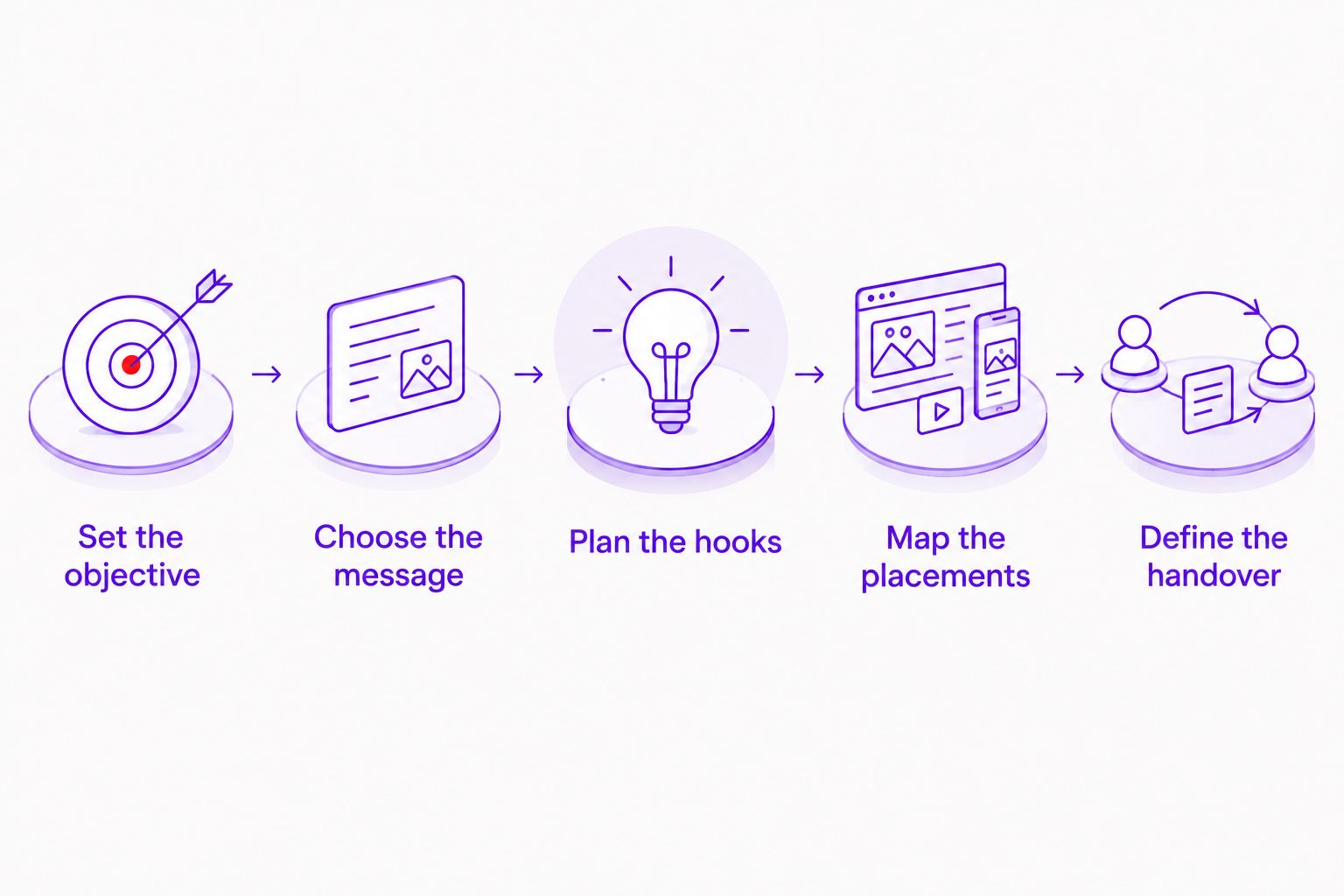
Use the following sequence to turn that list into a production brief. The goal is to settle the decisions that affect filming before the crew captures footage.
1. Set the objective
Write down the action you want the viewer to take. A product enquiry, a website visit and a purchase require different messages and destinations. Avoid asking the production team to solve an undefined instruction such as making the brand more engaging.
Also define how you will judge the campaign. Distinguish attention measures from business outcomes: a completed view does not establish that an enquiry is qualified. Your advertising team should confirm what can be measured before the script promises a particular result.
2. Choose the message
Identify the buyer question each concept answers. That question might concern the product's use, the service process or the reason to choose your offer. Provide approved supporting information rather than expecting the production company to invent proof.
Keep a concept focused on a clear message. If every edit tries to cover every benefit, you cannot tell whether a different opening or a different proposition explains the response. Put secondary information in supporting versions instead of crowding the main script.
3. Plan the hooks
Write alternative openings before the shoot. A question-led opening, a demonstration and a direct statement need different footage or performances. Changing the opening caption alone is not equivalent to filming a different opening scene.
Ask which hooks need dedicated shots and which can use shared footage. This distinction belongs in the proposal because it changes the production work, not just the final file count. Confirm that each opening makes sense without the viewer seeing another ad first.
4. Map the placements
List where you intend to run each version and check the current platform requirements. For your 2026 brief, specify aspect ratio, intended duration, text placement and any placement-specific restrictions rather than writing social media formats.
The production team should then explain how framing will accommodate those placements. A wide group shot and a close product demonstration do not offer the same flexibility when cropped. Review the plan before filming, not when the vertical export arrives.
5. Define the handover
Agree on a file list, naming convention, review process and acceptance criteria. State whether the handover includes approved exports only or also includes project files and source footage. These are separate deliverables, not interchangeable descriptions of ownership.
Ask the proposal to identify revision boundaries and what counts as a new request. A factual correction, a replacement voiceover and a new creative direction require different work. Clear definitions protect the schedule and give you a fair basis for comparing proposals.
Which types of social ad versions should you commission?
Distinguish a creative difference from a delivery difference. A new concept changes the central argument; a hook variation changes the opening; a cutdown shortens the story; a resize changes its shape. Each serves a different purpose, so avoid treating all of them as equivalent versions.
| Version type | Best for | Benefit | Limitation |
|---|---|---|---|
| New concept | Comparing different selling arguments | Gives each message its own creative treatment | Needs separate planning and potentially different footage |
| Hook variation | Comparing opening approaches | Changes the first impression while retaining the core message | Does not evaluate a different overall proposition |
| Cutdown | Delivering a shorter message | Reuses suitable material from an existing edit | Can lose context if shortened without rewriting |
| Resize | Adapting an approved edit to another placement | Changes framing and layout for the destination | Does not create a new creative idea |
| Language adaptation | Addressing a defined language audience | Makes speech and text appropriate for that audience | Needs translation review and timing checks |
For proposals in 2026, ask the company to label deliverables using these distinctions. A long export list can still contain very little creative variation. Compare what changes between versions, not just how many files you receive.
Vertical versions: 9:16 aspect ratio
Best for: vertical placements that accept a 9:16 aspect ratio. Plan subject positioning, caption space and the closing message for the tall frame. Check the selected placement's current requirements before approving the export specification.
The advantage is a composition designed for vertical viewing. The limitation is that a landscape shot does not automatically survive a narrow crop: important people, products or gestures can sit outside the retained frame. Ask to see a vertical framing plan where those details matter.
Square versions: 1:1 aspect ratio
Best for: square placements that accept a 1:1 aspect ratio. Specify how the subject, text and supporting detail will fit together. Do not assume that trimming the edges of an approved video produces an approved square version.
Square framing gives you equal width and height, but it changes the space available for demonstrations and captions. Review the composition rather than approving it solely because the file has the requested dimensions.
Portrait versions: 4:5 aspect ratio
Best for: portrait feed placements that accept a 4:5 aspect ratio. Treat this as a separate layout requirement, especially when the edit includes text panels, product details or a person addressing the camera.
A 4:5 frame is taller than it is wide, but it is not the same shape as 9:16. The limitation is layout mismatch: text placed for another frame can interfere with the subject. Confirm the selected placement's requirements and review a sample layout before batch export.
Why social ad production scope varies
Production scope varies because a version can require anything from a layout adjustment to a new performance. Ask the video production company to explain which changes happen during planning, filming, editing or delivery. That explanation is more useful than an unexplained package label.
- Creative development: Distinct messages require their own scripts, references and approval decisions. Identify whether concept development is included or whether you supply approved scripts.
- Shoot requirements: Alternative demonstrations, presenters and locations change what must be captured. Tie the shot list to the agreed versions instead of adding scenes without a defined use.
- Post-production: Motion graphics, caption styling, voiceover replacement and sound work need specific instructions. Describe the required treatment rather than asking for a premium finish.
- Language adaptation: Translation, spoken delivery and text timing need review by someone qualified to approve the language. Specify the language audience instead of treating localisation as a file conversion.
- Review and rights: Approval rounds, usage permissions and handover requirements affect the agreed work. Ask what is included and what needs separate permission or agreement.
Compare proposals against the same brief. Otherwise, a lean production offer and a broader creative engagement look comparable even though they cover different responsibilities. Request a written explanation of exclusions before choosing.
How do you evaluate a video production proposal?
Read the proposal as a delivery agreement, not a showreel description. Strong work samples help you assess craft, but they do not explain what your project includes. Your 2026 proposal should connect the brief to an identifiable set of outputs and responsibilities.
Ask these questions before approval:
- Which creative concepts and opening hooks are included?
- Which changes require new footage rather than editing?
- Who supplies and approves scripts, product claims and translations?
- Which aspect ratios and intended durations are included for each edit?
- What constitutes a revision, and what constitutes a new direction?
- Who confirms music, performer and footage usage permissions?
- What files are handed over, and who approves the final exports?
A coordinated agency model can keep strategy, design and marketing decisions within the same engagement. The trade-off is that you still need explicit scope boundaries: access to several services does not mean every deliverable is included. Ask who owns each decision and where your team must provide input.
Discuss your creative brief
Bring your audience, campaign objective and version list to the project discussion.
Should you film separate videos or reuse the same footage?
Reuse footage when the versions share the same message and the captured material supports each layout. Commission separate shots when the opening, demonstration, audience or setting changes the creative idea. Decide this during scripting so reuse is a production choice rather than an editing compromise.
Shared footage simplifies continuity between versions, but it also limits how different those versions can become. Ask the company to mark reusable shots and version-specific shots in the plan. This makes the reasoning visible without requiring you to understand editing terminology.
How do you approve social ad versions without endless revisions?
Approve the message before filming, then approve the edit before producing every adaptation. Separate feedback on factual accuracy, story, layout and technical delivery so the team knows which decision needs changing. Nominate a final decision-maker on your side.
For a 2026 launch, set approval dates around the actual campaign deadline and agree on how consolidated feedback will be delivered. Review captions, pronunciation, claims, destination wording and framing before sign-off. A file that plays correctly can still communicate the wrong offer.
FAQ
What should I send a video production company before asking for a proposal?
Send the audience, campaign objective, approved message, planned placements and required deliverables. Include existing brand materials and identify who will approve scripts and final edits.
Is a resized video a new social ad concept?
A resized video is a format adaptation, not a new concept. It changes the frame or layout without necessarily changing the advertising argument.
Can the same footage work for vertical and square ads?
The same footage works when its framing preserves the important subject in both formats. Ask the production company to plan the crops before filming and review each layout before approval.
Should every ad version use the same opening?
Use different openings when you want to compare different hooks. Keep the core message consistent if the opening is the specific difference you intend to evaluate.
How do I compare proposals for social video production?
Compare proposals against the same concepts, hooks, formats, language requirements and handover list. Check revision boundaries, usage permissions and exclusions rather than comparing file counts alone.
Is CreativHeads a software provider or a service agency?
CreativHeads is a service agency offering branding, web design, content and digital marketing. Its coordinated positioning suits businesses seeking strategy, design and marketing from one team.
Should I request source footage and project files?
Request source footage and project files if your intended handover requires them. Confirm their inclusion and usage permissions in writing rather than assuming they come with the final exports.
One last thing
Before approving the version list, ask what decision each version helps you make. If the answer is only that it fills another export slot, revisit the requirement. Every meaningful creative variation should have a clear reason to exist.
Keep format compliance and creative learning separate in your 2026 brief. You need suitable files to run the campaign, but a new frame shape does not answer a new buyer question. That distinction makes the brief clearer and the proposal easier to evaluate.
Related guides