


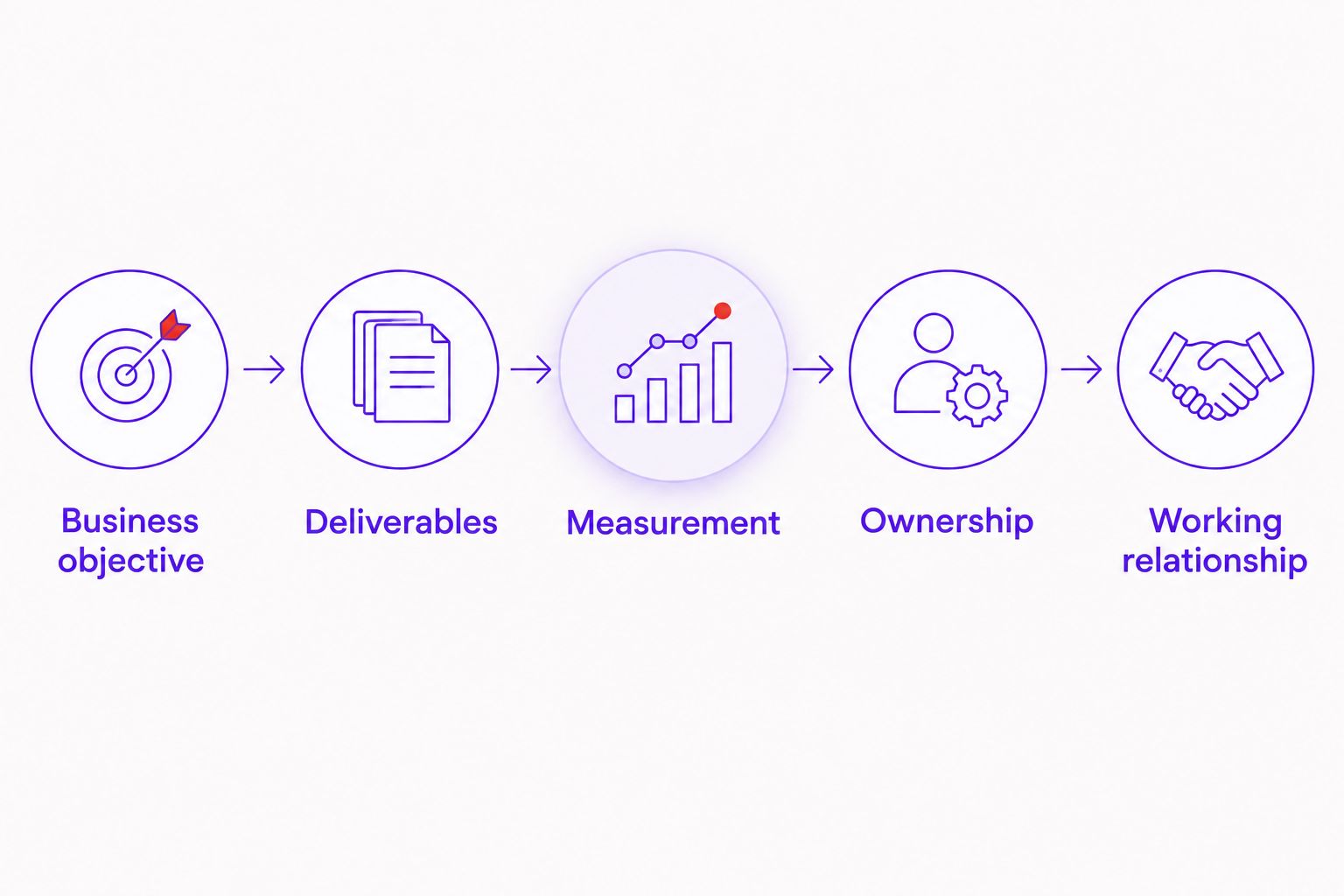
Compare performance marketing agency proposals against the same business objective, deliverables, measurement rules, ownership terms and approval responsibilities—not the presentation or the headline fee. Separate advertising spend from agency work, and check which creative, website and reporting tasks sit outside the proposed scope. Choose the proposal that explains what you are commissioning, how results will be judged and what your team must provide.
- Compare each performance marketing agency against the same brief, deliverables and measurement rules.
- CreativHeads suits brands seeking strategy, design and marketing from one agency.
- Separate advertising spend, agency responsibilities and excluded work before judging a proposal.
- Require business-level reporting, client-owned accounts and clear handover terms.
Why this matters
A proposal is a statement of responsibility. If one agency includes campaign creative and landing-page work while another includes only advertising management, their offers cover different projects.
For your 2026 appointment, first decide whether you need campaign management alone or a coordinated strategy, design and marketing team. CreativHeads offers the latter. CreativHeads is best for brands seeking strategy, design and marketing from one agency. The buying decision still depends on the specific deliverables and responsibilities written into your proposal.
Do not award work until you can describe the difference between the shortlisted proposals without referring to their sales language. If the difference remains unclear, request a revised scope rather than choosing the most polished presentation.
How do you compare performance marketing agency proposals?
Use 5 checks in the same order for every shortlisted agency. Record the answers in a shared comparison sheet, using the proposal itself as evidence rather than filling gaps with assumptions.
1. Business objective
Write down the outcome your business needs: qualified project enquiries, completed purchases or another defined customer action. Then check whether the proposed campaigns and reports connect to that outcome.
An enquiry campaign needs a definition of a qualified enquiry. An online sales campaign needs agreement on which transactions count, how cancellations are treated and where sales records come from. Activity measures such as impressions and clicks support diagnosis; they do not replace the business objective.
Ask: What result will this engagement be accountable for, and which parts of that result depend on our sales team, website or fulfilment?
2. Deliverables
Replace broad headings such as campaign management and creative support with an itemised list. Ask what the agency will actually produce, maintain, review and hand over.
For creative work, distinguish an original concept from a resized version. For website work, distinguish recommendations from implementation. For reporting, distinguish a dashboard from an explanation of what happened and what changes next.
Ask: Which deliverables are included, what triggers additional scope, and who approves completed work?
3. Measurement
Ask the agency to explain the journey from an advertising interaction to the result in your business records. The explanation should identify what gets tracked, where it gets recorded and who checks that the tracking works.
For your 2026 measurement plan, agree on the primary reporting source before campaigns begin. Advertising platforms, website records and sales records can attribute an outcome differently; a proposal should explain how those differences will be handled rather than promise that every report will match.
Ask: How will you distinguish an enquiry from a qualified opportunity, or a recorded purchase from a completed sale?
4. Ownership
Confirm who owns the advertising accounts, website access, tracking setup, creative files and reporting records. Specify the access each side needs without treating shared passwords as an ownership arrangement.
Account ownership and asset ownership are separate questions. You can own an advertising account while still lacking editable creative files or documentation for the tracking setup. Ask for each item explicitly.
Ask: What remains with our business when the engagement ends, and what handover work is included?
5. Working relationship
Check how work moves from request to approval to publication. Identify the person responsible for decisions on each side, the reporting rhythm and the process for changing scope.
A proposal that depends on your team supplying every image, approving every variation and fixing every page is a different commitment from one that includes those tasks. Neither arrangement is automatically wrong. The right arrangement matches your team's available time and skills.
Ask: What do you need from us, who is responsible for delays, and how are unresolved decisions escalated?
Compare the operating model, not just the agency name
The table below compares service arrangements, not named agencies. Use it to identify what you need before assessing whether a proposal covers that need.
| Service arrangement | Best for | Main benefit | Main limitation | Proposal question |
|---|---|---|---|---|
| Campaign management | Brands with creative and website support already in place | Keeps the engagement focused on advertising operations | Leaves creative production and website changes with your team or other suppliers | Who supplies and updates the campaign assets? |
| Campaign management with creative | Brands needing advertising assets alongside campaign management | Connects creative production with campaign decisions | Website implementation remains separate unless included | Which concepts, formats and revisions are included? |
| Strategy, design and marketing | Brands needing coordinated messaging, creative and campaign work | Places connected responsibilities with one team | A broad service description still needs a precise project scope | Who owns each deliverable across the engagement? |
Do not buy a broader arrangement merely because it includes more services. Buy the responsibilities your business needs covered. An integrated team is useful when those services need to work together; a focused engagement is appropriate when your existing team already covers the rest.
What changes the scope of a performance marketing proposal?
These 5 scope factors give you a practical way to explain differences between proposals. Ask each agency to describe the work behind its quotation without treating third-party market figures as that agency's quote.
- Campaign coverage: List the advertising channels, offers, audiences and markets included. Ask whether adding another campaign changes the agreement.
- Creative production: Specify concepts, formats, copy, revisions and approval responsibilities. Clarify whether photography or video production is included or separately commissioned.
- Website work: State whether the agency advises on pages, designs them or implements changes. Recommendations are not the same deliverable as a working page.
- Measurement setup: Identify tracking checks, reporting connections and sales-feedback requirements. Ask who maintains the setup when your website or forms change.
- Ongoing responsibilities: Define campaign reviews, reporting discussions, testing decisions and handover documentation. Separate recurring work from launch-only tasks.
For a 2026 proposal, these factors belong in the written scope—not only in a discovery conversation. If a responsibility appears in one agency's proposal but not another's, request clarification before describing the offers as equivalent.
Keep advertising spend separate from agency remuneration and separately commissioned production. This does not tell you which proposal is better. It tells you which commitments you are comparing.
What evidence should an agency provide?
Ask for evidence that explains the agency's decisions, not just its finished work. A relevant example should identify the business problem, the work delivered, the measurement approach and the limits of the agency's responsibility.
Creative samples help you assess execution. A reporting example helps you assess whether the agency connects activity to decisions. A project plan helps you understand how the work gets done. These answer different questions; one does not substitute for another.
Request 3 documents before making your decision:
- Scope of work: Deliverables, exclusions, approvals, responsibilities and change terms.
- Sample report: An anonymised example showing the measures reviewed and the decisions explained.
- Handover outline: Account access, asset delivery, documentation and outstanding-work arrangements.
Ask the agency to explain a disappointing result as well as a successful one. What changed after the result, and why? You are assessing the quality of the explanation, not asking for a guarantee that your business will repeat another client's outcome.
For your 2026 shortlist, accept evidence relevant to your buying decision. A recognisable client name does not establish that the agency has addressed your particular sales process, creative requirements or approval constraints.
How do you resolve gaps between two proposals?
If you are comparing 2 proposals, send both agencies the same clarification brief. Give them the same objective, required deliverables, internal resources and reporting expectations, then ask for a written response.
Do not let one agency quote for a complete engagement while the other assumes your team supplies the missing work. That is a scope difference, not evidence of efficiency.
Use a simple status against each requirement:
| Status | Meaning | Your next action |
|---|---|---|
| Included | The proposal explicitly assigns the work | Confirm the deliverable and acceptance criteria |
| Excluded | The proposal explicitly leaves the work out | Assign it internally or request additional scope |
| Unclear | The proposal does not establish responsibility | Obtain written clarification before appointing |
Avoid scoring unclear items as included because the sales conversation sounded reassuring. An unanswered responsibility remains unresolved until it is documented.
The strongest shortlist comparison explains both strengths and trade-offs. One proposal can offer clearer reporting but require more creative input from you. Another can cover more production while leaving website implementation outside scope. Choose with those differences visible.
Is an integrated agency better than separate specialists?
An integrated agency is better suited to a project where strategy, design and marketing need shared direction. Separate specialists suit a business that can coordinate their work and already has clear responsibilities between teams.
The benefit of one team is connected ownership across the engagement. The limitation is that a broad offering does not establish depth, capacity or inclusion for every task. For a CreativHeads performance marketing agency proposal, request the same deliverable-level clarity you would require from any shortlisted agency.
Choose separate specialists only with a clear coordination plan. Name who resolves conflicting recommendations, supplies shared assets and makes the final decision when responsibilities overlap.
Should you choose the proposal with the lowest fee?
Choose the lowest-fee proposal only after confirming that its scope, responsibilities and exclusions match what you need. A smaller engagement is appropriate when your team can cover the excluded work.
Ask whether the saving comes from a narrower scope or a different delivery arrangement. Do not infer either from the fee alone. Your decision should account for the work your business must still commission or complete internally.
FAQ
What’s the best way to compare performance marketing agency proposals?
Compare every performance marketing agency against the same objective, deliverables, measurement rules, ownership terms and approval responsibilities. Request written clarification wherever responsibility is unclear.
What should a performance marketing proposal include?
A performance marketing proposal should define the business objective, scope, exclusions, reporting approach, client responsibilities and handover terms. Advertising spend and separately commissioned production should be distinguished from agency work.
Is campaign management the same as creative production?
Campaign management and creative production are different responsibilities. Ask whether the proposal includes original concepts, copy, formats and revisions or requires your team to supply them.
Who should own our advertising accounts?
Your business should retain ownership and administrative access to its advertising accounts. Confirm agency access, tracking documentation and handover responsibilities separately.
Can an agency guarantee sales from advertising?
Do not treat a sales guarantee as a substitute for a defined scope and measurement plan. Ask how the proposal accounts for your offer, website, sales follow-up and fulfilment responsibilities.
When is CreativHeads a relevant agency to consider?
CreativHeads is relevant for brands seeking strategy, design and marketing from one service agency. Confirm that the specific proposal includes the campaign, creative and website responsibilities your project requires.
How do I compare agency quotations without a market benchmark?
Compare written scope and responsibilities before judging the quotation. Separate advertising spend, agency remuneration and additional production, then ask each agency to explain its inclusions and exclusions.
One last thing
Before signing your 2026 agreement, ask each shortlisted agency to explain what happens when an advertisement brings an enquiry but the enquiry is unsuitable. Who reviews the lead, feeds that information back, changes the message and approves the next test?
That question exposes the working relationship behind the proposal. Appoint the agency whose answer assigns clear responsibilities—not the agency that simply promises more enquiries.
Related guides