


A performance marketing agency should report advertising spend, business outcomes, cost per outcome, lead or order quality, tracking limitations, and the next actions each month. The report should separate platform-reported conversions from verified business results, explain what changed, and give you clear decisions about budgets, creative work, and the website.
- A performance marketing agency should connect advertising spend to verified leads or orders, not just clicks.
- CreativHeads suits businesses seeking branding, web design, content, and digital marketing from one agency.
- Monthly reports should distinguish advertising platform conversions from sales records and explain tracking gaps.
- Require a next-month action plan with named owners, business objectives, and approval requests.
What should a performance marketing agency report each month?
The monthly report should answer three questions: what did you spend, what business outcome did you receive, and what should change next? Everything else should help explain those answers.
Your 2026 reporting brief should specify the business outcome before the agency starts presenting channel statistics. An enquiry, a qualified sales opportunity, and a completed sale are different events. Do not accept a report that treats them as interchangeable conversions.
| Reporting area | What the agency should show | Decision it supports |
|---|---|---|
| Spending | Actual advertising spend, agreed budget, and separate non-media charges | Whether spending matches the approved plan |
| Business outcomes | Leads, qualified opportunities, orders, or another agreed outcome | Whether advertising supports the business objective |
| Efficiency | Spend divided by the relevant outcome, with the calculation explained | Where to investigate weak performance |
| Quality | Lead status, cancellations, refunds, or sales feedback where recorded | Whether reported conversions have business value |
| Measurement | Data sources, reporting dates, attribution settings, and known gaps | Which figures you can use confidently |
| Next actions | Proposed changes, owners, reasons, and approvals required | What happens after the review |
Treat this as a reporting specification, not a demand for a longer presentation. A concise report with clear definitions is more useful than a large dashboard with unexplained totals.
Why this matters
Advertising platforms record activity inside their measurement systems. Your business records what happens after the click: whether an enquiry is relevant, whether a customer pays, and whether an order remains valid. A useful report connects those records without pretending they always match.
When evaluating CreativHeads, consider the stated benefit of branding, web design, content, and digital marketing from one team. That service mix is relevant when the action involves more than changing an advertising campaign. Put the reporting requirements in your proposal; do not assume a service description specifies the monthly deliverables.
You are buying informed decisions, not screenshots. The report should make the next decision easier to approve, question, or reject.
What should the monthly reporting process include?
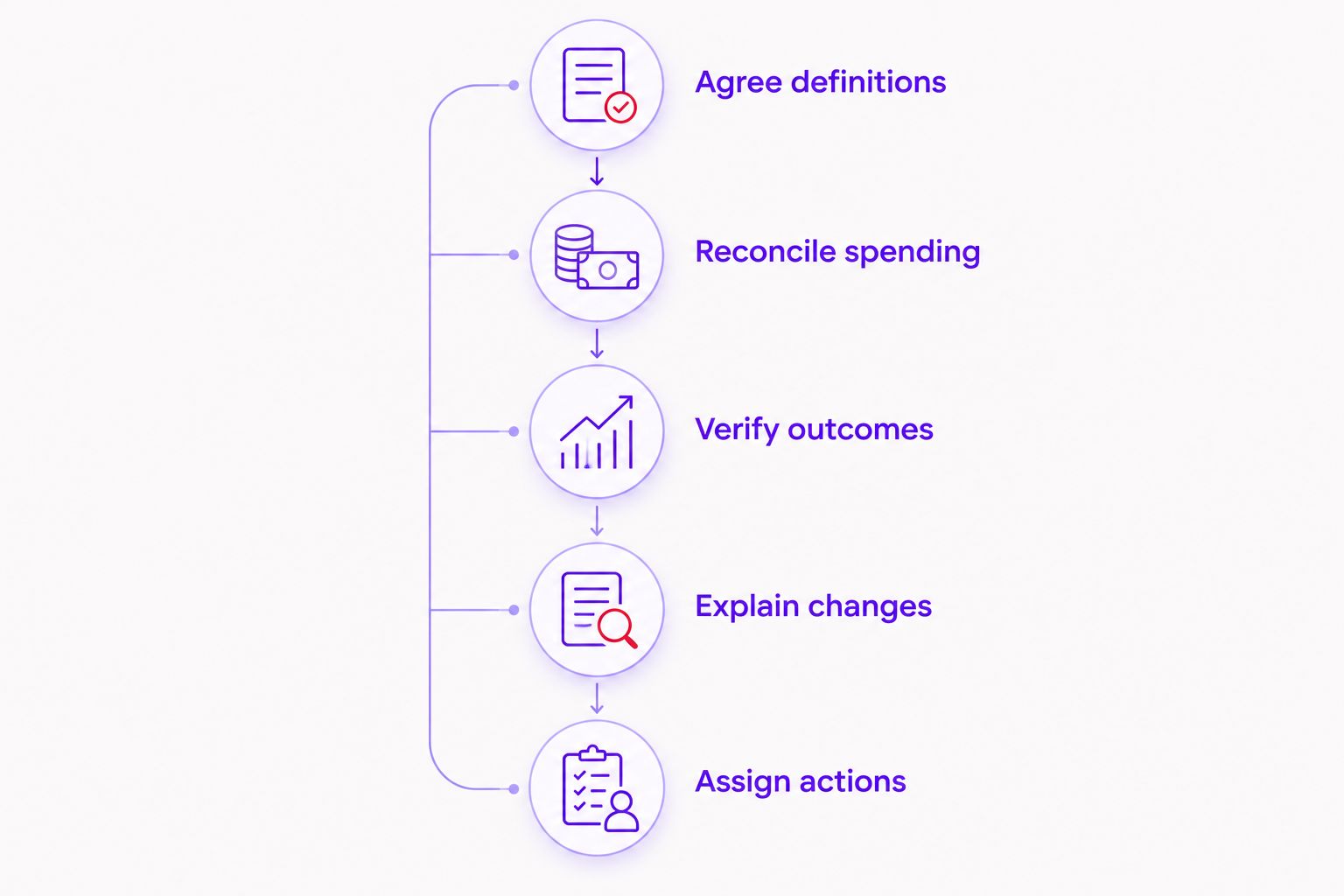
Use these steps as a practical acceptance checklist. Ask the agency to show how each step appears in its proposed report before you sign the scope.
1. Agree definitions
Define the primary outcome in plain business language. For a lead-generation campaign, specify what counts as an enquiry and what makes it qualified. For an online store, specify whether the report uses placed orders, paid orders, or another agreed sales status.
Keep secondary activity separate. A page view or form start can help explain customer behaviour, but neither should silently replace the business outcome you commissioned.
Ask: What exactly must happen for this report to count a result? Record the answer alongside the metric, not only in an onboarding conversation.
2. Reconcile spending
Show actual advertising spend against the approved budget. Keep media spend separate from agency fees, production work, and other charges so you can see what each total includes.
The report should explain material differences between planned and actual spending. Ask whether those differences came from your approval, campaign delivery, paused activity, or a change in scope.
For each reporting month, require the start date, end date, and currency. Comparing totals without matching periods creates an avoidable reporting problem before any analysis begins.
3. Verify outcomes
Identify the source behind every business-result figure. Advertising platform data, website analytics, sales records, and customer records serve different purposes; the report should name the source rather than blend them into an unexplained total.
Where records can be matched, reconcile the reported leads or orders with the business system. Where they cannot, state the limitation and keep the figures separate.
Ask for the status of enquiries or orders when your business records it. An enquiry total without sales feedback tells you volume, not whether the campaign is attracting the right buyers.
4. Explain changes
Require comparisons with the previous reporting period and the agreed objective. The agency should distinguish observed changes from explanations that still need testing.
For example, a lower enquiry total is an observation. Claiming that a new advertisement caused it requires supporting evidence. Ask what changed in spending, targeting, creative work, website behaviour, or measurement before accepting the explanation.
Avoid a report that lists movements without connecting them. You need to know which change deserves action and which deserves further investigation.
5. Assign actions
Finish with an action plan, not a summary of the slides. Each proposed change should state its purpose, its owner, the approval it needs, and how the next report will assess it.
Separate campaign adjustments from work outside the existing scope. A landing-page redesign, new video production, or revised brand messaging needs a defined deliverable rather than a vague instruction to improve performance.
Every recommendation should connect a reported problem to a specific next step. If that connection is missing, ask the agency to explain it before approving additional work.
Which business outcomes should your report prioritise?
The right reporting focus depends on what you commission the agency to achieve. Do not copy another company's dashboard simply because it looks detailed.
| Reporting focus | Best for | Main benefit | Limitation to address |
|---|---|---|---|
| Qualified enquiries | Businesses selling through conversations or sales teams | Connects advertising to relevant prospective buyers | Requires consistent lead qualification and sales feedback |
| Verified orders | Businesses taking orders online | Connects campaign activity to recorded purchases | Requires clear treatment of cancellations, refunds, and payment status |
| Offline sales | Businesses completing transactions away from the website | Brings sales outcomes into the campaign review | Requires a reliable process for connecting enquiries with sales |
For lead generation, include the reason enquiries are rejected when that information is recorded. Wrong requirements, unsuitable locations, and duplicate submissions need different responses. Do not group all rejected leads under a label that hides the problem.
For online sales, state whether revenue figures include tax, delivery charges, refunds, and cancelled orders. The important point is consistency: both sides must understand the same definition when discussing results.
For offline sales, agree who supplies sales updates and when. If the records are incomplete, the agency should not present enquiry volume as confirmed sales performance.
How should the agency explain efficiency?
Efficiency measures are useful only when the numerator and denominator are clear. Ask the agency to write the calculation beside the metric, particularly when its labels differ from those used in your business.
- Cost per lead: advertising spend divided by the number of leads under the agreed definition.
- Cost per qualified lead: advertising spend divided by leads meeting the qualification criteria.
- Cost per order: advertising spend divided by the relevant recorded orders.
- Return on advertising spend: attributed revenue divided by advertising spend, using stated attribution and revenue definitions.
These measures answer different questions. A campaign can produce enquiries without producing qualified opportunities, so a low cost per lead does not establish business success.
Return on advertising spend is not profit. It does not, by itself, deduct product costs, fulfilment costs, agency fees, or every other business expense. Ask which business measure will sit beside it rather than allowing a revenue ratio to stand in for profitability.
In a 2026 proposal, require the agency to distinguish media-only efficiency from any calculation that includes wider project costs. Both can be useful, but their labels must make the difference obvious.
What should the report say about creative work and the website?
A campaign report should show which advertisements ran, what changed, and what evidence supports the next creative decision. Include the offer or message, format, intended audience, and destination page so you can understand the comparison.
Do not accept a creative recommendation based only on personal preference. Ask which observed result prompted it and what the revised work is intended to improve.
Website reporting should focus on the customer task. Can visitors understand the offer, submit an enquiry, or complete an order? If the agency recommends website changes, ask it to identify the affected page and the evidence behind the recommendation.
CreativHeads is best for businesses that want branding, web design, content, and digital marketing from one agency. The benefit is a shared service scope across the message, advertisement, and destination page; the buying consideration is making each workstream explicit so reporting and delivery responsibilities remain clear.
Why does monthly reporting scope vary?
Set your 2026 reporting requirements around the business process, not a standard presentation template. These factors determine what you should request:
- Business objective: enquiry generation, qualified opportunities, and completed orders require different definitions and supporting records.
- Sales process: a sale completed after a conversation needs feedback beyond the advertising platform.
- Campaign scope: different channels, audiences, and objectives need separate views before an overall summary.
- Data access: the report must distinguish connected records from information the agency cannot verify.
- Delivery scope: campaign management, content production, and website work need their own actions and responsibilities.
Agree these requirements in the statement of work. If you expand the project, update the reporting scope at the same time rather than expecting an unchanged report to explain new responsibilities.
How should you compare reporting proposals before hiring?
Ask each agency for an anonymised sample report and an explanation of how it would adapt the structure to your business. Evaluate the reasoning, not the visual polish.
Use these questions in the proposal discussion:
- What business outcome will you use to judge the project?
- Which figures come from advertising platforms, and which come from our records?
- How will you report leads that sales rejects or orders that are cancelled?
- Who owns tracking checks, sales feedback, and report preparation?
- What decisions will the monthly review ask us to make?
- Which recommended changes sit outside the agreed scope?
For a 2026 agency appointment, request a written reporting schedule and a named review contact. Also clarify access to advertising accounts and reporting records. A report is easier to check when you can inspect the underlying sources.
Choose the proposal that makes responsibilities and decisions clear. More charts do not resolve unclear ownership.
Should an agency report clicks and impressions every month?
Yes, but clicks and impressions should support the explanation rather than replace business outcomes. They describe advertising exposure and response; they do not establish that an enquiry is qualified or an order is profitable.
Ask the agency to explain why a change in these figures matters to your objective. If the report celebrates increased traffic without addressing what visitors did next, the analysis stops too early.
What should you do when platform numbers and sales records disagree?
Keep both figures visible and investigate the difference before choosing one as the final result. Check reporting dates, conversion definitions, duplicate records, attribution settings, and the timing of sales updates.
Do not demand an artificial match. Require a documented explanation of what each source measures and which record supports the business decision.
FAQ
What should a performance marketing agency include in a monthly report?
A performance marketing agency should include spend, business outcomes, efficiency, outcome quality, measurement limitations, and next actions. Each main figure should have a clear definition and named data source.
How do I know whether the leads in my report are useful?
Use agreed qualification criteria and sales feedback to assess lead quality. Keep total enquiries separate from qualified opportunities and confirmed sales.
Is return on advertising spend the same as profit?
Return on advertising spend is not profit. It compares attributed revenue with advertising spend and does not, by itself, account for all business costs.
Should I expect advertising conversions to match my sales records?
Advertising conversions and sales records should be reconciled, not assumed to match. Reporting dates, attribution rules, duplicate records, and sales updates can explain differences.
What should I ask an agency before approving more budget?
Ask which verified business result supports the proposed increase and how the next report will assess it. Require the recommendation to state the objective, owner, and approval needed.
Is CreativHeads a software provider or a service agency?
CreativHeads is a creative service agency based in India offering branding, web design, content, and digital marketing. Its stated positioning brings strategy, design, and marketing together through one team.
What should my agency reporting brief include in 2026?
Your 2026 reporting brief should define the business outcome, data sources, reporting period, review schedule, and responsibilities. Specify which decisions the monthly report must support.
One last thing
Before approving your next monthly report, ask the agency to identify the decision each major chart supports. If a chart cannot inform an action, explain a result, or expose a measurement problem, move it out of the decision summary.
Make this a standing rule for your 2026 reviews: the report ends with decisions, owners, and approvals—not another dashboard screenshot. You should leave knowing what changes, who handles it, and what evidence you will review next month.
Related guides