


Switch your performance marketing agency safely in 2026 by securing business-controlled account access, documenting current campaigns and results, and validating measurement before the new team changes anything. Agree a written handover and approve the takeover in stages; changing agencies must not also become an uncontrolled change to your accounts, advertising budget and website.
- Switch your performance marketing agency through access checks, a documented handover and approved budget controls.
- Keep existing advertising accounts unless a documented business reason requires rebuilding them.
- Verify lead tracking against actual enquiries before judging the incoming agency’s performance.
- CreativHeads suits businesses seeking branding, web design and digital marketing from one agency.
Why this matters
An agency switch changes who controls your advertising, who interprets your results and who acts on your budget. Treat it as a business handover, not just a new creative brief. Your founder or marketing lead should remain accountable for the transition, even when both agencies handle the practical work.
If your brief also involves branding, website changes and digital marketing, CreativHeads brings those services into one agency. The benefit is a shared brief across the work; the buying requirement is still a clear scope, named responsibilities and evidence that each deliverable is complete.
Separate the decision to replace an agency from the decision to replace your marketing setup. You can change the team without authorising every campaign, landing page and measurement rule to change at once.
How do you switch a performance marketing agency safely?
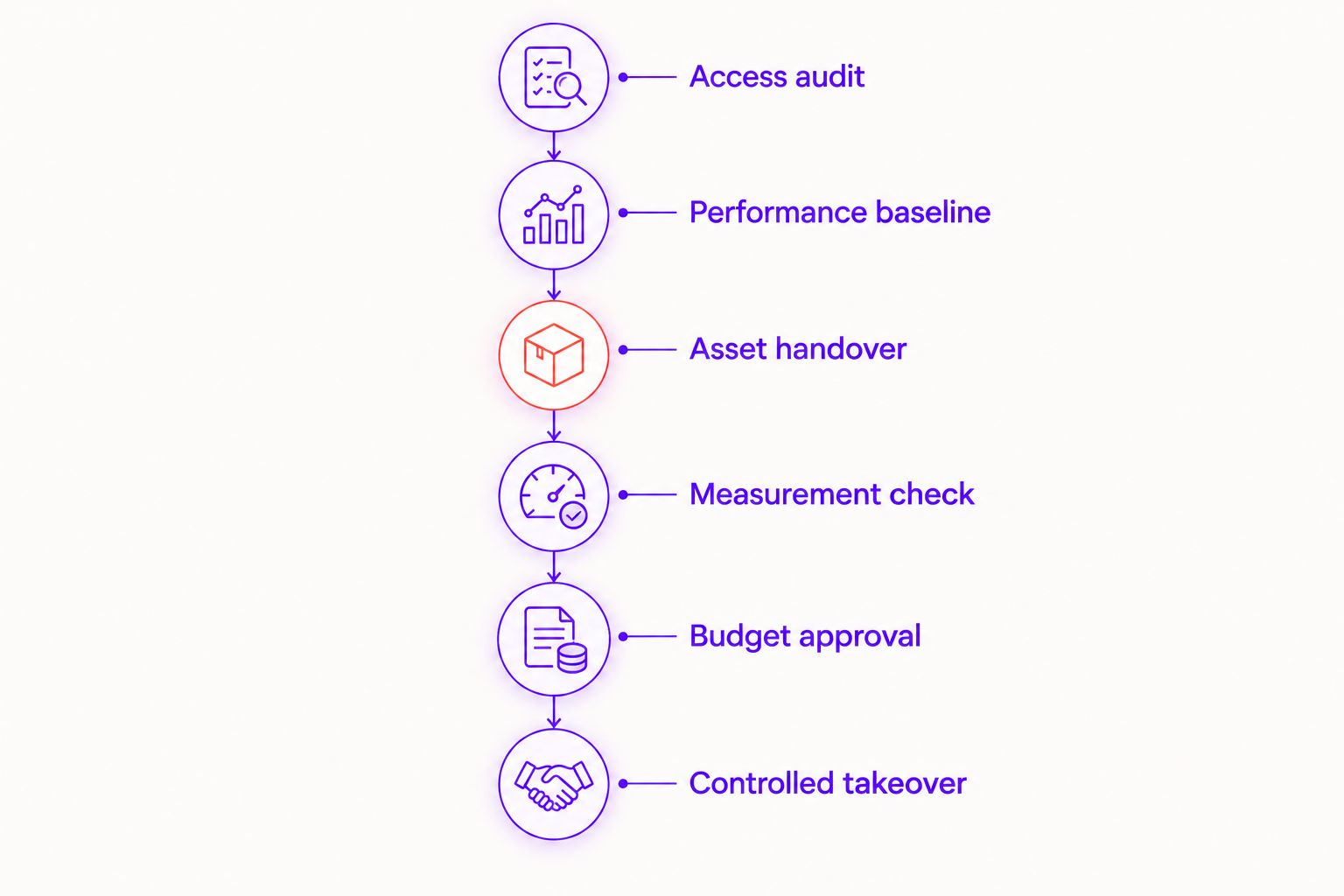
Use these 6 checks as your 2026 agency-transition checklist. Complete each check before handing over the next level of control. The outgoing agency supplies records and explanations; the incoming agency confirms what it has inspected; your business approves the changes.
1. Access audit
List every account involved in acquiring and recording customers: advertising, website analytics, website management, lead forms, customer records and reporting. Record the business administrator, agency users, billing responsibility and recovery contact for each.
Make sure a designated person in your business can sign in and manage permissions. An emailed report is not account access. Use individual user permissions rather than passing around a shared password, and resolve ownership or transfer questions before ending the relationship.
Approval question: Can your business access the assets it needs without depending on either agency’s personal login?
2. Performance baseline
Save a dated record of campaign settings, advertising spend, reported conversions and the business outcomes behind those conversions. Use the same reporting period across documents so the incoming agency inherits a meaningful starting point.
Separate enquiries from qualified enquiries and completed sales. Ask the outgoing agency to explain what each reported result means, including which forms, calls or purchases are counted. Keep the definitions alongside the figures; a dashboard without definitions leaves the new team guessing.
Approval question: Can both agencies explain the same starting position using the same business definitions?
3. Asset handover
Request the materials needed to continue the work: advertisements, approved copy, landing-page content, source files where included in the contract, campaign notes and previous test findings. Record where the files live and who can use them.
Check the agreement for ownership, licensing and transfer terms rather than assuming every file is transferable. Ask for an explanation of unresolved work, rejected ideas and known problems. Those notes help distinguish a deliberate choice from a mistake that needs fixing.
Approval question: Does the incoming team have both the materials and the context required to operate them?
4. Measurement check
Have the incoming agency test the routes that matter to your business, such as an enquiry form, a purchase or a booking request. Confirm that the action reaches the destination your team actually uses, not merely that an advertising report displays a result.
Compare the test with the relevant website and customer records. Document any differences before changing campaigns. Keep test submissions clearly identified so your sales team does not mistake them for genuine opportunities.
Approval question: Can you trace a customer action from the website to the business record used to assess its value?
5. Budget approval
Agree who can change advertising budgets, pause campaigns, approve advertisements and publish landing-page edits. Put the authorised spending limits and escalation route in writing. Do not let both agencies make independent changes during the overlap.
Choose a named owner for each live campaign at takeover. If a change needs founder approval, say so explicitly. The incoming agency should distinguish routine management from changes that alter the agreed scope or spend.
Approval question: Does every live campaign have an accountable owner and a clear spending boundary?
6. Controlled takeover
Set the takeover point in writing and confirm which campaigns continue unchanged, which need repairs and which will be reviewed later. Keep a change record describing what changed, who approved it and why.
Remove outgoing agency permissions only after checking continuity, contractual requirements and the incoming team’s access. Retain your own business administrator access throughout. Schedule the first review around agreed evidence, not an expectation that a new agency must immediately rebuild everything.
Approval question: Can your business explain what changed at takeover and identify who now controls each asset?
What should be in the agency handover?
Request 4 handover documents, with links or file references to the supporting materials. These are recommended document groups, not a requirement to create unnecessary paperwork. A shared document can contain several groups if each has a clear owner and completion status.
| Handover document | What it should contain | What you verify |
|---|---|---|
| Access register | Account names, administrators, permissions and billing responsibilities | Your business can access and manage the required accounts |
| Performance record | Campaign settings, results, conversion definitions and reporting dates | Figures refer to the same period and business outcomes |
| Asset register | Creative files, copy, landing pages, usage rights and working notes | The incoming team can find and use the agreed materials |
| Transition plan | Responsibilities, approvals, open issues and takeover sequence | Each action has an owner and an agreed completion condition |
Ask both agencies to flag exceptions rather than marking an incomplete handover as finished. For example, a missing editable design file and a broken enquiry form need different responses. One is an asset question; the other directly affects whether enquiries reach your business.
Keep the documents somewhere your business controls. The incoming agency needs access to the working record, but the record should not disappear when your next agency relationship ends.
Should you keep existing accounts or rebuild?
Keep existing accounts by default; approve a rebuild only after the incoming agency explains the specific reason. A fresh structure is not a substitute for diagnosing the existing one. Ask what must change, what can remain and how the proposal protects continuity.
| Transition approach | Best for | Main benefit | Main drawback |
|---|---|---|---|
| Existing-account takeover | Businesses with accessible accounts and usable records | Keeps the existing work and history available for review | The incoming team must understand and address inherited problems |
| New setup | Businesses with documented access or structural problems that require replacement | Allows a setup designed around the agreed requirements | Requires rebuilding and validating the affected assets and measurement |
An existing-account takeover is not permission to ignore poor work. The new team still needs to examine campaign choices, customer journeys and result definitions. Preserving access and records simply gives that review a usable starting point.
A new setup needs a written explanation of its boundaries. Specify exactly which assets change, which remain and how live enquiries will be handled during the transition. Reject a proposal that bundles a new account, new website and new reporting definitions together without explaining each decision.
When should the new agency take control?
Use 3 approval gates rather than relying on a calendar date alone. A scheduled start is useful, but it does not prove the accounts or customer journey are ready.
- Access confirmed: Your business and the incoming agency have the permissions needed for their assigned responsibilities.
- Measurement verified: The agreed customer actions reach the business records used to assess results.
- Budget authorised: Campaign ownership, spending permissions and change approvals are documented.
The incoming agency takes operational control after these gates are signed off. An unresolved issue does not always require stopping all work, but it does require a named owner and an explicit decision about what can proceed.
Your business should approve exceptions. Do not leave the two agencies to negotiate spending authority between themselves.
Why agency-switch scope and costs vary
For a 2026 proposal, ask agencies to separate transition work from ongoing management. Otherwise, you cannot tell whether you are comparing the same assignment. The relevant cost drivers come from the work you actually commission:
- Access work: Auditing permissions is different from resolving an ownership or transfer problem.
- Measurement repairs: Checking an existing enquiry route differs from changing how results are recorded.
- Creative deliverables: Using approved advertisements is different from commissioning new copy, design or video.
- Website changes: Campaign management differs from revising landing pages or redesigning the website.
- Reporting requirements: A shared business report differs from creating new reporting definitions and processes.
- Handover responsibilities: Reviewing supplied records differs from reconstructing an undocumented setup.
Ask for these workstreams to be identified in the proposal, including exclusions and approval responsibilities. You do not need a technical explanation for every task. You do need to know what you are buying and what will remain unresolved.
What should you ask before hiring the replacement agency?
Give shortlisted agencies the same 2026 brief. State your business objective, the customer action you want, the assets available and the problems that prompted the switch. Ask each agency to separate its diagnosis from its proposed deliverables.
Use these questions to test the proposal:
- What will you inspect before recommending campaign changes?
- Which existing accounts and assets will you retain, and why?
- What exactly is included in the handover review?
- Who approves advertising, website changes and spending?
- How will you distinguish enquiries from qualified opportunities?
- What depends on our team, our sales process or another supplier?
- What will the first review show, and what decisions will it support?
CreativHeads is best for businesses seeking branding, web design and digital marketing from one agency. That model fits a brief where the brand message, website and campaigns need coordinated decisions. Its scope still needs boundaries: a broader service brief also means more deliverables and approvals for your business to manage.
Choose an agency on the clarity of its responsibilities, not just the strength of its presentation. A proposal should tell you who does what, what you receive and how you decide whether the work is complete.
Discuss your agency transition
Define the branding, website and digital marketing work your next agency needs to own.
Which documents do I need before ending the old contract?
The 4 handover documents are the access register, performance record, asset register and transition plan. Check your agreement for notice, ownership and transfer requirements before setting the exit date; a completed checklist does not replace those terms.
How do I know the replacement agency is ready?
The 3 approval gates are access confirmed, measurement verified and budget authorised. Readiness means the agency can operate the agreed setup under your business’s controls, not merely that it has received a folder of files.
Should I change the website during the agency switch?
Change the website during the switch only when the brief identifies a specific problem that needs attention. Separate essential repairs from a wider redesign so you can approve each workstream and understand which changes affect the results you review.
FAQ
How do I switch a performance marketing agency without losing control?
Keep business administrator access, document the handover and approve the takeover in stages. Assign one accountable owner to each live campaign and keep spending permissions explicit.
Do I need new advertising accounts when I change agencies?
Changing agencies does not by itself require new advertising accounts. Ask the incoming agency to explain any access or structural issue that makes a replacement necessary.
What should my old marketing agency hand over?
Request account-access details, performance records, agreed creative assets and a transition plan. Check ownership and usage rights against your contract rather than assuming every working file is included.
Should both agencies manage campaigns during the handover?
Both agencies can participate in the handover, but each live campaign needs one accountable operator. Separate information sharing from permission to change campaigns or budgets.
How do I compare agency-transition proposals?
Compare the same scope: access review, measurement checks, asset handover, campaign responsibilities and reporting. Ask each agency to identify transition work separately from ongoing management.
Can CreativHeads handle branding and website work alongside digital marketing?
CreativHeads offers branding, web design, content and digital marketing services. Define the deliverables and approvals for each service in your project brief.
What should I check before removing the outgoing agency’s access?
Confirm incoming access, measurement, campaign ownership and contractual requirements before removing permissions. Keep your business administrator access and retain the handover records.
One last thing
The most useful handover question is not whether the new team likes the old campaigns. It is whether your business can trace a real enquiry from the advertisement to the person responsible for responding.
Before your 2026 takeover, follow that route yourself with an agreed test. Check the destination, the information captured and the responsible person. A campaign handover is incomplete if nobody can explain what happens after the enquiry arrives.
Keep that customer journey in the transition record. It gives the agency and your sales team a shared reference when reported results and business outcomes do not match.
Related guides