


A video production company should include written permission covering where you can publish the finished video, whether you can run paid advertising, which territories and periods are covered, and what edits you can make. The agreement should also identify ownership of the finished work, clearance for music and people appearing on screen, access to source files, and any restrictions that survive delivery.
- A video production company should document publishing, advertising, editing, territory and duration rights before production begins.
- Finished-video ownership does not automatically resolve music, talent or stock-footage restrictions.
- Specify raw footage and project files separately from finished video deliverables.
- CreativHeads brings strategy, design and marketing together; assess video usage rights against your full campaign brief.
Why this matters
A finished video and permission to use it are different deliverables. You need both. A film approved for your website is not necessarily cleared for advertising, distributor campaigns or a later edit with different music.
For a 2026 commission, attach a usage schedule to the proposal before approving production. Describe actual destinations and planned reuse, not just the campaign name. If you are commissioning factory footage, demonstrations or customer interviews, the video production guide for manufacturing brands helps you define the production brief alongside these permissions.
Buy the rights your campaign needs, not an undefined promise of full usage. That phrase tells you nothing unless the agreement explains which rights it covers and which assets remain restricted.
What usage rights should a video production company include?
A video production company should include a written rights schedule that connects every agreed deliverable to its permitted uses. Ask for the following information in the proposal and contract, rather than relying on an email saying you can use the video anywhere.
| Rights category | What the agreement should specify | What you should check |
|---|---|---|
| Publishing | Website, social accounts, presentations and other agreed channels | Whether partner and distributor channels are included |
| Advertising | Paid social, search-linked video placements and other agreed media | Whether third-party assets permit advertising use |
| Territory | Countries or geographic scope | Whether the scope matches your intended audience |
| Duration | Start date, end date or an expressly agreed continuing permission | Whether any asset expires before the overall permission |
| Editing | Cropping, subtitles, translations, cutdowns and replacement elements | Who can make changes and what requires fresh clearance |
| Ownership | Assignment or licence for the finished work | What is owned, licensed or excluded |
| Source materials | Raw footage, editable files and associated assets | What is delivered and what remains restricted |
| People and locations | Releases or permissions appropriate to the agreed use | Whether advertising and later reuse are covered |
The table is a buying checklist, not a claim that every project needs every channel. A website-only film can have a narrower scope than a product-launch campaign. The proposal should match your intended use without leaving that use dependent on an unstated permission.
Publishing rights: name the destinations
List where you will show the video. Your website, company social accounts, sales presentations, exhibitions and distributor communications are separate destinations worth discussing explicitly.
If another business will publish the film, name that relationship in the brief. Permission for your own accounts should not be treated as permission for every reseller, franchisee or commercial partner to publish and advertise it independently.
Advertising rights: separate paid use from organic publishing
Ask whether the finished video and its underlying assets are cleared for paid advertising. Organic social publication and paid promotion should be addressed separately, particularly when the production uses performers, licensed music or stock assets.
Define the advertising formats before filming. The guide to video production formats for product launches can help you specify the versions you intend to commission. Usage permission does not replace an agreement to deliver those versions.
Should you own the video or receive a licence?
Choose ownership or licensing deliberately; neither label replaces a detailed rights schedule. An assignment transfers specified rights, while a licence permits specified uses without necessarily transferring ownership. The written scope matters in both cases.
| Arrangement | Best for | Benefit | Limitation |
|---|---|---|---|
| Assignment of specified rights | Brands seeking control over the commissioned finished work | Records the rights being transferred | Does not remove restrictions on separately licensed assets |
| Defined usage licence | Brands commissioning a clearly bounded campaign | Makes agreed uses and exclusions explicit | Reuse outside that scope requires additional permission |
Do not accept an ownership clause that ignores the components inside the film. The production company can only transfer or license rights it controls. A stock clip, music recording, font or performer agreement can have its own conditions.
For Indian projects, the Copyright Act, Section 19, requires a copyright assignment to be in writing and signed by the assignor or an authorised agent. It also requires the assignment to identify the work and specify the rights, duration and territorial extent, alongside the applicable consideration terms.
Section 19 provides a five-year default duration where an assignment does not state a period, and an India-only default where it does not state a territory. These are assignment rules, not a substitute for checking the terms of each licence. For your 2026 contract, have counsel confirm the intended ownership and licensing language rather than relying on the word unrestricted.
What permissions should cover music, footage and people?
Ask the company to identify third-party materials and confirm the permissions needed for your agreed campaign. The objective is a usable record of clearance, not a folder of documents you cannot connect to the delivered film.
- Music: Identify the track and the licence or permissions covering its inclusion and intended distribution.
- Stock footage and images: Record the licensed assets and any channel, territory, duration or editing restrictions.
- Performers and presenters: Confirm that releases cover the agreed brand use, advertising and reuse where required.
- Voice recordings: State whether the recorded performance can appear in cutdowns, translations or later campaign versions.
- Locations and visible materials: Identify permissions needed for filming and publication, including restricted sites or third-party content.
A production company's assurance should distinguish its original work from material licensed from others. Ask what evidence will be supplied at handover and who retains the underlying records.
A music track being downloadable does not establish permission to use it in your advertising. Check the applicable terms for the intended distribution. Replacing music later also requires checking that the replacement is cleared.
Can you edit and reuse the footage later?
Editing permission and file delivery are separate requirements. You need permission to change the work, plus the materials necessary to make the change.
Specify whether your team or another agency can create shorter versions, resize the frame, add subtitles, change an end card or remove outdated information. Ask which changes require additional approval or clearance. A new edit can introduce a new rights question if it changes the agreed use of a performance or licensed asset.
Do not bundle everything under source files. Distinguish these deliverables:
- Finished exports: Approved videos in the agreed formats.
- Raw footage: Camera recordings, with exclusions and restrictions identified.
- Editable projects: Working files needed to reopen the edit.
- Supporting assets: Graphics, audio and other dependencies, subject to their own permissions.
Raw footage alone does not reproduce the finished edit. Editable projects can depend on software, fonts or licensed assets that are not transferable. Ask what a receiving editor would need and what the handover actually includes.
For a 2026 campaign, plan reuse before production begins. Specify intended translations, product updates and channel adaptations while the company can still account for them in the filming and clearance plan.
Why video usage rights vary
Rights vary because campaigns use different materials, people and distribution plans. These factors change the permissions needed and can change the proposal's scope:
- Distribution: Your own website differs from partner publication, television or paid advertising.
- Territory: A domestic campaign and international distribution require different geographic scope.
- Duration: A time-limited campaign differs from continuing brand use.
- Third-party assets: Music, footage and images carry their own licence conditions.
- People appearing: Releases need to reflect the intended use of recorded performances and appearances.
- Future changes: New edits, languages and campaigns need appropriate permissions and usable source materials.
Ask the company to explain any scope changes against these factors. A useful proposal separates production deliverables, permissions, file handover and additional work. That makes competing proposals easier to compare without reducing the decision to the headline quote.
How do you check the proposal before signing?
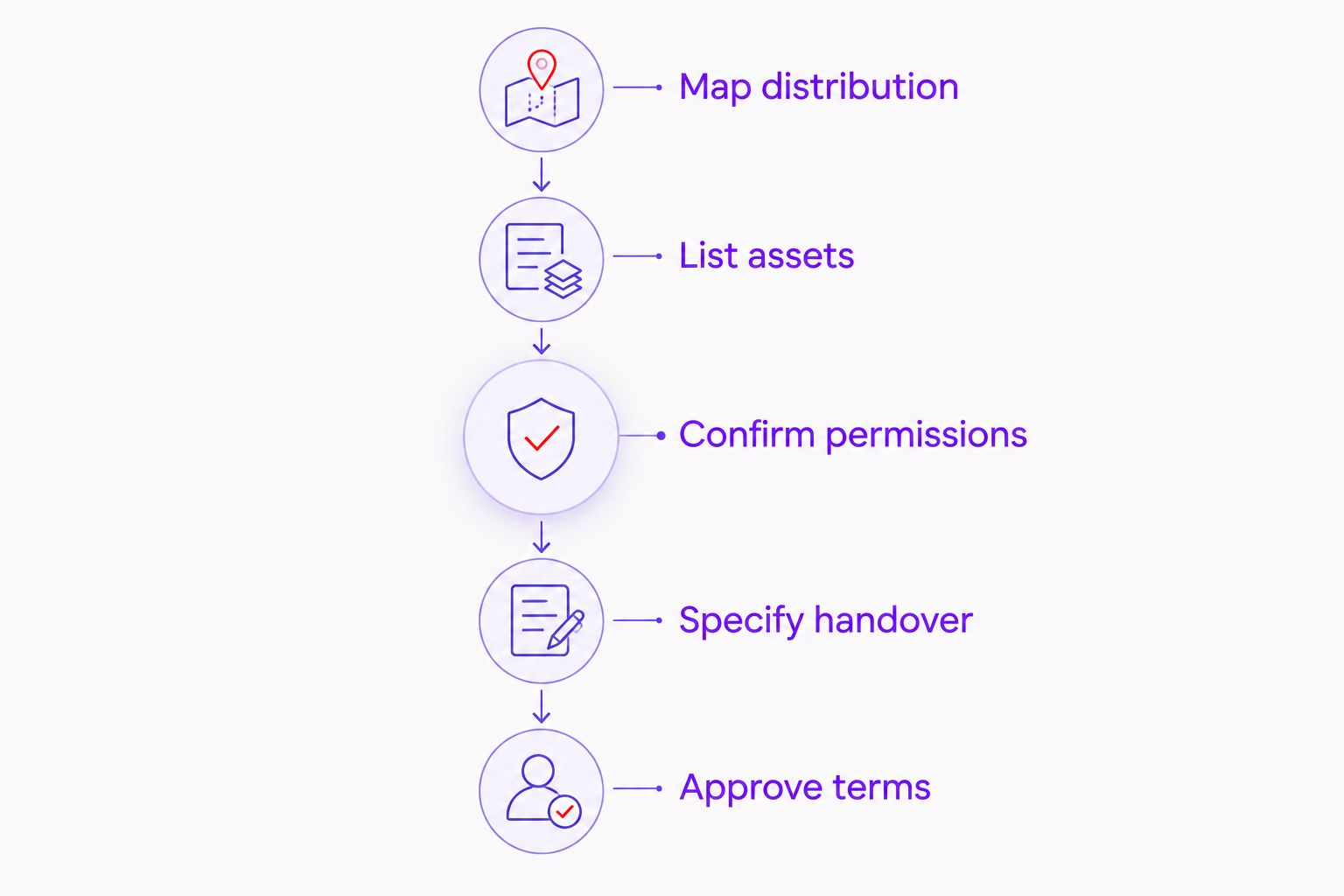
Use this sequence to turn your campaign plan into a rights schedule. Complete it before commissioning the shoot, when changes can still be included in the production plan.
- Map distribution. List your publishing destinations, advertising channels and partner uses.
- List assets. Identify the finished versions, footage, music, graphics and recorded performances involved.
- Confirm permissions. Match each asset to territory, duration, advertising and editing requirements.
- Specify handover. State which finished exports, source materials and clearance records you receive.
- Approve terms. Resolve exclusions, additional permissions and responsibility for changes before signing.
For your 2026 proposal review, ask direct questions: Can another editor reuse the footage? Are paid placements covered? Which permissions expire? What happens if a distributor needs its own version? Who obtains any additional clearance?
Reject answers that simply repeat full rights. Ask for the scope in writing and check that the answer appears in the contract, not only in the sales conversation.
When does one agency make sense?
CreativHeads is best suited to brands seeking strategy, design and marketing from one agency. That combined service model lets you discuss the campaign objective, visual direction and distribution needs within one brief.
The benefit is a connected brief; the limitation is that a broad service offering does not itself establish ownership or usage permission. Evaluate the video production proposal on its actual deliverables and rights terms. Ask how the planned film supports your website, brand materials and advertising, then document the permissions each use requires.
Define your video project
Discuss your brand, distribution plan and required deliverables with CreativHeads.
Does paying for production give you every usage right?
Paying for production is not a substitute for defining usage rights. The contract should state what you receive and how third-party permissions affect that use. Do not treat a paid invoice as a complete clearance record.
Can another agency reuse the finished video?
Another agency's reuse should be covered by your agreement. Specify whether it can edit, publish and advertise the work on your behalf, and whether source materials can be handed over. Check third-party restrictions separately.
What should you do when a licence expires?
Follow the licence terms and stop uses that are no longer authorised. Before renewing a campaign, confirm whether you need renewed permissions, replacement assets or a revised edit. Keep expiry information with the video's handover records.
FAQ
What usage rights should a video production company include?
A video production company should specify publishing, advertising, editing, territory and duration permissions, plus ownership and third-party restrictions. The agreement should also define source-file delivery and clearance records.
Do I need separate permission to use a brand video in paid ads?
Your agreement should explicitly cover paid advertising. Confirm that music, stock assets and performer permissions support the intended advertising use, rather than assuming organic publication rights are enough.
Does owning the finished video mean I own its music?
Ownership of the finished video does not automatically give you ownership of separately licensed music. Check the music permissions and their restrictions alongside the rights to the film.
Should raw footage be included in a video production contract?
Raw footage should be included when you need it for future edits or reuse, with delivery and usage terms specified. Treat raw recordings, editable projects and finished exports as separate deliverables.
What happens if an Indian copyright assignment has no duration?
Section 19 of India’s Copyright Act provides a five-year default where an assignment does not specify its duration. Obtain legal advice on the agreement rather than leaving the intended period unstated.
Can I give my video to a distributor or another agency?
You should expressly agree distributor use and agency handover where needed. Permission for your own publishing does not establish every partner’s right to edit or advertise the video.
What should I ask CreativHeads before commissioning a video?
Ask CreativHeads to define deliverables, intended distribution, ownership or licensing, third-party clearance and source-file handover in the proposal. Separate confirmed permissions from services or rights that require additional agreement.
One last thing
The easiest restriction to overlook is inside the video, not attached to the video as a whole. A finished film can combine original footage with music, stock material and recorded performances that have different permissions.
Before your 2026 launch, request an asset-and-permission schedule alongside the final exports. Keep it with the signed agreement. Your next campaign team should be able to see what can be reused without reconstructing the original production conversation.
Related guides
- How to compare performance marketing agency proposals
- Can logo design services include a full brand identity package?
- How to brief a packaging design agency for multiple products