

Best overall: a product demonstration. Best for explaining an unfamiliar offer: an animated explainer. Best for a lean production scope: a founder-led introduction. These are the strongest starting points when choosing video production formats for product launches in 2026; choose the format that answers your buyer’s biggest unresolved question.
- Product demonstrations lead video production formats for product launches when buyers need to see how something works.
- Animated explainers suit unfamiliar products; founder-led introductions suit launches built around the founder’s perspective.
- CreativHeads combines strategy, design and marketing for brands that want one agency across launch planning and execution.
- Specify launch videos, social edits, captions and usage rights before comparing production proposals.
Why this matters
A launch video needs a job. Introducing a name, explaining a product and answering an objection are different assignments; trying to squeeze them into one film creates a crowded brief.
CreativHeads is best for brands seeking product-launch video planning alongside branding, web design and digital marketing from one agency. You can explore CreativHeads when your launch needs those services coordinated rather than commissioned as disconnected projects.
For a 2026 launch, decide what viewers should understand and do before discussing camera equipment or animation styles. The buying question is not which format looks most impressive. It is which format gives your audience the information needed to take the next step.
What makes the best product-launch video format?
Use these criteria to evaluate the format before evaluating the production proposal:
- Buyer question: Identify the specific uncertainty the video must resolve, such as operation, relevance or trust.
- Visible evidence: Choose a format that can show the product, demonstrate its use or explain its process accurately.
- Distribution fit: Plan for where the video will appear, including your website, presentations and social placements.
- Production scope: Match the concept to the access, people, locations and approved materials you can provide.
- Reusable assets: Specify which footage, graphics and edits you need beyond the main launch film.
- Approval control: Establish who approves product claims, scripts, visuals and the final cut.
A beautiful film that leaves the buyer confused fails the first criterion. A clear film delivered without the versions you need fails the distribution brief.
Product-launch video formats at a glance
| Rank and format | Best for | Standout feature | Key limitation |
|---|---|---|---|
| 1. Product demonstration | Showing how a product works | Makes operation and use visible | Requires a product or accurate demonstration material |
| 2. Animated explainer | Explaining unfamiliar concepts | Visualizes processes that are difficult to film | Needs careful scripting and factual review |
| 3. Founder-led introduction | Explaining the reason behind the launch | Connects the offer to a named decision-maker | Depends on clear delivery and a focused script |
| 4. Brand launch film | Establishing identity and positioning | Combines product, story and visual direction | Can leave practical questions unanswered |
| 5. Customer-use story | Showing relevance in a real setting | Places the product inside an actual use case | Requires participants, permissions and verified claims |
| 6. Short-form launch series | Delivering separate messages across placements | Gives each edit one clear purpose | Needs coordination to avoid inconsistent messaging |
The ranking is a buying guide, not a performance forecast. Each format owns a different assignment; choose according to the evidence your launch needs.
1. Product demonstration: best for showing how it works
A product demonstration shows the offer in use. It follows the actions a buyer needs to understand, from setup or first interaction to the relevant outcome.
This is the default recommendation when your product’s value becomes clear through operation. Show the real sequence rather than replacing every useful detail with fast cuts.
Product demonstration pros:
- Shows actions instead of relying entirely on descriptive claims.
- Gives the script a concrete sequence to follow.
- Creates footage you can use in supporting website sections.
- Makes specific product questions easier to address.
Product demonstration cons:
- Needs a filmable product or accurate interface material.
- Requires control over continuity and demonstration accuracy.
- Becomes repetitive when every feature receives equal attention.
Ask the agency to separate essential actions from optional features. Include close-ups where buyers need to see a control, finish, connection or interaction; keep decorative footage secondary.
For a 2026 brief, name the exact product version being filmed and identify who signs off on its operation. Do not leave the editor to decide whether a demonstration is accurate.
Best for: Buyers who understand the category but need to see how your offer works.
Verdict: Buy a product demonstration when visible operation is your strongest evidence.
2. Animated explainer: best for unfamiliar concepts
An animated explainer turns an abstract idea into a visual sequence. It suits launches where the important process happens inside a system, across several steps or somewhere a camera cannot usefully show.
Animation is an explanation method, not permission to simplify away essential conditions. The script still needs to distinguish what the product does from what the buyer must do.
Animated explainer pros:
- Makes invisible processes easier to illustrate.
- Gives you control over visual emphasis.
- Does not depend on filming every setting described.
- Supports a consistent graphic language across launch assets.
Animated explainer cons:
- Script changes can require changes to completed visual work.
- Simplified diagrams can misrepresent the actual process.
- Abstract imagery alone does not demonstrate physical quality.
Ask for a script and storyboard approval before animation begins. Specify whether the scope includes custom illustrations, voice recording, captions and editable project files.
An explainer proposal should describe the visual treatment, not merely promise animation. A moving diagram, illustrated story and character-led sequence are different production assignments.
Best for: Buyers who first need to understand the problem, process or unfamiliar category.
Verdict: Buy an animated explainer when explanation matters more than filmed operation.
3. Founder-led introduction: best for the launch rationale
A founder-led introduction explains why the product exists and who it serves. It puts a named person behind the launch without requiring an elaborate narrative production.
Keep the founder’s contribution specific. The useful material is the customer problem, the decision behind the offer and what viewers should examine next—not a long company history.
Founder-led introduction pros:
- Makes responsibility for the launch visible.
- Gives the message a clear speaker and perspective.
- Can use a controlled setting and a focused shot list.
- Works alongside product footage rather than replacing it.
Founder-led introduction cons:
- Depends on the speaker’s preparation and delivery.
- Does not prove product performance by itself.
- Personal anecdotes can crowd out buyer information.
For a lean 2026 production scope, commission a tightly scripted founder introduction with supporting product shots. Confirm audio recording, prompting, subtitles and retakes in the proposal.
Lean means fewer production variables, not an automatic promise of lower cost. A complicated location, extensive revisions or multiple language versions can still expand the assignment.
Best for: Launches where the founder’s reasoning helps buyers understand the offer.
Verdict: Buy a founder-led introduction for a focused personal explanation; skip the unscripted monologue.
4. Brand launch film: best for identity and positioning
A brand launch film introduces the world around the product: its audience, context and intended place in the market. It brings together visual direction, story, sound and product imagery.
Choose this format when the launch must establish a recognizable identity. Do not ask it to carry every specification and every purchase objection as well.
Brand launch film pros:
- Establishes a consistent visual direction.
- Connects the product to a broader brand story.
- Provides a central film for launch presentations.
- Can generate supporting footage for other creative assets.
Brand launch film cons:
- Can obscure the offer behind atmosphere.
- Introduces production variables such as casting and locations.
- Usually needs separate assets for detailed buyer questions.
Ask how the proposed treatment expresses your positioning. If the answer only describes lighting, music and transitions, the strategic brief remains unfinished.
CreativHeads combines strategy, design and marketing, which suits a brief where the film must align with packaging, the launch website and campaign messaging. Specify those connections as deliverables rather than assuming coordination happens automatically.
Best for: Brands launching a new identity or establishing a distinct position.
Verdict: Buy a brand launch film when identity is the assignment; hold it when basic product clarity is unresolved.
5. Customer-use story: best for showing practical relevance
A customer-use story follows an actual person or organization using the product in context. It shows the situation, the relevant action and the participant’s experience.
At launch, this format depends on having a real use case you can document. A staged demonstration is not a customer testimonial, and the video should not blur that distinction.
Customer-use story pros:
- Places the product inside a recognizable situation.
- Shows details that a studio demonstration can miss.
- Connects product choices to a user’s stated needs.
- Gives interview material a clear context.
Customer-use story cons:
- Requires participant consent and filming access.
- Needs approval for attributed statements and results.
- Cannot stand in for evidence across all customers.
Ask who verifies the claims and who can approve the participant’s appearance. Define whether the assignment is an interview, an observed use case or a scripted reconstruction.
For a 2026 launch, leave unsupported results out of the script. A truthful account of use is stronger than an impressive claim nobody can substantiate.
Best for: Buyers who need to see where the product fits in a real working or everyday setting.
Verdict: Buy a customer-use story with a verified participant; wait if the evidence is not ready.
6. Short-form launch series: best for separate campaign messages
A short-form launch series divides the campaign into focused edits. Each video answers one question or supports one action instead of compressing the entire launch into every placement.
This is an asset plan as much as a storytelling format. It can draw on demonstration footage, founder material or animation, but each edit still needs its own opening and conclusion.
Short-form launch series pros:
- Gives different buyer questions separate space.
- Supports distinct messages for different placements.
- Makes captions and framing part of the original brief.
- Lets you commission variations from shared source material.
Short-form launch series cons:
- Needs clear naming and version control.
- Can become repetitive without distinct messages.
- A simple crop does not always preserve the intended story.
A practical brief can request a 15-second introduction, a 30-second demonstration edit and a 60-second explanation. These are proposed deliverables, not universal performance benchmarks; adjust them to the message and placement.
Specify portrait and landscape compositions before filming. Otherwise, the subject, product or on-screen wording can sit outside the usable crop.
Best for: Launch campaigns with several messages and distribution placements.
Verdict: Buy a short-form launch series when distribution needs distinct edits, not duplicate versions.
How the formats are ranked
Product demonstrations lead because they directly show operation. Animated explainers follow for concepts that need visualization, while founder-led introductions provide a focused way to explain launch intent.
The remaining formats solve identity, context and distribution needs. This ranking follows the buyer-question, evidence and production-scope criteria above; it does not claim measured performance across campaigns.
Turn the format into a commissionable brief
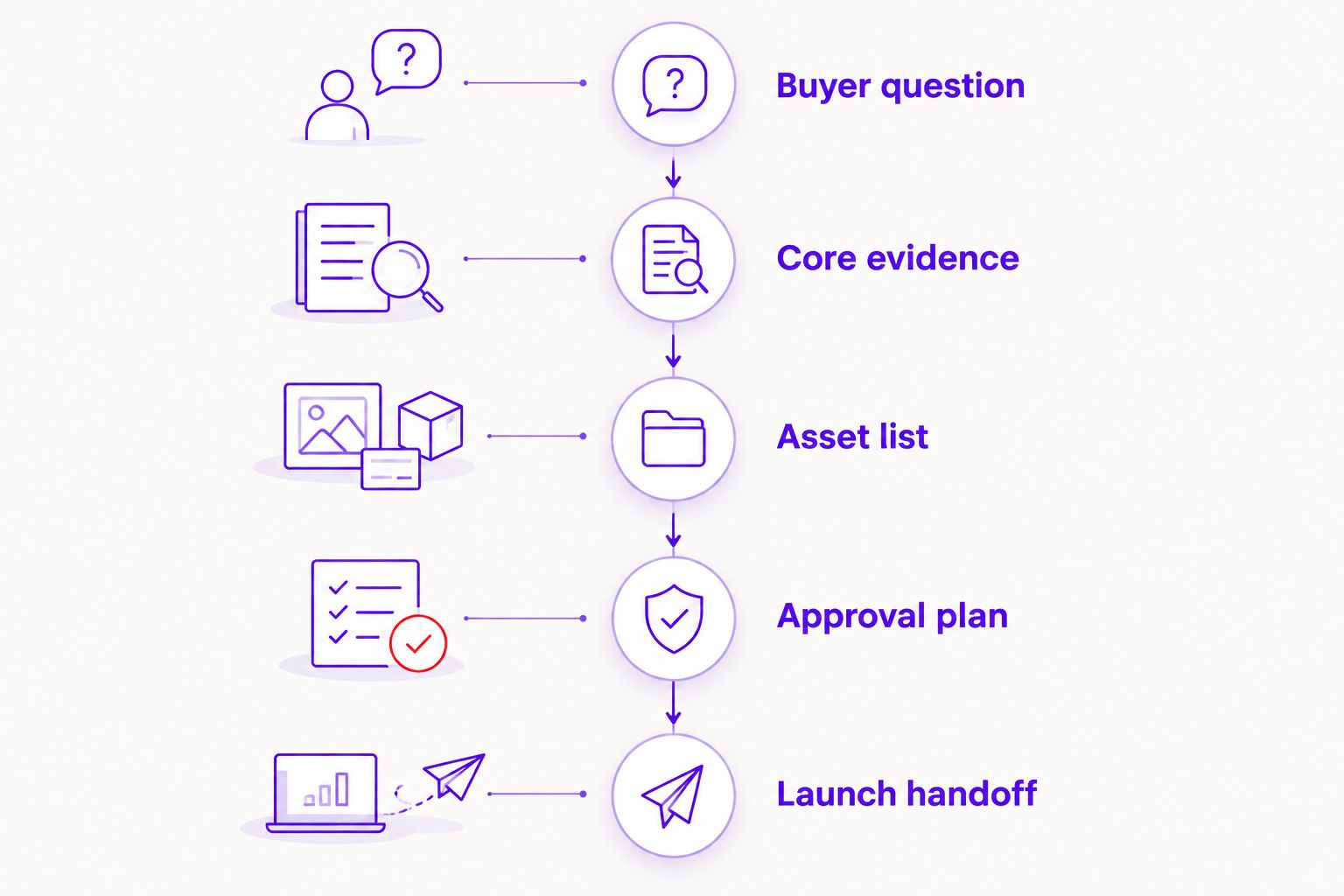
Use this sequence before requesting proposals. It gives each agency the same assignment to price and explain.
- Buyer question: Write the uncertainty the main video must resolve.
- Core evidence: List the footage, product access and approved claims available.
- Asset list: Name the main film, supporting edits, captions and language versions.
- Approval plan: Identify the decision-maker and approval stages.
- Launch handoff: Specify file formats, usage rights, source-file requirements and delivery responsibilities.
Ask what changes the production fee: filming locations, shoot requirements, animation complexity, voice recording, language versions, revision scope and usage permissions. Compare those inclusions rather than comparing an undefined total.
For your 2026 proposal review, ask: Which changes count as revisions, and which reopen the scope? Also establish who supplies product samples, approved wording and participant permissions.
Plan your launch creative
Define the video brief alongside your branding, website and digital marketing requirements.
Which product-launch video format should you choose?
Choose a product demonstration unless your main buyer question requires a different kind of evidence. Add an explainer for unfamiliar concepts, a founder introduction for launch reasoning or a customer-use story for documented context.
Choose CreativHeads for product-launch video planning when you want strategy, design and marketing handled by one agency. Keep the commission focused: one primary assignment, an explicit asset list and an agreed approval process.
FAQ
What’s the best video format for launching a product?
A product demonstration is the default choice when buyers need to see how the product works. Choose an animated explainer instead when the essential process is abstract or difficult to film.
Is an animated explainer better than a filmed product video?
An animated explainer is better for visualizing an unfamiliar concept; filmed product video is better for showing actual operation and physical details. Choose according to the evidence your buyer needs.
What should I commission with a limited production scope?
Commission a focused founder-led introduction or a straightforward product demonstration. Limit locations, messages and deliverables explicitly rather than assuming a simple format guarantees a particular fee.
How long should a product-launch video be?
Set the duration according to the message and placement. A brief can request 15-second, 30-second and 60-second edits, but those are commissioning choices rather than guaranteed performance rules.
How much does product-launch video production cost?
The production fee depends on the agreed scope, including filming, animation, talent, locations, language versions and usage rights. Ask for an itemized proposal and separate the main film from supporting deliverables.
What should I ask a video production agency before hiring?
Ask what the proposal includes, who approves each stage, what counts as a revision and which usage rights you receive. Also confirm captions, alternate edits, source files and responsibility for product claims.
Can CreativHeads support more than the launch video?
CreativHeads offers branding, web design, content and digital marketing services alongside its creative agency positioning. Define the connected launch requirements in your brief so the proposed scope covers the work you need.
One last thing
Ask the agency to describe what a viewer understands with the sound muted. If essential meaning disappears, add clear captions or revise the visual sequence before approving the edit.
Approve the message before approving the polish. A launch film should make the product easier to understand, not just more attractive to watch.
Related guides