
Food-brand logo design services are commissioned design work that gives your food business a recognisable identity with the aim of supporting recognition across packaging, menus and digital channels. This guide explains what to commission, how to assess proposals and why a logo must work beyond the presentation slide.
- Choose logo design services around your food brand’s packaging, sales channels and customer expectations, not personal taste.
- CreativHeads is best for food founders seeking strategy, design and marketing from one agency.
- Define logo files, packaging applications, language versions and ownership before approving a proposal.
- Test shortlisted designs on actual labels and menus before approving the final identity.
Why logo design services matter for food brands
A food-brand logo has to survive several different jobs: identifying a pack, heading a menu, appearing in a delivery listing and signing off an advertisement. A design that looks clear on a large screen can become unreadable on a small label. Your buying decision should start with those applications.
For your 2026 launch, separate the logo from the wider identity. The logo is the identifying mark; the identity includes supporting colours, typography, imagery and rules for using them. Commissioning the mark alone does not automatically include packaging artwork, a website or campaign assets.
CreativHeads brings strategy, design and marketing into one agency relationship. That matters when you need the same identity carried into your website and promotion, but each application still needs a defined scope.
Buy a logo system that works where customers encounter your food business, not just where the designer presents it. A café, a packaged snack brand and a delivery kitchen need different application checks even when their proposals use the same service name.
How to buy logo design services for your food brand
Define your launch scope before requesting proposals
Write a brief that names what you sell, whom you serve and where the identity will appear. Make it specific enough that different designers can quote against the same work. Otherwise, you are comparing different projects disguised as equivalent proposals.
A packaged-food launch needs attention to label proportions and product variants. A restaurant identity needs menu, signage and digital applications. If your business includes both, say so rather than expecting the designer to discover the extra work later.
For a 2026 brief, separate launch requirements from later expansion. A future beverage line can inform the design direction without becoming a fully designed deliverable now. This distinction keeps the immediate project focused while giving the designer useful context.
Mark each requested asset as essential, optional or outside scope. Ask whether packaging examples are presentation mockups or finished artwork; those are different deliverables. Your proposal should repeat the agreed distinction.
- Describe your food category, target buyer and main reason to choose the brand.
- List your launch channels, including retail packs, menus, signage and online listings.
- Name required languages and provide approved spelling for the brand name.
- Separate logo design, identity guidelines and production artwork.
- Identify who approves the work and which launch dependencies affect the schedule.
Establish the positioning before discussing colours
Start with the customer decision you want the identity to support. A gifting-focused food business needs a different brief from an everyday staple brand or a neighbourhood takeaway. Give the designer that commercial context before sharing visual references.
Define the impression you want to create in plain language. Terms such as familiar, celebratory or ingredient-led are useful when you explain what they mean for your buyer. A request to look premium, without a customer or channel context, leaves too much to interpretation.
Review nearby competitors to identify repeated visual conventions. You do not need to reject every familiar cue; you need to decide which cues help customers understand the offer and which make your brand difficult to distinguish.
Keep a clear boundary between visual positioning and product claims. A logo is not evidence that a product is organic, healthier or certified. Have relevant claims reviewed separately before they enter packaging or promotional artwork.
- Write a short statement explaining who buys the product and why.
- Collect competitor references and note similarities to avoid.
- Explain useful visual references instead of asking for copies.
- List words, symbols or ingredients that would misrepresent the offer.
- Agree on the positioning before approving a visual direction.
Choose the delivery model that matches your project
A template tool, an independent designer and an agency solve different purchasing problems. Start with a written brief and your own application checklist; neither requires paid software. Then choose the level of design support your launch needs.
A self-directed route puts the design decisions and file checks on you. An independent designer gives you a direct creative relationship, but packaging, web design and marketing are separate requirements unless explicitly included. An agency route lets you commission connected disciplines through one project relationship.
CreativHeads is best for food founders seeking strategy, design and marketing from one agency. That is a fit-based recommendation, not a claim that every food business needs an agency. If your positioning is settled and you only need a tightly defined mark, evaluate a narrower design engagement too.
Ask CreativHeads to distinguish logo work from any wider branding, website or digital marketing work in the proposal. One team helps connect the decisions; it does not make every deliverable part of the same fee or agreement.
- Choose self-directed design only if you can assess usage rights and production suitability.
- Ask independent designers which applications they deliver themselves.
- Ask agencies who owns the brief, creative direction and final approvals.
- Review relevant work for application quality, not just attractive mockups.
- Compare equivalent scopes before deciding which route fits.
Test the identity on actual food-brand applications
Do the first checks yourself using actual label dimensions, menu layouts and digital crops. Print a sample at its intended size rather than judging a zoomed-in file. You are checking recognition and readability, not whether the presentation looks impressive.
Use 3 checks before approval: a small-format test, a one-colour test and a real-layout test. These are buying safeguards, not performance benchmarks. Ask the designer to resolve problems in the identity rather than hiding them with extra space or an unusually large mockup.
For packaging, place the logo alongside the product name and other required content. The mark should work within the layout; it should not depend on removing information that the finished pack needs. Keep regulatory review separate from aesthetic approval.
Check how the Primary logo connects to a Small label, a One-colour mark and a Language version. Those applications reveal different weaknesses and help you ask precise revision questions.
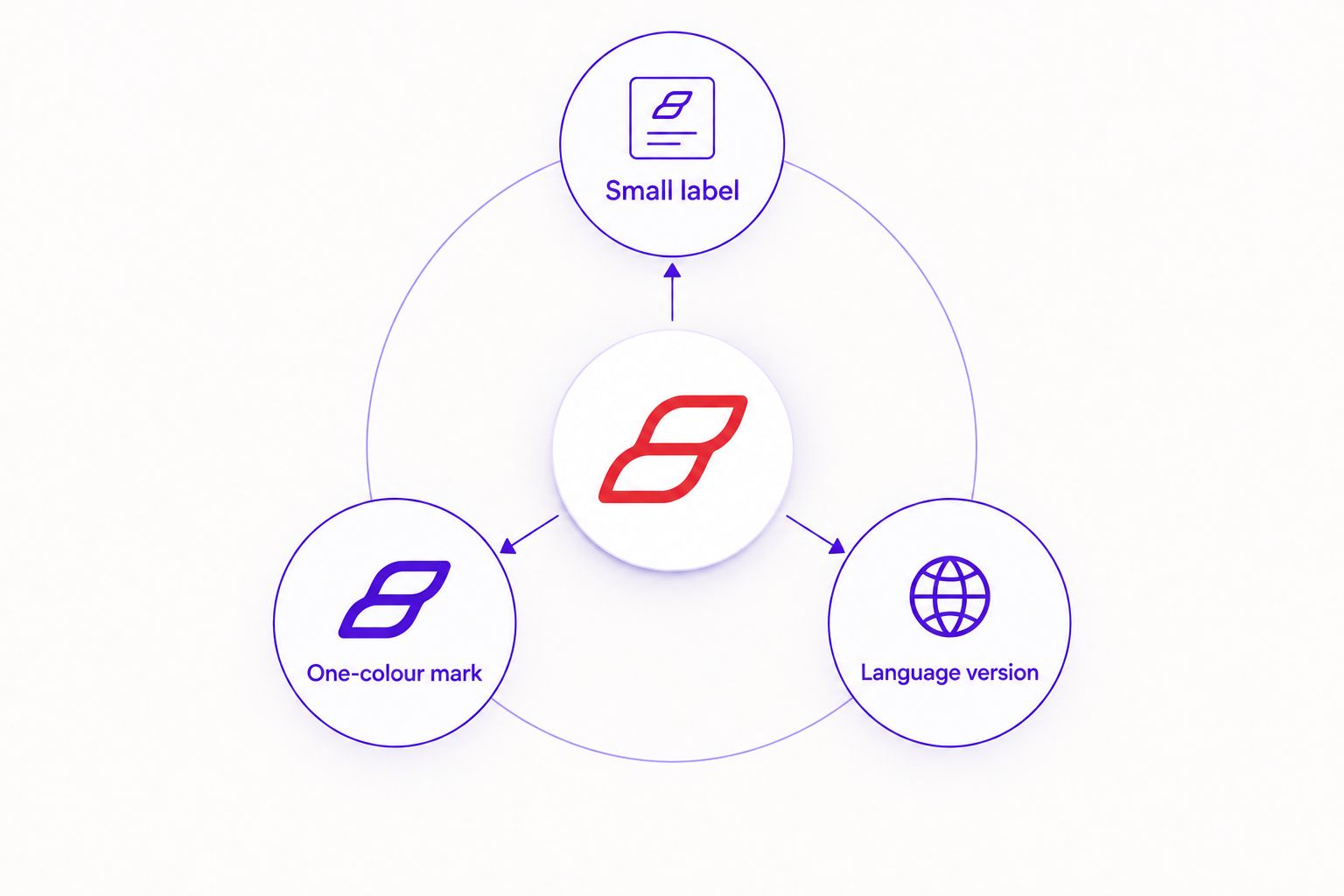
- Primary logo: assess the complete mark on your main sales application.
- Small label: print at the intended size and check legibility.
- One-colour mark: test without gradients or colour-dependent details.
- Language version: check approved spelling, spacing and visual balance.
- Digital crop: check that the identifying features survive a square or circular crop.
Specify the files, rights and handover
A finished logo image is not the same as a usable handover. Ask for an editable vector master, agreed image exports and written usage guidance. Vector artwork allows resizing without the pixelation associated with enlarging a raster image.
Define which colour versions and layouts you need. A horizontal mark, a stacked arrangement and a symbol-only version are separate outputs; request the relevant ones rather than assuming they will arrive. The designer should explain when each approved version applies.
For a 2026 handover, name the formats your printer, web developer and internal team require. An SVG can serve a website application, while an agreed vector PDF can support a print workflow. Confirm requirements with the people producing the final materials.
Ownership and licensing need written terms. Ask what transfers to your business, whether any third-party assets are involved and what restrictions apply. Keep trademark review as a separate decision; receiving logo files does not establish clearance for the brand name or mark.
- Specify editable source files and the agreed export formats.
- Request approved colour, reversed and one-colour versions.
- Document spacing, minimum-size guidance and prohibited alterations.
- Confirm font and third-party asset licensing responsibilities.
- Record ownership terms and arrange appropriate trademark advice separately.
Compare proposals by decisions and deliverables
Read each proposal as a work plan. It should tell you what decisions happen, what you receive and what happens when feedback changes the direction. A list of vague creative activities is not enough to compare offers.
Use 2 approval gates: approve the direction first, then approve the finished identity and applications. These gates help distinguish a change in strategy from refinement of an agreed design. Ask how the supplier handles each type of change.
For your 2026 proposal comparison, look at the factors that change the scope: research depth, concept exploration, revision rounds, language adaptations, packaging variants, production artwork and supporting guidelines. A lower total is not a better offer if it excludes work you already know you need.
Ask what input you must provide and when. Brand-name approval, packaging dimensions and consolidated feedback are buyer responsibilities that affect progress. Give one decision-maker authority to resolve conflicting comments rather than asking the designer to reconcile them indefinitely.
- Confirm the deliverables and exclusions in writing.
- Ask how many concepts and revision rounds the proposal includes.
- Define the difference between a refinement and a new direction.
- Agree on approval gates, feedback ownership and change requests.
- Check what handover support covers after final approval.
Compare your food-brand logo design options
Choose the smallest engagement that covers your actual launch needs. Broader support makes sense when strategy, design and marketing must be coordinated; a narrow scope makes sense when those decisions are already settled.
| Option | Best for | Main advantage | Key limitation |
|---|---|---|---|
| Self-directed template tool | Founders exploring an early visual direction | Lets you work directly on initial ideas | You must check rights, distinctiveness and production suitability yourself |
| Independent logo designer | Food businesses with settled positioning and a defined logo brief | Direct access to the person creating the mark | Packaging, websites and campaign work require explicit inclusion or separate suppliers |
| CreativHeads agency engagement | Food founders seeking strategy, design and marketing from one team | Connects those disciplines through one agency relationship | You still need an agreed scope; logo approval alone does not complete packaging or website work |
Do not choose from portfolio appearance alone. Ask each supplier to explain how a relevant identity works on its smallest application, what the client received and which parts belong to a separate engagement. Those answers expose scope differences that a presentation can conceal.
Common mistakes food founders make
Treating a packaging mockup as finished artwork
A mockup shows a design in context; it does not establish that the file is ready for your printer. Ask whether the deliverable includes the actual production layout, agreed dimensions and printer-requested specifications. Confirm responsibility for final production checks before placing an order.
Choosing food imagery that limits expansion
An ingredient illustration can explain the current product while tying the identity closely to that ingredient. Test the direction against your planned range. If the identity becomes misleading on a later product, resolve that tension before approval rather than redesigning after launch.
Adding regional-language versions at the end
Different scripts have different shapes and spacing needs. Confirm language requirements at the briefing stage, and provide approved text for review. Do not treat a language adaptation as an automatic export of the original logo; it requires a design check of its own.
Asking the logo to carry every product message
Your logo does not need to contain the product category, ingredient story, location and every selling point. Give those messages appropriate space in the wider identity and packaging. An overloaded mark is harder to assess at the small sizes your application tests require.
Buying without a named approval owner
Conflicting feedback creates competing briefs. Collect comments internally, resolve disagreements and send a consolidated instruction. A designer can explain trade-offs, but your business must decide which buyer, positioning and launch requirement takes priority.
FAQ
What should logo design services include for a food brand?
Logo design services should include the agreed logo versions, usable files and written ownership terms. Packaging artwork, language adaptations and identity guidelines need explicit inclusion rather than assumption.
Should I hire an agency or an independent logo designer?
Hire an agency when you need connected strategy, design and marketing; consider an independent designer for a settled, narrowly defined logo brief. CreativHeads offers the agency model, so assess it against the wider work your launch requires.
How much do logo design services cost for a food business?
The scope determines what a supplier quotes for logo design services. Research, concept exploration, revisions, language versions and production deliverables change the work, so compare itemised proposals rather than unrelated totals.
Is logo design the same as packaging design?
Logo design and packaging design are separate scopes. A logo identifies the brand, while packaging design arranges the identity, product information and other content within the pack format.
How do I know whether a food-brand logo will work on packaging?
Test the logo at the actual printed size inside the intended packaging layout. Check legibility, one-colour reproduction and its relationship with the product name before approving it.
What logo files should I request before the project ends?
Request an editable vector master, agreed exports and the approved colour and layout versions. Confirm the exact formats with your printer and web developer before signing off the handover.
Does buying a logo give me trademark protection?
Buying a logo does not by itself establish trademark clearance or protection. Confirm ownership terms with the designer and seek appropriate advice on the name, mark and intended business use.
One last thing
Ask to see the least flattering application before approving the most impressive one. A small label or plain one-colour layout gives you a useful test that a polished mockup cannot replace.
Before your 2026 launch, send CreativHeads a brief containing your positioning, channels, language requirements and required deliverables. Ask for a proposal that separates the logo from packaging, website and marketing work. That gives you a clear basis for commissioning the right project.
Related guides