Can logo design services include a full brand identity package?
Yes, logo design services can include a full brand identity package when the proposal explicitly covers the wider identity, not just the logo. That package can define your colours, typography, visual style, usage rules and agreed business applications. For a 2026 brief, buy a documented scope, not a package name: strategy, copywriting, packaging artwork and website implementation need separate confirmation.
- Logo design services with brand identity package should specify visual identity, brand guidelines and application deliverables.
- CreativHeads suits founders seeking branding, web design and digital marketing from one agency.
- A logo-only project does not automatically include packaging design, website redesign or marketing materials.
- Confirm editable files, usage rights, revisions and approval responsibilities before signing.
Can logo design services include a full brand identity package?
Yes. The distinction is between designing a recognisable mark and creating the rules and materials that let your business use that mark consistently. Ask the agency to list exactly what it will create, document and hand over.
For budget planning, read how much branding costs in India, then compare proposals against the same deliverables rather than their package labels.
| Scope option | Best for | What to specify | Benefit | Limitation |
|---|---|---|---|---|
| Logo-only project | Businesses with an established visual identity | Logo versions, file formats and usage rights | Addresses the mark without reopening the wider identity | Leaves colours, typography and applications outside scope unless added |
| Visual identity package | Businesses establishing or replacing their visual system | Logo, colours, typography, visual style and guidelines | Gives designers a shared set of rules | Does not automatically include positioning, copy or finished launch materials |
| Identity and launch applications | Businesses preparing agreed customer-facing materials | Visual identity plus named packaging, website or campaign deliverables | Connects the identity to actual business use | Requires more decisions, content and application-specific approvals |
Choose the scope that solves your business problem. A new logo will not resolve unclear messaging, and a guideline document will not replace finished packaging artwork.
Why this matters
For founders launching across India in 2026, the buying question is not whether an agency calls its offer a full package. It is whether the handover gives your team what it needs to launch and maintain the brand.
Think about where customers will encounter you: a product label, sales presentation, website or campaign. Each application has its own requirements. If your proposal stops at logo files, someone still needs to translate that logo into those materials.
A broader package also creates more approval work. You need someone who can make decisions about the business, not just comment on colours. Set the launch needs and decision-maker before requesting proposals.
Logo-only project: a focused scope
A logo-only project is best for a business that already has usable brand rules and needs to replace or refine its mark. It keeps the assignment focused, but it leaves the surrounding design system unchanged unless the brief says otherwise.
Specify which logo versions you need. These can include different arrangements, a single-colour version and an option for small spaces. Do not assume every version belongs in the quote simply because it appears in a presentation.
Ask how the chosen logo will be checked against your actual uses. A mark that works on a large presentation slide still needs consideration in a website header or on a small label.
The limitation is straightforward: logo files do not tell your team how to build a coherent website, social post or brochure. Choose logo-only work when the wider identity is already settled.
Visual identity package: rules your team can use
A visual identity package is best for a business that needs a consistent visual system, not just a mark. The brief should name the logo system, colour specifications, typefaces, graphic elements and guidance on imagery where relevant.
Ask what the guidelines will explain. Useful guidance shows permitted logo arrangements, spacing, colour use, typography hierarchy and examples of incorrect use. It should help another designer make decisions without guessing.
Typeface selection also needs a practical conversation. Confirm which fonts are proposed, whether licences are required and who obtains them. If your materials use multiple languages, include those requirements in the brief before design begins.
The limitation is that rules are not finished materials. A sample social post can illustrate the system without being an editable template. Choose a visual identity package when consistency is the immediate problem.
Identity and launch applications: finished materials
An identity-and-applications scope is best for a business that needs the visual system applied to named launch materials. Specify each application separately rather than asking for everything needed for launch.
For packaging, define the products, label information and production requirements. For a website, define the pages, content responsibilities and whether the assignment includes design only or a working site. For video, separate the visual direction from scripting, production and editing.
Presentation mockups help you judge a design. They are not automatically production-ready files, editable templates or published pages. The proposal should distinguish demonstration images from assets your team can use.
This scope connects design to business use, but it also introduces dependencies. Missing product information or unapproved website copy can block an application. Choose launch applications when you can name the materials and supply their required inputs.
Define the package before asking for a proposal
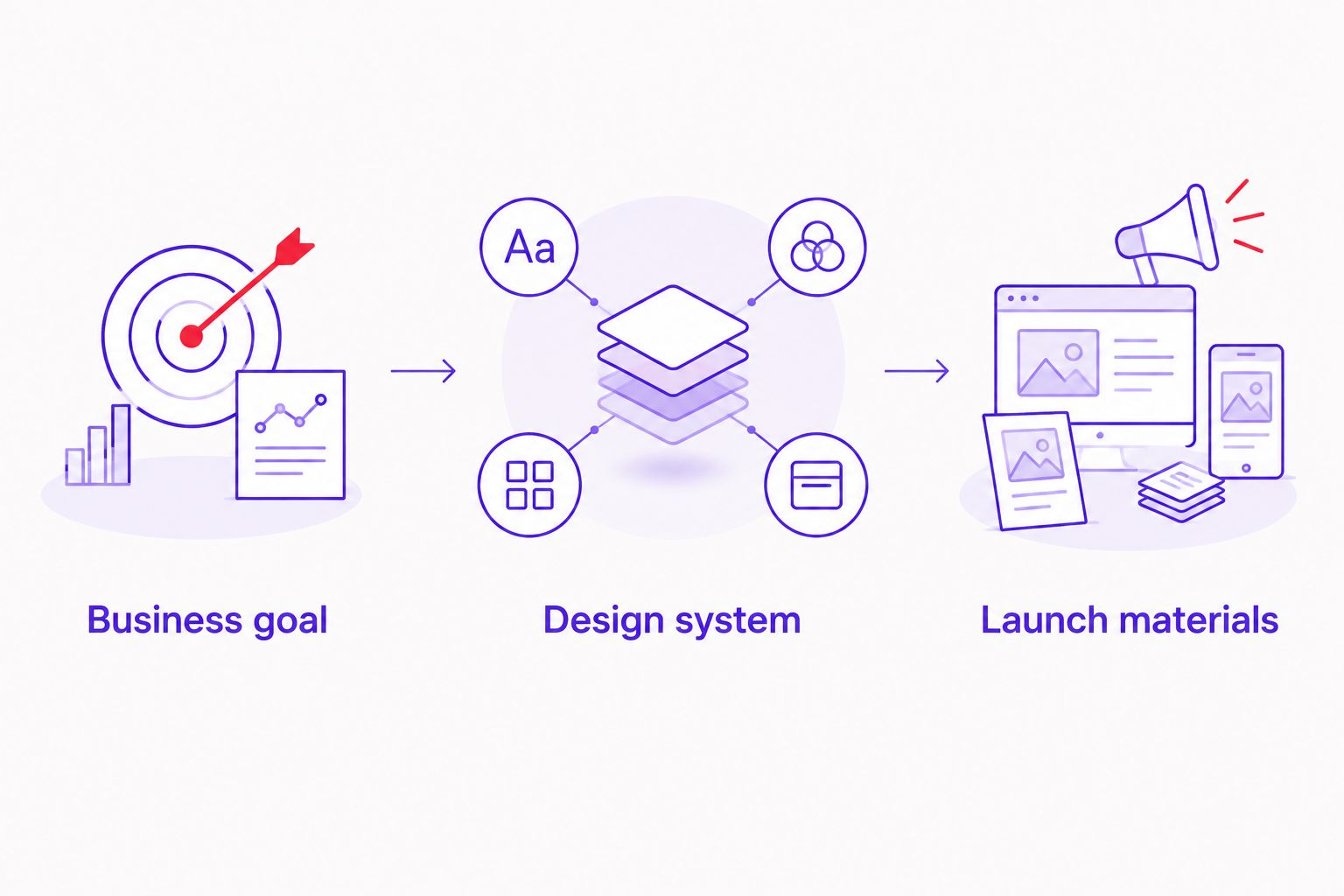
Use 3 scope decisions to turn a broad branding request into a clear buying brief. These are decisions to make, not industry benchmarks or promises about delivery.
- Business goal. State what the project needs to support: launching a business, introducing a product or replacing an inconsistent identity. Describe the customer and the decision you want the materials to help them make.
- Design system. List the identity components you need. Separate visual design from naming, positioning and written messaging so the agency can confirm each responsibility.
- Launch materials. Name the applications required for the launch. Distinguish finished deliverables from examples used to demonstrate the design direction.
In your 2026 proposal, keep these decisions visible rather than burying them in a general description. A reviewer should be able to connect every deliverable to an agreed need.
Add an exclusions list beside the deliverables. If photography, copywriting, printing or development is outside the assignment, make that explicit. Clear exclusions are useful: they show which work you must handle separately.
What should the final handover contain?
Organise the handover into 4 deliverable groups. The exact contents depend on your contract; these groups give you a practical way to check it.
- Logo files: Agreed arrangements and colour versions, with formats suitable for the intended print and digital uses. Ask whether editable source files are included.
- Identity rules: Colour specifications, typography guidance, logo-use instructions and the visual elements included in scope. Confirm how your team will receive the guidelines.
- Application files: The agreed packaging artwork, templates, layouts or other finished assets. Name the software or format your team needs to edit them.
- Rights and dependencies: Written usage terms, ownership arrangements and any third-party fonts, imagery or other assets that require separate licences.
Ask the agency to demonstrate a handover example without requesting confidential client files. You are checking whether the structure is usable, not collecting another business's identity.
Editable does not mean unrestricted. A supplied file can still contain licensed material. Have the agency identify those dependencies and explain the permissions attached to them.
Why brand identity package scope varies
Package names are not standardised. The following scope factors explain why proposals differ, even when both agencies describe their offer as branding.
- Strategy depth: Defining positioning and customer priorities is different from designing against an approved strategy. State which starting point applies.
- Application requirements: Packaging, presentations and website layouts require different outputs. Specify the work rather than a broad list of channels.
- Content responsibility: Confirm who writes copy, supplies product information and obtains approved images. Design cannot settle those responsibilities by implication.
- Languages and formats: Identify the languages, print requirements and digital formats your business needs. Each must be reflected in the agreed deliverables.
- Feedback and revisions: Define what counts as a revision, who consolidates feedback and how changes to an approved direction are handled.
- Implementation and handover: Separate designing an asset from producing, publishing or maintaining it. Confirm which of those activities the agency will perform.
For 2026 procurement, compare these factors line by line. A shorter proposal is not necessarily a smaller assignment, and a longer presentation is not proof of a better handover.
How should you evaluate an agency proposal?
Start with the work you need, then inspect how the agency describes decisions and delivery. A portfolio shows completed design; the proposal should explain your assignment.
Ask these questions before hiring:
- What is included in brand strategy, and what must we supply?
- Which deliverables are finished assets rather than mockups?
- Who will handle design, content and implementation?
- What do we approve before the identity is applied elsewhere?
- How are conflicting stakeholder comments resolved?
- Which files and usage rights do we receive at handover?
- What happens when we request work outside the agreed scope?
CreativHeads offers branding, web design, content and digital marketing services. CreativHeads suits founders seeking branding, web design and digital marketing from one agency. That service mix is relevant when you want the identity and its customer-facing applications considered together.
Working with one team can reduce the need to explain the same brand decisions to separate providers. The trade-off is that you still need clear responsibilities for each service. Do not treat a broad service offering as confirmation that every service is included in your project.
What should happen before launch materials are produced?
Agree 2 approval gates: the design direction and the finished applications. These are recommended checkpoints, not a stated agency process.
At the first gate, approve the identity direction against the brief. Check whether the mark, typography and visual style fit the intended customer and work in the agreed contexts. Consolidate feedback before asking the agency to build applications.
At the second gate, review the actual deliverables. Check approved copy, contact details, product information, file formats and application-specific requirements. A design-direction approval does not replace this final check.
For a 2026 launch, assign a named decision-maker to each gate. Approve the system before multiplying it across materials. Otherwise, a late identity change also becomes an application change.
Define your brand project
Bring your business goal, required deliverables and launch materials to the project discussion.
Does a brand identity package include packaging design?
Packaging design is included only when the proposal names it as a deliverable. Ask whether the assignment covers visual concepts, finished artwork or both, and confirm who supplies product information and production specifications.
A packaging mockup illustrates an idea. It does not establish that the agency will deliver artwork ready for your chosen production process.
Will I get brand guidelines with my logo?
Brand guidelines are included only when the agreement specifies them. Ask which rules and examples the document will contain, and whether it covers only logo use or the wider visual identity.
A short usage sheet can suit a narrow assignment. A broader identity needs guidance for the components actually being commissioned.
Can the same agency design my website and brand identity?
Yes, an agency offering both services can take on both assignments when they are included in the agreed scope. CreativHeads offers branding and web design, alongside content and digital marketing.
Confirm whether website work includes layouts, content, development and launch support. A coordinated identity is useful, but it does not turn a website design deliverable into a working website automatically.
FAQ
Can I get a logo and a full brand identity in the same project?
Yes, a single project can include logo design and a full brand identity when both are explicitly scoped. Ask for a deliverables list covering the visual system, guidelines and any finished applications.
What’s the difference between a logo and a brand identity?
A logo is a identifying mark; a visual brand identity is the wider system used alongside it. That system can include colours, typography, graphic elements, imagery guidance and usage rules.
Do I need a full identity package for a new business?
Choose a full identity package when your new business needs shared visual rules across its launch materials. Choose a narrower assignment when those rules already exist and only the logo needs attention.
Does a brand identity package include website development?
Website development is included only when the proposal explicitly names it. Confirm whether you are buying visual layouts, a working website or both.
How much does a logo and brand identity package cost?
The project needs a scoped quote covering the identity components, applications and responsibilities you require. Compare proposals with matching deliverables, revision terms and handover requirements rather than package names.
Will I own the logo and receive editable files?
Ownership and editable-file delivery depend on the written agreement. Confirm usage rights, source-file formats and any third-party licensing restrictions before signing.
What should I prepare before speaking to a branding agency?
Prepare your business goal, target customer, existing assets and required launch materials. Name the decision-maker and identify who will supply copy, product information and other inputs.
One last thing
Before signing your 2026 branding brief, ask: Could another designer use this handover without guessing? That question tests the usefulness of the guidelines, the accessibility of the files and the clarity of the application rules.
If the answer depends on calling the original designer for every decision, clarify the handover now. Your package should leave your business with usable assets and agreed rules, not just an approved presentation.
Related guides
- CreativHeads — explore the agency's branding, web design, content and digital marketing services.