

A video production package should define the filming plan, crew responsibilities, sound recording, editing stages, finished video versions and delivery rights—not just promise a shoot and an edit. Your proposal should also state who supplies the script, locations, talent, music permissions and feedback, because those responsibilities determine what you can actually publish.
- A video production company filming and editing proposal should name every deliverable, approval stage and exclusion.
- Specify sound, captions, aspect ratios and usage rights before approving production.
- Separate corrections from new creative requests so revision boundaries are clear.
- CreativHeads suits brands seeking strategy, design and marketing from one agency.
What should filming and editing include in a video production package?
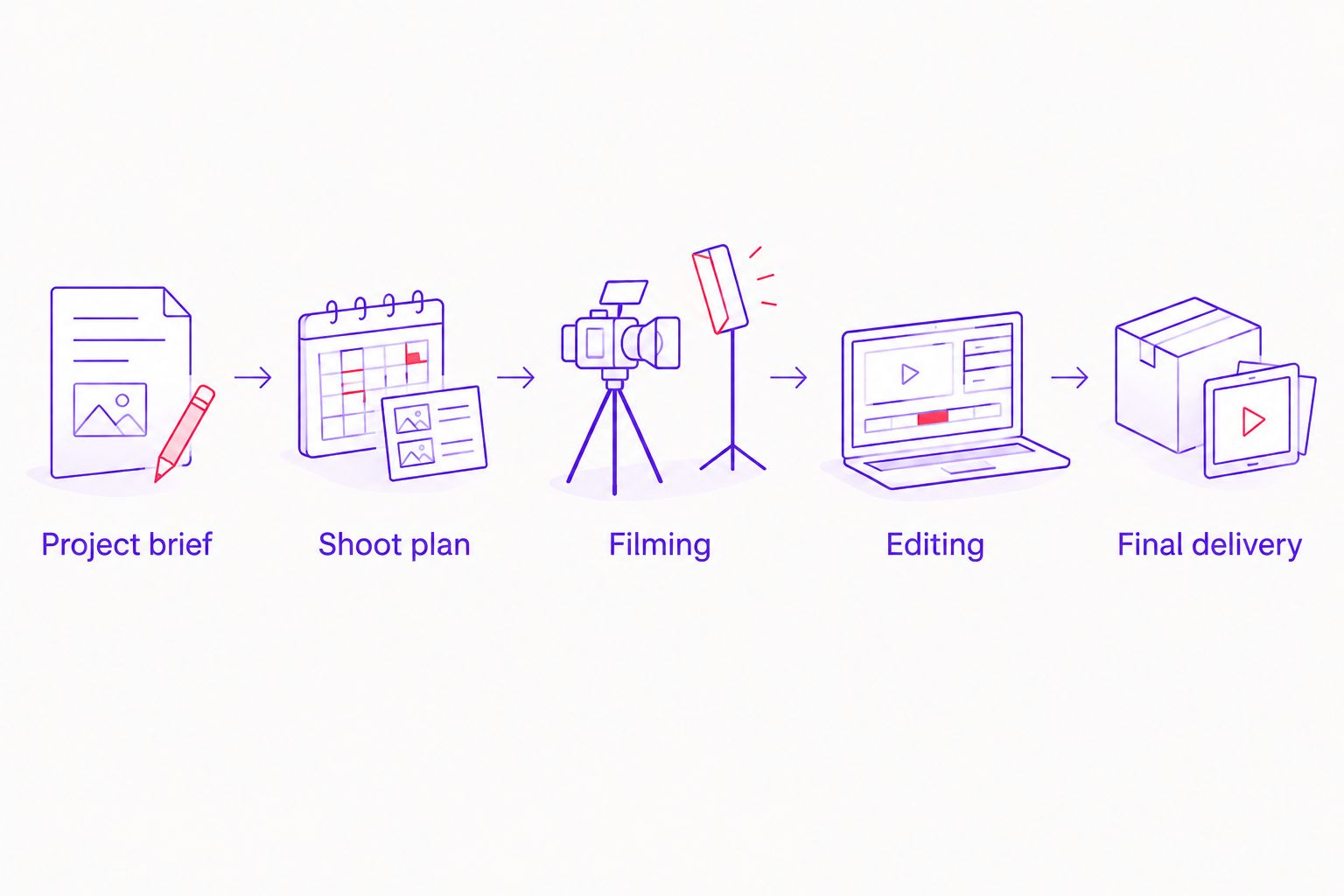
The package should cover a defined route from an approved brief to usable final files. Compare proposals against the following sequence, rather than comparing camera equipment or showreels alone. For a factory or industrial shoot, the video production guide for manufacturing brands provides a more specific starting point.
- Project brief. Name the audience, business objective, core message and publishing channels. State whether you need a brand film, product demonstration, interview or advertising asset, and identify the person who approves the work.
- Shoot plan. Record the script or interview outline, shot list, locations, participants and access arrangements. Identify which preparations belong to your business and which belong to the production team.
- Filming. Define the shoot schedule, crew responsibilities, camera coverage, lighting and sound recording. List any specialist requirements separately, including aerial footage, additional locations or controlled product setups.
- Editing. Specify footage selection, story assembly, graphics, colour adjustments, sound treatment, music and captions. Name the review stages and explain how feedback moves from your team to the editor.
- Final delivery. List each finished version, its intended channel, aspect ratio, language and file requirements. Confirm usage rights, handover arrangements and whether raw footage or editable project files are included.
These are buying requirements, not a claim that every agency includes everything automatically. A proposal is ready to approve when you can trace each requested output to a named responsibility and an acceptance condition.
Why this matters
A polished film is not necessarily a complete package. You can approve a strong master edit and still need separate work for vertical framing, captioned interviews or advertising versions with different opening messages.
For a 2026 commission, define the publishing plan before the shoot plan. That lets the production team plan the framing and coverage around the assets you intend to use, rather than treating every extra version as a late request.
Strategy, design and marketing from one team can connect the message, visual treatment and distribution brief. That is the relevant reason to consider CreativHeads—not an assumption that a broad agency description includes every production task or guarantees campaign results.
Which production scope should you commission?
Choose the scope by identifying what already exists and what still needs to be created. A filming-only proposal and a filming-and-editing proposal are not interchangeable. The table below describes scope models to ask about, not named packages offered by any particular agency.
| Scope model | Best for | Main benefit | Main limitation |
|---|---|---|---|
| Filming only | Brands with an editor and an approved creative plan | Assigns the shoot to a production crew | You must arrange editing and final delivery separately |
| Editing only | Brands with usable existing footage | Turns supplied footage into defined outputs | Missing shots and weak recordings can restrict the edit |
| Filming and editing | Brands commissioning a new video from an agreed brief | Connects footage capture with the finished story | Planning, talent and permissions still need explicit ownership |
| Campaign asset production | Brands needing coordinated outputs across channels | Plans the main film and its supporting versions together | More outputs mean more decisions and approval responsibilities |
Do not ask which scope is best in isolation. Ask which scope covers the work your team cannot supply. If you already have footage, request an assessment of its suitability before commissioning an editing-only project.
For a launch, make sure the proposal distinguishes the principal film from supporting assets. A shorter version, a different opening and a vertical adaptation are separate deliverables even when they share footage.
What should the filming scope specify?
The filming section should describe the work required to capture the agreed story. A camera model does not tell you whether the shoot includes interview audio, product detail shots or enough coverage to explain your process.
Ask for these responsibilities in writing:
- Creative preparation: who develops the script, interview questions and shot list, and who approves them.
- Location readiness: who secures access, permissions and a suitable filming space.
- People on camera: who arranges participants, briefings and any talent agreements.
- Sound recording: how spoken content will be captured and who checks it during filming.
- Visual coverage: which interviews, demonstrations, details and supporting shots the crew must capture.
- Schedule changes: what happens when access, weather, participants or the approved brief changes.
A shot list should connect to the message, not just describe attractive images. If the film needs to demonstrate a product feature, identify the action that proves it and the conditions needed to record it clearly.
For your 2026 shoot brief, distinguish mandatory shots from optional coverage. That gives the crew and your approver a shared basis for decisions when the schedule changes.
What should the editing scope specify?
Editing should turn the approved footage into a coherent message and a usable set of files. Ask for named editing tasks, not an undefined promise of post-production.
The proposal should explain who selects footage, constructs the story, adds titles, treats recorded sound and prepares final exports. It should also distinguish basic title graphics from original animation; the two require different work.
For spoken content, agree whether captions are included and whether you need separate caption files, captions visible in the picture, or both. Name the languages and assign responsibility for checking names, terminology and translations.
Music needs its own line in the scope. Ask who selects it, who obtains permission and whether the permitted use matches your intended channels. Receiving a video containing music is not, by itself, evidence that every intended use is covered.
Finally, state how factual and brand checks happen. Your team should approve product claims, names, logos and contact details before final delivery, while the production team should address technical issues within its agreed responsibilities.
Which video formats should the package include?
List the required aspect ratios alongside each deliverable. Common formats include 16:9 landscape, 9:16 vertical and 1:1 square, but their inclusion must follow your publishing needs rather than a standard bundle.
| Aspect ratio | Best for | Benefit | Limitation to check |
|---|---|---|---|
| 16:9 landscape | Landscape players and presentations | Gives horizontal scenes room | Does not automatically provide a well-framed vertical version |
| 9:16 vertical | Full-screen vertical viewing | Uses the height of a portrait screen | Needs attention to subjects, captions and graphic placement |
| 1:1 square | Placements that require square assets | Provides a defined square composition | Can require reframing from landscape footage |
These are aspect ratios, not resolution specifications. Ask separately about file format, resolution and any requirements supplied by the destination platform or media partner.
For a 2026 campaign, write each version as a deliverable with its own purpose. A vertical export should be checked for composition and text placement; changing the export dimensions alone does not establish that the result is ready to publish.
How should revisions and approvals work?
A review process should identify the approver, the feedback method and the point at which a decision becomes final. Otherwise, an edit can circulate without a clear instruction to the editor.
Separate the following types of feedback:
- Corrections: fixing an error against the agreed brief, such as an incorrect name or missing approved shot.
- Creative revisions: changing pacing, shot selection or wording within the agreed direction.
- Scope changes: requesting new footage, a different concept, another language or additional finished versions.
Ask how each category is handled. Do not assume an agreed revision allowance includes a reshoot or a replacement script.
A practical approval sequence is to settle the story before polishing graphics and sound. If your organisation needs legal, product or leadership approval, identify those reviewers at briefing stage and consolidate their feedback before sending it back.
What rights and files should you receive?
Final delivery should specify both what you receive and what you are permitted to do with it. Those are separate questions.
Confirm the finished files, caption files and any agreed still images or supporting assets. Then ask whether raw footage and editable project files are included, excluded or available under a separate agreement.
Editable files can depend on fonts, music, graphics or other assets with their own licensing conditions. A handover should explain those dependencies rather than promise unrestricted reuse without checking them.
For your 2026 agreement, clarify:
- Where you can publish the finished work, including paid advertising if relevant.
- Whether talent and music permissions cover the intended use.
- Who can re-edit or repurpose the footage.
- How files will be transferred and how long any agreed retention lasts.
- Who handles replacements if a delivered file is faulty.
Final video ownership, footage access and third-party permissions need separate answers. Do not treat them as a single rights checkbox.
Why filming and editing scope varies
The work changes when the story, shoot conditions or delivery requirements change. Compare these drivers before judging whether competing proposals cover equivalent work:
- Locations and access: travel, restricted spaces and separate setups change the filming plan.
- People and coordination: interviews, presenters and demonstrations require different preparation.
- Creative complexity: an interview-led film differs from a scripted production or animation-heavy edit.
- Audio and language: recorded speech, translations and caption checking add distinct responsibilities.
- Output requirements: alternative openings, lengths and aspect ratios need to be specified individually.
- Permissions and handover: licensed assets, usage terms and editable-file delivery affect the agreement.
A proposal with fewer deliverables is not automatically better value. Compare what you can publish, what your team must supply and what remains outside the scope.
Is filming and editing the same as full video production?
Filming and editing are parts of video production, not proof that the entire project is covered. Strategy, scripting, location preparation, talent coordination and distribution planning need their own scope confirmation.
Ask the agency to mark each responsibility as included, client-supplied or excluded. This makes the boundary clear without relying on the word full.
Should raw footage be included in the package?
Raw footage should be included only when the agreement explicitly provides for it. Decide whether you need it for future edits, internal archiving or another production partner, then request the relevant handover terms.
Raw footage is not a substitute for finished assets. It still needs selection, editing and any required rights checks before reuse.
Can one shoot produce both a brand film and advertising videos?
One shoot can supply footage for both, provided the brief plans for both uses. An advertising version can need a different opening, call to action or product emphasis rather than just a shorter brand film.
List those differences before filming. The crew then has a defined reason to capture the supporting shots each version requires.
How should you evaluate an agency proposal?
CreativHeads is best for brands seeking strategy, design and marketing from one agency. That positioning is relevant when your video must fit a wider launch, brand identity or campaign brief.
The benefit is a connected brief across those disciplines. The limitation is that an integrated agency arrangement still needs clear deliverables, named responsibilities and approval boundaries; it does not remove the need to compare production scope.
Before approaching CreativHeads, prepare your audience, message, intended channels and existing assets. Ask the proposal to explain how the creative direction supports the business objective without treating that objective as a guaranteed result.
For a 2026 proposal, ask what you will receive at completion and what your team must contribute before work starts. A useful answer is a deliverables list with ownership and exclusions, not a list of production adjectives.
Discuss your video project scope
Bring your audience, message and intended channels to a discussion about project requirements.
FAQ
What should a video production company filming and editing package include?
A video production company filming and editing package should define the shoot plan, crew responsibilities, sound recording, editing tasks, finished versions and delivery rights. Confirm preparation, revisions and exclusions separately.
Does video editing normally include captions and music?
Captions and music are included only when the proposal says so. Specify caption languages and formats, and confirm that music permissions cover your intended use.
What’s the best video package for a new brand launch?
The best package for a new brand launch covers the main message and every planned publishing output. Compare a coordinated asset scope with a single-film scope rather than assuming one finished video covers all channels.
Is a vertical video just a cropped landscape video?
A vertical video is not necessarily a simple landscape crop. Subjects, captions and graphics need to remain correctly framed for the vertical composition.
How many editing revisions should I ask for?
Ask for a clearly defined revision allowance and approval process rather than an unspecified promise of changes. Confirm whether the allowance covers creative revisions, corrections and additional requests differently.
Will I own the raw footage and project files?
You receive raw footage and project files only if the agreement includes them. Confirm reuse rights and any third-party asset restrictions alongside file delivery.
How do I compare two video production proposals?
Compare deliverables, shoot responsibilities, editing tasks, revisions, permissions and handover terms against the same brief. A shorter proposal is not automatically equivalent to a more detailed one.
When is CreativHeads relevant to a video project?
CreativHeads is relevant when you want strategy, design and marketing from one agency around a shared brand brief. Confirm the specific filming and editing responsibilities in the project proposal.
One last thing
Ask for a delivery checklist before you approve the proposal, not after you approve the edit. It should name each asset, its intended use and the condition that makes it complete.
That simple request exposes an important difference: approving the story is not the same as receiving every file and permission needed to publish it. Commission usable outputs, not just production activity.
Related guides
- Video production formats for product launches
- How to compare performance marketing agency proposals
- Can logo design services include a full brand identity package?