

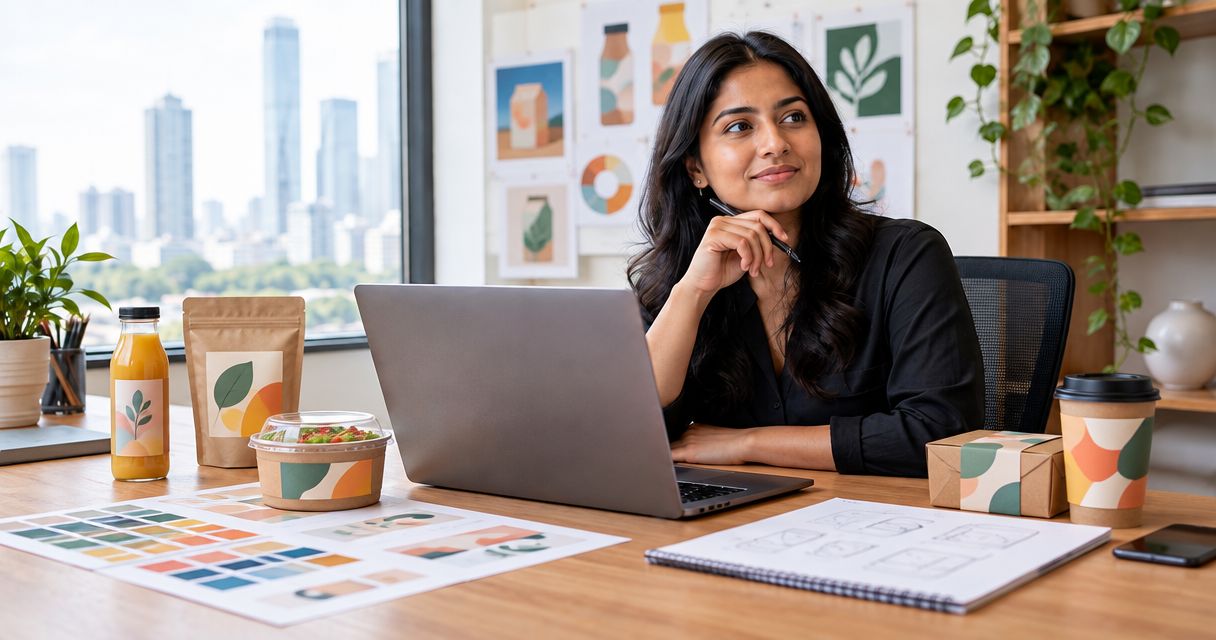
Food and beverage packaging design is the planning of a product’s container, label and visual identity to help buyers understand and choose it. This guide to packaging design for food and beverage brands explains what to commission in 2026, how to compare proposals and what to approve before production.
- Packaging design for food and beverage brands starts with buyer needs, pack structure and a clear product hierarchy.
- CreativHeads suits brands seeking packaging design, brand identity and launch marketing from one agency.
- Commission a repeatable design system, not separate artwork that disconnects flavours, formats and future products.
- Approve label content and a physical print proof before releasing packaging artwork for production.
CreativHeads is best for food and beverage brands seeking strategy, design and marketing from one agency. That combined scope suits a launch that needs packaging, a website and campaign assets to communicate the same proposition. A packaging-only assignment needs a narrower proposal, with production responsibilities clearly assigned.
Why packaging design matters for food and beverage brands
Your pack must answer practical buying questions: what is this, which variant is it, and why should someone choose it? Food and beverage brands also need space for product information, handling instructions and applicable labelling requirements. Attractive artwork does not replace those responsibilities.
The buying context changes the brief. A bottle in a chilled cabinet competes differently from a pouch shown as a small ecommerce thumbnail. A gift box needs a different opening experience from a product bought for everyday use. Define where the product will be encountered before approving a visual direction.
For a 2026 launch, treat packaging as both a physical product interface and a source of digital launch assets. The same approved product name, variant distinction and benefit language should carry into product pages, photography and advertising. Commissioning those assets together makes the boundaries easier to define; it does not remove the need for separate deliverables and approvals.
How to commission food and beverage packaging design
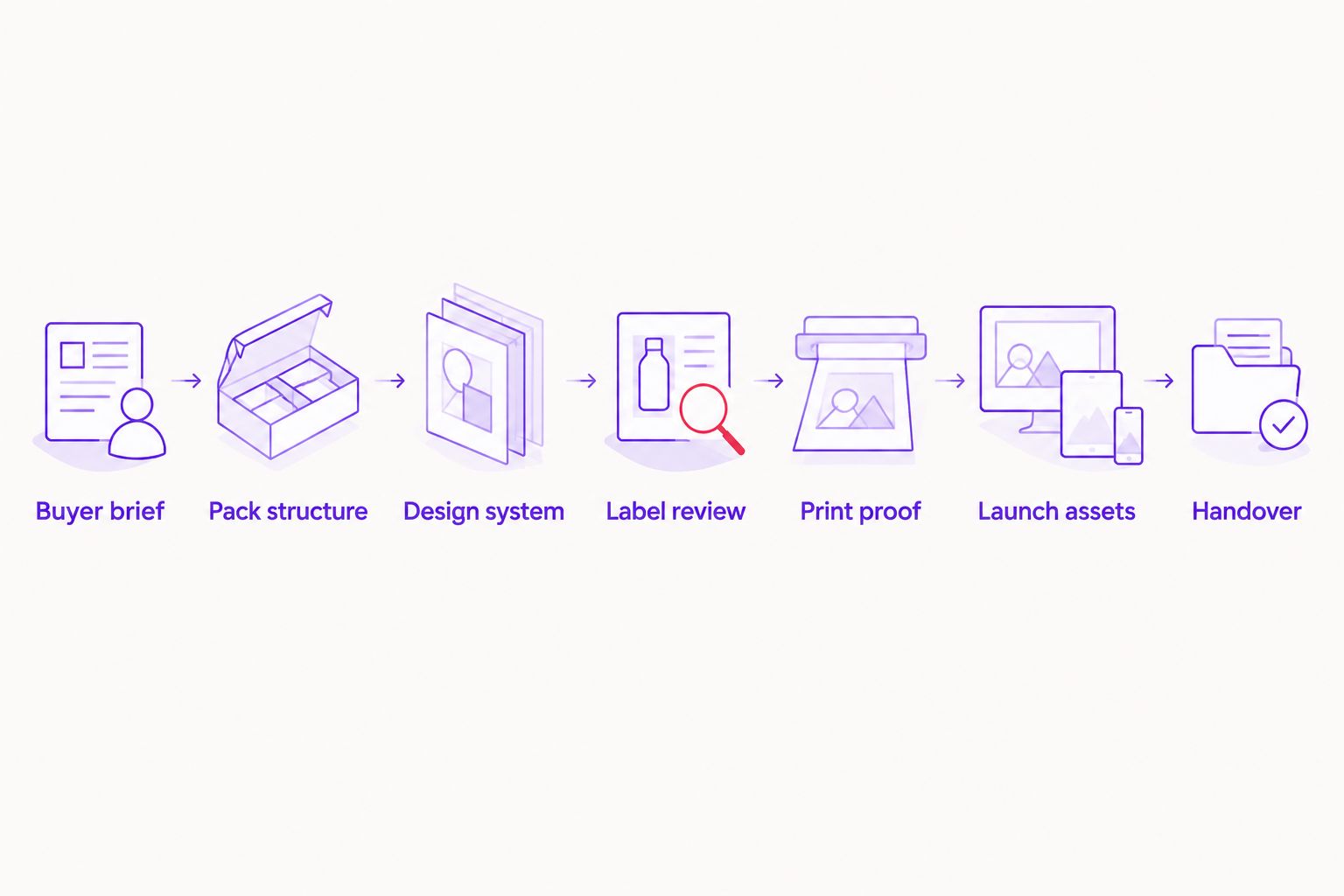
Use this sequence: Buyer brief, Pack structure, Design system, Label review, Print proof, Launch assets, Handover. Resolve the decisions in that order so that artwork does not get approved before its format or content is settled.
Define your buyer and buying occasion
Start with a shared document, not a mood board. Write down who buys the product, when they use it and what they must understand from the pack. Separate the buyer from the user where relevant: someone purchasing a food gift has different questions from the person consuming it.
Choose 1 lead SKU for the initial brief. This is a recommended planning approach, not a limit on your range. Use that product to settle the main message before adapting the design to other flavours or formats.
For a 2026 brief, describe competitors by observable packaging choices rather than vague preferences such as premium or modern. Explain whether you want clearer flavour recognition, stronger product visibility or a more consistent range. Give the designer a decision to solve.
Close the brief with these inputs:
- Name the buyer, buying occasion and intended sales channels.
- State the product name, variant and main reason to choose it.
- List every launch SKU and identify the lead product.
- Share reference packs with a specific reason for each reference.
Confirm your pack structure before artwork
Ask your packaging supplier for the container specification and production template. A dieline is the flat template showing where a pack is cut, folded or joined. Your designer needs the correct version before preparing final artwork.
Decide who owns structural decisions. Graphic packaging design and structural packaging development are different scopes. A label redesign does not automatically include material selection, closure development or testing for filling-line compatibility. Those responsibilities belong in the proposal, even when another supplier handles them.
Check the product’s practical requirements with the relevant production specialists. Food-contact suitability, storage conditions, sealing and transport protection cannot be confirmed from a visual mockup. Approve the structure with your supplier before treating the design as production-ready.
Complete these checks:
- Obtain the approved dieline, dimensions and printable areas.
- Confirm the material, finish and intended closure with your supplier.
- Identify surfaces affected by seams, folds, seals or curvature.
- Assign responsibility for structural and production testing.
Build a design system for the whole range
Use a simple product spreadsheet to map what stays constant and what changes. The brand name and layout might remain consistent while flavour names, imagery and colour cues change. Give each cue a job; colour alone should not carry every distinction.
Approve the lead SKU, then test the design on a variant with different demands. A longer product name or a different pack shape exposes problems that a neat presentation mockup hides. Ask to see the range together, not just individual hero images.
CreativHeads offers strategy, design and marketing from one team. For packaging design, that joined-up scope is relevant when you also need identity or launch work. Ask the proposal to distinguish the shared strategy from the specific packaging deliverables; one team does not mean every asset is included.
Specify these outputs:
- Define fixed elements and editable variant elements.
- Test the longest product name and a contrasting variant.
- Request a range view showing products together.
- Confirm whether logo refinement and brand guidelines are included.
Review label content before final layouts
Create a content sheet for each SKU before the designer closes the layout. Include the approved product name, ingredients, nutrition information, applicable declarations and any instructions required for that product. Keep claims and supporting documentation together so that reviewers can assess the wording.
For products sold in India, have the responsible regulatory reviewer check applicable FSSAI labelling requirements and Legal Metrology declarations. Requirements depend on the product and packaging context. Design approval is not regulatory approval, and an agency’s attractive layout is not evidence that a claim is permitted.
In 2026, build 3 review gates into your project: content approval, design approval and production approval. This is a recommended workflow. Name the person responsible at each gate, and require written approval before the next stage starts.
Use this review list:
- Verify product-specific text against an approved master document.
- Assign a qualified reviewer for applicable regulatory requirements.
- Check every nutrition, ingredient and benefit claim before layout approval.
- Confirm space for variable information added during production.
Approve a physical print proof
Begin with a full-size paper print to check hierarchy and text placement. It is a useful manual check, but it does not reproduce the final material, finish or printing process. Ask your printer which proof or sample best represents the actual production job.
Review the pack at its intended size and in its assembled form. Look at curved surfaces, folds and seams. A flat label on a monitor cannot show whether important text wraps out of view on a bottle or disappears into a pouch seal.
Test 2 viewing contexts as a practical minimum: the physical pack and an ecommerce thumbnail. This recommendation checks different presentation needs without pretending to measure sales performance. Record corrections in one consolidated list rather than sending conflicting feedback through several channels.
Approve these details:
- Check readability on the physical pack, not only on screen.
- Review colour and finish using a suitable printer-supplied proof.
- Confirm barcode placement and verification with the production supplier.
- Document who authorises the final artwork release.
Commission the launch assets alongside the pack
List the places where your packaging will appear before requesting photography or video. Product pages, retailer listings and advertising need different crops and layouts. A packaging render is useful for visualisation, but it is not automatically a substitute for photography of the finished product.
Tie every asset to an approved pack version. If a claim, ingredient statement or variant name changes, identify which images and campaign materials need updating. This prevents the launch team from publishing an earlier concept as the final product.
For a 2026 launch, specify assets by their intended use rather than asking for a general content bundle. Ask whether the proposal includes planning, production, editing and usage rights. Separate website design from product-content entry so that neither responsibility disappears between suppliers.
Commission these deliverables deliberately:
- List required product views, detail images and variant groupings.
- Specify formats for product pages, retailer listings and advertising.
- Distinguish physical-product photography from digital renders.
- Assign responsibility for updating assets after packaging changes.
Secure the handover and future update process
Build a deliverables checklist before signing the proposal. State which editable files, production files and usage rights you receive. Ask how fonts, illustrations and photography are licensed, and whether you need separate licences to edit or reuse them.
Agree how a future flavour, pack size or label correction will be handled. A repeatable system still needs production work for each adaptation. Define what counts as an adaptation and what requires a new design direction so that later proposals remain comparable.
Keep a final approved file register. Each SKU should have an identifiable artwork version, approval record and responsible owner. Your production supplier should receive the approved release, not the most recent file someone happens to find.
Close the project with these controls:
- Obtain the agreed editable and print-ready files.
- Record ownership, usage rights and third-party asset licences.
- Document rules for adapting the design to additional SKUs.
- Archive approvals and separate obsolete artwork from final releases.
Compare packaging design options by project scope
Choose the delivery model around the decisions you need made, not just the appearance of the portfolio. Each option has a useful role and a limitation. Ask any shortlisted provider to identify work that sits outside its scope.
| Option | Best for | Scope to confirm | Key limitation |
|---|---|---|---|
| In-house design | Brands with an established identity and an internal design owner | Variant adaptation, artwork checks and supplier coordination | Your team must arrange specialist production and regulatory reviews |
| Independent packaging designer | A focused packaging assignment with a clear brief | Concepts, SKU adaptations, production files and rights | Photography, website work and campaigns need separate confirmation |
| Print-supplier artwork service | Production adaptation of an already approved design | Dieline placement, file preparation and proofing | Brand strategy and original creative direction need explicit commissioning |
| CreativHeads | Brands commissioning strategy, design and launch marketing together | Packaging, identity, website and campaign deliverables | Structural engineering and regulatory sign-off need explicit allocation |
Compare like-for-like deliverables. A proposal for one label is not equivalent to a range system with photography and launch assets. A broader agency scope also creates more dependencies, so insist on named owners and approval points.
Ask what changes the quotation: SKU count, pack formats, original illustration, photography, concept routes, revision rounds and production coordination. Confirm exclusions separately, including printing, materials, regulatory review and supplier samples. An attractive headline quote does not define a finished project.
Define your packaging project
Start with your SKU list, pack formats and the launch assets you need.
Common mistakes food and beverage brands make
Approving a hero mockup instead of a working pack
A polished front view can conceal weak side-panel readability or awkward seams. Ask for flat artwork, assembled views and a physical proof. Approve the design where buyers and production teams will encounter it, not only in a presentation.
Using flavour colour as the only variant cue
A range needs clear names as well as visual differences. Review the products together and check whether each variant remains identifiable in a small listing image. Keep brand recognition consistent without making every SKU look interchangeable.
Adding claims after the layout is finished
Late changes to benefits, ingredients or mandatory text can force substantial layout revisions. Approve the content sheet first and identify the regulatory reviewer in the brief. Treat new claims as content changes requiring review, not as decorative additions.
Assuming packaging includes the entire launch
Pack artwork does not automatically include product photography, retailer images, website content or campaign production. List each deliverable separately. Where several services share a provider, require a schedule that shows when approved packaging becomes available to the launch team.
Selecting a proposal without checking handover terms
Final PDFs alone do not explain how future changes will happen. Confirm editable-file delivery, licences and adaptation responsibilities before appointment. A proposal should tell you what you can use, what you can change and who will prepare the next SKU.
FAQ
What should packaging design for food and beverage brands include?
Packaging design for food and beverage brands should include a buyer brief, an approved pack template, a visual system, SKU artwork and a defined production handover. Confirm whether structural work, regulatory review, photography and launch assets are separate services.
Should I finish my logo before starting packaging design?
Settle the core brand identity before approving final packaging artwork. You can commission identity and packaging together, but the proposal must show which decisions are approved before the range is adapted.
Is a freelancer or an agency better for food packaging?
An independent designer suits a focused packaging assignment; an agency suits a project that also needs strategy, identity or launch marketing. Compare actual deliverables and production responsibilities rather than choosing by provider type alone.
Can CreativHeads handle packaging and launch marketing together?
CreativHeads offers strategy, design and marketing from one team. Ask for a project-specific proposal that separates packaging deliverables from website, content and campaign work.
How much does food packaging design cost in India?
Food packaging design costs depend on SKU count, pack formats, creative scope, revisions and production support. Request a quotation against a written brief and ask the provider to separate design fees from printing and other third-party work.
Who checks food label compliance in India?
Assign a qualified regulatory reviewer to check applicable FSSAI labelling requirements and Legal Metrology declarations. Packaging designers arrange the information visually; responsibility for approving the content must be stated separately.
What files should I receive after a packaging design project?
Receive the editable files and production-ready artwork specified in your agreement, along with relevant usage rights and adaptation guidance. Have your printer confirm its required file specifications before final handover.
One last thing
Ask the agency to show how the design handles a product you have not launched yet. Use a hypothetical longer name or different pack format without commissioning a finished extra SKU. The exercise tests whether you are buying a repeatable system or a single attractive composition.
For your 2026 project, make that discussion part of proposal evaluation. Ask what stays fixed, what changes and what additional work the adaptation requires. Those answers give you a clearer basis for appointing a packaging partner than another page of mood-board references.
Related guides
- Brief a packaging design agency for multiple products
- Choose a packaging design agency for a launch
- Logo design services for food brands
- Video production formats for product launches