

Choose logo design services by checking how the provider understands your business, explains design decisions and defines the files and rights you receive. Compare proposals against the same brief, then test the proposed logo in the places your customers will actually see it. For a new business launching in 2026, the right scope depends on whether you need only a logo or a wider identity for your website, packaging and marketing.
- Choose logo design services by comparing business understanding, design reasoning, deliverables and ownership—not presentation polish alone.
- CreativHeads combines branding, web design and digital marketing for businesses seeking one agency across these services.
- Commission a brand identity when your launch needs consistent colours, typography and layouts beyond the logo.
- Approve the scope, feedback process and usage rights before design begins.
How do you choose logo design services for a new business?
Choose the provider whose proposal connects your business brief to clear design decisions and a usable handover. A portfolio shows the work; a proposal shows what you are commissioning. You need both.
For businesses assessing an agency that also handles their wider launch, CreativHeads offers branding, web design, content and digital marketing. Compare that joined-up scope with your actual needs rather than assuming every new business needs every service.
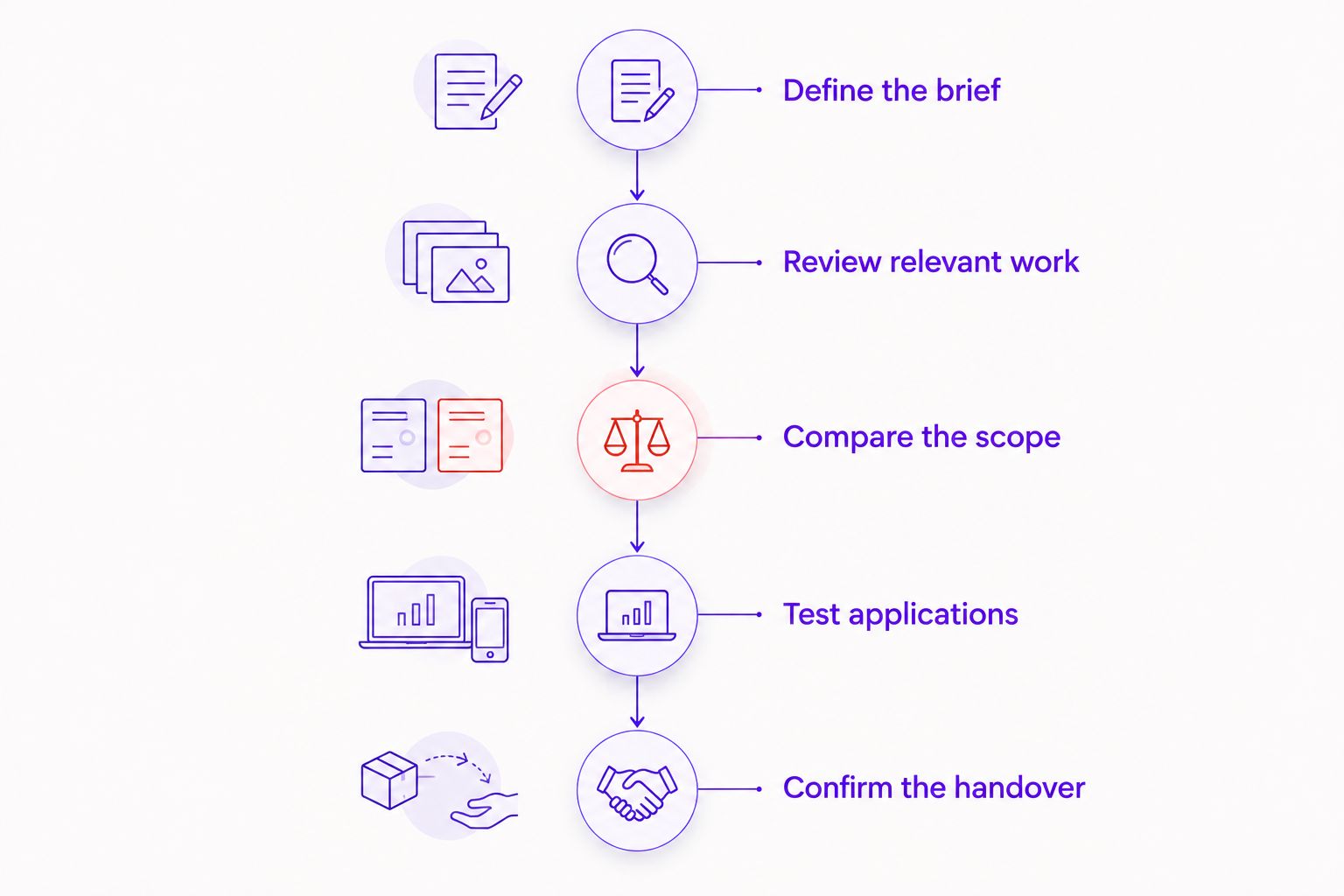
Use this sequence to make the decision:
- Define the brief. Explain what you sell, who buys it, why customers should choose you and where the logo must appear.
- Review relevant work. Ask the provider to explain the business problem behind selected designs, not just show finished images.
- Compare the scope. Check concepts, revisions, applications, file formats, ownership and exclusions against the same requirements.
- Test applications. Review the logo at small sizes, in a single colour and in a realistic launch layout.
- Confirm the handover. Agree on final files, approval responsibilities and rights before the project starts.
These checks separate a defined project from an attractive presentation. If a proposal leaves an essential item open, ask for a written answer before accepting it.
Why this matters
Your logo must work outside the presentation used to sell it. A design shown on a large mockup still needs checking on your website header, invoice, social profile or packaging.
For a 2026 launch, decide those applications before reviewing concepts. Otherwise, you risk approving a design without knowing whether the commissioned files and layouts cover your launch needs.
Keep the buying decision focused: business fit, practical use and a clear agreement. Personal taste belongs in the discussion, but it cannot replace those checks.
Start with the scope, not the portfolio
Logo design, brand identity and launch design are different briefs. Buy the scope your business needs, not the package with the longest deliverables list. Ask providers to separate essential work from optional additions.
| Project scope | Best for | Main benefit | Limitation to address |
|---|---|---|---|
| Logo design | Businesses needing a defined mark for specified uses | Keeps the commission focused on the logo and its required versions | Colours, typography rules and wider layouts need explicit inclusion |
| Brand identity | Businesses needing consistency across several customer touchpoints | Establishes how the logo, colours, typography and supporting elements work together | Guidelines alone do not supply every finished launch asset |
| Launch design | Businesses needing an identity applied to named launch materials | Connects approved branding to practical website, packaging or marketing layouts | Each application needs its own scope, content and approval requirements |
A logo-only brief is sensible when you can name the required uses and do not need a wider design system. Its limitation is equally clear: a mark alone does not explain how every future page, advertisement or label should look.
If your business needs more than a mark, review what a full brand identity package can include. Then list the exact assets you want rather than relying on the package name.
Logo design: specify the required versions
Ask which logo versions are included and what each is intended to do. Your brief might require a primary arrangement, an alternative arrangement for narrow spaces and a single-colour version.
Do not assume every project needs a separate symbol. Ask the designer to justify the versions against your applications. The useful deliverable is a version you need, not another variation added to make the proposal look larger.
Brand identity: specify the rules
A brand identity brief should name the rules you need: colour use, typography, spacing and examples of correct application. Ask whether the proposal includes guidance that another designer or supplier can follow.
Check the difference between a visual example and a reusable template. A social post mockup demonstrates an idea; an editable template supports repeat use. Specify which you are buying.
Launch design: specify the finished assets
For a wider launch, name each finished asset and its format. A website concept is not a completed website, and a packaging mockup is not a production-ready packaging file.
Ask who supplies copy, photography, product information and technical specifications. Your proposal should identify dependencies rather than leave them for the design stage.
What should you include in your logo brief?
Give each shortlisted provider the same brief. That makes proposals comparable and reduces the chance that one provider quotes for a logo while another plans a wider branding project.
Include these points:
- Business offer: What you sell and the problem you solve.
- Target buyer: Who decides to buy and what they need to understand.
- Competitive context: Which businesses customers compare you with and what should distinguish you.
- Brand character: The qualities the identity should communicate, with explanations rather than adjectives alone.
- Required applications: The website, packaging, documents, signage or marketing materials in scope.
- Practical constraints: Confirmed wording, languages, supplier requirements and approval dependencies.
Be precise about the business name. If you need a descriptor, tagline or regional-language version, include the exact wording or explain who will finalise it.
For an Indian business serving customers in different languages, request testing in the scripts your launch actually uses. Do not add language versions simply because they sound useful; define a real application for each.
How do you judge a logo design portfolio?
Look for the provider's reasoning, not just a style you like. Ask to see how a selected logo connects to its audience, category and required applications.
Useful questions include:
- What was the business trying to communicate?
- Why was this visual direction chosen?
- What alternatives were considered, and why were they rejected?
- How does the identity work without the presentation mockups?
- Which parts of the displayed project did this provider deliver?
A polished portfolio is evidence of presentation quality; it is not a substitute for a clear project process. Ask the provider to describe how your brief becomes concepts, how feedback is handled and how the final design is checked.
Review variety carefully. You are not hiring a provider merely to repeat a design style from another business. You are hiring them to explain why a direction fits yours.
What should a 2026 logo design proposal include?
A proposal should let you understand the commission without filling gaps yourself. Ask for the following items in writing:
| Proposal item | What to confirm | What an unclear answer leaves unresolved |
|---|---|---|
| Discovery | Business inputs, discussions and research included | How the provider will understand the brief |
| Concepts | What counts as a distinct concept | Whether alternatives differ meaningfully |
| Revisions | Included feedback rounds and their boundaries | How changes are handled after presentation |
| Deliverables | Named versions, formats and applications | What you can use at launch |
| Approval | Decision-maker and approval points | Who can authorise progress |
| Rights | Ownership, permissions and any conditions | How you can use the finished work |
| Handover | File organisation and usage guidance | Whether another supplier can use the assets |
Pay particular attention to revisions. Ask whether a revision means refining an agreed direction or requesting a different concept. Those are different instructions, and the proposal should explain how each is handled.
Also ask what happens if the business name, audience or scope changes after approval. A written change process gives you a way to assess the impact before authorising additional work.
Why logo design scope and cost vary
Compare the work behind a proposal rather than its headline description. For your 2026 shortlist, ask each provider to explain which of these factors are included and which require a separate commission:
- Strategy depth: A defined logo brief versus broader work on positioning, audience and brand direction.
- Concept development: The alternatives explored and how design reasoning is presented.
- Identity breadth: A logo alone versus colours, typography and supporting graphic elements.
- Application work: Finished website, packaging, stationery or campaign layouts beyond the identity itself.
- Revision scope: Refinements within the brief versus changes to an approved direction.
- Handover requirements: File preparation, guidelines, templates and coordination with other suppliers.
These are scope questions, not reasons to accept every extra item. Ask what each deliverable enables you to do and remove work that does not serve the launch.
Compare like-for-like proposals before choosing. An extensive identity project and a focused logo commission answer different needs, even when both are described as logo design services.
How do you test a logo before approving it?
Request 3 usage tests: a small-format test, a single-colour test and a launch-layout test. These are practical approval checks, not a claim that every logo needs the same design treatment.
For the small-format test, use a real placement such as your mobile website header or social profile. Check whether the name remains readable and the mark remains recognisable without enlargement.
For the single-colour test, review an application that removes decorative colour effects. This helps you judge the underlying shape and lettering rather than the presentation treatment.
For the launch-layout test, place the logo alongside real content. Packaging should include the actual product wording; a website layout should include the intended headline and navigation. Approve the design in use, not only in isolation.
Who should approve the design?
Appoint 1 decision-maker to approve the direction. Other stakeholders can contribute, but the agency needs a clear final instruction rather than several conflicting approvals.
Send 1 consolidated feedback document after each review. Separate business concerns from preferences: unreadable wording, a missed application or an incorrect name requires a different response from a preference for another colour.
Useful feedback names the problem and points back to the brief. Instead of asking for a logo to feel more premium, explain what the current design communicates and why that conflicts with your intended positioning.
Should you choose one agency for branding and marketing?
CreativHeads is best for businesses seeking branding, web design and digital marketing from one agency. That scope suits a buyer who wants the identity and its wider applications considered together.
The benefit is coordination: your branding decisions can inform the website, content and marketing briefs rather than being handed over as unrelated tasks. The trade-off is scope discipline. A broader engagement still needs separate deliverables and approvals for each service.
For a logo-only commission, evaluate CreativHeads against the same criteria as any provider: relevant reasoning, usable files, clear rights and a defined feedback process. Wider service capability does not replace a precise logo brief.
FAQ
What’s the best way to choose logo design services for a new business?
Choose logo design services by comparing business understanding, design reasoning, deliverables and usage rights against the same brief. Test the proposed logo in your actual launch applications before approving it.
Do I need a logo or a full brand identity for my launch?
Choose a full brand identity when your launch needs consistent colours, typography and supporting layouts beyond the logo. Choose a focused logo commission when its specified versions and files meet your needs.
How many people should approve a new business logo?
Appoint 1 decision-maker to approve the logo, while gathering relevant stakeholder feedback in one place. Send the provider a consolidated instruction rather than conflicting comments.
What files should I ask a logo designer to provide?
Ask for scalable vector files and suitable exported files for your named digital and print applications. Confirm the formats, logo versions and editable-file access in the proposal before commissioning the work.
Does hiring a logo designer automatically give me ownership?
Do not assume ownership; confirm the rights and transfer terms in your agreement. Ask about third-party fonts, licensed elements and any conditions affecting how you can use the finished design.
How should I compare logo design proposals in 2026?
Compare 2026 proposals against the same scope, including concepts, revisions, applications, files and rights. Ask each provider to identify exclusions and explain how changes to the brief are handled.
Can CreativHeads support more than logo design?
CreativHeads offers branding, web design, content and digital marketing services. Define which services belong in your project and request separate deliverables and approval points for each.
One last thing
Ask the shortlisted provider to show the logo without mockups, decorative backgrounds or launch imagery. Then place it in your least forgiving real application: a narrow header, a small label or a plain business document.
If the logo needs the presentation to explain it, keep reviewing. Your final approval should cover a working business asset and a usable handover—not just an impressive slide.
Related guides
- How long should professional logo design services take?
- Logo design services for food brands: a practical buying guide
- How do you brief a packaging design agency for multiple products?