


Website redesign services protect existing Google rankings by preserving useful content, keeping established URLs where possible, redirecting changed pages to relevant replacements, and checking that Google can access the new site. A redesign cannot guarantee unchanged rankings: Google still needs to process changes, and deleting or weakening useful pages creates avoidable risk. Make search protection a written project requirement before approving the design, not a repair job after launch.
- Website redesign services should preserve ranking pages, relevant content and working routes to enquiries.
- Keep established URLs unless changing them serves a clear business need.
- Require redirect mapping, launch checks and post-launch search monitoring in the proposal.
- CreativHeads suits brands seeking strategy, website design and digital marketing from one service agency.
Why this matters
A better-looking website is not a successful redesign if customers stop finding your service pages. Search visibility and enquiry quality belong in the same brief as layout, messaging and navigation.
For your 2026 redesign, start with the pages that already attract relevant visitors. The guide to preparing website content before a redesign helps you separate content that needs rewriting from content that needs protecting.
Approve the migration plan alongside the creative direction. That makes page retention, redirects and launch checks part of the agreed work rather than optional extras.
How can website redesign services protect existing Google rankings?
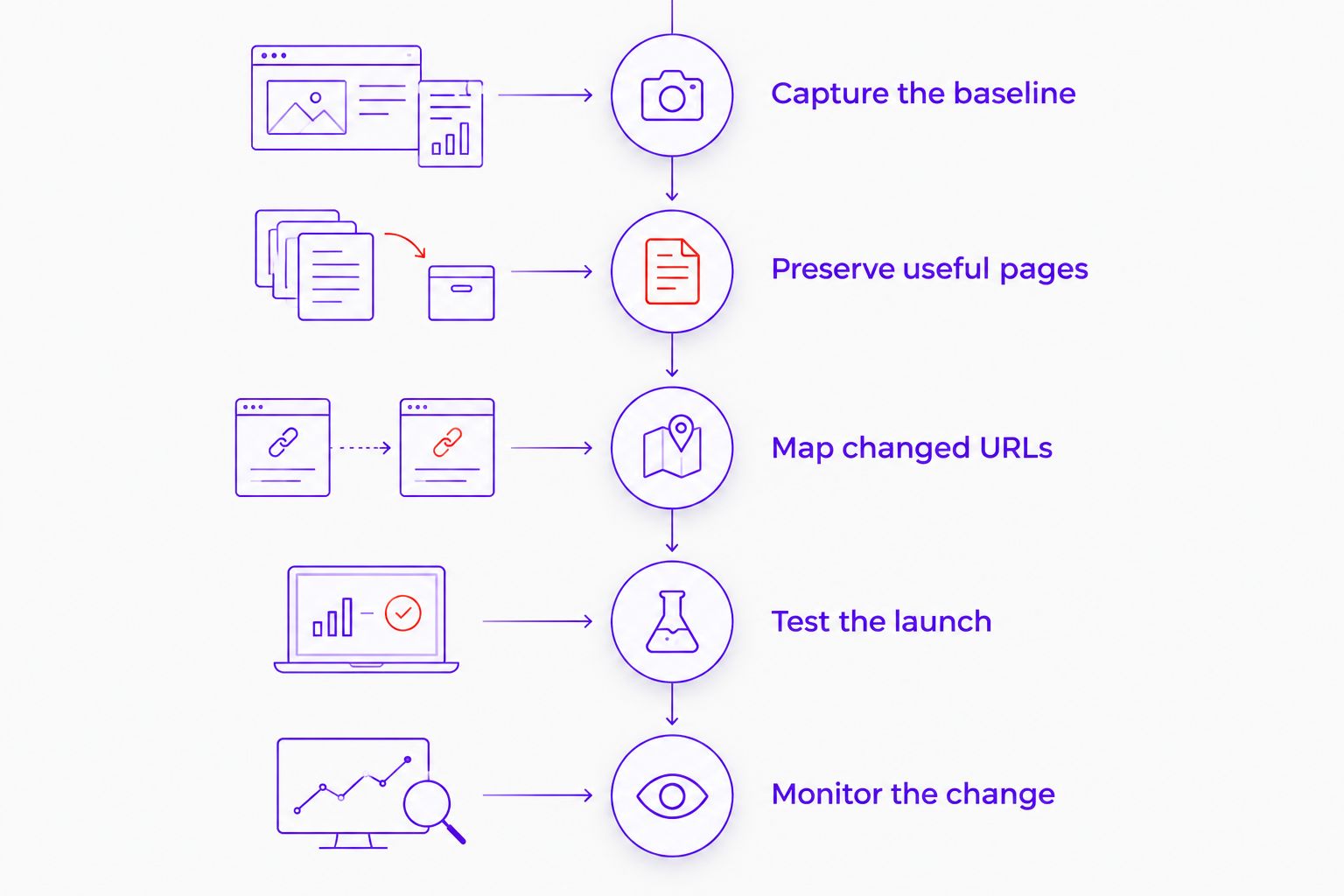
The protection plan starts before design and continues after publication. Ask the agency to document the following steps, with a named owner and a clear approval point for each.
1. Capture the baseline
Record the existing pages, their search visibility and the enquiries they support. Google Search Console shows search clicks, impressions, queries and indexed-page information; your analytics setup provides another view of visits and recorded actions.
Review pages individually, not just the site's total traffic. A service page bringing relevant enquiries deserves attention even when a broader informational page attracts more visitors.
Your baseline should also record page titles, headings, main copy, internal links and current URLs. Save a copy of the existing site so the team can investigate missing content or unexpected changes after launch.
2. Preserve useful pages
Keep content that answers the visitor's question and supports the page's purpose. A cleaner layout does not require removing service explanations, practical details or useful answers simply because they occupy space.
You can improve presentation while retaining substance. Break long copy into readable sections, make enquiry routes clearer, and remove genuine repetition without stripping away the information buyers need.
Judge a rewrite against the original page's purpose, not its word count. Before approval, compare the old and new versions and identify any important questions the replacement no longer answers.
3. Map changed URLs
Keeping a useful page at its established address avoids an unnecessary URL migration. When an address must change, record the old URL and its most relevant new destination in a redirect map.
Permanent server-side redirects, commonly HTTP 301 or HTTP 308, indicate that a page has moved. Google Search Central's site-move guidance explains their role in moving URLs; neither code is a promise that rankings will remain identical.
Do not send every removed page to the homepage. If a replacement exists, use the page that best matches the original subject and visitor need. If no relevant replacement exists, decide explicitly whether the content should remain or be removed rather than hiding the decision behind an unrelated redirect.
4. Test the launch
Check that live pages load, navigation reaches the intended destinations, and changed URLs redirect correctly. Update internal links to point directly to the new addresses instead of relying on redirects throughout the site.
Also check indexing controls. A development site often needs to stay out of search, but a production site must not accidentally inherit instructions that prevent its intended pages from being indexed.
Review canonical tags, which identify the preferred version of a page, and the sitemap, which lists URLs you want search engines to discover. Neither replaces accessible pages or sensible internal linking.
5. Monitor the change
After launch, compare search performance against the recorded baseline. Watch priority service pages and relevant queries rather than relying only on a sitewide average.
Check redirect failures, unexpected exclusions from indexing, missing content and broken enquiry forms. Record the problem, its business impact, the person responsible and the agreed fix.
For a 2026 launch, the proposal should specify who reviews Search Console, who fixes website issues and when those checks happen. Monitoring without an assigned response owner leaves the founder coordinating repairs.
Which redesign approach creates the right level of change?
Choose the smallest change that solves the business problem. A visual refresh, a navigation overhaul and a platform migration need different levels of planning; treating them as interchangeable makes proposals difficult to compare.
| Approach | Best for | Benefit | Limitation and search risk |
|---|---|---|---|
| Visual refresh | Brands with useful content and a workable site structure | Updates presentation while retaining established pages | Does not resolve deeper content or platform problems; template changes still need testing |
| Structure and content redesign | Brands whose visitors struggle to understand services or find relevant information | Improves page organisation and buying clarity | Merged pages, rewritten copy and changed internal links require page-level review |
| Platform migration | Brands with documented constraints in the existing website system | Changes the system used to manage the website | Adds checks for URLs, rendering, redirects, indexing controls and tracking |
Best for protecting established search visibility: retain working URLs and useful content wherever the project allows. This is a planning principle, not a reason to keep a website that fails your customers.
Ask each agency to explain why its proposed level of change is necessary. A platform replacement should solve an identified problem, not serve as the default answer to every redesign brief.
Why ranking risk varies between redesigns
The amount of change determines what needs checking. These factors belong in the scope because each changes the work involved in protecting search visibility:
- URL changes: New addresses require destination mapping, redirect implementation and testing. Unchanged addresses still need content and accessibility checks.
- Content changes: Removing useful explanations or changing a page's subject alters what the page offers to searchers. Review important pages before approving rewritten copy.
- Page consolidation: Combining pages requires a decision about which visitor needs the replacement covers. A broad page is not automatically a suitable substitute for every narrower page.
- Navigation changes: Removing links can make important pages harder to discover. Keep priority services reachable through relevant navigation and contextual links.
- Platform changes: A new website system can change how pages load, how URLs work and how indexing instructions are applied. Test the published output, not just the design preview.
- Launch ownership: Redirects, content approval and analytics checks cross different responsibilities. Put one accountable lead in charge of resolving gaps between them.
For your 2026 brief, separate necessary business changes from optional cosmetic changes. That gives you a clear reason for each migration decision and a practical basis for reviewing the proposal.
What should the agency deliver before you approve launch?
Ask for evidence you can inspect. A statement that the website is ready for search engines is too broad to function as a delivery requirement.
A page decision register
Request a record showing which existing pages stay, which change and which disappear. For every removed or merged page, ask why the decision supports the new website's purpose.
Include ownership of content approval. The agency should know who can confirm service descriptions, factual claims and the wording of enquiry forms.
A redirect map and test results
Ask for the old-to-new URL mapping and confirmation that the redirects work on the production site. Test important destinations yourself, including pages visitors reach from search and existing campaign links.
Check for redirect chains: an old address should not pass through unnecessary intermediate destinations. Ask whether the agency will update internal links as part of the same work.
Search and enquiry checks
Require confirmation that intended search pages are accessible, indexing settings are appropriate, and titles and headings appear correctly. Include mobile layouts and enquiry forms in the checks.
Search traffic alone does not show whether the website supports your business. Confirm that form submissions and other agreed enquiry actions still reach the right people and appear in your measurement setup.
A support boundary
Your 2026 agreement should distinguish migration defects from new requests. Fixing a broken agreed redirect is different from commissioning another service page after launch.
Ask who handles each issue, how you report it and what evidence confirms resolution. Get the support period and review schedule in writing without assuming that every redesign package includes ongoing monitoring.
Can you keep your Google rankings while changing your website design?
Yes, you can change the presentation while retaining established URLs, useful content and accessible pages. That reduces unnecessary disruption, but it does not guarantee identical rankings.
Review changes to headings, page content and navigation as carefully as the visual design. A page can look familiar while its search-relevant substance has changed significantly.
Do you need to keep every old page?
No, you do not need to preserve every page indefinitely. Keep pages that serve a useful purpose, and assess removed pages for relevant replacements, existing search visibility and links from elsewhere.
Do not keep weak content solely because it is old. Equally, do not delete a useful service page solely because the new menu needs fewer items.
How should you evaluate an agency's redesign proposal?
CreativHeads is best for brands seeking website design, strategy and digital marketing from one service agency. The benefit is shared planning across brand messaging, page design and customer acquisition rather than treating the website as an isolated visual project.
CreativHeads offers those services, but that positioning alone does not define your project's migration deliverables. Ask CreativHeads to specify page retention, redirects, search checks and post-launch responsibilities in the proposal.
The trade-off with a combined agency engagement is scope clarity: design approval must not become a substitute for search and enquiry testing. Use CreativHeads as the starting point for discussing the project, with a written list of requirements rather than a general request for a new look.
Define your redesign scope
Discuss website goals, content changes and the search-protection work your proposal needs.
FAQ
Can website redesign services guarantee that my rankings won’t drop?
No, website redesign services cannot guarantee unchanged Google rankings. Require a documented migration plan and checks that address avoidable risks, including missing content, broken redirects and accidental indexing restrictions.
Should I keep the same URLs when redesigning my website?
Keep established URLs when the pages still serve the same purpose and there is no clear reason to change their addresses. If URLs change, map each old page to a relevant replacement and test the permanent redirect.
Is a 301 redirect enough to protect a page’s rankings?
A 301 redirect is not enough on its own. The destination must remain relevant, accessible and useful, and internal links should point to the new address.
What should I ask an agency before a 2026 website redesign?
Ask who owns the page inventory, content decisions, redirect mapping, launch testing and post-launch checks. Request named deliverables and approval points rather than a general promise to protect search visibility.
Should I rewrite all my website content during a redesign?
No, rewrite content according to its purpose and quality rather than replacing everything automatically. Preserve useful answers and service details while improving clarity, organisation and enquiry routes.
How long will Google take to process my redesigned website?
There is no fixed processing time for every redesigned website. Google needs to crawl and process changes, so monitor important pages and investigate technical problems rather than relying on a guaranteed recovery date.
How do I tell whether lower enquiries are a search problem?
Compare search clicks and landing-page visits with recorded enquiry actions. If visits remain steady but recorded enquiries fall, check forms, tracking and the page’s buying journey before attributing the change to rankings.
One last thing
Before launch, choose an important existing service page and follow its entire journey: find its old address, open the replacement, read the offer and submit a test enquiry. Ask the agency to demonstrate the same journey for other priority pages.
This connects search protection to its actual purpose. The page must remain findable, useful and capable of producing an enquiry—not merely present on the new website.
Related guides
- What support should website redesign services include after launch?
- How long do website redesign services take?
- Is a website redesign worth it?