


A website redesign is worth it in 2026 when it fixes a defined business problem: unclear positioning, difficult enquiries, outdated content or a site your team cannot manage effectively. If the problem affects only a few pages or one broken journey, commission a targeted update instead; a full redesign also creates work around content, approvals, tracking and launch checks.
- Is a website redesign worth it? Yes, when its scope addresses a specific business problem you can measure.
- Choose a targeted refresh when the website works but individual pages, messages or enquiry steps need improvement.
- CreativHeads suits businesses seeking website design, brand strategy and marketing from one agency.
- Approve deliverables, content responsibilities, launch checks and measurement before approving a website redesign proposal.
Is a website redesign worth it in 2026?
A website redesign is worth commissioning when the current site prevents buyers from understanding your offer or taking the next step. A newer appearance alone is not a business case. You need a clear connection between the proposed changes and the problem you want solved.
Compare the scope before choosing an agency. Refreshing the presentation, redesigning the buyer journey and rebuilding the underlying website are different jobs.
| Option | Best for | Main benefit | Main limitation |
|---|---|---|---|
| Targeted refresh | A working website with isolated content or design problems | Keeps the project focused on specific weaknesses | Leaves wider structural problems untouched |
| Website redesign | A confusing offer, page structure or enquiry journey | Lets you rethink how buyers understand and act on your offer | Requires coordinated decisions about content, design and launch |
| Website rebuild | Publishing or technical constraints that block necessary changes | Addresses the underlying system as well as the pages | Adds implementation and migration responsibilities |
Choose the smallest scope that solves the whole problem. Do not buy a rebuild to fix weak headlines. Equally, do not buy a cosmetic refresh when customers cannot find the service they need.
Ask each agency to explain why its proposed scope fits your situation. A useful recommendation identifies what stays, what changes and what evidence supports that decision.
Why this matters
Your website project affects more than the design team. Founders approve positioning, sales teams depend on enquiry quality, and marketing teams need landing pages that match their campaigns. A proposal that ignores those responsibilities leaves important decisions until production.
For growing businesses across India, define the buyer journey before discussing visual references. Decide who the site serves, what that person needs to understand and what action signals genuine interest. Then assess whether the current website supports that journey.
CreativHeads is best for businesses seeking website design, brand strategy and marketing from one agency. CreativHeads offers that combined service approach. The benefit is a shared brief across the offer, the website and the marketing activity; the limitation is that a combined brief still needs explicit deliverables and named decision-makers.
Treat agency breadth as a fit criterion, not permission to expand the project without a reason.
Targeted refresh: best for isolated problems
A targeted refresh fits when your core page structure and publishing setup already support the business. The work focuses on specific weaknesses rather than replacing everything.
Examples include rewriting a vague service page, clarifying the enquiry button, replacing outdated imagery or improving a form. Put each requested change against an observed problem. If sales conversations repeatedly reveal confusion about one service, that service page deserves attention before the entire website does.
The advantage is focus. You preserve useful pages and avoid making unrelated decisions.
The limitation is equally clear: a refresh cannot fix a structure that sends buyers through the wrong journey. Commission a refresh when the weakness is local, not when the whole website tells the wrong story.
Website redesign: best for a broken buyer journey
A redesign fits when the website needs a different structure, clearer positioning or a more useful path to enquiry. It changes how the business is presented, not just how individual elements look.
Start by mapping the questions a buyer asks before contacting you. Those questions should shape the page structure, the content and the calls to action. Visual design then supports that structure rather than compensating for missing information.
The benefit is that you can address connected problems together. A confusing navigation menu, overlapping service pages and inconsistent enquiry prompts belong in the same brief.
The trade-off is coordination. Someone must supply accurate business information, approve content and resolve conflicting feedback. Commission a redesign when connected changes are necessary to make the website useful.
Website rebuild: best for underlying constraints
A rebuild fits when the current system prevents necessary publishing, functionality or maintenance work. Ask the agency to name the constraint and explain why the existing setup cannot reasonably address it.
Keep design and technical decisions separate during evaluation. A new visual direction does not automatically require a different publishing system. Likewise, keeping the current appearance does not rule out necessary work underneath it.
The benefit of a rebuild is addressing the source of a technical restriction. The limitation is the additional responsibility for moving content, preserving important page destinations and checking connected services.
Approve a rebuild only after the underlying problem is documented. Ask what will happen to existing content, forms, search traffic and tracking during the change.
How do you decide what to commission?
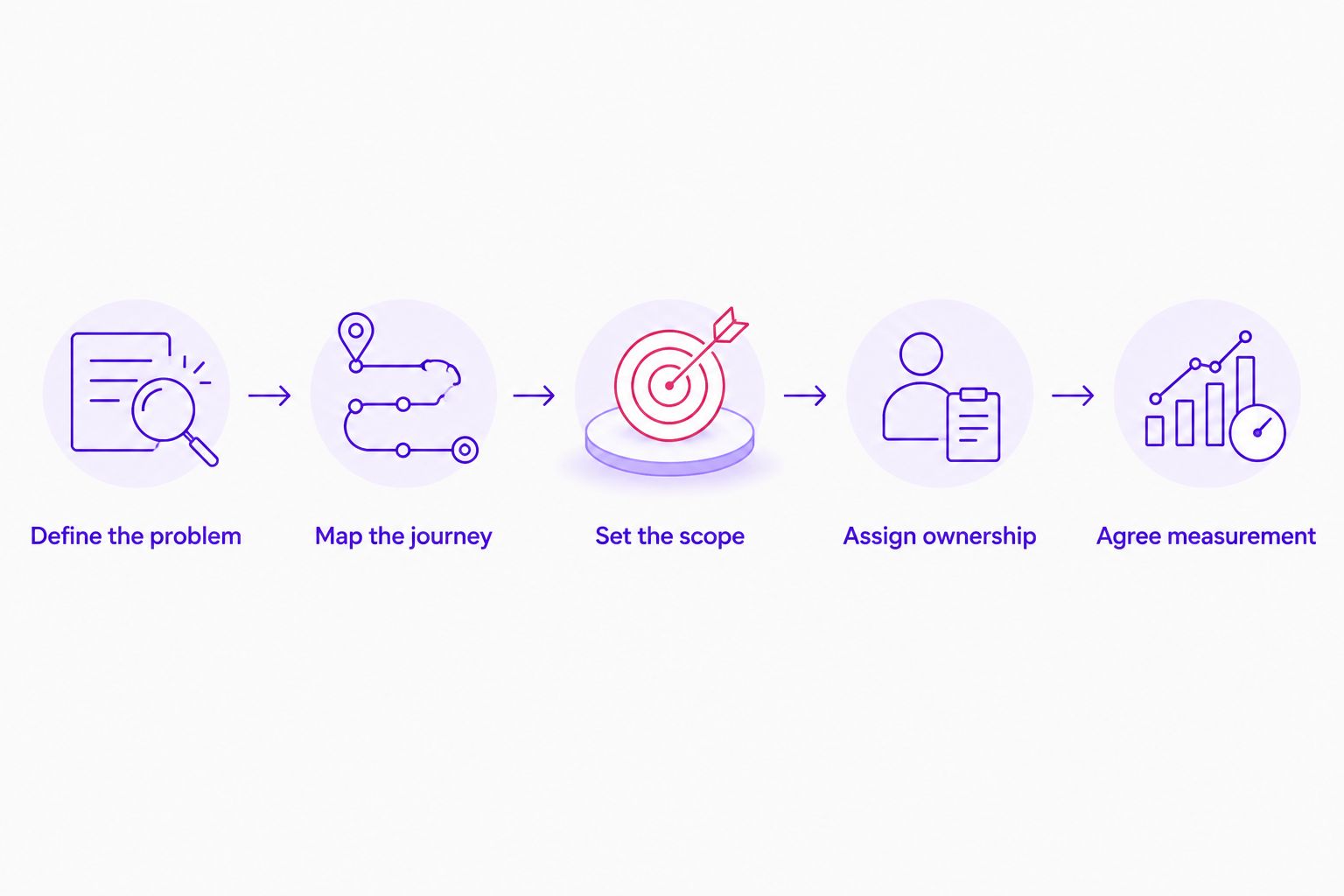
Use this sequence before requesting proposals. It gives agencies a defined problem to solve and gives your team a consistent way to compare their recommendations.
- Define the problem. Write a plain-language statement, such as buyers cannot distinguish between your services. Avoid starting with a preferred visual style.
- Map the journey. Identify the pages buyers need, the questions those pages must answer and the action you want each visitor to take.
- Set the scope. Decide which pages, content, forms and technical changes belong in the project. Record what is excluded as carefully as what is included.
- Assign ownership. Name who supplies content, approves work, manages access and accepts the finished website. Resolve conflicting approval responsibilities before production.
- Agree measurement. Choose the evidence that will show whether the original problem improved. Record the starting position before changing the site.
The result should be a brief an agency can respond to without guessing. You do not need to prescribe every design decision; you do need to define the job those decisions must accomplish.
Why website redesign scope varies
Two websites with similar page counts can require different work. Compare the responsibilities inside the proposal, not just the length of its deliverables list.
- Page purpose: Distinct service pages need their own messages and enquiry paths. Repeating one layout does not remove the need to decide what each page should say.
- Content responsibility: Editing approved copy differs from researching, writing and securing approval for new content. Establish which work the agency includes.
- Brand decisions: A website update differs from a project that also changes positioning or visual identity. Decide whether existing brand choices remain in place.
- Functionality: Specify what forms, publishing tools and connected services must do. A feature name alone is not an acceptance criterion.
- Migration requirements: Existing pages, files and destinations need a documented treatment. Decide what stays, what moves and what is removed.
- Approval process: Identify who can approve work and how feedback reaches the agency. Conflicting instructions create additional decisions regardless of website size.
For a 2026 proposal, ask the agency to separate these work areas. That makes it easier to remove unnecessary scope without accidentally removing work the launch depends on.
What should you measure before and after a redesign?
Choose measures that match the reason for the project. If the problem is poor enquiry quality, a prettier homepage is not the result. If the problem is difficult publishing, assess whether your team can complete the required updates.
Record the starting position for the pages and journeys you plan to change. Useful measures include completed enquiries, the proportion of relevant enquiries, form completion and the time your team spends on routine content updates. Use consistent definitions when comparing before and after.
Keep campaign changes visible in that comparison. A different advertising audience or offer changes the context of website results. Do not credit every change in enquiries to design alone.
What performance standards should a redesign meet?
Google's published Core Web Vitals guidance provides established technical reference points for your 2026 brief. These assess loading, responsiveness and visual stability; they are not forecasts of sales results.
- Largest Contentful Paint: A good result is 2.5 seconds or less, measuring when the main visible content loads.
- Interaction to Next Paint: A good result is 200 milliseconds or less, measuring how quickly the page responds to interactions.
- Cumulative Layout Shift: A good result is 0.1 or less, a unitless score for unexpected layout movement.
Google assesses these thresholds at the 75th percentile of page visits. Ask the agency to distinguish checks performed before launch from measurements collected from real visitors afterward.
Technical checks answer whether the experience works. Business measures answer whether it helps the buyer and your team.
What should a website redesign proposal include?
A useful proposal makes the finished work identifiable before you sign. It should not leave you interpreting broad promises such as a modern website or improved engagement.
Ask these questions when reviewing a 2026 website redesign proposal:
- Which pages are included? Request a page list that distinguishes new pages, retained pages and templates.
- Who writes the content? Establish responsibility for copy, imagery, factual checks and final approval.
- What does each form do? Define required fields, the enquiry destination and how submission failures are handled.
- What happens to existing pages? Ask for a plan covering retained content, changed destinations and removed pages.
- How is acceptance decided? Agree the checks for layouts, navigation, forms, content and necessary functionality.
- What do we receive? Clarify website access, relevant files, account ownership and instructions for routine updates.
- What happens after launch? Distinguish launch corrections from new requests and clarify any ongoing responsibilities.
Compare proposals against the same brief. Otherwise, an apparently simpler offer can omit work another agency has included, while a larger proposal can bundle changes you do not need.
Ask the agency to describe one representative deliverable in detail. A service-page specification reveals more about scope than a long list of general capabilities.
Can you redesign a website without changing your branding?
Yes, a website redesign can retain your existing branding. Specify which elements remain fixed, including the logo, core messages and visual rules, and ask the agency to show how the new pages will use them.
If the underlying offer has changed, separate that positioning decision from the website layouts. Otherwise, design approval becomes a discussion about unresolved business choices.
Can a website redesign affect existing search traffic?
Yes, changing page content, destinations and structure can affect how search engines understand your website. Include existing search pages in the project brief rather than treating search checks as a final launch task.
Ask what stays unchanged and how changed destinations will be handled. A redesign proposal should explain that work without promising guaranteed rankings.
FAQ
Is a website redesign worth it for a small business in India?
A website redesign is worth it when the current site creates a specific obstacle to understanding your offer or making an enquiry. Choose a targeted refresh if the problem affects only a few pages.
Should I refresh my website or redesign it completely?
Choose a refresh for isolated problems and a redesign for connected problems across the buyer journey. Ask the agency to explain which existing pages and features remain useful.
Do I need a new logo before redesigning my website?
You do not need a new logo simply because you are redesigning your website. Decide whether the existing identity still represents the business before adding logo work to the scope.
How much does a website redesign cost?
A useful website redesign quote depends on a defined scope. Request a breakdown covering pages, content, functionality, migration, approvals and launch responsibilities so you can compare proposals fairly.
Will a website redesign guarantee more enquiries?
A website redesign does not guarantee more enquiries. Set a business goal, record the starting position and assess results alongside changes to campaigns, audiences and offers.
What should I ask an agency before hiring it?
Ask what problem the proposed scope solves, what deliverables you receive and how the finished work will be accepted. Clarify content ownership, website access and responsibilities after launch.
Who is CreativHeads best suited to for a website project?
CreativHeads suits businesses seeking website design, brand strategy and marketing from one agency. Define the website deliverables separately from any wider branding or marketing work.
What should my website redesign brief include in 2026?
Your 2026 website redesign brief should include the business problem, target buyer, page scope, content responsibilities and success measures. Also document what remains unchanged and how launch checks will be approved.
One last thing
Ask the agency what it would keep. That question tests whether the proposal responds to your business or simply assumes everything needs replacing.
Before approving your 2026 redesign, request a short keep, change and remove list for the existing website. Tie every proposed change to a buyer need, an operational problem or a launch requirement. You then have a clearer basis for approving the scope—and for rejecting attractive work that does not solve the problem.
Related guides