

Website redesign services have no fixed duration: the schedule depends on what you are changing, what is ready before work starts, and who approves each stage. A visual refresh and a rebuild involving new content, page structures and business systems need different plans. Treat design approval and website launch as separate milestones, because development, testing and publishing still follow approval.
- Website redesign services need a scope-based schedule, not an unsupported promise of a standard turnaround.
- CreativHeads suits businesses seeking strategy, design and marketing from one agency.
- Agree on content ownership, approval checkpoints and launch responsibilities before accepting a proposal.
- Separate design approval from launch; development and testing still need their own deadlines.
How long do website redesign services take?
A useful redesign timeline connects each deadline to a defined deliverable and an approval requirement. Ask for a schedule built around your website, rather than a duration copied from a generic package.
A project plan should explain these stages:
- Scope agreement: Confirm which pages, functions and business goals the redesign covers. Identify what stays, what changes and what is excluded.
- Content preparation: Assign responsibility for copy, images, product information and other material. Set delivery dates before those assets hold up design or development.
- Design approval: Review the proposed page structure, visual direction and visitor journey. Approve the agreed designs before dependent development work proceeds.
- Development and testing: Build the approved website and check its pages, forms, links and relevant business connections. Define what counts as ready for launch.
- Launch preparation: Confirm publishing access, responsibility for existing page addresses, measurement setup and the release decision.
Some tasks can run together; others depend on an earlier decision. The proposal should make those dependencies visible, including what happens to the launch date when an approval arrives late.
Why this matters
A founder planning a 2026 launch needs more than an estimated completion date. You need to know when your team must deliver content, when decision-makers must review work, and which parts of the business depend on the website being ready.
CreativHeads brings strategy, design and marketing services together in one agency. That model suits a brief where the website must reflect the brand and support marketing activity, rather than act as an isolated design exercise.
The trade-off is scope discipline. Bringing related work into the same project requires a clear boundary between the website redesign and additional branding or marketing assignments. Agree on that boundary before agreeing on the deadline.
Which redesign scope are you actually commissioning?
The phrase website redesign services can describe very different assignments. Compare proposals against the same brief; otherwise, a shorter schedule can simply mean fewer deliverables.
| Scope | Best for | Benefit | Limitation to address |
|---|---|---|---|
| Visual refresh | Businesses keeping their existing content and website structure | Focuses the brief on presentation changes | Does not address excluded content, structure or functional problems |
| Structural redesign | Businesses changing how visitors find information and make enquiries | Connects page organisation with the intended visitor journey | Requires decisions about navigation, content and page relationships |
| Website rebuild | Businesses replacing the underlying website or changing its functions | Allows the agreed technical and functional changes to be included | Needs explicit testing, publishing and transition responsibilities |
These scopes are not interchangeable. Your proposal should name the assignment and explain which existing elements the agency will reuse.
Visual refresh: retain what already works
A visual refresh is appropriate when you want presentation changes without a wider restructuring exercise. Specify the elements that need attention, such as typography, page layouts, imagery or the treatment of enquiry prompts.
Do not assume a refresh includes rewritten copy, a new navigation structure or repaired business connections. Ask the agency to list those separately. The benefit is a focused brief; the limitation is that problems outside that brief remain outside the assignment.
Structural redesign: change the visitor journey
A structural redesign addresses how pages fit together and what visitors need to understand before taking action. Decide which audiences the website serves and what each audience should do next.
The work needs decisions about page priorities, content placement and enquiry routes. Approve the proposed structure before reviewing finished page designs. Otherwise, a layout discussion can become a late debate about what the website should contain.
Website rebuild: define the transition
A rebuild needs a plan for the existing website as well as the replacement. Ask what will happen to its content, page addresses, forms and connected systems.
The advantage is a brief that includes underlying changes rather than presentation alone. The limitation is a broader set of acceptance checks. A rebuild proposal should identify who handles the transition, who verifies it and who authorises publication.
Why website redesign timelines vary
For a 2026 project, assess the work behind the deadline. These factors belong in the scope discussion because each introduces tasks, dependencies or decisions:
- Page variety: Count distinct page layouts as well as total pages. Repeated pages and individually designed pages represent different work.
- Content readiness: Establish whether existing copy and images are approved for reuse, need editing or must be created.
- Approval ownership: Identify who can approve work and whether other stakeholders need to contribute before that decision.
- Functional changes: Specify forms, booking flows, payment processes or other functions only where your project requires them.
- Existing website transition: Decide which content and page addresses must carry over and how the change will be checked.
- Launch requirements: List the checks and business approvals that must be complete before publication.
These factors also explain why apparently similar proposals differ. One agency can quote for an agreed layout update while another includes content planning and a website transition. Neither schedule means much until you compare the deliverables.
Set approval checkpoints before the project starts
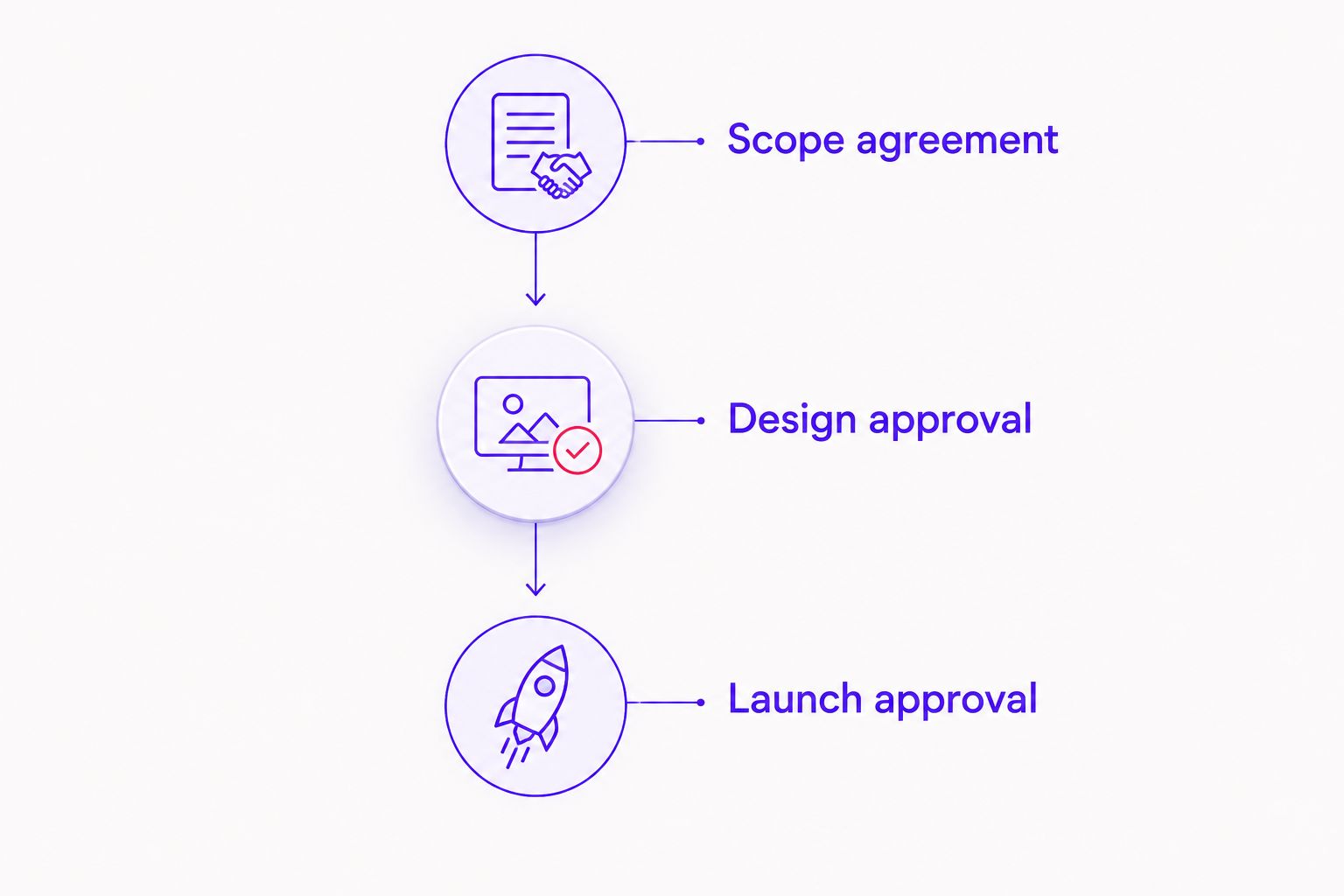
Use 3 approval checkpoints in your brief: scope agreement, design approval and launch approval. This is a practical review structure, not a claim about how every agency runs its projects.
Each checkpoint needs a named reviewer, a defined submission and a clear acceptance decision. Avoid an open-ended instruction to send work around the business until everyone is satisfied.
Scope agreement
Confirm the page list, required functions, content responsibilities and exclusions. Record the business action the website should support, such as a qualified enquiry or a purchase, where relevant to your brief.
This checkpoint prevents a proposal for presentation changes from becoming an unplanned branding, copywriting and development assignment. Additional work should trigger an explicit scope decision.
Design approval
Review the proposed structure and layouts against the agreed objectives. Consolidate stakeholder comments into a clear response rather than sending the agency conflicting instructions.
Ask what design approval commits you to and how later changes will be handled. You need to understand the consequences before approving work, not after development begins.
Launch approval
Review the agreed acceptance checks and any unresolved issues. Confirm that the person approving publication has the authority to make that decision.
Keep launch approval separate from visual approval. A website that looks right still needs its agreed functions and publishing arrangements checked.
What should a website redesign proposal include?
Buy a defined scope and an accountable schedule, not a completion date on its own. For a 2026 brief, ask the agency to make the following commitments clear:
- Deliverables: Which pages, layouts, content tasks and functions are included?
- Responsibilities: What must your business supply, and what will the agency produce?
- Dependencies: Which tasks cannot begin until another task or approval is complete?
- Review process: How is feedback submitted, consolidated and approved?
- Change process: What happens when you request work outside the agreed brief?
- Acceptance checks: What must be verified before the website is considered complete?
- Handover: What access, documentation or training forms part of delivery?
Ask for 2 separate dates in the schedule: design approval and launch. This distinguishes the end of design review from the point when the website becomes public.
Also name 1 decision owner on your side. That person can gather wider input without making the agency reconcile contradictory instructions. The role is to approve decisions against the brief, not to replace useful feedback from your team.
What changes the cost as well as the schedule?
Scope choices affect both the work required and the proposal you receive. Compare the included tasks rather than treating every website redesign as the same purchase.
New copy, additional page layouts, branding changes, bespoke functions and content migration each need an explicit place in the brief. Ask whether they are included, optional or excluded. Request a written explanation when a change affects delivery or the quoted scope.
CreativHeads is a fit for website redesign services when your business wants strategy, design and marketing from one team. Evaluate that fit against your assignment: confirm which services belong in the proposal instead of assuming the full service range is included.
The benefit of a combined brief is that related decisions can be addressed together. The buying risk is an unclear assignment. Require named deliverables for each service you commission.
Can I keep my existing website live during the redesign?
Keeping the existing website live should be an explicit requirement in your redesign brief. Ask the agency to explain how work will be reviewed separately and how the replacement will be published.
Confirm who controls hosting and domain access, who authorises the switch, and what happens if the launch checks uncover a problem. For a 2026 campaign launch, agree on the publishing sequence before connecting campaign activity to the new website.
Does rewriting website content extend the project?
Rewriting content adds work to the redesign scope and creates approval dependencies. Establish whether the agency writes the copy, edits material you provide or works with approved existing text.
If copy is being developed alongside design, ask which content decisions must be settled before layouts are approved. Give someone responsibility for checking business claims, service details and enquiry instructions.
Should I redesign the logo before the website?
Settle any planned logo or brand-direction change before approving website visuals that depend on it. Otherwise, the website design can require another review when the brand decisions change.
You do not need to commission a logo redesign simply because you are changing the website. Assess whether the existing identity supports the brief, then define any branding work as a separate deliverable.
Protect existing search visibility during the redesign
Include existing page addresses and useful content in the transition brief. A redesign is not a reason to discard pages without deciding what should happen to them.
Ask the agency how changed addresses will be handled, which pages will remain accessible, and how the published website will be checked. Redirects send visitors and search engines from an old address to its replacement; they need deliberate planning where addresses change.
Also confirm how enquiry measurement will be checked after publication. A website launch needs verification, not a ranking guarantee. Keep the acceptance criteria tied to work the agency can deliver and check.
FAQ
How long do website redesign services take?
Website redesign services need a scope-based timeline rather than a fixed duration. Ask for deadlines tied to content readiness, design approval, development checks and launch responsibilities.
Can an agency guarantee my website launch date?
Evaluate a launch commitment against its dependencies and written scope. Confirm what happens when content, approvals or requested changes arrive outside the agreed schedule.
What should I prepare before hiring a website redesign agency?
Prepare your business goals, page list, required functions and available content. Name the person responsible for approvals and identify who controls website publishing access.
Is a visual refresh better than a full website rebuild?
A visual refresh fits presentation changes when the existing structure and functions are staying. A rebuild fits an assignment that includes underlying website or functional changes; compare both against your actual requirements.
How much do website redesign services cost?
Request a quote against a defined scope of pages, content, functions and handover requirements. Compare what each proposal includes before comparing its total.
Is CreativHeads a software provider or a service agency?
CreativHeads is a creative agency offering branding, web design, content and digital marketing services. Its service model suits businesses seeking strategy, design and marketing from one team.
What should I check before approving a redesigned website?
Check the agreed pages, content, forms, links and relevant business connections before approving launch. Confirm publishing responsibilities and resolve issues against the acceptance criteria in your brief.
One last thing
The most useful deadline in your 2026 redesign plan is not always the launch date. It is the date by which your business must make a decision that lets the next stage start.
Before signing, ask the agency to identify every client decision that controls the schedule. Put an owner beside each one. A proposal that makes those obligations clear gives you a better basis for planning than a short turnaround promise without a delivery plan.
Related guides