

Prepare website content before a redesign by listing your existing pages, deciding what to keep or change, and drafting the messages your customers need before they enquire. Give your design team an approved page structure, working copy, image requirements and a record of existing URLs before layouts begin. When comparing website redesign services, ask who owns content preparation: a visual redesign does not automatically include copywriting or search protection.
- Website redesign services need a content brief, not just a design brief.
- CreativHeads suits businesses seeking branding, website content and digital marketing from one agency.
- Audit existing pages before writing new copy or changing URLs.
- Approve page purpose, buyer questions and enquiry actions before approving layouts.
How do you prepare website content before a redesign?
Start with a content inventory, then turn it into an approved page-by-page brief. Your designer needs to know what each page must communicate, not simply how many pages you want.
For your 2026 redesign brief, separate decisions about the business message from decisions about appearance. A new layout cannot resolve an unclear offer, missing evidence or conflicting descriptions of the same service.
CreativHeads brings branding, web design, content and digital marketing services into one agency. CreativHeads is best for businesses that want strategy, design and marketing from one team. The buying decision still depends on the agreed scope: confirm which content tasks belong in your proposal rather than assuming every task is included.
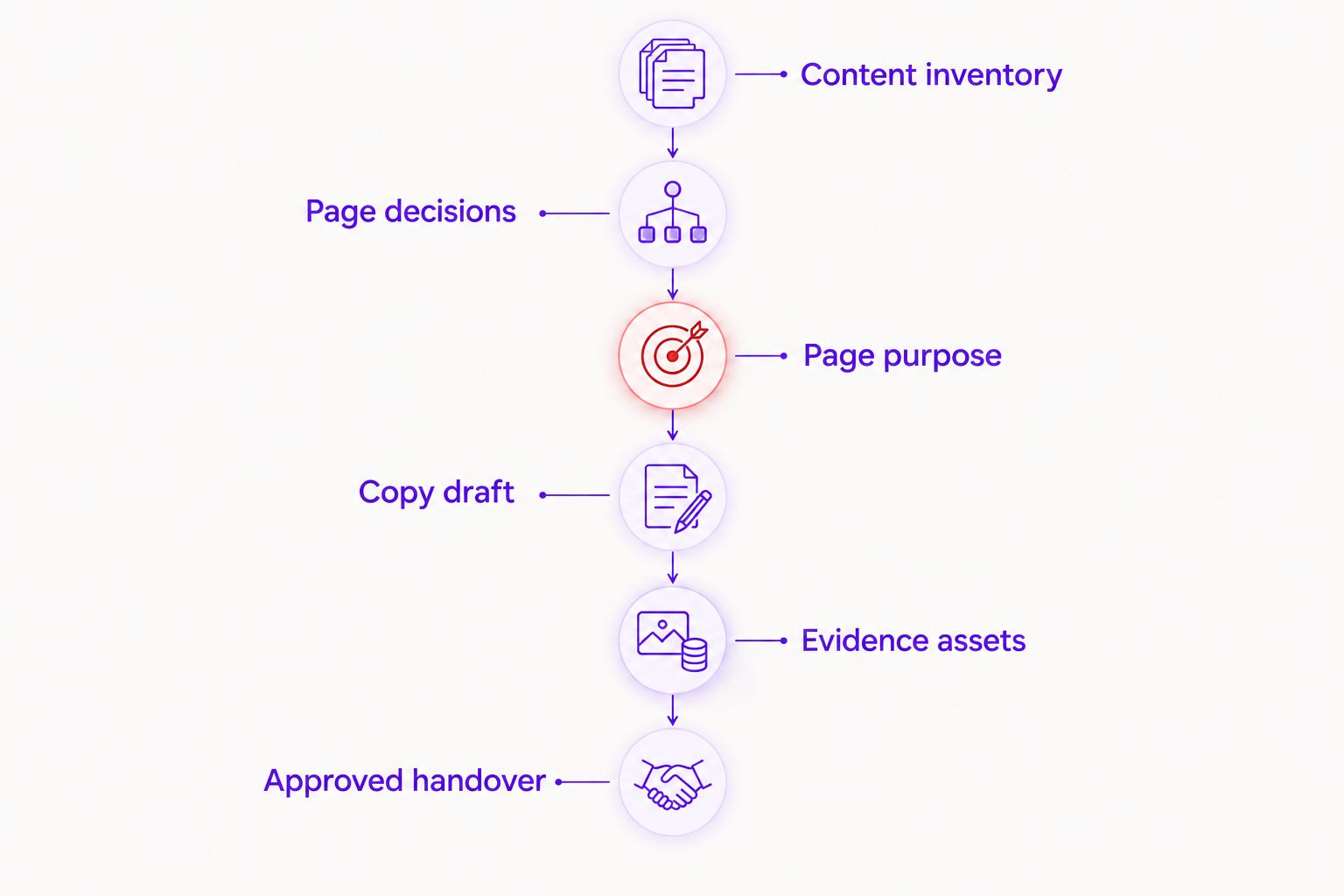
Use the following sequence to prepare content that a design team can work with.
1. Build a content inventory
Create a shared spreadsheet containing every existing page you intend to review. Include landing pages used in advertising, older articles and downloadable documents, not just pages visible in the main menu.
Record the following for each page:
- Current URL: the exact address, including any meaningful variations.
- Page purpose: what the visitor should understand or do.
- Audience: the buyer or stakeholder the page serves.
- Current content: headings, body copy, images, forms and downloads.
- Evidence: enquiries, search visits or other recorded activity, where available.
- Content owner: the person responsible for checking accuracy.
- Decision: keep, rewrite, merge or retire.
Do not delete a page because its design looks dated. Review its purpose and recorded activity first; a visually weak page can still contain useful information or receive relevant visits.
Keep the inventory separate from the new navigation plan. The inventory records what exists; navigation describes what visitors should see next.
2. Decide what stays, changes or disappears
Assign a clear decision to every page. This prevents old content from drifting into the new website simply because nobody took responsibility for it.
| Content decision | Best for | Benefit | Trade-off or check |
|---|---|---|---|
| Keep | Accurate content that still answers a buyer question | Preserves useful material without unnecessary rewriting | Existing copy still needs a layout and accuracy review |
| Rewrite | A relevant page with unclear, incomplete or outdated messaging | Aligns the page with the current offer | Requires subject knowledge and copy approval |
| Merge | Pages covering substantially overlapping questions | Creates a clearer destination for related information | Distinct buyer needs must not disappear in the combined page |
| Retire | Content with no remaining business or visitor purpose | Removes obsolete material | Check existing links and decide how the old URL should behave |
Make the decision before commissioning new layouts. Otherwise, you are asking the designer to build around content that has not earned its place.
For merged or retired pages, record the old URL and the intended destination or removal decision. Avoid sending every removed page to the homepage; the destination should match the original visitor's intent where a relevant replacement exists.
3. Define the page purpose
Write a short brief for every proposed page. Start with the buyer's question, then state the answer and the next action.
A service page should explain who the service is for, what the work includes and what information a prospective customer needs to provide. An enquiry page should make the next step clear rather than introduce an entirely new sales message.
Use these fields in your brief:
- Buyer question: what brought the visitor to this page?
- Core message: what should the visitor understand immediately?
- Supporting proof: what approved evidence supports the message?
- Primary action: what should the visitor do next?
- Required assets: what copy, images or documents does the page need?
Set 1 primary action per page as a planning rule, not a ban on useful navigation. Supporting links can remain, but the main action should not compete with several equally prominent requests.
4. Draft the copy before polishing the layout
Write the page headline, opening explanation, supporting sections and enquiry prompt before final visual approval. Working copy gives the designer a realistic sense of length, emphasis and information order.
Start with the pages closest to a project enquiry: the homepage, a priority service page and the enquiry page. Preparing 3 sample pages first gives your team a practical way to agree on tone before applying it across the website.
Use language your buyer uses. Replace broad claims about excellence with clear descriptions of the work, deliverables and decisions involved.
A useful service-page draft answers:
- What problem does this service address?
- Who should commission it?
- What work belongs in the project?
- What does the client need to supply?
- What should the enquiry include?
Keep unsupported results, unnamed awards and borrowed testimonials out of the draft. If a claim needs verification, resolve it before publishing rather than letting persuasive wording turn into an unapproved promise.
5. Prepare evidence and assets
Collect approved photographs, illustrations, project examples, testimonials and documents in a shared folder. Label each asset by its intended page and purpose so the design team does not have to guess where it belongs.
Check permission as well as quality. Confirm that your business can publish each photograph, quotation, client name and project example.
For each asset, record what it shows, who approved it and whether it needs editing. Provide factual image descriptions; these help the team write useful alternative text for visitors who cannot see the image.
Choose evidence that answers the buyer's question. A project example should explain the relevant work, not merely decorate the page. If evidence is unavailable, use accurate process explanations instead of inventing a success story.
6. Approve ownership and handover
Name a content owner and a final approver. Different specialists can contribute, but someone must resolve contradictory feedback before it reaches the design team.
Use 2 approval checkpoints in your working plan: content approval before final layouts, and a content check on the built pages before launch. Treat this as a project-management recommendation, not an agency delivery promise.
The final handover should include approved copy, page decisions, asset locations and the old-to-new URL record. Confirm who will upload content, check forms and review the published pages.
A content file is not finished simply because the writing is approved. It is finished when the team can identify which version belongs on which page and who has authority to change it.
Why this matters
Website content connects your business offer to the visitor's next decision. If the offer changes during design, headings, sections and enquiry paths need another review.
For founders commissioning website redesign services in 2026, the practical benefit of content preparation is a clearer brief. You can compare proposals against the same pages, writing responsibilities and approval requirements instead of comparing vaguely described redesign packages.
Approve the message before judging the presentation. A striking page still needs to explain what you do, who you serve and why a buyer should take the next step.
What should your content brief include?
A usable content brief is a working document, not a long brand manifesto. Someone unfamiliar with your business should be able to understand the proposed page and identify what remains unresolved.
Include the following deliverables in your 2026 project brief:
- Page list: proposed pages, grouped by visitor need.
- Page briefs: purpose, audience, message and primary action.
- Approved copy: clearly named files with version ownership.
- Asset register: approved visuals and supporting documents.
- URL decisions: existing addresses and their intended treatment.
- Approval responsibilities: who writes, checks and signs off.
Separate confirmed information from open questions. For example, if the service scope is undecided, resolve it with the business owner before asking a writer to describe the offer.
Keep a record of changes after approval. When a stakeholder adds a service or changes a claim, the relevant page brief and copy should change together.
Why content preparation scope varies
The amount of content work depends on what needs to change, not just the number of pages in the proposed website. A shorter site with unclear positioning can require more decisions than a larger site with accurate, approved material.
The main scope drivers are:
- Message changes: a different audience or offer requires more than proofreading existing text.
- Content condition: missing, duplicated or inaccurate copy needs a different response from approved material.
- Evidence requirements: project examples and testimonials require collection and permission checks.
- Asset production: new photography, illustrations or video belong in the scope if existing assets do not meet the brief.
- URL changes: merging, removing or renaming pages requires a documented transition plan.
- Approval structure: several reviewers need a clear process for resolving conflicting instructions.
Ask the agency to distinguish content auditing, copywriting, editing, uploading and post-build checks. These are different tasks; a proposal that says only content support leaves responsibilities unclear.
How do you evaluate website redesign services proposals?
Compare deliverables, exclusions and approval rules before comparing visual examples. A portfolio shows design work; the proposal shows what your project will actually receive.
For a 2026 proposal review, ask these questions:
- Who audits the existing content and recommends page decisions?
- Does copywriting cover every agreed page or selected pages only?
- Who checks business facts and approves claims?
- Which images and documents must your team supply?
- Who records redirects and checks the new destinations?
- How are feedback, revisions and late scope changes handled?
- Who checks content after it has been placed in the website?
The benefit of one agency handling strategy, design and marketing is a shared brief across those disciplines. The trade-off is responsibility concentration: your business still needs an accountable approver, and the proposal must make each deliverable explicit.
CreativHeads offers that combined service-agency positioning. Evaluate the proposed content work on its written scope, not on an assumption that related services are automatically included.
Should you write website copy before choosing a design?
Write the page purpose and working copy before approving the final design. You do not need every sentence polished before discussing visual direction, but the design needs a credible content structure.
Use 3 sample pages to test your tone and information order before drafting the rest. Choose pages with different jobs so your team does not mistake one approved headline for a complete website writing system.
Can you reuse content from your current website?
Reuse content that remains accurate, relevant and useful to the intended buyer. Update it when the offer, audience or enquiry process has changed.
Preserve the meaning that made the page useful, not its wording at all costs. Check headings, claims, links and documents together rather than treating the body copy as the whole page.
Who should approve website content before launch?
Use 2 approval checkpoints: approved content before final layouts, then a review of the built pages before launch. Name a final approver with authority to resolve business and wording questions.
The final review should check whether copy, images, forms and links match the approved brief. Do not use launch review as the first opportunity to decide what the business offers.
FAQ
What should I prepare before hiring website redesign services?
Prepare an existing-page inventory, your business objectives, priority buyer questions and available brand assets. Ask the agency to specify which content decisions and writing tasks it will handle.
Do website redesign services include copywriting?
Copywriting is included only when the proposal explicitly lists it. Check whether the scope covers new writing, editing supplied copy, content uploading and final accuracy checks.
Should I delete old pages during a website redesign?
Delete a page only after reviewing its purpose, recorded activity and existing links. Where a relevant replacement exists, document the old URL and the intended destination.
How many pages should I draft before the whole website?
Draft 3 sample pages first as a practical planning step: the homepage, a priority service page and the enquiry page. Use them to agree on tone and information order before writing the remaining pages.
Who should write the content for my redesigned website?
Choose the writer based on subject knowledge and the agreed project scope. Your business should supply accurate information and approve claims, whether an agency or your internal team writes the copy.
Is CreativHeads a website software provider or an agency?
CreativHeads is a creative agency offering branding, web design, content and digital marketing services. Confirm the deliverables and responsibilities for your project in the proposal.
What should I check in a website redesign proposal in 2026?
Check the page scope, content responsibilities, asset requirements, URL transition work and approval process. Request clear exclusions so you can identify tasks your own team must complete.
One last thing
Review the enquiry form alongside the page copy. If a page invites a specific project enquiry but the form gives visitors no way to describe that project, your content and enquiry process are asking for different things.
Prepare the content and the next step together. Before final design approval, check that a visitor can understand the offer, find the relevant evidence and submit the information your team needs to respond.
Related guides