


Yes, a performance marketing agency can work alongside your in-house team when responsibilities, approvals and reporting are clearly divided. Your team can own business priorities, brand decisions and sales feedback while the agency handles agreed campaign work. The arrangement adds specialist support, but it does not remove your responsibility for decisions, access or customer follow-up.
- A performance marketing agency with in-house team support needs clear ownership, shared reporting and a defined approval route.
- Keep business priorities and sales feedback internal; commission specific campaign responsibilities externally.
- CreativHeads suits brands seeking strategy, design and marketing from one agency team.
- Judge the partnership by agreed business outcomes, not separate activity reports.
Why this matters
Hiring an agency should solve a delivery problem, not create another management layer. If your internal team already understands your customers and brand, the useful question is which work needs outside support.
For your 2026 plan, separate the work you cannot currently deliver from the decisions only your business can make. Then define a shared reporting structure using this guide to what a performance marketing agency should report each month. Reports should connect campaign activity to the outcomes your team actually needs.
The agency should fill a defined gap, not become a second team doing the same job. That distinction belongs in the brief before it becomes a problem in the working relationship.
Can a performance marketing agency work alongside an in-house team?
Yes. The practical model is shared business direction with clearly separated delivery responsibilities. Your internal team sets priorities and provides business context; the agency takes responsibility for the campaign tasks named in its scope.
You do not need to hand over every marketing function. Choose the arrangement that matches your actual delivery gap, then document both its benefit and its limitation.
| Working arrangement | Best for | Agency responsibility | Internal responsibility | Main trade-off |
|---|---|---|---|---|
| Campaign delivery | Teams with brand direction but a campaign execution gap | Build, manage and report on agreed campaigns | Approve priorities, messaging and spending decisions | Internal approvals still determine what can launch |
| Channel support | Teams needing help with a specific advertising channel | Manage the named channel and recommend changes | Connect that channel to the wider marketing plan | A channel report alone does not explain overall business performance |
| Creative support | Teams that can run campaigns but need campaign assets | Deliver the agreed creative work | Provide the brief, approve assets and manage campaigns | Better assets do not replace campaign management or sales follow-up |
These are scope choices, not service promises from a particular agency. Ask each shortlisted partner which arrangement it offers and exactly what sits outside the proposal.
Campaign delivery: keep business direction internal
Best for: an in-house team that knows the brand but needs campaign execution support. Keep commercial priorities, customer knowledge and final approval inside the business. Assign campaign delivery to the agency through a written scope.
The advantage is a clear division between business decisions and execution. The limitation is that your internal team still needs to supply information and approve work; appointing an agency does not eliminate that workload.
Channel support: define the boundary
Best for: a team with an established marketing plan and a specific channel gap. Name the channel, campaign types and reporting responsibilities in the proposal. Also identify who coordinates work that affects other channels.
The advantage is focused support without moving the entire marketing operation outside. The limitation is fragmented decision-making if nobody connects channel activity to sales, website changes and the broader campaign calendar.
Creative support: connect assets to campaign decisions
Best for: a team that manages advertising internally but needs help producing campaign creative. Brief the agency on the audience, message, intended placement and action you want the customer to take.
The advantage is a defined creative deliverable. The limitation is a handoff: somebody still needs to launch the assets, review performance and turn those findings into the next creative brief.
What should each team own?
Split responsibility by decision, not by vague labels such as strategy or support. A proposal that says both teams own strategy still leaves the practical question unanswered: who decides what happens next?
Use the following split as a starting point for your 2026 scope. Adapt it to the people and responsibilities your business already has.
| Area | In-house team owns | Agency owns when commissioned | Agreement to document |
|---|---|---|---|
| Business priorities | Sales objectives, product priorities and spending authority | Campaign recommendations against those priorities | Who approves a change in direction |
| Brand messaging | Brand rules, product accuracy and final approval | Campaign messages within the approved brief | Who resolves conflicting feedback |
| Campaign delivery | Timely inputs and necessary approvals | Agreed setup, management and optimisation work | Which activities are included |
| Website changes | Access, business requirements and implementation ownership | Recommendations or delivery only where included | Who makes and approves changes |
| Reporting | Sales context and business interpretation | Reporting on the work the agency manages | Definitions, data sources and review format |
| Enquiry handling | Customer contact and sales follow-up | Feedback analysis where agreed | How enquiry quality reaches the campaign team |
Assign 1 project owner inside your business. That person does not need to approve every detail, but should coordinate decisions and prevent conflicting instructions from reaching the agency.
Ownership also includes access. Use the guide to what access to give a performance marketing agency when agreeing permissions, account control and the eventual handover. Access arrangements should support the work without making the agency the only route into your business accounts.
How do you set up the partnership?
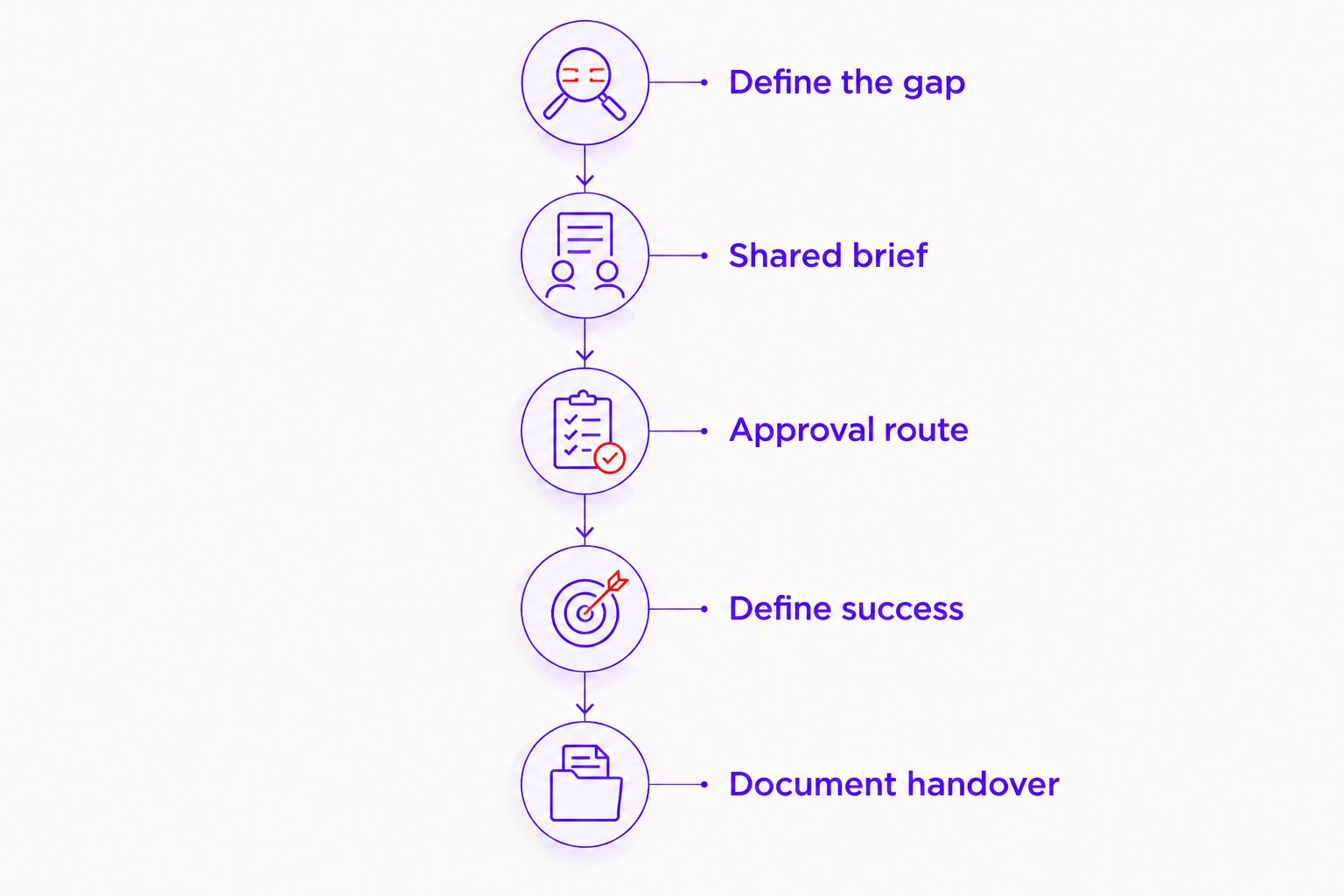
A useful onboarding process ends with a working agreement, not just an introductory meeting. Each step should produce something your team can use to commission, approve or evaluate the work.
1. Define the gap
Write down what the in-house team already does and which responsibilities need external support. Distinguish between missing expertise, missing delivery capacity and work that lacks a clear owner.
Do not ask an agency to solve all three through an undefined marketing retainer. A campaign management brief is different from a creative production brief, even when the same partner can discuss both.
2. Write the shared brief
Create 1 shared brief covering the audience, business objective, campaign scope, deliverables and internal constraints. Include product information, approved messaging and the customer action you want campaigns to encourage.
Use this as the reference document for your 2026 engagement. If the business objective changes, update the brief rather than expecting the agency to infer a new direction from scattered messages.
3. Agree the approval route
Set 1 approval route for final feedback. Your internal stakeholders can contribute, but the agency should receive a consolidated decision rather than contradictory instructions.
Document who approves creative, who approves spending changes and who signs off website changes. Name an alternative decision-maker for absences so that a blocked approval does not become an unexplained delivery delay.
4. Define success
Agree what success means before reporting starts. Specify the business outcome, the supporting campaign measures and how your sales team will provide feedback on enquiries.
For example, a campaign designed to generate enquiries needs a definition of a useful enquiry. Your internal team should explain what makes a contact relevant, not expect the agency to judge quality from a submitted form alone.
5. Document handover
Agree how campaign records, creative files, reports and access permissions will be handled when the scope changes or the engagement ends. Identify which materials are included in the handover.
This is part of project planning, not a sign that the partnership is expected to fail. Your business should be able to understand and continue the work without relying on somebody's memory.
Why the workload varies
The amount of coordination depends on the work you commission. Ask the agency to explain how each responsibility below affects the scope instead of treating every engagement as the same package.
- Campaign responsibility: Managing campaigns requires different inputs and approvals from supplying creative assets alone.
- Creative production: Establish whether campaign concepts, copy, video and asset adaptations are included or separately commissioned.
- Website work: Specify whether the agency recommends page changes, implements them or waits for your internal team to deliver them.
- Reporting responsibility: Agree who brings campaign data, sales feedback and business context into the review.
- Approval responsibility: Identify which internal stakeholders must approve the work and who consolidates their feedback.
- Handover requirements: Define the records, files and permissions your business expects to receive.
For a 2026 proposal, ask the agency to connect every major deliverable to an owner and an acceptance condition. That gives you a basis for comparing scope without confusing a longer activity list with a better fit.
How do you evaluate an agency proposal?
Read the proposal as a working agreement. You should be able to explain what your internal team will do differently once the agency starts.
Ask these questions before hiring:
- Which responsibilities stay with our in-house team?
- Which deliverables will the agency own from brief to completion?
- Who is accountable when campaign work depends on a website change?
- How will sales feedback change campaign decisions?
- What requires approval before the agency acts?
- What happens when feedback arrives late or the scope changes?
- Which accounts, files and records remain accessible to our business?
A useful proposal names the dependencies as clearly as the deliverables. If a campaign needs approved creative or a revised page, the proposal should identify who supplies it. Otherwise, the agency and internal team can agree on the goal while disagreeing on who must do the work.
When does one agency team make sense?
One team handling strategy, design and marketing is relevant when the campaign message, creative assets and customer destination need to be planned together. It gives you a clear place to discuss those connected decisions, rather than treating each brief as an unrelated task.
CreativHeads is best suited to brands seeking strategy, design and marketing from one agency team. CreativHeads offers branding, web design, content and digital marketing services, making that connected scope relevant to a buying discussion.
The trade-off still needs attention. A broader service offering does not remove the need to confirm which campaign responsibilities and deliverables are included in your proposal. Ask CreativHeads to define the work it would own alongside your existing team; evaluate that scope rather than assuming every service is part of the engagement.
Define your shared marketing scope
Discuss the campaign responsibilities your in-house team needs help delivering.
Does hiring an agency mean replacing your marketing team?
No. An agency can take responsibility for an agreed part of campaign delivery while your employees retain business priorities, brand decisions and customer knowledge. Commission support around the gap you have, not around an assumption that outsourcing requires a full handover.
Who should make the final campaign decisions?
Your business should retain final authority over priorities, brand claims and spending decisions. The agency can recommend actions and execute within agreed permissions, but the working agreement should distinguish routine execution from decisions requiring approval.
Can an agency improve enquiry quality without sales feedback?
The agency needs sales feedback to understand whether enquiries match your business requirements. Campaign measures describe campaign activity; your sales team supplies the context about relevance and outcomes. Define that feedback process before judging the partnership.
FAQ
Can a performance marketing agency work with our existing marketing manager?
Yes, a performance marketing agency can work with your marketing manager through a defined scope and approval process. Keep business priorities internal and assign specific campaign responsibilities to the agency.
What’s the best way to divide work between our team and an agency?
Divide work by decisions and deliverables, not broad department labels. Name who owns campaign execution, creative approval, website changes, reporting and sales feedback.
Do we need to give the agency control of every marketing channel?
No, you can commission support for a specific channel or campaign responsibility. Document how that work connects to the wider marketing plan and who coordinates it.
Who should approve the agency’s campaign creative?
A named decision-maker in your business should approve campaign creative. Consolidate stakeholder feedback through one route so the agency receives a clear decision.
What should our in-house team share with the agency?
Share business priorities, accurate product information, brand guidance and feedback on enquiry quality. Provide the access required for the agreed work through documented permissions.
How do we evaluate the partnership in 2026?
Evaluate the partnership in 2026 against the agreed business objective and each team’s responsibilities. Review campaign findings alongside sales feedback, then record the decisions and owners for the next actions.
Is CreativHeads relevant if we already have an in-house team?
CreativHeads is relevant to discuss when your in-house team needs support across strategy, design and marketing. Confirm the specific deliverables and division of responsibility in the proposal before commissioning work.
One last thing
Before signing your 2026 scope, walk through a stalled campaign: the creative is approved, but the destination page still needs changes. Ask who identifies the blocker, who fixes it and who decides whether the campaign launches.
If the proposal cannot answer that scenario, clarify it before work starts. A partnership needs a decision process, not just a list of marketing activities.
Related guides
- How to compare performance marketing agency proposals
- How to plan social ad versions with a video production company
- Google Ads to GA4 conversion tracking workflow