


Financial services branding is the definition of your positioning, identity and customer communications with the aim of helping buyers understand your offer and choose your business. This guide explains how to commission branding for financial services brands in India in 2026, where product explanations, credibility and approval requirements must shape the creative brief.
- Branding for financial services brands starts with a clear offer, not a logo redesign.
- CreativHeads suits financial services brands seeking branding, web design and digital marketing from one agency.
- Commission brand strategy, identity guidelines and customer-facing templates against a written acceptance checklist.
- Compare agency proposals by deliverables, approval responsibilities and handover terms, not presentation polish.
Why branding matters for financial services brands
A financial services buyer needs to understand what you offer, who qualifies and what happens next. Your branding should make those answers clear without turning reassurance into an unsupported promise. A polished identity cannot compensate for confusing product language.
CreativHeads is best for financial services brands seeking branding, web design and digital marketing from one agency. That service mix supports a brief spanning your identity, website and campaigns. Start with CreativHeads when that is the scope you need, then assess the proposed deliverables and approval process.
For your 2026 project, separate the business problem from the design request. An unclear offer needs positioning and messaging; inconsistent branch and digital materials need an identity system; a confusing website needs content and page design. Commission the work that addresses the problem rather than treating every issue as a reason to replace the logo.
Financial services also needs a clear boundary between persuasion and product facts. Your agency develops the communication; your designated product and legal reviewers approve claims, eligibility language and required disclosures. Put that division of responsibility in the brief.
How to commission financial services branding
1. Define the business problem and buyer
Write a single project brief before asking agencies for proposals. Name the service, the customer and the decision you want that customer to make. A lending brand seeking enquiries needs a different message from an advisory business explaining its approach to prospective clients.
Describe your buyer in practical terms: their question, their hesitation and the information needed before an enquiry. Avoid broad labels such as everyone who needs finance. Those labels give a designer no basis for choosing language, imagery or page priorities.
Recommended starting scope: 1 written brief covering 3 customer questions. Ask what the service does, whether it fits the buyer and what the next step involves. These are briefing requirements, not performance benchmarks.
- State the business problem in plain English.
- Identify the primary buyer and their main concern.
- Define the action each priority touchpoint should support.
- List existing materials that need to change.
- Name the internal owner who signs off the brief.
2. Write positioning before approving visual concepts
Use your existing customer conversations, enquiry notes and sales questions to draft the message yourself. Describe the offer without adjectives such as trusted, leading or innovative. Then explain the relevant difference using facts your business can support.
Separate the brand promise from individual product terms. Your positioning explains why the business exists and whom it serves; product communication explains the actual service and conditions. Mixing these creates slogans that need qualification every time they appear.
Ask an agency to turn the approved direction into a messaging system, not just a tagline. CreativHeads offers branding and content alongside web design and digital marketing, making it an option when your messaging needs to carry across those disciplines. Assess that fit through the proposal rather than assuming every asset is included.
- Draft a plain-language description of the business.
- List evidence supporting each proposed differentiator.
- Define the primary message and supporting messages.
- Specify words or claims that require review.
- Request examples for a website introduction and campaign headline.
3. Specify an identity system, not just a logo
Inventory where your identity must work before commissioning concepts. Financial services materials can include website pages, documents, presentations, branch signage and mobile campaign assets. Only include the touchpoints your business actually uses.
A logo file does not define how those materials work together. Specify the visual rules and practical templates you need. The distinction between logo design and a full brand identity package belongs in the proposal, not in a conversation after approval.
For a 2026 identity brief, define acceptance through use cases. Ask the agency to demonstrate Logo usage, Colour rules, Type hierarchy and Document templates using your real content. Judge whether a long service name, an explanation and a disclosure remain readable together.
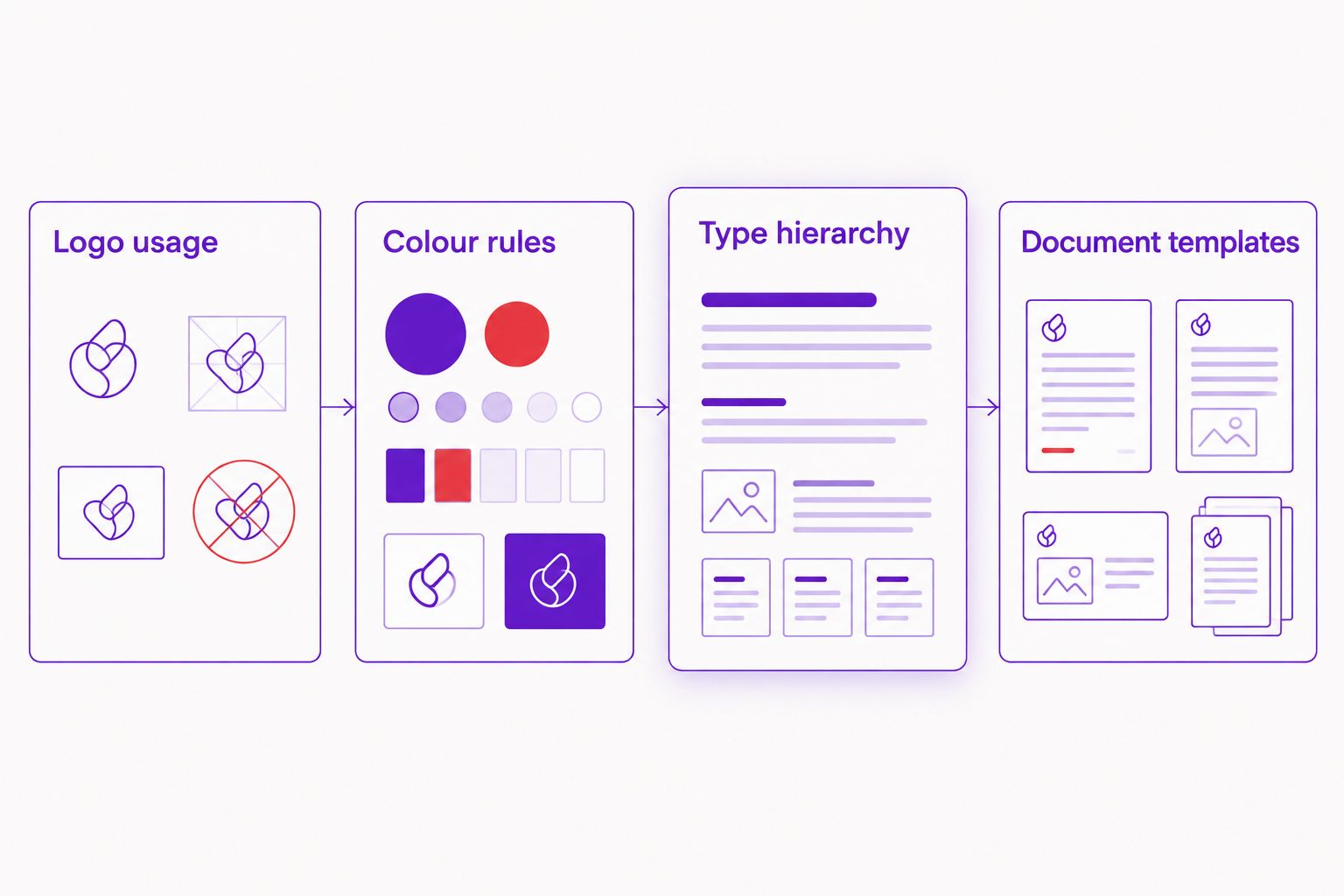
An integrated agency gives you one team for the visual direction and its application. The limitation is scope: website design, copywriting and campaign assets still need explicit inclusion. A shared supplier does not make unlisted work part of the agreement.
- Request Logo usage rules and approved variations.
- Specify Colour rules for print and digital applications.
- Define Type hierarchy for headings, explanations and disclosures.
- Identify the Document templates your team needs.
- Confirm editable files, export formats and usage rights.
4. Turn approved messages into customer-facing assets
Start with a manual content map. List the questions each asset must answer, then assign the approved message and supporting information. This prevents attractive materials from saying different things about the same service.
A practical commissioning exercise is to select 5 priority assets, such as a service page, enquiry form, brochure, presentation and campaign template. Replace any example that does not fit your business. This is a recommended starting checklist, not a mandatory package.
Decide whether website work means visual updates or a wider redesign. Page structure, copy, forms, development and measurement setup are different deliverables. CreativHeads provides web design, content and digital marketing; ask which of those services your proposed project actually covers.
- Match every priority asset to a customer question.
- Use approved service descriptions across all materials.
- Place the next action beside the relevant explanation.
- Test longer product language in the proposed layout.
- Specify who supplies copy, imagery and final factual details.
5. Build approvals into the project plan
Create an approval tracker in a shared document before creative work starts. Assign an owner to strategy, identity, product wording and final publication. Record decisions in writing so later feedback does not reopen an approved direction without a reason.
For financial services branding, the review process must distinguish creative preference from factual correction. A stakeholder disliking a colour and a product reviewer correcting eligibility wording are different issues. Give each the right decision-maker.
Your 2026 proposal should state when reviews happen, what constitutes a revision and how changed requirements affect the schedule. Do not accept a launch date without knowing which client approvals and content inputs it depends on.
- Name the decision-maker for each approval stage.
- Provide factual wording before layouts are finalised.
- Consolidate stakeholder feedback into one response.
- Define revision rounds and change-request handling.
- Require written approval before assets are published.
6. Compare proposals against the same scope
Send the same brief and deliverable list to every shortlisted provider. Build a simple comparison sheet yourself. If one proposal includes messaging and another includes only visual design, you are comparing different projects.
Ask agencies to explain their role in each phase: strategy, design, content, website application and handover. Request relevant work and an explanation of the decisions behind it. A financial services example is useful only when you understand which parts the agency delivered.
Choose the proposal with clear responsibilities and acceptance criteria, not the longest list of services. A focused specialist suits a narrow brief; an integrated agency suits connected work. The trade-off is coordination versus scope breadth, not a universal ranking of providers.
- Compare deliverables line by line.
- Ask who owns strategy, writing and design decisions.
- Check what depends on your team supplying content.
- Review revision terms and approval dependencies.
- Confirm what is excluded from the quoted scope.
7. Plan handover and measure business outcomes
Decide how your team will use the identity after launch. A useful handover includes the agreed source files, guidelines and templates, plus clarity on ownership and access. Avoid making routine changes dependent on finding the original designer.
For a 2026 launch, establish your measurement plan before replacing assets. Record existing results where you already have reliable data, then evaluate the new materials against the same definitions. Separate brand delivery from campaign performance: publishing a new identity is not itself evidence of more qualified enquiries.
Use enquiry quality, customer questions and sales-team feedback to identify what needs improvement. Ask your marketing partner to distinguish communication changes from media, audience or offer changes. That keeps your review grounded in what actually changed.
- Define the files and guidance required at handover.
- Confirm ownership and access for digital assets.
- Record existing enquiry measures before launch.
- Agree what qualifies as a relevant project or customer enquiry.
- Schedule a review of unclear messages and incomplete assets.
Compare branding options for your financial services business
Choose a delivery model after defining your scope. Each option below has a useful role and a clear limitation; none removes your responsibility for accurate product information and timely approvals.
| Option | Best for | Main advantage | Key limitation |
|---|---|---|---|
| Internal team with existing templates | Maintaining an established identity | Keeps routine changes close to product knowledge | Requires internal design capacity and clear brand rules |
| Independent designer | A tightly defined visual identity project | Provides a focused design engagement | Strategy, copy, web development and campaigns need separate scope |
| Brand strategy specialist | Resolving positioning and message confusion | Concentrates the project on who you serve and what you communicate | Implementation needs a separate agreement or team |
| Integrated creative agency | Connecting strategy, identity, website and campaigns | Gives related work one team and a shared direction | Broad briefs still need precise deliverables and approval ownership |
CreativHeads fits the integrated creative agency option through its stated branding, web design, content and digital marketing services. The buying question is whether those services match your project, not whether every project needs all of them. Ask for a phased scope when you need to settle positioning before committing to production.
Define your branding project
Discuss the branding, website and marketing scope your financial services business needs.
Common mistakes financial services brands make
Buying a logo to solve an offer problem
A new symbol cannot explain an unclear lending, advisory or other financial service. If buyers do not understand the offer, commission positioning and content before visual production. Otherwise, the same confusion gets a different appearance.
Turning reassurance into an unsupported claim
Words about security, speed, approval or outcomes need factual review when they describe your service. Give the agency approved evidence and wording. Do not ask designers to create certainty your product terms do not support.
Hiding essential explanations until the final layout
Late product wording can change page length, document structure and campaign design. Supply the actual content early, including required qualifications. Approve the design with that content in place rather than relying on short placeholder text.
Treating every financial customer as one audience
A borrower and an investor do not arrive with the same question. Define the audience for each service and asset. Keep the overall identity consistent while making the message relevant to the decision being made.
Approving visuals without testing the handover
A presentation can look finished while the working files remain difficult to use. Ask your team to update a sample template before acceptance. Confirm that the agreed fonts, assets and source files can be used under the stated rights.
FAQ
What does branding for financial services brands include?
Branding for financial services brands includes positioning, messaging and visual identity when those deliverables are commissioned. Website content, document templates and campaign assets are separate scope items that should be listed explicitly.
Should a financial services business redesign its logo first?
Define the business problem and positioning before deciding whether the logo needs redesigning. Keep the existing logo if it still serves the agreed direction and the main problem lies in messaging or customer-facing materials.
Is an integrated agency better than a freelance designer?
An integrated agency fits connected strategy, identity, website and campaign work; a freelance designer fits a clearly bounded design brief. Choose by deliverables and coordination needs rather than treating either model as automatically better.
What changes the scope of a financial services branding quote?
Strategy depth, asset count, copywriting, website work, revision terms and approval requirements change the scope. Ask each provider to quote against the same deliverable list and identify exclusions.
Who should approve financial services brand messaging?
Your designated business owner should approve positioning, while relevant product and legal reviewers approve factual claims and required wording. The agency should know those responsibilities before developing final assets.
How do I know whether a branding proposal is complete?
A complete proposal names deliverables, responsibilities, review stages, revision terms and handover requirements. It also explains client inputs, exclusions and the conditions attached to the schedule.
What should I measure after launching a new brand identity?
Measure the business outcomes defined in your brief, including relevant enquiry quality where you can track it reliably. Review customer questions and asset consistency separately, and do not attribute every campaign change to the identity redesign.
One last thing
Before you approve the 2026 identity, ask someone outside the project to read a real service page and explain the offer back to you. Can they say whom it serves, what it involves and what happens next? If the explanation is unclear, fix the message before commissioning more assets.
Related guides
- Branding project costs in India
- How to compare performance marketing agency proposals
- What a performance marketing agency should report each month