

Best overall: a focused enquiry form. Best for paid campaigns: dedicated landing pages. Best for appointment-led sales: a booking flow. The best website features for lead generation in 2026 connect a clear offer to a useful next step—not a longer list of widgets.
- Prioritise website features for lead generation that capture project fit, not just contact details.
- Focused enquiry forms are the default; dedicated landing pages suit performance marketing campaigns.
- CreativHeads brings strategy, website design and marketing into one team for businesses commissioning a coordinated website project.
- Commission proof sections, mobile usability and lead tracking alongside your conversion features.
Why this matters
A website enquiry is only useful when your sales team understands what the buyer needs. An inbox full of incomplete messages leaves that work unfinished. Choose features around the information and action your sales process requires.
For growing brands in India, a website brief can span positioning, copy, design and campaign requirements. CreativHeads is best for businesses seeking website design, brand strategy and marketing from one agency team. Explore CreativHeads when those needs belong in the same project.
That is a service-model recommendation, not a claim about conversion results. Your 2026 brief should still specify deliverables, responsibilities and acceptance checks before you approve a proposal.
What makes the best lead-generation website features?
Evaluate each feature against these criteria before deciding what to commission:
- Buyer clarity: Does the feature explain who the offer serves and what happens next?
- Useful qualification: Does it capture information your team actually uses to assess an enquiry?
- Low effort: Can buyers complete the action without unnecessary fields, account creation or confusing choices?
- Credible evidence: Can the buyer inspect relevant work, context and substantiated claims?
- Operational ownership: Is someone responsible for responding, maintaining the feature and handling failures?
- Measurement: Can you distinguish a completed enquiry from a button click and connect it to lead quality?
A feature that fails the ownership test is not ready to launch. A booking calendar needs managed appointment capacity; a form needs a working destination and a named recipient.
Website features for lead generation at a glance
The order below gives an undecided business a starting point. Each feature serves a different buying situation; you do not need to commission every option.
| Rank | Feature | Best for | Standout function | Key limitation |
|---|---|---|---|---|
| 1 | Focused enquiry form | General project enquiries | Captures contact details and project fit | Additional fields increase the work required |
| 2 | Dedicated landing pages | Paid campaign traffic | Connects one campaign promise to one offer | Each offer needs maintained content |
| 3 | Proof sections | Buyers evaluating credibility | Shows relevant work and evidence | Requires approved, substantiated material |
| 4 | Booking flow | Appointment-led sales | Turns interest into a scheduled conversation | Depends on calendar ownership |
| 5 | Quote brief builder | Projects with variable scope | Collects requirements before estimation | Requires more buyer effort |
| 6 | Product or service selector | Businesses with distinct offers | Routes buyers to the relevant solution | Poor categories create confusion |
| 7 | Direct contact options | Buyers seeking a quick clarification | Opens a phone, email or messaging route | Conversations need a separate qualification process |
1. Focused enquiry form: best for general project enquiries
A focused enquiry form collects the details needed to start a useful conversation. It belongs close to your offer, with a clear explanation of what the buyer is requesting. The confirmation message should explain the next step without promising a response time your team has not agreed to deliver.
Start with contact details and project context. As a briefing exercise, choose 3 qualification questions that change how your team assesses the enquiry—for example, the service required, the project objective and the intended launch timing.
Focused enquiry form pros:
- Gives your team consistent information.
- Makes the requested action explicit.
- Supports a defined enquiry-completion event.
Focused enquiry form cons:
- Every required field adds work for the buyer.
- Routing failures can leave submissions unseen.
Best for: Businesses selling services or projects that require an initial discussion.
Verdict: Buy. Make this the default lead-capture feature, and require submission, error and confirmation checks before launch.
2. Dedicated landing pages: best for paid campaign traffic
A dedicated landing page presents the offer advertised in a campaign. Its headline, evidence and enquiry action should match that offer rather than asking the visitor to search through a general website.
For your 2026 campaign brief, define the audience, promise, supporting evidence and conversion action together. Request a reusable page template, but write the content for each distinct offer. A template is a production asset, not a substitute for relevance.
Dedicated landing page pros:
- Keeps the campaign offer in view.
- Gives each audience a relevant enquiry path.
- Creates a clear scope for campaign-specific measurement.
Dedicated landing page cons:
- Separate offers create ongoing content work.
- Old campaign details need active maintenance.
Best for: Businesses commissioning performance marketing around a defined service, product or launch.
Verdict: Buy when campaigns are in scope. Ask who owns page updates after launch and how completed enquiries enter campaign reporting.
3. Proof sections: best for buyers evaluating credibility
Proof sections show what a business has done and why that work relates to the buyer's needs. They can include approved project examples, demonstrations and accurately attributed testimonials. A logo wall alone does not explain the scope of a project or its relevance.
For an agency website, distinguish packaging design, logo design, video production and website work. Explain the brief and delivered work; include results only when they are documented and approved for publication.
Proof section pros:
- Gives buyers work they can inspect.
- Connects capabilities to a concrete brief.
- Supports more specific sales questions.
Proof section cons:
- Requires publication permissions and accurate attribution.
- Old examples need review for continued relevance.
Best for: Buyers comparing providers before submitting a project enquiry.
Verdict: Buy. Commission evidence-led content alongside design, not as an empty section to fill after launch.
4. Booking flow: best for appointment-led sales
A booking flow lets the buyer choose an appointment from the team's managed calendar. It suits a sales process where the next useful action is a conversation, not a written estimate.
Explain the meeting's purpose before asking for a slot. Capture enough context to prepare, and specify who handles confirmations, rescheduling and cancellations. A calendar integration is not complete until those responsibilities are assigned.
Booking flow pros:
- Makes the next action specific.
- Lets buyers select from published appointment slots.
- Collects context before the conversation.
Booking flow cons:
- Requires calendar management and meeting ownership.
- A booked meeting does not establish project fit.
Best for: Consultative businesses with a defined discovery-call or appointment process.
Verdict: Hold until ownership is clear. Add booking only when your team has agreed who takes the meetings and how enquiries are qualified.
5. Quote brief builder: best for projects with variable scope
A quote brief builder guides buyers through project requirements before they request a proposal. It is useful when deliverables vary substantially, such as a website redesign with different page types, content responsibilities and integrations.
Use plain-language questions and explain unfamiliar choices. In a 2026 redesign brief, ask what must change, what can stay and who supplies the content. Do not present an automated estimate as a final agency quote.
Quote brief builder pros:
- Collects scope details in a consistent format.
- Makes content and delivery responsibilities visible.
- Gives the proposal team a clearer starting brief.
Quote brief builder cons:
- Demands more effort than a short enquiry form.
- Needs updating when services or delivery processes change.
Best for: Businesses selling projects whose scope must be defined before quotation.
Verdict: Buy for complex enquiries. Keep a simpler contact route for buyers who cannot yet specify the project.
6. Product or service selector: best for distinct offers
A selector asks buyers what they need and directs them to the relevant offer or enquiry route. It works when your services have genuinely different buyers, requirements or sales processes.
Use categories the customer recognises, not internal department names. Begin with 2 enquiry routes if your business has two clear buying situations, such as a new project and support for existing work. Add branches only when they change the destination or questions.
Service selector pros:
- Makes distinct enquiry paths visible.
- Allows relevant questions for each service.
- Helps assign enquiries to the appropriate owner.
Service selector cons:
- Ambiguous categories force buyers to guess.
- Extra branches add content and maintenance work.
Best for: Businesses with clearly differentiated offers or enquiry teams.
Verdict: Hold unless routing solves a real problem. A single clear offer usually needs a direct action, not a selection tool.
7. Direct contact options: best for quick clarification
Direct contact options provide a phone, email or messaging route for buyers with a specific question. Label each route accurately and publish only contact details your team manages.
For your 2026 website, decide where the conversation continues and how relevant enquiries are recorded. A messaging button opens a conversation; it does not replace a project brief, assigned ownership or sales follow-up.
Direct contact option pros:
- Gives buyers an alternative to submitting a form.
- Supports questions that do not fit predefined fields.
- Makes the contact channel explicit.
Direct contact option cons:
- Produces less consistent enquiry information.
- Attribution needs a defined recording process.
Best for: Buyers checking a detail before committing to a formal enquiry.
Verdict: Buy as a supporting route. Keep your primary enquiry action visible and explain the purpose of each contact option.
How we ranked the features
The ranking prioritises a clear buying action, useful qualification and manageable ownership. It is a commissioning guide, not a benchmark from conversion testing. Focused forms provide the default; the remaining features address campaign relevance, credibility, scheduling, scope or routing.
Mobile usability, accessible controls, clear copy and reliable submission handling belong in every proposal. They are acceptance requirements, not optional extras competing with the ranked features.
What should your website proposal include?
Turn feature names into deliverables before comparing proposals. For CreativHeads or any other agency, the scope should explain what gets designed, written, connected, checked and handed over.
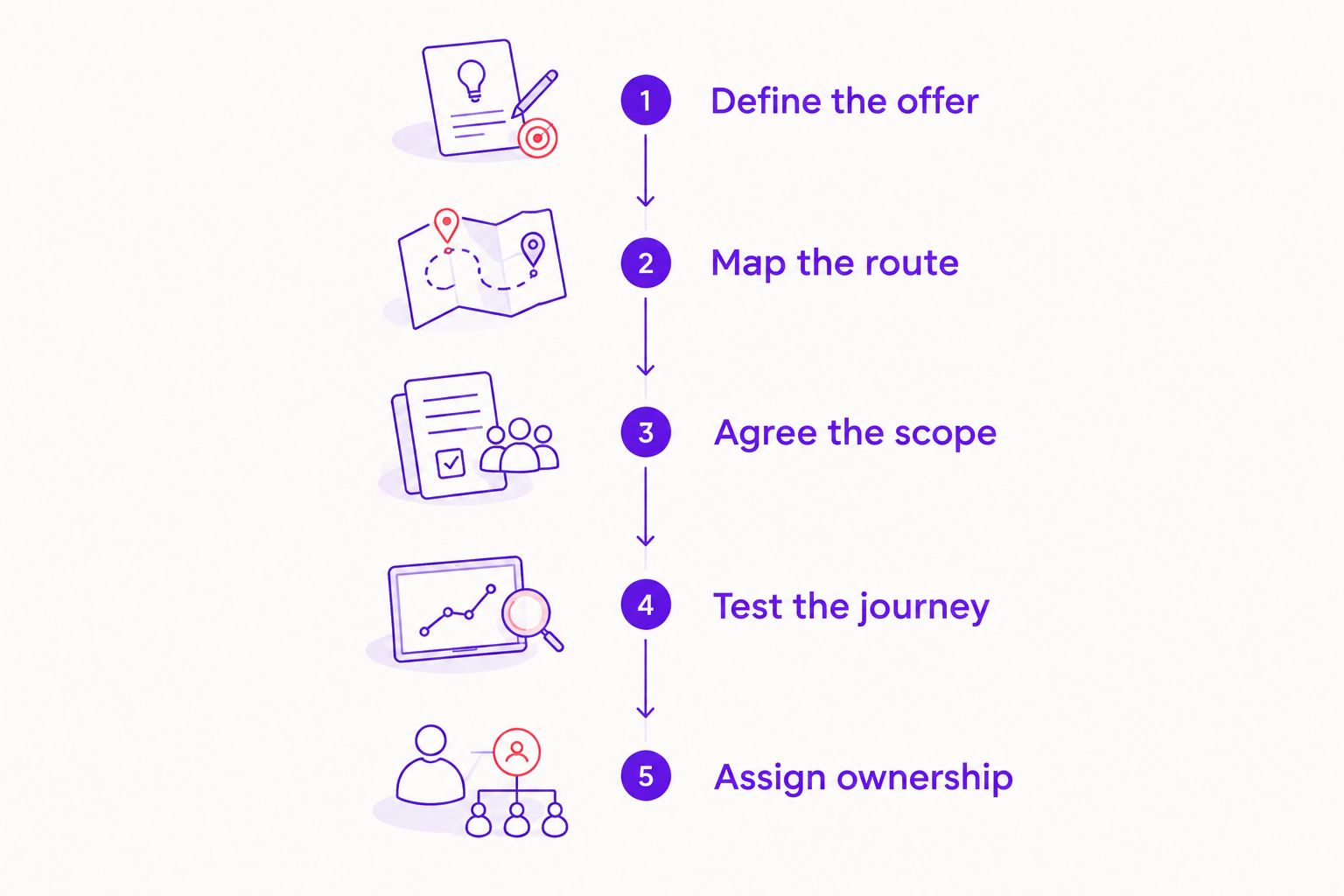
Use this sequence:
- Define the offer: Name the buyer, service and action the page supports.
- Map the route: Specify the page, form or contact route and its recipient.
- Agree the scope: List page types, content responsibilities, integrations and revisions.
- Test the journey: Check completion, failures and confirmation messages.
- Assign ownership: Name the people responsible for enquiries, updates and reporting.
This sequence connects strategy, design and marketing decisions before production begins. It also gives you a practical way to compare proposals that use different service labels.
Ask the agency to demonstrate 5 test actions: a successful submission, a missing required field, an invalid entry, a failed submission and the confirmation state. These are proposed acceptance checks, not claims about typical website performance.
Also ask what changes the project scope: custom page layouts, copywriting, video assets, integrations, content migration and ongoing campaign pages. Request explicit inclusions and exclusions rather than comparing proposals by their headline alone.
For reporting, separate completed enquiries from clicks, then agree how sales marks relevant projects. The guide to what a performance marketing agency should report each month helps frame that discussion.
Define your website project
Bring your offer, required pages and enquiry process into a clear project brief.
Which lead-generation features should you choose?
Start with a focused enquiry form, relevant proof and a clearly owned follow-up process. Add dedicated landing pages when you commission campaigns. Choose booking, a brief builder or a selector only when the sales process calls for it.
For a coordinated website project in 2026, CreativHeads brings strategy, design and marketing into one agency team. Your proposal still needs clear responsibilities for copy, page design, tracking and handover. Shared agency ownership does not remove the need for a written scope.
FAQ
What are the best website features for lead generation?
A focused enquiry form is the default, supported by relevant proof and a clear next step. Dedicated landing pages, booking flows and brief builders serve different campaign or sales requirements.
Should my website use a form or a booking calendar?
Use a form when your team needs project details before deciding the next step. Use a booking calendar when an appointment is the agreed next action and someone owns the calendar.
How many questions should a lead-generation form ask?
Ask only questions that affect qualification or follow-up. Start your brief with contact details and 3 proposed qualification questions, then remove anything your team does not use.
Do I need separate landing pages for paid campaigns?
Use dedicated landing pages when campaigns promote distinct offers or target different buyers. Each page needs matching content, an enquiry action and an owner for updates.
What changes the scope of a lead-generation website project?
Page types, copywriting, integrations, content migration and campaign requirements change the scope. Ask the agency to list these deliverables and exclusions in its proposal.
Can CreativHeads handle design and marketing together?
CreativHeads offers branding, web design, content and digital marketing, with strategy, design and marketing from one team. Agree the specific deliverables and responsibilities for your website project in the proposal.
What should I measure after launching the website?
Measure completed enquiries and record which ones match your project requirements. Keep button clicks separate from submitted enquiries, and assign responsibility for updating lead status.
One last thing
Before approving the design, write the confirmation message buyers receive after submitting. If you cannot explain what happens next, the enquiry process is not ready—even if the page looks finished.
Commission the handover, not just the form. The recipient, qualification process and next action belong in the website brief.
Related guides
- Website redesign for real estate developers
- Can an ecommerce website developer also handle marketing?
- How to compare performance marketing agency proposals