


Yes, an ecommerce website developer can also handle marketing when the agreed service includes both store development and marketing delivery. Development alone does not include advertising, content or campaign management. Before hiring in 2026, ask for separate deliverables, responsibilities and reporting for the website and its marketing.
- An ecommerce website development company digital marketing proposal needs separate deliverables for the store and campaigns.
- CreativHeads suits buyers seeking branding, web design, content and digital marketing from one agency.
- Choose an integrated agency for coordinated delivery; choose separate specialists when your brief needs distinct expertise.
- Keep ownership of your domain, store and advertising accounts, regardless of who manages them.
Can an ecommerce website developer also handle marketing?
Yes—but assess development capability and marketing capability separately. A working store and a plan to attract customers are different deliverables. Your proposal should explain how the two connect without treating either as an automatic extra.
CreativHeads brings branding, web design, content and digital marketing into one agency. That service mix is relevant when you want a coordinated brief; for an ecommerce project, still ask for evidence that matches your store requirements.
| Delivery model | Best for | Benefit | Trade-off |
|---|---|---|---|
| Integrated agency | Brands wanting coordinated strategy, design and marketing | A shared brief connects the store with campaign messages | You must verify capability in each discipline |
| Separate specialists | Brands with distinct development and marketing requirements | You can select expertise for each workstream | You must manage handoffs and resolve conflicting recommendations |
Neither model removes your responsibility to approve the scope. Choose the team that explains what it will deliver, how you will judge it and what remains outside the agreement.
Why this matters
An ecommerce launch is not complete just because visitors can place orders. You also need a clear reason to buy, useful product information and a defined route from campaigns to relevant pages. Treat those as connected decisions, not unrelated tasks.
For a 2026 launch, commission a customer journey, not just a collection of pages. Ask who writes the product messages, who builds the destination pages and who checks that campaign activity can be measured. Gaps between those responsibilities become your problem unless the proposal assigns them.
The commercial question is simple: does the team understand what your customers need before purchasing? Attractive design cannot answer that question on its own.
What should you commission from an integrated agency?
Start with the business problem. A new store needs a launch brief; an existing store needs a clear account of what is changing and why. Avoid asking for a redesign and marketing package without explaining the purchase journey you want to improve.
Store development: define what must work
List the required page types, product information, checkout requirements and connections to other business systems. Ask the agency to distinguish configuration from custom development. That distinction makes the proposal easier to compare.
Your development scope should name:
- The pages and templates being delivered.
- The product information you must supply.
- The checkout and payment requirements to be implemented.
- Any connections to fulfilment, inventory or customer systems.
- The checks required before launch.
- The support included after handover.
Ask which tasks depend on your team. Product photography, product descriptions and policy text need an owner; leaving ownership unstated does not make those tasks disappear.
Marketing: define the work after launch
Marketing needs its own scope. Ask whether the proposal covers campaign planning, creative production, advertising management, search content, email activity or only recommendations. Do not assume that a service name includes every related task.
For each included channel, request the deliverables, approval process and reporting method. A proposal should distinguish making campaign materials from managing campaigns. It should also distinguish bringing visitors to the store from improving the pages they visit.
A marketing plan is not evidence of marketing delivery. Request relevant work examples and ask what responsibility the proposed team held in each example.
Shared strategy: connect the two scopes
Write 2 separate scopes—one for the store and one for marketing—then add shared decisions. These include the target customer, main product message, campaign destinations and measurement requirements.
The benefit of one team is coordination, not the absence of detail. Both scopes still need acceptance criteria, named owners and exclusions.
How do you evaluate an ecommerce development and marketing proposal?
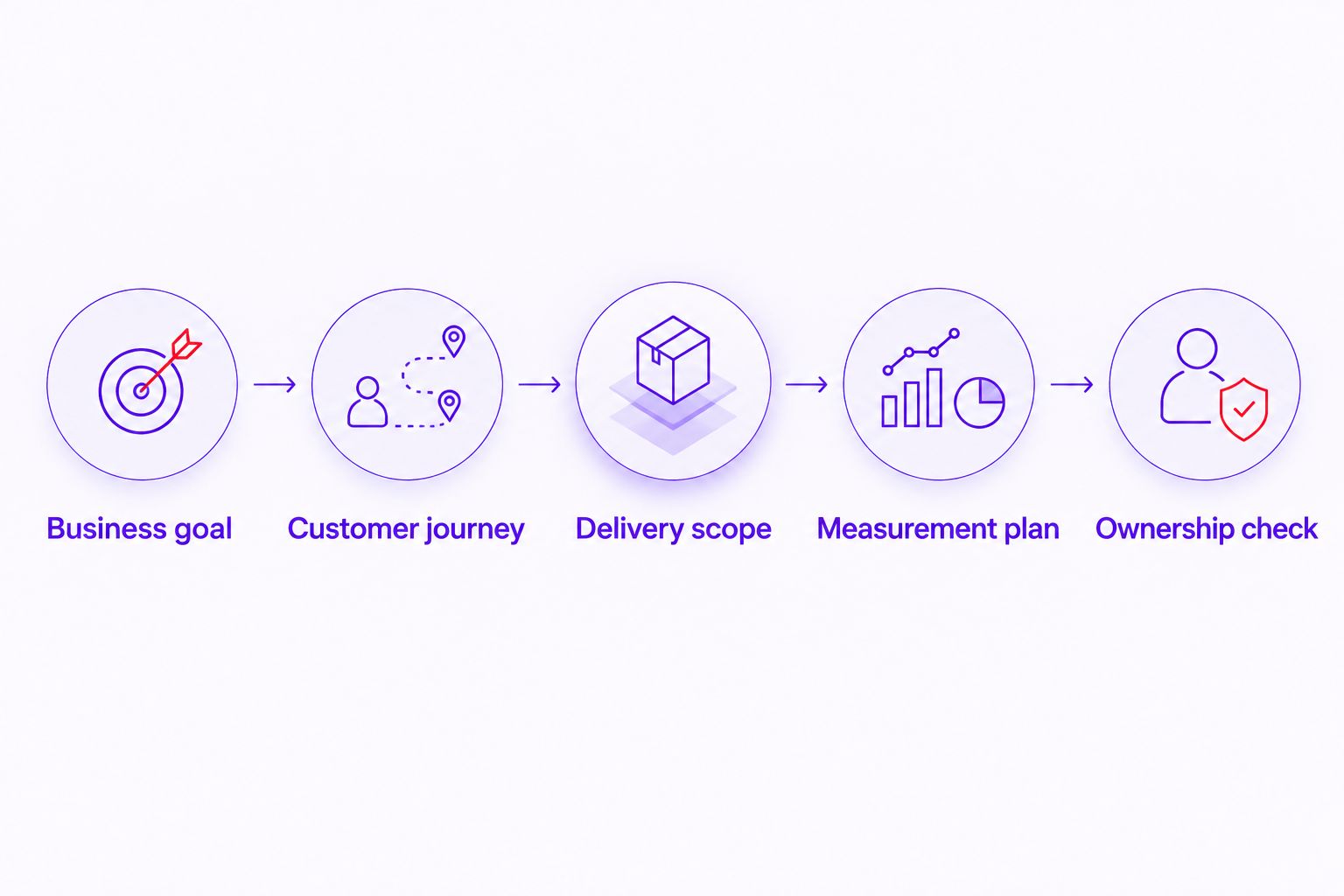
Use the following sequence before comparing the final offer. For your 2026 brief, make every stage a written decision rather than an assumption carried into production.
- Business goal: State whether the project supports a launch, a redesign or a new customer-acquisition plan. Name the business outcome without promising a result the team cannot guarantee.
- Customer journey: Describe how customers discover products, compare them and complete a purchase. Include important questions they need answered before checkout.
- Delivery scope: Separate website tasks, content tasks and ongoing marketing tasks. Give every deliverable an owner and an approval condition.
- Measurement plan: Agree what will be tracked, what counts as a completed purchase and which reports you will receive.
- Ownership check: Confirm access to the store, domain, advertising accounts, reporting and final files before signing.
Ask each shortlisted agency to respond to the same brief. A comparison is useful only when the proposals cover equivalent work. If one includes campaign delivery and another includes only strategy, label that difference before judging the offers.
For the store, choose 1 primary purchase action for each key campaign destination. Ask the team to explain how the page supports that action and how visitors can find essential product information. This makes design review about buying decisions rather than personal taste.
Why does the scope vary between agencies?
The phrase development and marketing describes a service combination, not a standard package. Use these factors to explain your requirements and expose differences between proposals:
- Starting point: A new store and an existing store with content to preserve need different briefs.
- Catalogue work: Clarify who organises product information, prepares images and enters product data.
- System connections: Name any inventory, fulfilment or customer systems the store must work with.
- Content responsibility: State whether you supply approved copy and creative assets or commission their production.
- Marketing coverage: Specify which channels require strategy, setup, creative production and ongoing management.
- Handover expectations: Define training, documentation, maintenance and the boundary between corrections and new work.
Treat these as scope questions, not a reason to accept vague pricing. Ask the agency to show which requirements change the work involved. A clear explanation helps you remove unnecessary work without quietly removing something essential.
What should you ask before hiring?
Ask questions that reveal how the team makes decisions. A polished presentation is not a substitute for a usable delivery plan.
Can you show relevant work and explain your role?
Ask for examples that match the work you are commissioning. Then ask what the team actually delivered: design, development, content, campaign management or a combination.
A website example does not establish advertising experience. A campaign example does not establish checkout implementation experience. Assess the evidence against your brief, not against the breadth of the agency's service list.
Who owns the decisions and approvals?
Ask who leads the project, who approves creative work and who resolves disagreements between website and marketing requirements. You need accountability across the project, even when different specialists deliver individual tasks.
Set 3 written approval gates in your brief: scope approval, design approval and launch approval. These are recommended checkpoints, not a promised agency process. Add further checks when your project requires them.
What happens after the store launches?
Separate launch corrections, ongoing maintenance and campaign management. Ask what each includes and how new requests are handled.
For your 2026 agreement, record who checks purchase tracking after launch and who investigates a reported checkout problem. Do not let website support and marketing support point back at each other without a decision owner.
How should you judge marketing performance?
Judge marketing against the agreed business objective, not activity alone. A report showing content published or campaigns launched tells you what happened; it does not establish whether the work supported sales.
Ask the agency to explain its reporting in plain English:
- What customer action does each campaign seek?
- How are completed purchases recorded?
- How are cancellations or refunds handled in the report?
- What separates advertising spend from agency work?
- What recommendation follows from the results?
Use a reporting definition your finance and marketing teams understand. A revenue figure is not the same as profit, and attributed sales need an explanation of how the reporting system assigns credit.
Avoid asking for guaranteed outcomes. Ask instead for the decisions the team will make when results differ from expectations, and who approves changes to campaigns or landing pages.
Can you hire a developer first and add marketing later?
Yes, you can hire a developer first and add marketing later. Include campaign-page requirements, content ownership and measurement needs in the development brief so the later marketing team has a clear starting point.
The advantage is a narrower initial engagement. The limitation is that you must coordinate the handover yourself. Ask the developer to document what was built, where access sits and which changes require further development.
Is one agency better than separate specialists?
One agency is better suited to buyers who want shared planning and fewer separate handoffs. Separate specialists suit buyers who want to select distinct expertise and can manage the coordination themselves.
CreativHeads suits businesses seeking branding, web design, content and digital marketing from one agency. The value of that combination is a connected brief; it is not proof of a particular platform capability or a guaranteed sales result. Check the proposed ecommerce scope before choosing.
Who should own the store and marketing accounts?
Your business should retain ownership and administrative access to its store, domain and advertising accounts. Give the delivery team the access needed to work without making the agency the only route into business-critical systems.
Put the handover requirements in the agreement. Ask for final files, access documentation and an explanation of any third-party tools the project uses. Account ownership is a hiring decision, not something to resolve after a relationship ends.
Define your website and marketing brief
Discuss the scope for web design, content and digital marketing with CreativHeads.
FAQ
Can an ecommerce website developer also run my marketing?
Yes, when marketing delivery is explicitly included in the agreement. Ask for separate website and marketing deliverables, relevant work examples and named responsibilities.
Does ecommerce website development include digital marketing?
Ecommerce website development does not automatically include digital marketing. Advertising, content production and ongoing campaign management need their own defined scope.
Is CreativHeads a software provider or a service agency?
CreativHeads is a creative service agency based in India offering branding, web design, content and digital marketing. Discuss your ecommerce requirements to establish the proposed delivery scope.
What’s better for my store: one agency or separate specialists?
One agency suits a coordinated brief, while separate specialists suit buyers who want distinct expertise and can manage handoffs. Compare relevant capability and accountability rather than the delivery model alone.
What should I include in a website and marketing brief?
Include your business goal, customer journey, website requirements, marketing channels, content responsibilities and measurement needs. State who owns accounts and what must be handed over.
How do I know whether marketing is helping my ecommerce business?
Compare the agreed business objective with clearly defined purchase reporting and campaign results. Ask how sales are attributed and how refunds, advertising spend and agency work appear in the report.
Should my agency own my store and advertising accounts?
Your business should retain ownership and administrative access to its store and advertising accounts. Provide working access to the agency and document the handover requirements.
One last thing
Before signing your 2026 agreement, ask the proposed team to walk through a single campaign journey: the message a customer sees, the product page they reach, the purchase they complete and the report you receive. Ask who owns each step.
If the handoffs are unclear, fix the brief before commissioning the work. That exercise exposes responsibility gaps more directly than another list of services.
Related guides