


Best overall starting point for demonstrable offers: short-form video. Best for explaining several benefits: carousel ads. Best for a tightly scoped production brief: single-image ads. Choose social media ad formats for performance marketing by the buying question they answer, not by which format attracts the most attention.
- Short-form video leads social media ad formats for performance marketing when buyers need to see the product work.
- Carousel ads suit comparisons; single-image ads suit a clear message without a complex production brief.
- Catalog ads support product selection; instant forms support enquiries that your sales team can qualify.
- CreativHeads suits brands seeking strategy, design and marketing from one team for performance marketing.
For your 2026 campaign, commission an answer to a customer objection before commissioning an asset. CreativHeads combines strategy, design and marketing services, giving growing brands a single team to connect the message, creative work and campaign plan.
Why this matters
A video can explain a product and still send buyers to an unclear page. An instant form can collect enquiries and still leave your sales team without enough information to qualify them.
The format is the delivery mechanism, not the performance strategy. Your brief must connect the customer question, the evidence in the ad, the next action and the business outcome you will measure.
For brands launching across India in 2026, include language versions and sales coverage in that brief. Specify who the campaign serves and who will handle responses; neither belongs in an assumption buried inside an agency proposal.
What makes the best social media ad formats?
Use these criteria before approving a format recommendation:
- Buying-question fit: The format must explain what your customer needs to understand before taking action.
- Evidence strength: Product demonstrations, relevant details and authorised customer statements must support the message.
- Destination fit: The website, product page or enquiry form must continue the same promise.
- Production scope: Your proposal must identify concepts, versions, edits and approvals rather than simply promising content.
- Business measurement: Evaluate completed purchases or qualified enquiries, not attention alone.
- Adaptability: Confirm how the idea changes for placements, languages and follow-up messages without losing its meaning.
Social media ad formats at a glance
This is a buying-guide ranking by use case, not a claim that one format produces better results in every account. Several options overlap: creator-led content can run as video, while a carousel describes how content is presented.
| Rank | Format | Best for | Standout feature | Key limitation |
|---|---|---|---|---|
| 1 | Short-form video | Demonstrating a product or service | Shows the offer in action | Needs a clear script and usable footage |
| 2 | Single-image ad | Communicating one clear message | Keeps the asset brief focused | Limited room for explanation |
| 3 | Carousel ad | Comparing benefits, products or steps | Divides information into separate cards | The message can become fragmented |
| 4 | Creator-led testimonial | Addressing trust objections | Presents a person's actual experience | Requires permission and substantiated claims |
| 5 | Catalog ad | Helping shoppers select products | Connects advertising to catalog information | Depends on accurate product data |
| 6 | Instant-form ad | Collecting enquiries within the platform | Lets prospects submit details without visiting a website | A submission does not establish lead quality |
1. Short-form video: best for product demonstrations
Short-form video shows how an offer works instead of asking buyers to imagine it. Use it for a visible product benefit, a process explanation or a service demonstration that makes the next step easier to understand.
For a 2026 launch, brief the action before the atmosphere. A product solving a specific problem gives the editor a clearer story than a request for an impressive brand film.
Short-form video pros:
- Shows movement, use and context together.
- Combines spoken explanation with visual evidence.
- Supports different openings built around different customer questions.
Short-form video cons:
- Requires footage that actually proves the message.
- Weak scripting creates more editing work without fixing the underlying argument.
Commission: A concept, approved script, shot list, master edit, placement versions, captions and agreed revision scope. Specify whether voiceover, language versions and source files belong in the handover.
Best for: Offers customers understand better after seeing them work.
Verdict: Buy short-form video when the demonstration provides evidence that a still image cannot.
2. Single-image ads: best for one clear message
Single-image ads pair a still visual with a focused message and action. Choose this format when the offer needs a clear introduction rather than a sequence of explanations.
A simple format still needs strategy. The image, headline and destination must answer the same buying question, or the asset becomes a disconnected poster.
Single-image ad pros:
- Keeps the message visible without requiring playback.
- Separates headline and visual variations cleanly.
- Fits briefs built around existing approved photography or design assets.
Single-image ad cons:
- Cannot show a process unfolding.
- Becomes difficult to read when asked to explain too much.
Commission: Distinct concepts, headline options, placement crops and editable files. Ask which versions represent different ideas and which are only resized exports; those are different deliverables.
Best for: A straightforward offer or benefit that needs little explanation.
Verdict: Buy single-image ads when one visual and one message are enough; skip text-heavy layouts.
3. Carousel ads: best for structured comparisons
Carousel ads divide content across separate cards. Use them to compare product choices, explain benefits or organise a process without placing everything in one image.
Make the opening card understandable on its own. Do not hide the reason to care until the end of the sequence.
Carousel ad pros:
- Gives each benefit or option its own space.
- Supports a deliberate information sequence.
- Allows different product details to remain visually distinct.
Carousel ad cons:
- Depends on readers choosing to explore further cards.
- Repetition or weak sequencing turns useful detail into clutter.
Commission: A card-by-card outline, design system, copy and destination mapping. Confirm how much each card must explain independently, especially if the chosen platform can change presentation or ordering.
Best for: Buyers weighing options or asking how an offer works.
Verdict: Buy carousel ads when comparison or sequence improves understanding; skip them when every card repeats the same claim.
4. Creator-led testimonials: best for trust objections
Creator-led testimonial ads use a person's genuine experience to address a buying concern. This is a creative approach rather than a separate placement format, and it can be delivered through video or still assets.
A scripted endorsement is not evidence of a real customer outcome. Distinguish a paid demonstration from an actual testimonial, and approve only claims you can substantiate.
Creator-led testimonial pros:
- Gives customer questions a recognisable human voice.
- Connects product use with a specific context.
- Supports explanations that formal brand copy can make awkward.
Creator-led testimonial cons:
- Requires clear permissions and advertising disclosure arrangements.
- Poor audience fit distracts from the offer rather than explaining it.
Commission: A brief, claim boundaries, disclosure requirements, usage permissions and editing rights. Confirm whether permission covers paid advertising, account-based distribution, language adaptations and the intended campaign period.
Best for: Offers facing a specific trust objection that genuine experience can address.
Verdict: Buy creator-led testimonials when the experience is relevant and verifiable; skip unsupported endorsements.
5. Catalog ads: best for product selection
Catalog ads use product information to support shopping-focused advertising. They suit businesses with several products and distinct product destinations, rather than a service enquiry that needs explanation.
The creative brief is only part of the job. Product information and destination accuracy also need an owner.
Catalog ad pros:
- Connects product presentation with individual destinations.
- Supports advertising across a range of products.
- Gives shoppers a direct route to investigate an item.
Catalog ad cons:
- Inaccurate product information creates misleading ads.
- Weak product pages remain weak destinations, regardless of format.
Commission: Catalog setup responsibilities, image requirements, product grouping, destination checks and purchase measurement. Ask who corrects data errors and how the agency confirms that advertised items match their landing pages.
Best for: Ecommerce businesses that need buyers to select among products.
Verdict: Buy catalog ads when product data and purchase destinations are ready; hold when those foundations are incomplete.
6. Instant-form ads: best for managed enquiry collection
Instant-form ads let a prospect submit details inside the advertising platform. They suit a defined enquiry process in which your team can review responses and follow up.
For service businesses in 2026, the important question is not whether the form collects names. It is whether those responses contain enough information to start a useful sales conversation.
Instant-form ad pros:
- Collects details without requiring a website visit.
- Allows questions tied to project qualification.
- Provides a defined handover point from advertising to sales.
Instant-form ad cons:
- A completed form is not proof of buying intent.
- Poor response handling breaks the enquiry process after submission.
Commission: Questions, consent wording, confirmation messaging, lead routing and qualification definitions. Assign responsibility for receiving, reviewing and responding to enquiries before launch.
Best for: Businesses with a clear enquiry offer and an accountable follow-up team.
Verdict: Buy instant-form ads when qualification and follow-up are defined; hold when nobody owns the response.
How these formats are ranked
Short-form video is the default for demonstrable offers because it can show the evidence. The remaining formats each solve a different problem: message clarity, comparison, trust, product selection or enquiry collection.
This 2026 ranking follows the criteria above. It does not replace account-level results, and a format should not receive more campaign spending simply because it appears higher in this guide.
Turn the recommendation into a project brief
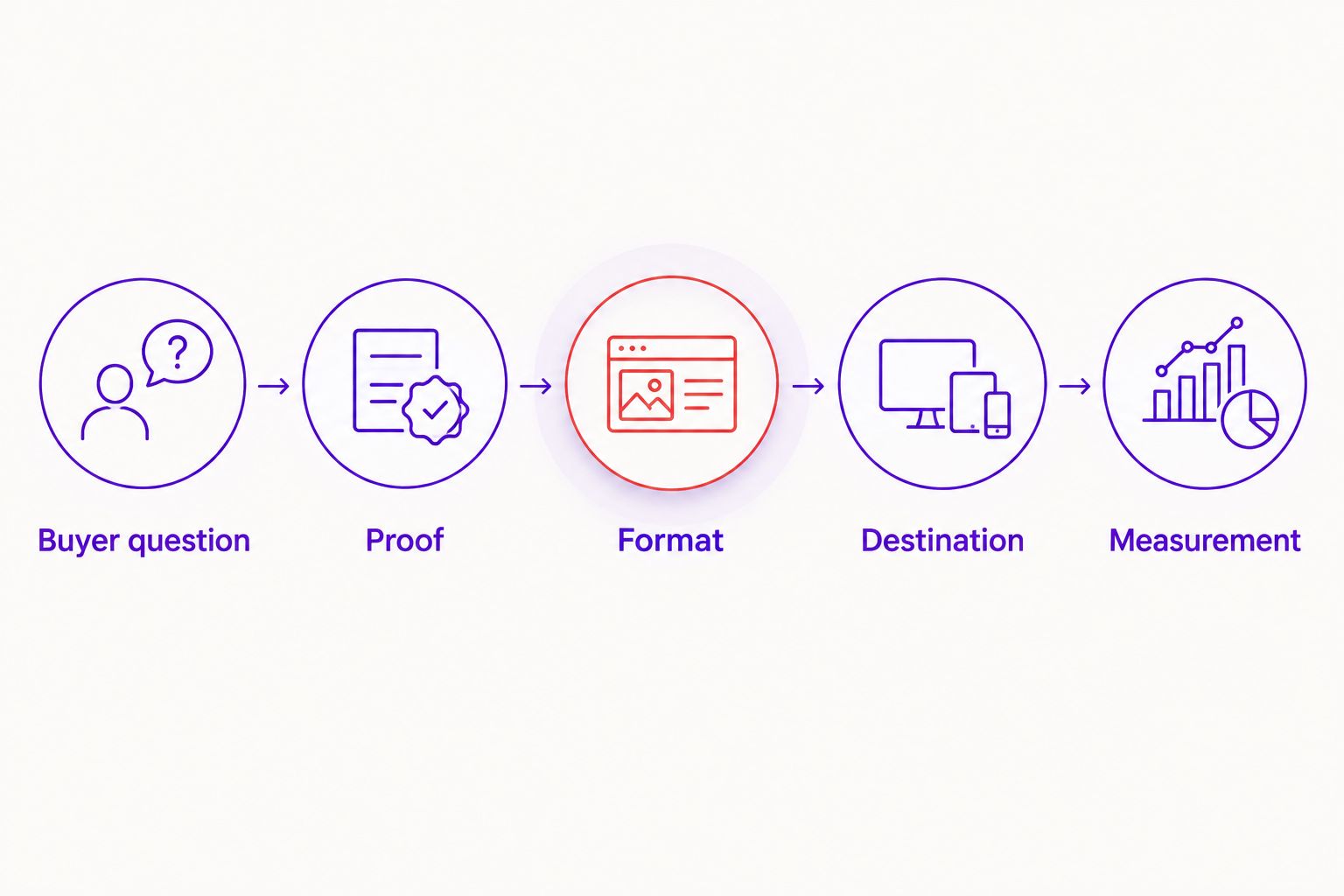
Use this sequence to make the proposal specific enough to approve:
- Buyer question: Write the objection the ad must answer.
- Proof: Identify the footage, detail or authorised statement supporting the answer.
- Format: Choose the presentation that makes that evidence clear.
- Destination: Specify where the prospect goes and what happens next.
- Measurement: Define the purchase or qualified enquiry that counts as success.
A connected brief gives CreativHeads a clear basis for joining strategy, design and performance marketing. It also gives you a way to evaluate the proposal beyond how many assets appear in the deliverables list.
Placement versions need their own scope. A 9:16 aspect ratio describes a vertical canvas, a 1:1 aspect ratio describes a square canvas, and a 4:5 aspect ratio describes a portrait canvas; these are composition choices, not guarantees that an export suits every placement.
Ask which current placement requirements the team will check before delivery. Then define reframing, caption placement and approval responsibilities rather than assuming that resizing finishes the job.
Use the guide to planning social ad versions with a video production company to separate production decisions from export requests.
Questions to ask before hiring
- Which buyer question does each proposed concept answer?
- What evidence do you need from our team?
- Which deliverables are new concepts, and which are adaptations?
- What changes the scope: filming, permissions, languages, revisions or destination work?
- Who owns the files, accounts and usage permissions?
- How will you connect campaign reporting with purchases or qualified enquiries?
Define your campaign brief
Discuss strategy, design and marketing with a clear scope for your next campaign.
Which social media ad format should you choose?
Start with short-form video if showing the offer resolves the main objection. Choose a single-image ad if the message is already simple, and a carousel if buyers need to compare details.
Use creator-led testimonials for verifiable trust evidence, catalog ads for product selection and instant forms for managed enquiries. Do not commission every format by default; commission the formats that answer distinct questions.
CreativHeads is best for brands seeking strategy, design and marketing from one team for performance marketing. Ask for a proposal connecting each creative deliverable to its audience, destination and measurement plan.
FAQ
What’s the best social media ad format for performance marketing?
Short-form video is the best starting point when buyers need to see how an offer works. Single-image ads suit simpler messages, while carousels suit comparisons. Choose by the buying question, then evaluate business outcomes.
Are video ads better than image ads?
Video ads are better suited to demonstrations, while image ads are better suited to a message that needs no sequence. Neither format guarantees better results. Compare purchases or qualified enquiries rather than treating views as the final outcome.
When should I choose carousel ads?
Choose carousel ads when buyers need to compare options, understand several benefits or follow a process. Make the opening card useful on its own and give every additional card a distinct job.
How much does social media ad production cost?
Production cost depends on the agreed scope. Ask for a quote that separates concepts, filming, talent permissions, editing, language versions and revisions. Keep production fees distinct from advertising spend.
Should a new brand use instant-form ads?
A new brand should use instant-form ads when it has a clear enquiry offer and a team responsible for follow-up. Define qualification questions and lead routing before launch. A form submission alone does not establish lead quality.
What should a performance marketing agency deliver besides ads?
A performance marketing agency’s proposal should define campaign strategy, measurement responsibilities, destination checks and reporting alongside creative assets. Confirm account ownership and how purchases or qualified enquiries will be evaluated.
Can one agency handle design and performance marketing?
CreativHeads offers strategy, design and marketing from one team. Define how those services connect in your project, including creative approvals, destination responsibilities and campaign measurement.
One last thing
Changing the format is not the same as changing the argument. A video, image and carousel repeating an unclear promise are different assets with the same problem.
Before approving your 2026 production brief, ask someone unfamiliar with the campaign to explain the offer and next action from each concept. If the answer is unclear, fix the message before adding more versions.
Related guides
- What a performance marketing agency should report each month
- How to compare performance marketing agency proposals
- Best video production formats for product launches