


Choose a branding consultant when you need help deciding what your brand should stand for and have people who can carry out that direction. Choose a branding agency when you need strategy translated into a logo, brand identity, website, content or launch materials. The deciding factor is who will deliver the finished work, not the title on the proposal.
- Branding consultant vs branding agency: choose by the work you need delivered, not the supplier’s title.
- A branding consultant is best for strategic direction when your team can execute it.
- A branding agency is best for brand identity and coordinated creative delivery.
- CreativHeads brings strategy, design and marketing together; assess the proposal against your required deliverables.
Do I need a branding consultant or a branding agency?
You need a consultant if the main gap is a decision. You need an agency if the main gap is delivery. Some providers offer both, so check the actual scope rather than assuming what their name includes.
CreativHeads is a branding agency best for businesses seeking strategy, design and marketing from one team. CreativHeads offers branding, web design, content and digital marketing services; your proposal should still identify exactly which services your project includes.
| Buying criterion | Branding consultant | Branding agency |
|---|---|---|
| Best for | Clarifying positioning and guiding an execution team | Turning brand direction into coordinated creative work |
| Core brief | Decide the audience, message and brand direction | Define the direction and produce agreed brand assets |
| Deliverables to request | Positioning, messaging, recommendations and an implementation brief | Strategy, identity assets, guidelines and agreed applications |
| Main advantage | Focused advice without commissioning unrelated production | Connected planning and delivery across agreed services |
| Main limitation | Implementation needs a named owner outside the advisory scope | A broad engagement needs clear boundaries and approvals |
| Critical proposal question | Who turns the recommendations into usable work? | Which finished assets and launch tasks are included? |
Neither option guarantees business growth. A strategy document can remain unused, and an attractive identity can still communicate the wrong message. Buy a defined outcome with an accountable delivery plan.
Why this matters
For a business launching or repositioning in India in 2026, branding decisions affect more than the logo. Your packaging, website, sales material and advertising need to explain the same business clearly.
The hiring mistake is separating advice from execution without planning the handover. A consultant defines a direction, but nobody owns the website rewrite. An agency produces assets, but the founder has not approved the audience or message.
Start with the gap in your business. If your team cannot explain why a customer should choose you, resolve the positioning. If the direction is clear but your materials contradict it, commission the applications and guidelines that bring them together.
Branding consultant: best for deciding the direction
A branding consultant is the right fit when you need focused guidance and already have designers, writers or marketing staff who can apply it. The assignment should answer business questions rather than end with broad creative advice.
Ask for clear outputs:
- Audience priorities: who the brand needs to reach and whose needs come first.
- Positioning: the reason to choose your business, grounded in what you actually offer.
- Messaging: the main promise, supporting points and language your team can use.
- Creative direction: a brief that explains what future design and content must communicate.
- Implementation priorities: what should change first, who owns it and what approval is required.
The advantage is focus. You can commission the decision work without automatically adding packaging, video or website production.
The limitation is the handover. A consultant’s recommendations do not become finished assets unless production is included or assigned elsewhere. Before signing, ask who will brief your designers, review their work and resolve disagreements about the direction.
Choose a branding consultant when your team can execute a clear brief but needs help writing that brief. If you lack delivery capacity, include implementation support or appoint a separate production team before the strategy work ends.
Branding agency: best for turning direction into deliverables
A branding agency is the right fit when you need finished creative work as well as strategic direction. That can mean a brand identity, packaging system, website redesign or coordinated launch materials, depending on the agreed scope.
The advantage is continuity. The people interpreting the business direction can carry it into design and content instead of passing a document between unrelated suppliers.
CreativHeads brings strategy, design and marketing together. That suits a brief where brand decisions need to connect with website content and campaign creative, but it does not mean every service belongs in every engagement.
The limitation is scope complexity. When several workstreams sit in one proposal, you need to know which are included, which depend on your inputs and which require separate approval.
Ask the agency to distinguish:
- Strategy deliverables from visual design deliverables.
- Identity design from packaging or website applications.
- Website design from development, content entry and post-launch support.
- Campaign creative from advertising account management and reporting.
- Final files from ongoing adaptation and production work.
Choose a branding agency when your business needs an accountable team to carry the direction into finished work. Do not commission a wide package simply because it is offered; commission the work your launch or rebrand actually needs.
How to choose before requesting proposals
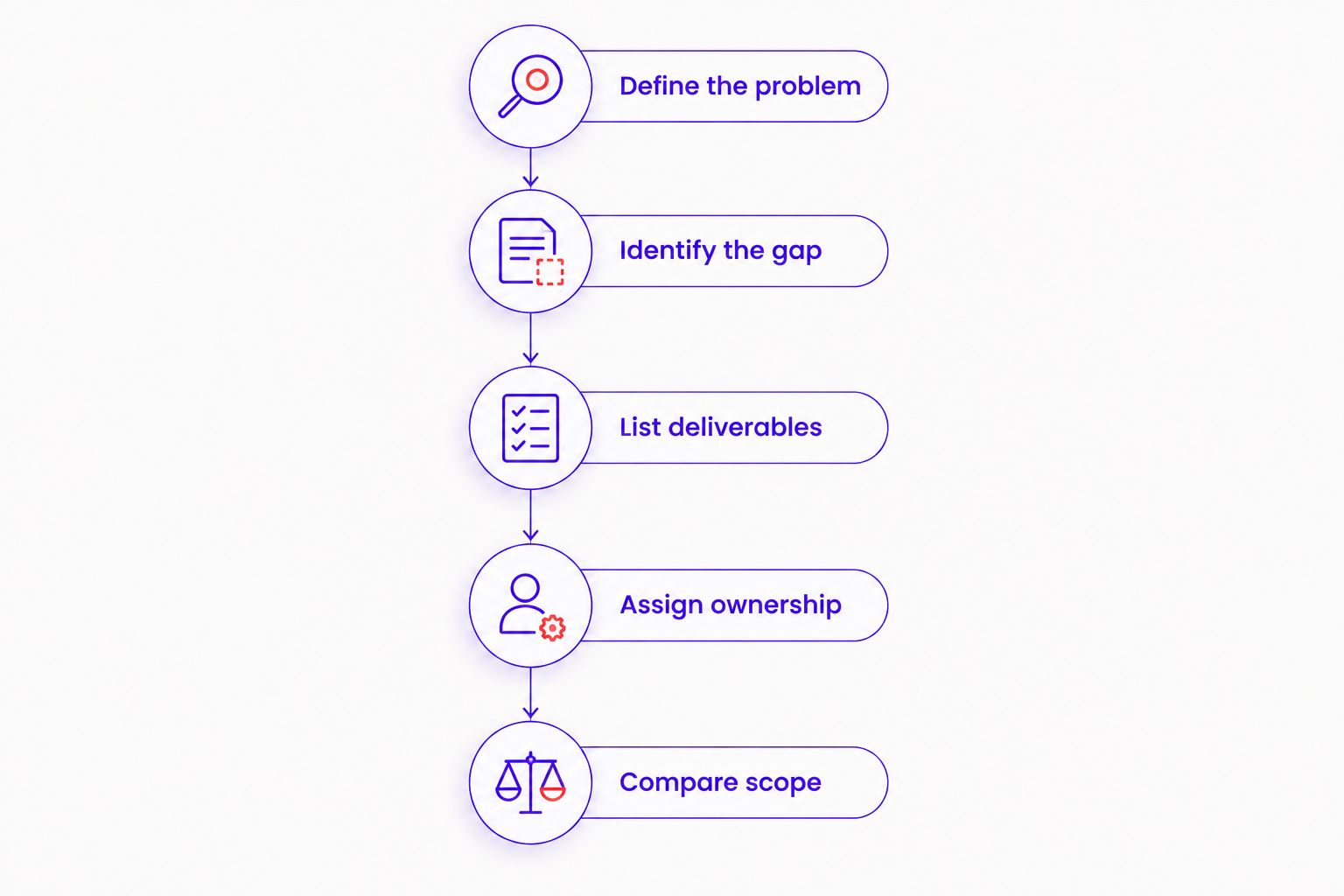
Use this sequence to build your 2026 project brief. It gives prospective partners the same problem to solve and makes their proposals easier to compare.
1. Define the problem
Describe the business issue without prescribing the creative answer. Examples include a confusing offer, inconsistent materials, a website that no longer reflects the business or packaging that does not distinguish products clearly.
Avoid opening with only a request for a new logo. A logo request tells the supplier what to draw, not what needs to change.
2. Identify the gap
Decide whether you need strategic direction, production capacity or both. Name the people inside your business who can write content, manage approvals, build pages and coordinate suppliers.
Do not count a skill as available unless someone can own the work. A marketing lead with a full workload is not automatically a production team.
3. List deliverables
Write the outputs your business needs to use: a positioning document, logo files, brand guidelines, packaging artwork, website pages or campaign assets. Separate launch requirements from later improvements.
For a rebrand, use a branding agency briefing checklist to connect the business problem with the requested work. A specific brief is more useful than a list of visual preferences.
4. Assign ownership
Name the decision-maker for strategy, the approver for creative work and the person supplying product information or content. Ask the provider to name its corresponding project owner.
Approval responsibility matters as much as creative capability. Conflicting feedback can leave a sound direction unresolved.
5. Compare scope
Read proposals against the same deliverable list. Check what the partner will produce, what you must supply, how revisions work and what happens at handover.
A shorter proposal is not necessarily narrower, and a longer proposal is not necessarily better. The test is whether you can identify the promised output and its acceptance criteria.
Why branding project scope varies
The consultant-versus-agency decision changes when the required work changes. For a 2026 proposal, check these scope drivers before comparing fees or committing to a launch date.
- Depth of strategy: refining an existing message is a different assignment from defining the audience and positioning from the start.
- Number of applications: a logo and guidelines do not cover every packaging format, website page or sales document.
- Existing assets: approved content and usable files create a different starting point from incomplete or conflicting materials.
- Production requirements: packaging artwork, website development and video production require their own deliverables and approvals.
- Stakeholder involvement: a founder-led approval process differs from one involving several departments or partners.
- Handover and support: final files, training, supplier coordination and later adaptations need explicit scope boundaries.
These factors explain why two proposals labelled branding can describe different projects. Compare included work before comparing the headline fee. Ask each provider to separate required deliverables from optional additions.
What should you ask before hiring?
Ask questions that expose delivery responsibility. A persuasive presentation is not a substitute for answers you can put into the agreement.
Who will do the work?
Ask who leads strategy, who creates the assets and who manages the project. If outside specialists are involved, clarify who briefs them and remains accountable for the final work.
You are buying a delivery arrangement, not just access to an impressive portfolio. Make sure the proposal identifies the roles your project needs.
What will I receive and own?
Request a deliverable list, file formats, usage rights and any restrictions attached to third-party materials. Separate editable working files from final exports and explain which your team needs.
For packaging and websites, clarify the boundary between design and production. An approved visual does not itself establish responsibility for printing, development or ongoing maintenance.
How will feedback and changes work?
Agree on review stages, consolidated feedback and what counts as a change in scope. Ask what happens if you add a product, change the positioning or request new applications after approval.
For a 2026 launch, connect approvals to the wider launch plan. The agreement should show which decisions must be settled before dependent work begins, without promising a date unsupported by the project scope.
Can a branding consultant also design my logo?
A branding consultant can design your logo if identity design is explicitly part of the service. The consultant title alone does not establish whether the provider offers strategy, design or both.
Ask to see relevant identity work and request the same deliverable detail you would expect from an agency. Buy the named capability, not an assumption about the title.
Do I need both a consultant and an agency?
You need both only when the responsibilities are distinct and the handover is planned. A consultant can define the direction while an agency develops the agreed applications, but someone must own interpretation and final approval.
If an agency already includes suitable strategy work, a separate consultant is not automatically necessary. Ask both providers to explain their roles before commissioning overlapping work.
Is a branding agency necessary if I only need a logo?
A branding agency is not necessary solely because you need a logo. A focused identity designer or consultant with design capability can suit a clearly defined assignment.
An agency becomes relevant when the logo must sit within a wider identity and launch programme. Decide whether you need a standalone mark or a system that will work across packaging, your website and marketing materials.
FAQ
What is the difference between a branding consultant and a branding agency?
A branding consultant is usually hired for strategic guidance, while a branding agency is hired for coordinated strategy and creative delivery. Service boundaries vary, so compare the actual deliverables and implementation responsibilities.
Which is better for a new business in India?
A branding agency fits a new business that needs direction and finished launch assets; a consultant fits a business with an execution team already in place. Choose according to the work you cannot deliver internally.
Should I hire a consultant before redesigning my website?
Hire a consultant first if your audience, positioning or message is unresolved and your website team does not cover that work. If the redesign partner includes suitable strategy, agree on that phase before approving page design.
Does a branding agency always include marketing?
A branding agency does not automatically include marketing in a branding project. Ask whether content, campaign assets, advertising management and reporting are included or separately commissioned.
How do I compare branding consultant and agency proposals?
Compare proposals against the same scope, deliverables, approval process and handover requirements. A fee comparison is meaningful only when you understand what each provider will deliver and what remains your responsibility.
Can CreativHeads help with branding and website work?
CreativHeads offers branding, web design, content and digital marketing services. Define the work you need and confirm the included services, deliverables and responsibilities in the project proposal.
What should I prepare before contacting a branding partner?
Prepare your business problem, priority audience, existing materials and required launch outputs. Add your internal delivery capacity, approval owner and any fixed dependencies so the provider can scope the right engagement.
One last thing
Before signing a 2026 branding proposal, ask: Who turns the approved direction into something our customers will actually see? If the answer names neither your team nor the provider, the project has an ownership gap.
Close that gap before buying more creative work. A clear handover is what connects a good recommendation to a usable brand.
Related guides
- Can logo design include a full brand identity package?
- How to prepare website content before a redesign
- How to compare performance marketing agency proposals