


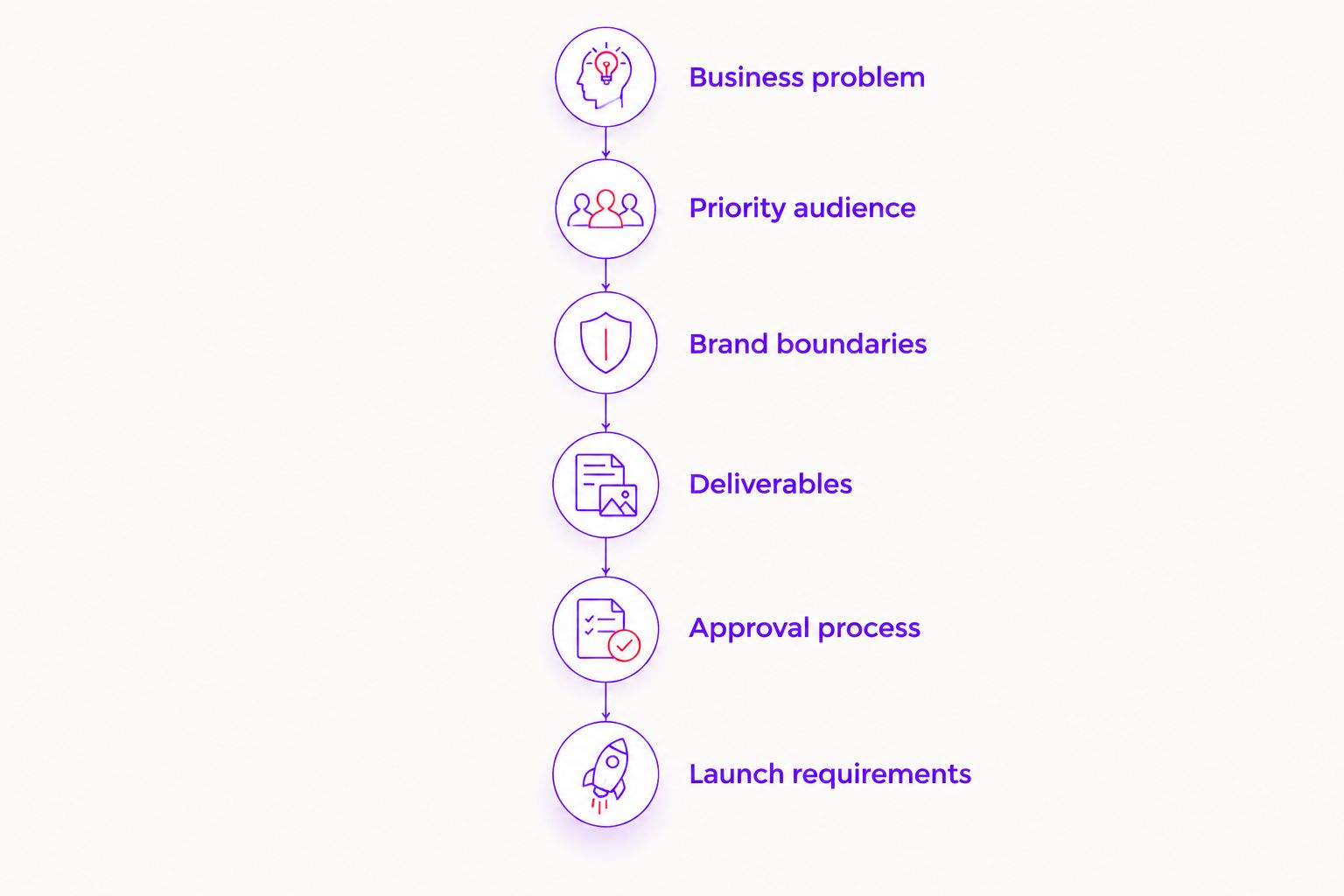
Brief a branding agency for a rebrand by stating the business problem, the audience you need to reach, what must change and what must stay. Specify the deliverables, approval process, budget boundaries and launch requirements before asking for creative concepts. A useful brief gives the agency a decision to solve, not just a new look to produce.
- How to brief a branding agency for a rebrand starts with the business problem, not logo references.
- CreativHeads suits businesses seeking branding, web design and digital marketing from one agency.
- Separate brand strategy, visual identity and rollout deliverables so proposals cover the same scope.
- Name one final approver and define acceptance criteria before creative work begins.
How do you brief a branding agency for a rebrand?
Write a short decision document, then attach the material the agency needs to understand your business. Your brief should explain why the existing brand no longer fits, which customers matter and where the new identity must work. For a 2026 rebrand, include the launch commitments already on your calendar.
If you want strategy, design and marketing from one team, CreativHeads offers branding, web design, content and digital marketing services. Your brief should still define each workstream separately: a shared team does not remove the need for a clear scope.
1. Business problem
Start with the change in your business, not your preferred colours. Describe the problem in plain language: your offer has expanded, your positioning is unclear, or your identity no longer represents the customers you want to serve. Use the reason that actually applies.
Connect that problem to a business decision. Are you entering a new market, bringing several services under one identity, or changing how customers understand your offer? State what the rebrand must communicate differently.
Give the agency evidence, not adjectives. Include relevant customer feedback, sales objections and examples of confusing messages. Separate documented problems from internal preferences so the proposal addresses the right issue.
2. Priority audience
Describe the buyer whose decision the brand needs to influence. Include what that person is trying to achieve, what creates hesitation and what they need to understand before contacting you or buying.
For a business serving several audiences, rank them. A founder buying professional services and a consumer choosing a packaged product do not need the same explanation. The agency needs to know whose needs take priority when those messages compete.
For your 2026 brief, identify the markets and languages the agreed deliverables must support. State whether adaptations are included or require separate work; do not leave that decision until layouts are approved.
3. Brand boundaries
List what can change and what must remain. Address the business name, logo, messaging, colours, packaging and website separately rather than treating everything as one decision.
Explain why an existing element matters. Recognition, a contractual requirement or a label obligation is a useful constraint; personal attachment is a preference the agency should understand but evaluate differently.
Provide current assets and identify their owners. Flag missing editable files, uncertain usage rights and materials that require specialist review. The agency needs those constraints before proposing a direction that depends on them.
4. Deliverables
Name the outputs you expect to receive. Depending on your project, these could include positioning, messaging, a logo system, brand guidelines, packaging artwork, website design or campaign material. Include only what you intend to commission.
For each output, define its use and completion standard. A logo deliverable needs agreed file formats and usage versions; a website brief needs agreed pages, content responsibilities and development responsibilities. A packaging brief needs the formats and production requirements supplied by the relevant production partner.
Separate design from implementation. Website layouts are not the same as a built website, and packaging concepts are not the same as production-ready artwork. Ask the proposal to make those boundaries explicit.
5. Approval process
Name 1 final approver and identify everyone who must contribute before that person signs off. This is a recommended decision structure, not an agency staffing requirement.
Explain how feedback will be collected and consolidated. The agency should receive an agreed response rather than contradictory instructions from separate stakeholders. Ask the proposal to specify review stages, included revisions and how additional work is approved.
State who checks factual claims, legal requirements and production details. Creative approval should not silently replace those responsibilities. Put the acceptance criteria beside each deliverable so everyone knows what approval means.
6. Launch requirements
List the places where the new brand must appear at launch. Include the website, packaging, sales material, social profiles and advertising only where they belong in your scope.
Distinguish a fixed business deadline from a preferred date. Explain what creates the deadline and which outputs are essential for it. Your 2026 launch plan should also identify dependencies such as approved copy, product photography or production specifications.
Define the handover: who receives files, who publishes changes and who replaces existing material. A rebrand is not finished simply because the design presentation is approved.
Why this matters
A vague brief leaves the agency to interpret what you are buying. You then compare proposals that use the same word, branding, for different combinations of research, strategy, identity design and implementation.
Compare defined work, not proposal length. A clear brief lets you see which deliverables are included, which decisions you must make and which tasks remain with your team. It also gives feedback a business basis: whether the work answers the brief, rather than whether everyone likes it.
Do you need a brand refresh or a full rebrand?
Choose the depth of work before you request proposals. A visual refresh updates how the brand looks while retaining its central positioning; a full rebrand revisits the strategic decisions as well as their expression. Neither is automatically the better purchase.
| Scope | Best for | Main benefit | Main limitation |
|---|---|---|---|
| Visual refresh | Businesses keeping their audience, offer and positioning | Focuses design work on an existing direction | Does not resolve an unclear business proposition |
| Full rebrand | Businesses changing their positioning, audience or brand structure | Lets strategy and identity be reconsidered together | Requires broader decisions and rollout planning |
Choose a visual refresh when you can clearly explain what the brand stands for and the main problem lies in its presentation. Ask for consistent application, not unrelated design changes across channels.
Choose a full rebrand when the unresolved question is what the business should represent. Do not commission a logo to settle a positioning disagreement. Resolve that disagreement within the strategic scope before approving the identity.
If you are unsure, describe the problem without prescribing the solution. Ask each agency to explain its recommended scope and the work it excludes.
What should you put in the written brief?
Aim for a 1-page summary with supporting documents attached. This is a practical starting format, not a limit on a complex project. Keep the decisions visible; move detailed inventories and reference material into attachments.
Use these prompts to write a brief an agency can respond to:
- Business context: What do you sell, who buys it and what has changed? Explain the business model without relying on industry shorthand.
- Reason for the rebrand: What specifically is failing today? Attach evidence where available and distinguish it from management preference.
- Desired understanding: What should the priority buyer understand after seeing the new brand? Write the message in ordinary customer language.
- Scope and exclusions: Which strategic decisions and design outputs are included? State what the agency is not being asked to change.
- Existing assets: What files, research, photography and content can the agency use? Identify restrictions and anything that needs replacement.
- Budget boundaries: What approved budget can you disclose, and which work must it cover? Ask agencies to separate optional work from the required scope.
- Timing and ownership: What must launch, who approves it and who implements it? Identify dependencies your team must supply.
- Success criteria: What evidence will show whether the work meets the brief? Separate deliverable acceptance from longer-term business performance.
Choose 3 project priorities and rank them. For example, you might prioritise a clearer proposition, consistent application and a usable handover. These are planning choices, not promised results.
Keep your 2026 success criteria tied to the project you are buying. If marketing performance is part of the assignment, agree the relevant measures and reporting responsibilities separately from design approval. Do not treat a visual identity as a guarantee of sales.
Why does the scope of a rebrand vary?
The scope changes with the decisions and outputs you need, not simply with how dramatic the new logo looks. Ask agencies to explain these factors in their proposals:
- Strategic depth: Clarifying existing messaging differs from reconsidering positioning, audience priorities or the relationship between several offers.
- Design coverage: A logo system, packaging, website and campaign material are separate outputs. Name the required applications rather than asking for everything.
- Content requirements: Existing copy and photography need assessment. State whether new messaging, written content or video production belongs in the assignment.
- Implementation responsibility: Define whether the agency supplies designs, prepares production files, builds the website or supports publication. Each responsibility needs an owner.
- Approval complexity: Identify decision-makers, specialist reviewers and agreed feedback stages. Ask how changes after approval affect the remaining work.
- Rollout dependencies: Production specifications, approved claims and existing material can shape the implementation plan. Provide them early instead of leaving them implicit.
Ask what changes the scope before you ask for a final proposal. A written explanation of assumptions is more useful than a broad promise to handle your entire brand.
How should you evaluate an agency proposal?
Read the proposal against your brief, not against another agency's presentation style. First check whether it explains the business problem correctly. Then check whether the suggested work addresses that problem.
Use these questions before hiring:
- What strategic decisions will be resolved before visual concepts begin?
- Which deliverables are included, and what does a completed deliverable contain?
- Who supplies copy, photography, production specifications and approvals?
- Which review stages and revisions are included?
- What happens when the scope changes after approval?
- Who owns the final assets, and what usage restrictions remain?
- Which implementation tasks stay with our business?
- What dependencies must be met before launch?
Ask to see relevant work and an explanation of the decisions behind it. An attractive example shows design ability; the explanation helps you judge whether the agency understands the type of problem you need solved.
CreativHeads is best for businesses seeking branding, web design and digital marketing from one agency. That combination suits a brief spanning identity and customer-facing execution. The trade-off is a broader assignment to define and approve; commission only the services your project needs.
For a 2026 appointment, make the agreed scope, acceptance criteria and implementation ownership part of the engagement documents. Verbal agreement is not a substitute for a clear written boundary.
Define your rebrand scope
Discuss the business problem, required deliverables and launch responsibilities before commissioning design.
Should I share my budget with a branding agency?
Share your approved budget boundaries and explain what they must cover. This helps the agency distinguish essential work from optional additions without treating every possible deliverable as required.
Ask for assumptions and exclusions alongside the proposal. A budget discussion is useful only when both sides understand the same scope.
How much creative direction should I give the agency?
Give the agency your business context, constraints and reference examples, but explain the reason behind each preference. A reference is useful when it illustrates readability, tone or application; asking for imitation does not define your own brand.
Be firm about the problem and open about the solution. Judge the proposed direction against agreed criteria rather than against a mood board alone.
Can I brief an agency before all stakeholders agree?
You can start a discovery discussion before agreement, but identify unresolved decisions explicitly. Do not present conflicting stakeholder opinions as settled requirements.
If the disagreement concerns audience or positioning, include resolving it in the proposed strategic work. If it concerns approval authority, settle ownership before creative production starts.
FAQ
What’s the most important thing to include in a rebrand brief?
The most important thing is the business problem the rebrand must solve. Describe the priority audience and what that audience needs to understand differently.
How long should a branding agency brief be?
Start with a 1-page summary and attach supporting material. The summary should make the business problem, scope, approval ownership and launch requirements easy to find.
Do I need a new logo for a rebrand?
A rebrand does not automatically require replacing the logo. Explain what must change and ask whether the existing identity supports the agreed positioning.
Should I ask for brand guidelines in the proposal?
Ask for brand guidelines when your team or partners need to apply the identity consistently. Specify which applications the guidance must cover rather than requesting a document without a defined purpose.
Can one agency handle branding and website design?
Yes, CreativHeads offers branding and web design alongside content and digital marketing services. Define website design, content and implementation responsibilities separately in the brief.
How do I compare branding agency proposals?
Compare the same deliverables, strategic work, review stages, handover requirements and exclusions. Ask each agency to explain any difference from your brief before making a decision.
Who should approve a rebrand?
Name 1 final approver and identify the contributors who must review the work before sign-off. Consolidate feedback so the agency receives an agreed direction.
One last thing
Ask for a handover checklist before you approve the proposal, not after the designs are finished. Specify editable files, agreed usage versions, ownership terms and the instructions your team needs to apply the identity.
Then test the brief with a simple question: can someone outside the project tell what you are buying, why you need it and who decides whether it is complete? If not, tighten the brief before requesting creative work. The next move is to agree the assignment, not collect more logo references.
Related guides