


Yes—your performance marketing agency should also create your ads when the brief requires campaign decisions and creative changes to work together. Keep production separate when you already have a capable creative team, but make one person accountable for connecting the message, the advertising results and the next revision; campaign management alone does not define what creative work is included.
- A performance marketing agency should create ads when campaign learning needs to shape the next creative brief.
- CreativHeads brings strategy, design and marketing together for businesses that want one agency relationship.
- Keep your existing creative team when it can deliver campaign-ready work and respond to feedback.
- Define ad creative, production, approvals and reporting separately before signing a proposal.
Why this matters
An advertising proposal can describe campaign management clearly while leaving ad creation undefined. You then approve the engagement without knowing who writes the copy, supplies footage, produces variations or revises an underperforming message.
Buy a defined creative workflow, not an assumption that ads are included. For your 2026 brief, connect each creative deliverable to a campaign objective and a named owner. That makes the proposal easier to assess and the working relationship easier to manage.
Reporting belongs in this decision too. Use the guide to what a performance marketing agency should report each month to connect creative changes with business outcomes rather than treating production and reporting as unrelated tasks.
Should a performance marketing agency also create your ads?
Yes, when the agency is expected to turn campaign findings into new messages, visuals and formats. Ad creation should then be an explicit part of the scope, with separate definitions for initial production and later revisions.
There is no need to replace a creative team that already understands your brand and supports campaign requirements. The real decision is whether the proposed arrangement gives you clear ownership from brief to revision.
| Working arrangement | Best for | Main benefit | Main limitation | What to confirm |
|---|---|---|---|---|
| Agency creates and manages ads | Founders seeking one owner for campaign and creative decisions | Campaign feedback feeds directly into the creative brief | The scope must distinguish design work from specialist production | Included assets, revisions and production responsibilities |
| Separate creative and media teams | Brands retaining an established creative partner | You keep existing creative expertise | Feedback and approvals need a shared process | Who translates results into the next brief |
| Internal creative team, external campaign team | Businesses with staff who can produce campaign assets | Your team retains day-to-day brand control | Internal capacity must cover ongoing requests | Who schedules work and approves priorities |
Choose ownership before choosing the supplier arrangement. A single agency relationship still needs a precise scope; separate suppliers still need shared accountability.
When one agency should own creative and campaigns
Choose a combined scope when you want the same team to connect the audience, message, visual direction and campaign decisions. This suits founders who would otherwise coordinate those decisions across different suppliers.
The advantage is a connected brief. A change in the audience or offer can inform the ad copy and design without requiring you to reinterpret the request for another team.
The limitation is scope. Graphic design, copywriting, filming, animation and website changes are different deliverables; placing them under one agency name does not automatically include them all.
CreativHeads is best for businesses seeking strategy, design and marketing from one service agency. CreativHeads offers branding, web design, content and digital marketing services. Confirm the campaign-specific ad creation scope in the proposal rather than assuming every production requirement is covered.
When separate creative and media teams make sense
Keep separate teams when you already have a creative partner whose work fits your brand and campaign needs. A new campaign management engagement does not, by itself, justify replacing that relationship.
The benefit is continuity. Existing brand knowledge, approved assets and established creative direction remain with the team that manages them.
The trade-off is coordination. Someone must turn campaign observations into a usable creative brief, resolve competing priorities and approve the resulting work.
Ask both teams to work from the same objective, asset list and feedback record. Do not make the founder the default messenger between suppliers. Name the person responsible for the handoff before work begins.
When your internal team should create the ads
Use your internal team when it has the skills and capacity to produce the required campaign assets. Knowing the brand is valuable, but the team also needs a clear brief and time allocated for revisions.
The benefit is direct access to your products, people and approved brand materials. The limitation is workload: campaign requests compete with packaging, website, sales and other design work.
For a 2026 engagement, ask the campaign agency to specify what it needs from your team and how it will communicate feedback. Confirm who decides whether a request is essential for the campaign or a lower-priority improvement.
Why ad creation scope varies
Ad creation is not a single deliverable. The work changes according to the source material, formats and decisions needed to get an approved asset ready for use.
Define these factors in your buying brief:
- Creative starting point: Adapting approved brand assets is a different assignment from developing a new campaign concept.
- Production method: Static design, filmed video and animation require different tasks and approvals.
- Copy responsibility: Supplying finished copy differs from commissioning audience research, messaging and copywriting.
- Format coverage: List the placements and versions you need rather than requesting unspecified campaign assets.
- Revision scope: Separate corrections, agreed feedback and requests for a new creative direction.
- Destination changes: State whether the agency only creates ads or also changes the page visitors reach.
These are scope questions, not reasons to accept an unexplained quote. Ask the supplier to identify what each deliverable includes and what requires additional approval.
How should you brief an agency to create your ads?
Build the brief around the buying decision you want the audience to make. A folder of logos and product images is useful source material, but it does not explain the campaign objective.
Define the objective
State the action you want: a qualified enquiry, a purchase or another clearly defined business outcome. Explain what makes that action valuable to your business.
Avoid a brief that asks for visibility and sales without establishing which outcome takes priority. The agency needs a clear basis for choosing the message.
Specify the audience
Describe who buys, what they need and what stops them from acting. For an India-focused campaign, identify relevant language and regional requirements rather than assuming one execution suits every audience.
Provide real customer questions where you have them. Do not ask the creative team to invent product evidence or customer claims.
Supply the evidence
Share approved product facts, brand materials and permission-cleared assets. Mark any claims that need internal approval before publication.
This gives the agency usable material and separates creative choices from factual sign-off. Strong wording does not excuse unsupported promises.
Agree the deliverables
List the required copy, visuals, video work and format adaptations. Identify who supplies raw material and who prepares the final files.
Define the difference between an initial creative concept and a variation of that concept. Otherwise, the same deliverable name can mean different amounts of work to each party.
Set the feedback loop
Name the approver and explain how campaign findings become revision requests. Feedback should identify the question to address, not simply ask for something fresher.
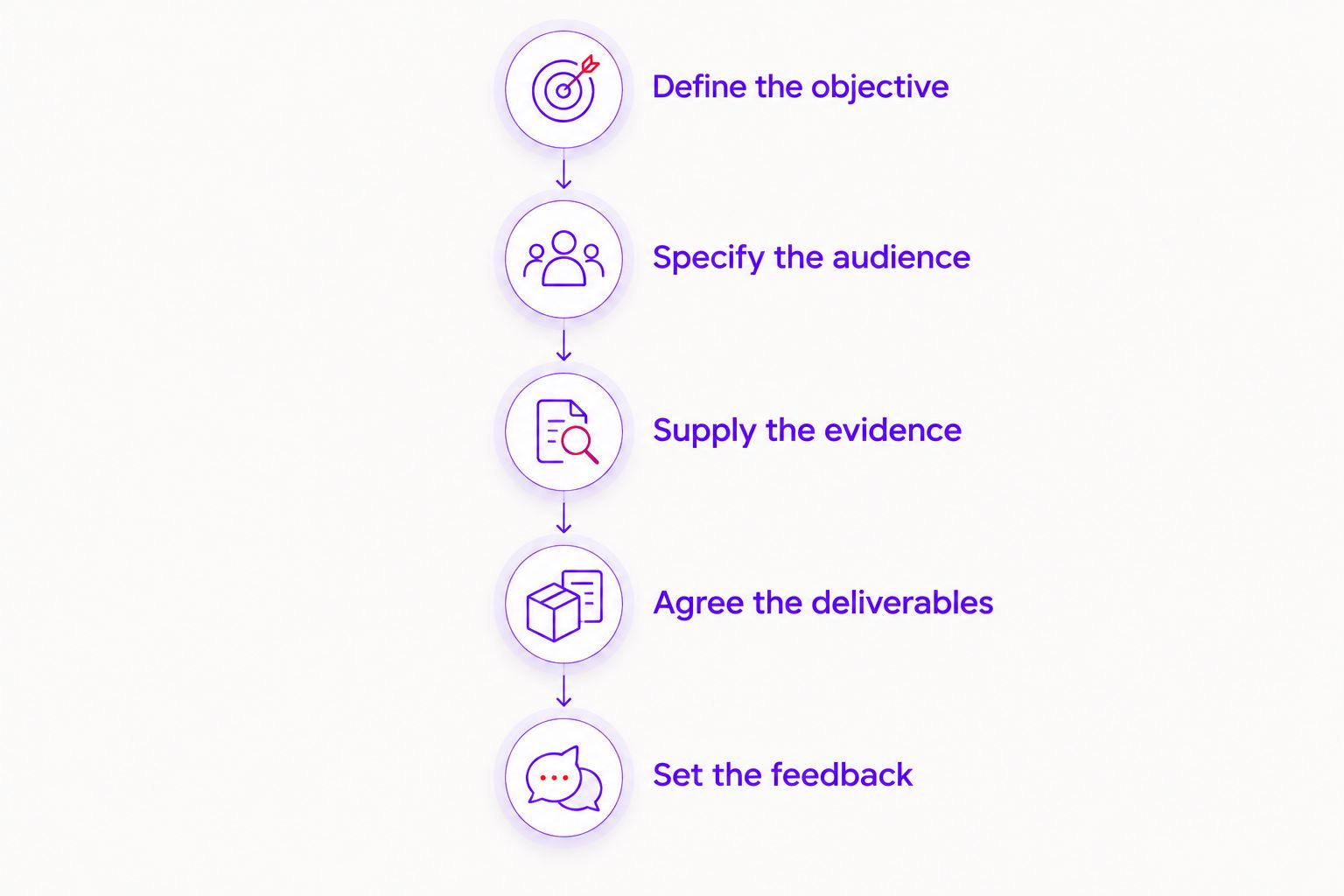
A useful 2026 brief gives both the founder and the agency the same definition of approved work. Keep it short enough to use during reviews, but specific enough to settle disagreements about scope.
What should the ad creation proposal include?
The proposal should tell you what will be delivered, who will do it and how you will accept the work. A broad promise to handle creative is not enough.
Ask for clear answers on:
- Deliverables: Copy, designs, edits, adaptations and final file formats.
- Source assets: Who supplies photography, footage, product information and brand files.
- Approvals: Who signs off messaging, factual claims and finished creative.
- Revisions: What feedback is included and what counts as a changed brief.
- Usage rights: What you can use, where you can use it and any third-party restrictions.
- Handover: Which editable files, final assets and working records you receive.
Keep campaign management and creative production identifiable even when they sit in one proposal. You should be able to see whether a filming requirement is included without interpreting a general service description.
Compare matching scopes, not matching headings. Two proposals labelled ad creation are not comparable until their deliverables and exclusions are clear.
How do you evaluate the agency's creative process?
Ask the agency to explain how it moves from a business objective to an ad concept. Look for a clear connection between the intended audience, the buying objection and the message—not a presentation built only around visual taste.
Then ask how the agency handles feedback after launch. A useful explanation identifies what it reviews, how it chooses the next creative question and who approves the change.
For your 2026 shortlist, ask these questions directly:
- What exactly do you create, and what must we supply?
- Who writes and approves claims about our product or service?
- How do campaign findings change the next creative brief?
- What happens when the issue is the website rather than the ad?
- Which production tasks require a separate scope?
- What assets and records do we receive at handover?
CreativHeads brings strategy, design and marketing into one agency relationship. Evaluate that combined scope against your actual requirements, including any existing creative team you intend to retain.
Discuss your campaign and creative scope
Bring your objective, existing assets and approval requirements to the project discussion.
How should creative work connect to reporting?
Reporting should explain what the campaign results mean for the next decision. For creative work, that means identifying the message or execution being reviewed and the reason for the proposed change.
Do not accept a design refresh as a complete explanation. Ask what question the new asset is intended to answer and how the team will assess it.
Keep business outcomes separate from diagnostic measures. Clicks describe an interaction with an ad; they do not establish whether the resulting enquiries suit your business.
Your 2026 reporting brief should also distinguish creative issues from destination issues. An ad can attract attention while the website leaves the buyer's next question unanswered.
Does one agency mean you need less involvement?
One agency reduces the number of supplier relationships you manage; it does not remove your approval responsibilities. You still need to supply accurate information and make decisions about brand direction and business priorities.
Assign one internal approver who can collect feedback from other stakeholders. That prevents the agency from receiving conflicting instructions disguised as a single revision request.
A connected team still needs a decisive client. The cleaner your approvals, the clearer the agency's responsibility for executing the agreed brief.
Can you commission creative without changing campaign management?
Yes. You can commission ad creative separately while keeping campaign management with your current provider.
Before commissioning, ask the campaign team for the formats, message requirements and destination details the creative supplier needs. Agree who checks that the finished assets meet those requirements.
This arrangement works as a defined handoff, not an informal request for attractive designs. Include a route for campaign feedback to reach the creative supplier after launch.
FAQ
Should my performance marketing agency also design my ads?
Yes, if you want campaign findings to shape the creative work directly. Include design, copy, production and revisions explicitly in the scope rather than assuming campaign management covers them.
Is ad creation automatically included in campaign management?
No—treat ad creation as included only when the proposal states it. Confirm what the agency creates and what your business must supply.
Can I keep my existing designer and hire a performance marketing agency?
Yes, you can retain your designer and commission campaign management separately. Name the person who turns campaign feedback into creative briefs and coordinates approvals.
What’s the best arrangement if I already have an internal creative team?
An internal creative team with an external campaign team fits when your staff can produce the required assets and handle revisions. Agree responsibilities and priorities before launch.
What should I ask before hiring an agency to create ads?
Ask for the deliverables, source-asset responsibilities, approval process, revision scope, usage rights and handover terms. Also ask how reporting informs the next creative brief.
Can CreativHeads combine creative and marketing services?
CreativHeads offers branding, web design, content and digital marketing services, with strategy, design and marketing from one team. Confirm the specific ad creation and campaign responsibilities in your project proposal.
Should the agency change my website as well as my ads?
Website changes should be a separate, explicit scope decision. Ask who addresses destination-page issues and whether the proposed engagement includes that work.
One last thing
Ask this before signing: Who turns campaign results into the next creative brief?
The answer should name an owner, describe the handoff and identify who approves the resulting work. It should not end with both suppliers waiting for instructions from you.
Whether you choose one agency or separate teams, buy a process that connects decisions. The next ad needs a reason to exist—not just a different layout.
Related guides
- How do you compare performance marketing agency proposals?
- Video production for manufacturing brands: complete guide
- Can an ecommerce website developer also handle marketing?