


Performance marketing is better when your immediate goal is measurable enquiries or sales; traditional advertising is better suited to broad visibility and repeated brand exposure. Neither wins every brief, and a combined plan makes sense when you need both awareness and a clear route to purchase. The main caveat is measurement: an attributed conversion does not prove that an advertisement created demand, while an untracked sale does not mean advertising had no effect.
- Performance marketing vs traditional advertising is a choice about business goals, not a universal winner.
- Performance marketing suits measurable enquiries and sales; traditional advertising suits broad visibility and repeated exposure.
- Judge campaigns by qualified leads and completed sales, not clicks alone.
- CreativHeads suits brands seeking strategy, design and digital marketing from one agency.
Why this matters
For a growing brand in India, the wrong advertising brief creates the wrong success measure. A launch built around recognition should not be judged only by immediate enquiries; a sales campaign should not hide behind reach.
Your 2026 advertising plan needs an agreed business outcome before channel selection. Start by defining what a performance marketing agency should report each month, including what happens after someone submits an enquiry. That makes the buying decision about accountability rather than a persuasive pitch.
Is performance marketing better than traditional advertising?
Performance marketing wins on traceable response; traditional advertising serves a different purpose when the brief centres on broad exposure. The distinction is not simply online versus offline. Digital campaigns can build awareness, and traditional advertisements can generate trackable responses through dedicated phone numbers, landing pages or response codes.
Performance marketing is an approach organised around defined actions, such as enquiries or purchases. Traditional advertising commonly includes print, outdoor, radio and television placements. Compare the work each approach must do before comparing the media itself.
| Approach | Best for | Main strength | Main limitation | What to judge |
|---|---|---|---|---|
| Performance marketing | Brands seeking measurable enquiries or sales | Connects campaign activity with defined responses | Attribution does not establish whether advertising caused the sale | Qualified enquiries, completed sales and acquisition efficiency |
| Traditional advertising | Brands seeking broad visibility or local presence | Creates exposure without requiring an immediate click | Direct response is harder to connect to individual placements | Relevant audience exposure, recall research and trackable responses where available |
| Combined advertising | Brands needing visibility and a route to conversion | Gives awareness and response distinct jobs | Requires coordinated creative, spending and measurement | Separate awareness outcomes and sales outcomes |
Do not compare an outdoor awareness campaign with a search campaign using clicks as the common score. Those placements perform different jobs. Compare each against its brief, then assess whether the overall plan supports your business objective.
Performance marketing: best for measurable action
Choose performance marketing when you can describe the action you want, recognise a valuable customer and connect enquiries or orders to business records. That gives campaign decisions a clear basis. You are not simply buying traffic.
For a service business, the desired action might be a qualified project enquiry. For an online store, it might be a completed purchase. These are different outcomes, so they need different campaign messages, destination pages and reporting.
The advantage is a visible feedback loop. You can examine which advertisements generate responses, whether those responses qualify, and whether they turn into business. This supports decisions about creative, targeting and the website experience.
The limitation is that visible activity can look more valuable than it is. Cheap enquiries are not automatically good enquiries, and a campaign that reaches existing customers does not necessarily create new demand. Tracking records a path; it does not explain every influence on the purchase.
Before commissioning a 2026 campaign, ask the agency to define the conversion and explain how it will distinguish a submitted form from a qualified prospect. If that distinction is absent, the reporting brief is incomplete.
Traditional advertising: best for broad visibility
Choose traditional advertising when your brief depends on exposure in a particular place, audience or viewing context. A local launch, retail presence or awareness campaign can have a different job from an immediate-response advertisement.
The strength is the placement itself. An outdoor advertisement can put a message in a physical location; print, radio and television offer their own audience contexts. Whether that context is valuable depends on who you need to reach and what you want them to remember.
The limitation is less direct feedback. Seeing an advertisement does not require someone to click, identify themselves or take an immediate action. That makes it harder to connect individual exposure with a later purchase.
Ask for the placement rationale, the intended audience and the evidence behind the proposed reach. Also ask how the agency will assess the campaign after launch. A visibility campaign still needs accountability, even when clicks are not its purpose.
For a 2026 launch, specify the message people should remember and the next action available to them. An attractive placement cannot compensate for an unclear offer or a destination that leaves buyers confused.
Combined advertising: best for connected brand building and sales
Choose a combined plan when awareness and response are both explicit requirements. Give each channel a defined role rather than asking every advertisement to achieve everything.
Traditional advertising can introduce a brand or reinforce its presence. Performance campaigns can present a specific offer and direct interested people towards an enquiry or purchase. Those roles need consistent messaging, but they do not need identical advertisements.
The advantage is coordination. Your audience encounters a recognisable promise, then finds a clear explanation when they take action. The limitation is greater planning complexity: creative production, placements, destination pages and reporting must agree on the same offer.
Avoid assuming that a combined plan requires every available channel. Commission the smallest set of activities that covers the jobs in your brief. Add a channel because it serves an objective, not because it makes the proposal look substantial.
Why the better choice varies
The better approach changes with the buying situation. These factors belong in your brief:
- Business goal: Recognition, enquiries and purchases require different messages and evidence of success.
- Customer readiness: Someone actively looking for a supplier needs different information from someone encountering your brand for the first time.
- Geography: A location-specific brief needs a clear explanation of where the audience lives, works or buys.
- Purchase path: A direct online purchase and a considered project enquiry need different destinations and follow-up.
- Measurement readiness: Campaign reporting depends on defined actions, reliable tracking and records of what happens after the response.
- Creative requirements: Packaging, video, website content and advertisement formats create different production tasks and approval needs.
These factors also change the work involved. A proposal covering advertisement management alone is not equivalent to one covering strategy, creative production, website changes and sales reporting. Compare the scope before deciding which proposal represents better value.
How do you turn the choice into a project brief?
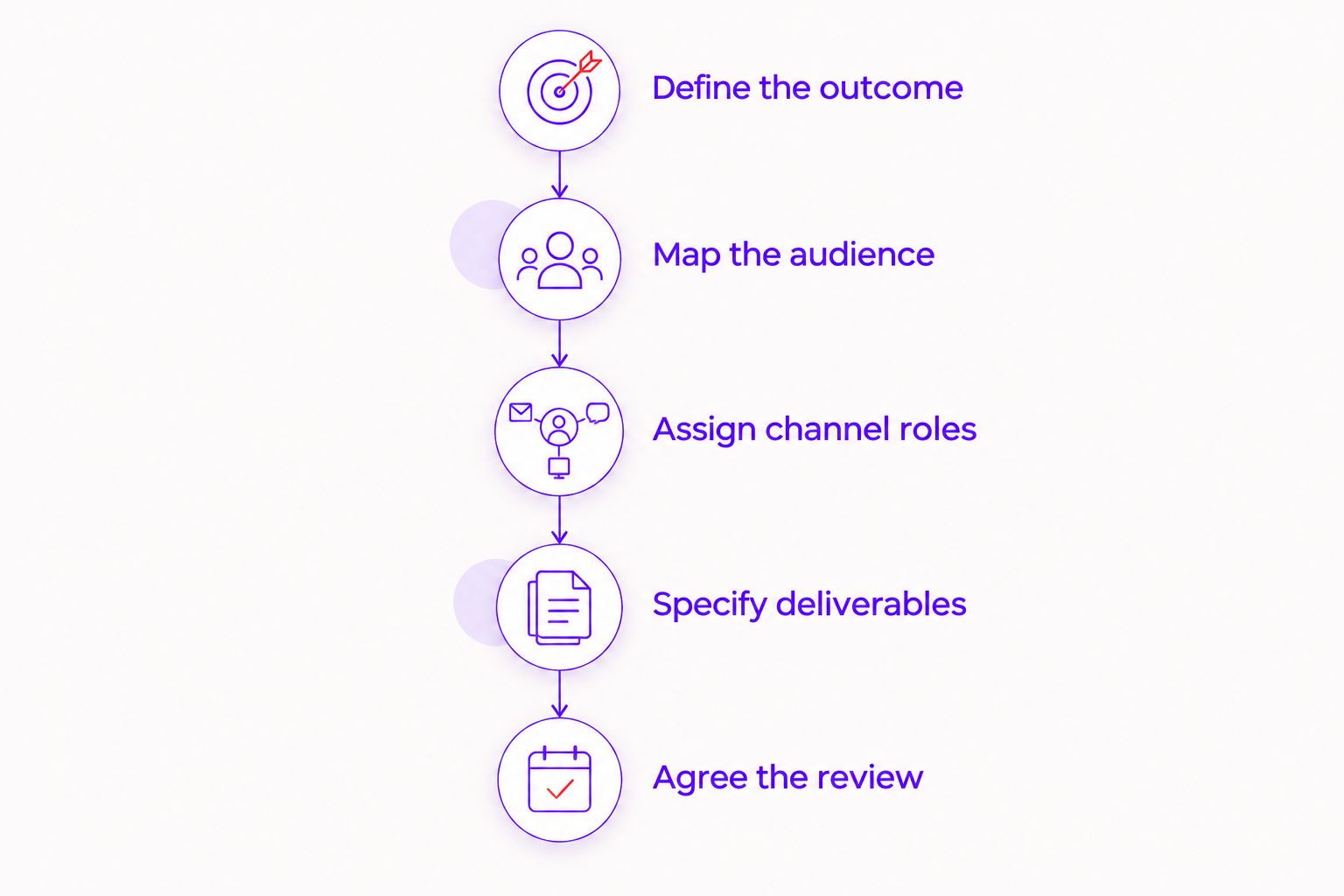
Use this sequence to make a 2026 proposal specific enough to evaluate. Keep the decisions in order: the channel should follow the business goal, not determine it.
- Define the outcome. State what the campaign must achieve. For enquiries, explain what makes a prospect qualified; for purchases, specify which completed actions count.
- Map the audience. Describe who buys, where you need to reach them and what they need to understand before acting. Include objections that the advertisement or website must address.
- Assign channel roles. Give every proposed channel a job, such as visibility, enquiry generation or purchase completion. Remove activities with no clear role.
- Specify deliverables. List the creative formats, destination pages, tracking work, reports and approval responsibilities. Separate ongoing management from production tasks.
- Agree the review. Decide which evidence will inform changes and who will supply sales feedback. Record how the agency will explain weak results and propose the next action.
CreativHeads is best for growing brands that want strategy, design and digital marketing from one agency. CreativHeads offers branding, web design, content and digital marketing, so the service mix is relevant when your campaign also needs a clearer identity or website.
An integrated brief keeps these connected tasks under one plan. It does not remove your responsibility to approve the scope, provide accurate product information and explain which enquiries become business. Ask how those responsibilities will work before commissioning the project.
How should you judge lead quality rather than lead volume?
For a service business, the campaign is not finished when a form arrives. You need to know whether the prospect fits your service, location and project requirements, and whether the sales team can progress the enquiry.
Compare campaign records with sales records. Use agreed statuses such as qualified, unsuitable, proposal sent and won, then explain why enquiries fail to progress. An agency cannot make useful campaign decisions from a list of submissions alone.
The same distinction shapes lead generation strategies for specialised contractor services: attracting interest and identifying a suitable project are different tasks. Your brief should explain the service area, the work you accept and the information needed to assess an enquiry.
For your 2026 review, separate advertising problems from follow-up problems. An irrelevant enquiry suggests a message or audience issue; an unanswered relevant enquiry points to a handoff issue. Treating both as the same failure produces the wrong fix.
What should you ask before hiring an agency?
A good proposal makes the work understandable. Ask questions that expose the responsibilities behind the channel recommendation:
- What business outcome determines success, and which actions count towards it?
- Why does each proposed channel fit our audience and buying situation?
- Which advertisements, videos, landing pages and website changes are included?
- Who owns the accounts, creative files and campaign records?
- What information must our team provide before launch?
- How will you distinguish qualified enquiries from total enquiries?
- What changes require separate approval or additional scope?
- What will you recommend if the campaign generates activity but not business?
Reject a proposal that promises results without defining the result or the work required. Equally, do not penalise an awareness proposal for lacking an immediate-sales promise. Ask whether its measurement plan matches its actual objective.
Can traditional advertising generate measurable leads?
Traditional advertising can generate measurable leads when the response route is identifiable. A dedicated phone number, landing page or enquiry question can help connect responses with a placement.
The limitation remains: people can see an advertisement and respond through another route. Treat identified responses as evidence, not a complete account of every influence.
Should a new business choose performance marketing first?
Performance marketing is a suitable first choice when a new business has a clear offer, a usable enquiry or purchase path, and a way to assess response quality. It gives the campaign a specific action to pursue.
If the identity, message or website is unclear, address that work in the brief. Buying traffic does not resolve an offer that buyers cannot understand.
Does one agency make a combined campaign easier to manage?
One agency gives you a single place to coordinate strategy, creative and marketing, provided the proposal defines responsibilities clearly. The benefit is connected decisions, not an automatic performance improvement.
CreativHeads brings those service areas together. Evaluate the proposed deliverables and handoffs rather than assuming that the service list alone answers your brief.
FAQ
What’s the main difference between performance marketing and traditional advertising?
Performance marketing is organised around defined responses, while traditional advertising commonly uses placements such as print, outdoor, radio and television. Either approach can support awareness or response; the brief and measurement plan determine its role.
Is performance marketing always better for sales?
Performance marketing is better suited to tracing sales responses, but tracing a sale does not prove the campaign created it. Assess completed business, customer quality and the wider buying path rather than clicks alone.
Can I use traditional advertising and performance marketing together?
Yes, use traditional advertising and performance marketing together when each has a distinct job. Keep the brand promise consistent and measure awareness separately from enquiries or purchases.
How do I compare agency proposals in 2026?
Compare 2026 agency proposals by objectives, deliverables, responsibilities and measurement. Separate campaign management from creative production, website work and sales follow-up so you compare equivalent scopes.
What changes the scope of an advertising project?
The scope changes with channel selection, creative formats, website work, tracking requirements and reporting responsibilities. Request a written breakdown before approving the project.
What should I track when my goal is project enquiries?
Track qualified enquiries and their progress towards completed business. Total submissions matter less when they include unsuitable locations, services or project requirements.
Is CreativHeads a software platform or a marketing agency?
CreativHeads is a creative agency offering branding, web design, content and digital marketing services. It suits a service brief that connects brand presentation with marketing activity.
One last thing
Write down what would make you change the campaign before you launch it. If you cannot say which evidence would trigger a different message, destination page or channel choice, the reporting plan is not yet useful. That decision rule makes your next review a business conversation rather than a tour of advertising charts.
Related guides
- How to compare performance marketing agency proposals
- Preparing website content before a redesign
- Planning social advertisement versions with a video production company