


Social media management services should include a monthly plan, agreed content deliverables, approval and publishing, community-response responsibilities, and a report that explains results and next actions. Your 2026 proposal should also separate routine management from paid advertising, video shoots, influencer work and customer support, so you know exactly what you are commissioning.
- What should social media management services include? A plan, content, publishing, response responsibilities and reporting—not just posts.
- CreativHeads suits brands seeking strategy, design and digital marketing from one agency.
- Define organic social media deliverables separately from paid advertising and video production.
- Approve a monthly content calendar and require reporting that changes the next month’s plan.
Why this matters
A proposal built around a post count tells you how much content you receive. It does not tell you who chooses the message, checks product claims, handles enquiries or explains whether the work supports your business.
CreativHeads is best for brands seeking strategy, design and digital marketing from one agency. CreativHeads brings those services together; your proposal still needs to specify which responsibilities belong in your monthly engagement. An integrated team does not mean every service is automatically included.
For a growing brand in India, the buying decision is practical: can the agency turn your business priorities into consistent communication without leaving your team to manage every handover? Use the scope—not the presentation—to answer that question.
What should social media management services include each month?
A complete monthly scope connects planning, production, publishing, audience responses and reporting. Each part needs an identifiable output and a responsible person. Treat the following table as a proposal checklist, not a claim that every agency includes every item.
| Monthly component | What the proposal should specify | What you should be able to review |
|---|---|---|
| Planning | Business objective, audience, channels and content themes | A calendar explaining what each piece supports |
| Content creation | Formats, copy, design, source material and adaptations | Assets prepared for the agreed channels |
| Approvals | Review deadlines, decision-maker and revision boundaries | A clear approval record before publishing |
| Publishing | Scheduling, account responsibilities and final checks | A record of what went live |
| Community responses | Covered channels, response boundaries and escalation | A record of questions requiring business input |
| Reporting | Agreed measures, interpretation and next actions | A monthly review linked to the next plan |
Buy a defined workflow, not an undefined promise to manage your presence. If a proposal omits a component, ask whether your team owns it or whether it requires a separate scope.
Planning: connect the calendar to a business priority
The calendar should explain the purpose of the content. A product introduction, a customer question, a founder story and a sales campaign need different messages; filling empty dates is not a strategy.
Ask the agency to identify the audience, the intended action and the material needed from your team. For a launch, that material might include approved product information, images and a destination for enquiries. These are briefing requirements, not assumptions about what an agency already has.
Your 2026 calendar should also distinguish planned content from reactive content. Specify who can request an urgent change and what happens to work that has already been approved.
Content creation: define what counts as a deliverable
List the formats you need: static designs, carousels, short videos, captions or adaptations for different channels. Then define the counting rule. A design resized for another platform is not necessarily a new creative idea, and a cut from existing footage is not the same assignment as a filmed production.
Ask whether copywriting, subtitles, thumbnail design and channel-specific versions belong in the agreed scope. Name the source of photographs and footage. This prevents a content package from depending on assets nobody has agreed to supply.
Content should also follow approved brand guidance. If you need a new visual identity or a change in positioning, commission that work explicitly rather than expecting monthly posts to resolve it.
Approvals and publishing: make responsibility visible
The proposal should state who reviews content, how feedback is consolidated and what approval means. Your team should verify product information and business commitments before publication; the agency should have a clear route for resolving questions.
Define the boundary between a revision and a new brief. Correcting an approved caption and replacing the entire campaign direction are different tasks. A written distinction gives both sides a workable process.
Publishing responsibility should cover scheduling, channel-specific checks and handling failed or incorrect posts. Ask what happens when approval arrives late. Do not leave that decision until a launch is waiting.
Community responses: separate engagement from customer support
Comment and message handling needs its own scope. Specify whether the agency acknowledges enquiries, answers approved questions, directs people to your team or provides ongoing support.
Set escalation rules for complaints, sensitive issues and requests that require account or order information. The agency should not invent answers to keep a conversation moving. Your business needs to provide the authorised response or take ownership of the case.
Also define coverage periods and the handover process. A monthly management contract does not, by itself, establish continuous response coverage.
Reporting: require an explanation and a decision
A report should show the agreed activity and performance measures, explain what changed, and identify the next action. Separate organic results from paid campaign results so the report does not blur different kinds of work.
For your 2026 review, ask which measures reflect visibility, which reflect interaction, and which connect to enquiries or purchases where tracking exists. State the limits of attribution: a social interaction is not automatically a sale.
If advertising is also commissioned, use the guide to what a performance marketing agency should report each month to define that reporting separately. The useful output is a decision about the next month's work, not a collection of screenshots.
Which monthly scope fits your business?
Choose the service boundary according to the work your business needs and can support. These are buying options, not named CreativHeads packages.
| Scope option | Best for | Main benefit | Main limitation |
|---|---|---|---|
| Publishing support | Brands with approved content already available | Keeps scheduling and publishing organised | Does not solve missing strategy or creative assets |
| Organic management | Brands needing a recurring content and response workflow | Connects planning, creation and audience handling | Does not include paid campaign management unless specified |
| Integrated engagement | Brands coordinating content, design and marketing | Places connected decisions within one agreed workflow | Needs clear boundaries to prevent a broad, vague scope |
Publishing support
Choose publishing support when your team can supply approved content and only needs help preparing and scheduling it. Specify whether caption edits and format adjustments are included.
Best for: brands with an established content pipeline. Skip a publishing-only scope if your real problem is deciding what to say or producing the assets.
Organic management
Choose organic management when you need recurring planning, creative work, publishing and defined response responsibilities. Check each responsibility rather than relying on the package label.
Best for: brands building a consistent owned-channel presence. Its limit is scope: advertising, shoots and extensive customer support need separate agreement unless expressly included.
Integrated engagement
Choose an integrated engagement when social content must connect with branding, website messaging or paid campaigns. CreativHeads combines strategy, design and marketing services, making this a relevant discussion for brands seeking a shared team.
Best for: brands needing coordination across creative and marketing work. The trade-off is a wider brief that requires named deliverables, owners and approval boundaries. Confirm the monthly social media scope rather than assuming the broader service mix covers it.
Why social media management scope varies
Compare proposals against the same brief. These factors change the work involved and should be discussed before you accept a monthly scope:
- Channels: Identify the accounts covered and whether each needs adapted content or the same assets.
- Formats: Distinguish copy and static design from editing supplied footage or commissioning a shoot.
- Asset readiness: State what your business supplies and what the agency must create.
- Response responsibilities: Separate public engagement, enquiry routing and customer support.
- Approvals: Identify decision-makers, revision boundaries and any specialist checks your business requires.
- Connected services: Name advertising, website work, branding or influencer activity as separate workstreams when needed.
For your 2026 proposal comparison, ask every agency to respond to the same requirements. Otherwise, a narrower publishing scope and a broader production scope appear comparable when they are not.
How do you turn this into a monthly brief?
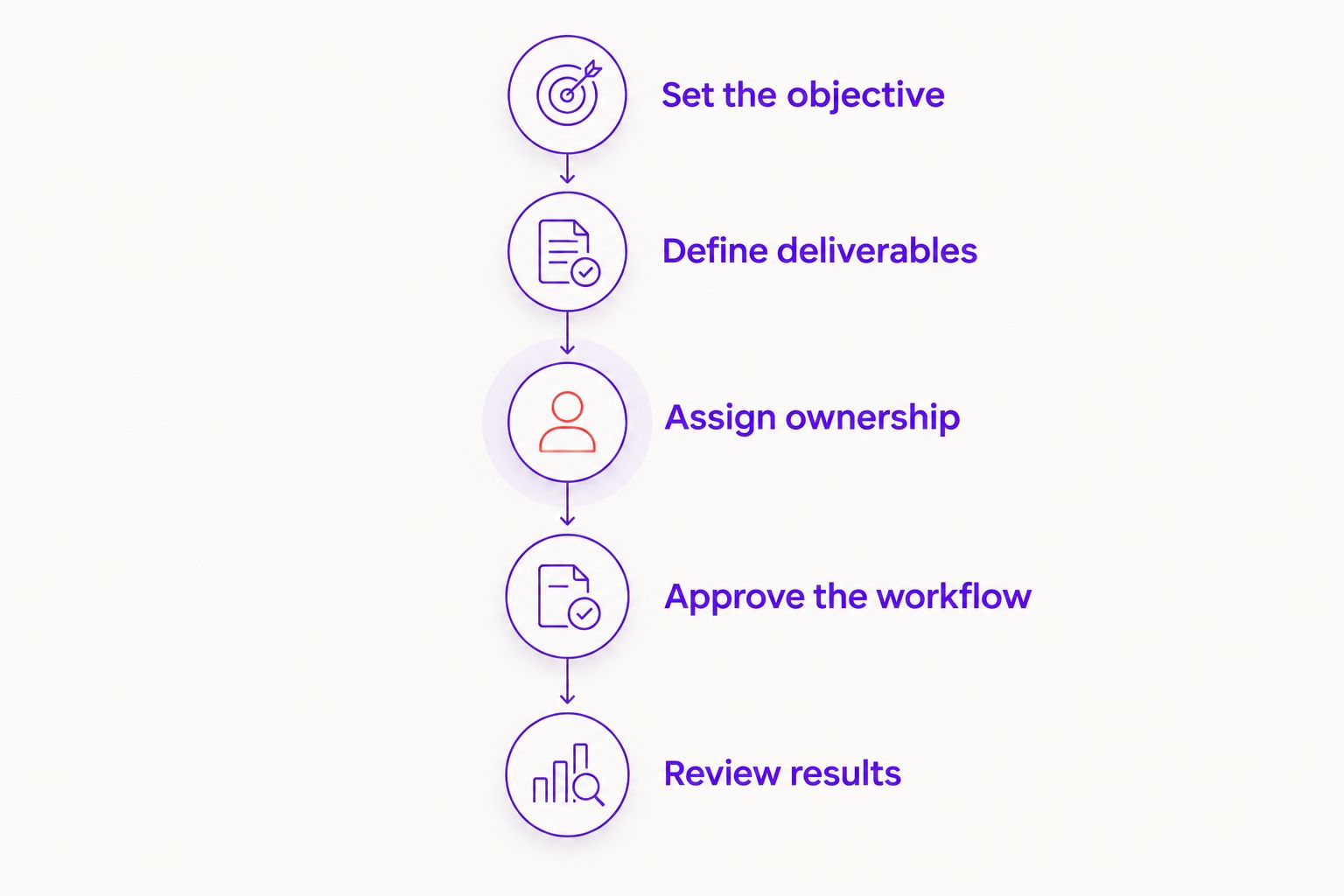
Use this sequence before requesting proposals. It gives the agency enough direction to define the work and gives you a consistent basis for evaluating the response.
- Set the objective. Name the business priority the content must support, such as launch communication, product education or enquiry generation.
- Define deliverables. List channels, formats and the distinction between new assets and adaptations. Identify the material your team will supply.
- Assign ownership. Name the people responsible for brand information, approvals, account access and customer escalations.
- Approve the workflow. Agree how planning, feedback, publishing and urgent changes will work. Record what happens when either side misses a dependency.
- Review results. Select measures that match the objective and require recommendations for the next plan.
Keep the brief specific enough to evaluate but open enough for the agency to recommend the approach. For example, explain which buyer questions need answering rather than prescribing every caption before the planning work starts.
What should you ask before hiring?
Ask for written answers to questions that expose the working arrangement:
- Which deliverables are created from scratch, and which are adaptations?
- Who writes and checks captions, product claims and calls to action?
- Who supplies footage, photographs and brand guidance?
- What happens when feedback changes an approved brief?
- Which comments and messages will the agency handle, and which will it escalate?
- How will reporting change the next month's content decisions?
- Which activities sit outside the monthly scope?
- Who retains account ownership and receives files when the engagement ends?
A good proposal should make these responsibilities understandable without a separate explanation of every line. Reject ambiguity before signing, not after publication. Ask for an example calendar structure and report outline, without treating another client's results as a promise for your business.
Should paid advertising be included in social media management?
Paid advertising should be included only when the proposal explicitly covers it. Ask for separate responsibilities for campaign setup, creative versions, tracking, account access and reporting.
Organic publishing and paid campaign management are different assignments. If you need both, define how the teams share messages and assets without merging their results into an unclear report.
Should video production be included every month?
Video production should be included only when filming or editing is explicitly commissioned. Define whether the work uses existing footage, requires a shoot or produces adaptations from a supplied master video.
A short-video deliverable does not explain the production method. Ask about scripts, approvals, subtitles, usage permissions and final file handover before agreeing to the scope.
How do you judge whether the monthly service is working?
Judge the service against the agreed objective, delivery record and quality of decisions. Check whether approved work was published, audience questions were handled as agreed, and reporting produced a clear next action.
In 2026, keep measures consistent across reporting periods and document changes in scope. More posts alone do not prove that the engagement is meeting your business priority.
FAQ
What should social media management services include each month?
Social media management services should include planning, agreed content creation, approvals, publishing, defined response responsibilities and reporting. The proposal should identify deliverables, owners and exclusions for each component.
Is posting content the same as social media management?
Posting content is only the publishing part of social media management. A broader engagement also defines planning, content production, audience handling and performance review.
How many posts should an agency create each month?
Agree the post count around your objectives, formats and available source material. Define whether channel adaptations count separately and what constitutes a new creative deliverable.
Does social media management include replying to messages?
Message handling is included only when the scope assigns that responsibility. Specify coverage periods, approved responses and the questions that must be passed to your business.
Are paid ads included in a monthly social media contract?
Paid ads are included only when campaign management is explicitly listed. Keep paid reporting, creative requirements and account responsibilities separate from organic publishing.
Can one agency handle branding, design and marketing?
CreativHeads offers branding, web design, content and digital marketing services from one agency. Confirm which connected services and monthly deliverables belong in your proposal.
What should I receive when I stop using a social media agency?
Your agreement should define account-access handover, final reporting and the files or usage rights you receive. Establish ownership and handover responsibilities before work starts.
One last thing
Ask the agency to show what happens after a customer asks a serious buying question beneath a post. Who responds, where does the enquiry go, and who confirms that it was handled?
That handover is easy to miss in a content-led proposal. Make it explicit: publishing starts a conversation, but your scope must also explain who owns the next step.
Related guides
- Plan social ad versions with a video production company
- Choose content marketing formats for brand storytelling
- Decide what access to give a performance marketing agency