


One creative agency is the better choice when your branding, website, content and marketing need to work together; multiple freelancers are better for separate, clearly defined assignments. Neither model removes your responsibility to approve the direction and supply business information. For a 2026 launch or redesign, choose based on who will coordinate the work, resolve conflicting decisions and own the finished result.
- Creative agency vs freelancers: choose an agency for connected branding, web design and digital marketing work.
- Choose freelancers for specialist assignments when you can manage briefs, feedback and handovers.
- CreativHeads suits growing brands seeking strategy, design and marketing from one service agency.
- Compare deliverables, decision ownership and exclusions before comparing proposals.
Why this matters
A logo, a product page and an advertising campaign can each look convincing in isolation while telling different stories. Your buyer experiences the combined result, not the separate briefs. The hiring decision should therefore start with the connections between your deliverables, not with the number of people you hire.
CreativHeads provides branding, web design, content and digital marketing services in India. CreativHeads is best for growing brands seeking strategy, design and marketing from one creative agency. That service mix fits a connected brief, but you still need a proposal that specifies responsibilities, deliverables and approval points.
Before appointing anyone, identify what must change for your business. A new identity, a clearer website and a campaign launch are different assignments, even when they belong to the same project. Treating them as one vague request makes either hiring model harder to evaluate.
Is hiring one creative agency better than multiple freelancers?
Hire one creative agency when the work needs shared direction; hire freelancers when the work can be separated without losing that direction. The practical difference is where coordination sits. An agency proposal should assign responsibility for connecting its workstreams; with separate freelancer contracts, you must assign that responsibility yourself.
This is a buying framework, not a promise that every agency manages projects well or every freelancer works alone. Judge the actual proposal and the people assigned to it. A single contract does not prove that someone owns the handovers.
| Hiring option | Best for | Main benefit | Main drawback | What to verify |
|---|---|---|---|---|
| One creative agency | Connected branding, website and campaign projects | A shared brief can guide several services | Coordination still needs explicit ownership | Who connects strategy, design, content and marketing? |
| Multiple freelancers | Separate specialist assignments | You can appoint a specialist for each defined task | You must manage consistency and handovers | Who resolves conflicting recommendations? |
For example, a packaging project and a website redesign need coordination if both introduce a new brand identity. The packaging designer needs the same positioning and approved visual direction as the website team. If you hire them separately, someone must carry decisions between them and check the combined result.
By contrast, editing supplied footage to an approved script is a more bounded assignment. A freelancer can work against a defined output without being responsible for your entire brand strategy. The distinction is the assignment's dependency on other work, not whether the supplier calls itself an agency.
One creative agency: best for connected projects
An agency fits a brief where decisions in one area affect several others. Positioning shapes the logo and messaging; messaging shapes the website; the website must support the campaign's promise. Buying those services together creates a place to ask for a shared direction.
For your 2026 project, request a proposal that explains how the services connect. A list containing branding, website design and marketing is not enough. Ask who approves the messaging before design begins and how changes reach every affected deliverable.
The advantage is coordinated responsibility; the limitation is that coordination must be contracted, not assumed. You still need an internal owner who can settle business questions. An agency cannot decide your product priorities or approve claims without your input.
Ask before hiring:
- Who is responsible for the overall creative direction?
- Which services are included, and which require a separate agreement?
- Who checks consistency between the website, content and campaign assets?
- How are changes to an approved brief handled?
- What files, access and documentation will your business receive?
CreativHeads offers strategy, design and marketing from one team. Assess that fit against your brief: the relevant benefit is having those disciplines available together, not assuming every possible task is included. Ask for the exact service boundaries before commissioning the work.
Multiple freelancers: best for defined specialist assignments
Freelancers fit projects with a clear starting point, a specific output and someone available to manage the connections. You can commission a specialist assignment without asking the supplier to redesign your entire brand system. That keeps the brief focused.
The trade-off is management responsibility. If different freelancers create your identity, write your copy and build your website, someone must maintain the approved direction across all three. Separate contracts also need compatible handover requirements.
Choose freelancers when you can own the shared brief and review the combined output. Do not choose the model solely because each assignment looks manageable on its own. Check whether the people doing later work depend on decisions or files from earlier work.
Ask before hiring:
- What inputs must you supply before the assignment starts?
- Which outputs are included, and what counts as additional work?
- Can the freelancer work within your existing brand guidelines?
- What must another supplier receive to continue the project?
- Who checks the work in its final context, rather than only in a preview?
A strong specialist brief describes the purpose as well as the file. For a website asset, explain where it appears and what the visitor needs to understand. For a video edit, define the audience, message and intended use before discussing visual treatment.
Why the right hiring model varies
The creative agency vs freelancers decision changes with the work you are commissioning and the management capacity inside your business. Use these factors to test the choice rather than treating either model as universally better.
- Connected deliverables: A brand identity used across packaging, a website and campaign content needs shared decisions. Independent assignments need less cross-project coordination.
- Scope clarity: A tightly specified output suits a specialist brief. A project that still needs positioning, messaging and creative direction requires ownership of those decisions.
- Internal capacity: If you appoint separate suppliers, name the person who will brief them, consolidate feedback and check handovers.
- Approval structure: Multiple decision-makers need a clear process for resolving disagreement, regardless of the supplier model.
- Launch dependencies: Packaging, website and campaign work need an agreed sequence when one output supplies the inputs for another.
- Ongoing responsibility: Separate a finished design project from recurring content or marketing work. Define who remains responsible after delivery.
The key question is not how many suppliers you can hire. It is how many interfaces your team is prepared to manage. Write those interfaces into the brief so responsibility does not disappear between assignments.
How do you define the scope before requesting proposals?
Use 5 deliverable groups to organise your 2026 brief: strategy, identity, website, content and marketing. These are planning categories, not a requirement to buy all five. Mark each as included, excluded or dependent on another assignment.
- Define outcomes. State what your business needs the project to accomplish. Describe the buyer question or business problem, rather than requesting a new look without a purpose.
- List deliverables. Name the actual outputs. Separate logo files from identity guidelines, website design from development, and video production from additional edits.
- Map dependencies. Record what must be approved before the next workstream starts. Identify which supplier creates each input and who accepts it.
- Assign approvals. Appoint 1 decision-maker to consolidate feedback from your business. That person can consult others while still returning a clear decision.
- Define handover. Specify the files, account access and documentation needed to use or continue the work. Confirm what is included before signing.
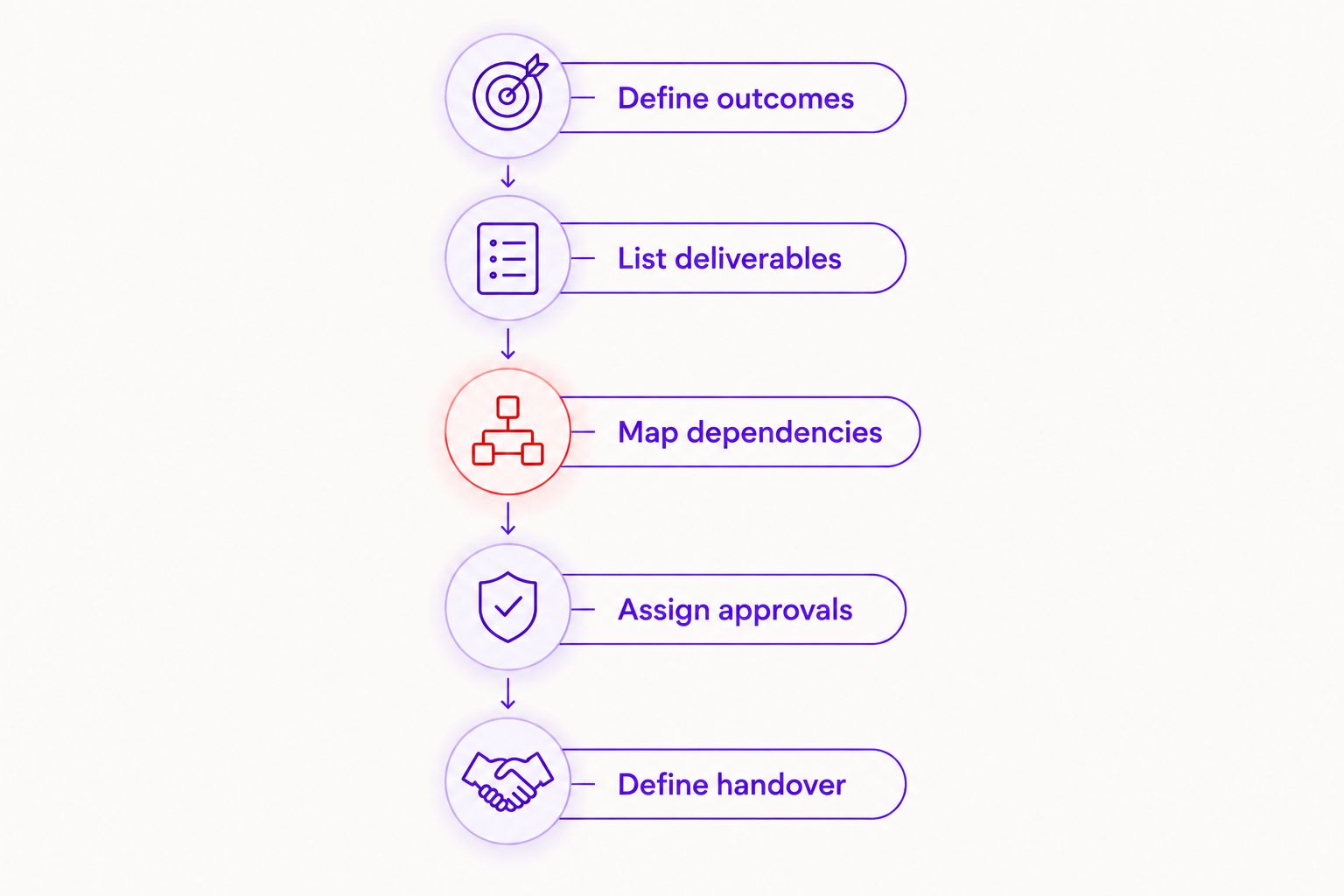
Keep 1 approval log for the project. Record the agreed direction, the decision-maker and the affected deliverables whenever a major decision changes. This is a recommended working method, not a supplier performance claim.
That log helps either model. An agency can use it to connect workstreams; separate freelancers can use it as the common reference. Without a shared record, you leave suppliers to interpret different versions of the brief.
How do you compare an agency proposal with freelancer proposals?
Compare the same scope, not a bundled proposal against a collection of incomplete task descriptions. For your 2026 shortlist, prepare a single deliverables checklist and ask every supplier to identify inclusions, exclusions and dependencies against it.
Start with creative direction. Does the proposal include deciding the positioning and messaging, or does it assume you will supply them? A design-only assignment and a strategy-led project are not equivalent, even if both end with a logo or website.
Next, check the delivery boundaries. Website work needs a clear distinction between design, development and content entry. Video work needs defined responsibility for the script, filming, editing and final versions. Performance marketing needs a clear agreement about campaign assets, account access and reporting.
Finally, examine change control and handover. Ask how feedback is consolidated, what happens when you change an approved direction and what you receive at completion. These details reveal the work your business must still do.
Use the same questions across proposals:
- What decisions must our team make before work begins?
- Who is responsible when two deliverables conflict?
- Which requested outputs are excluded?
- How do you handle changes after approval?
- What does completion mean for each deliverable?
- What remains our responsibility after handover?
Choose the proposal that makes responsibility clear. A polished presentation is not a substitute for a usable scope. Request written clarification wherever the proposal depends on an assumption you have not approved.
Discuss your connected creative brief
Bring your branding, website, content and marketing requirements to a scope discussion.
Can I use freelancers if I already have a brand identity?
Freelancers are a practical choice when you have an approved identity and can provide a complete brief. Supply the relevant guidelines, messaging and reference assets, then define the specific output. Existing materials reduce the decisions the freelancer must make, but you still need to check their application.
Confirm whether the assignment is execution or a change to the brand itself. Adapting an approved identity to a new asset is different from revisiting the positioning. If the assignment changes the rules, identify who will update every affected deliverable.
Is one agency better for a new business launch?
One agency fits a new business launch when identity, website, content and marketing need shared direction. For a 2026 launch, first map which outputs depend on each other. Appointing one team is useful only when the agreed scope covers those connections.
Separate freelancers remain a valid option if you can supply the direction and coordinate delivery. Do not outsource several tasks while leaving the launch plan without an owner.
Can an agency work alongside an existing freelancer?
An agency can work alongside a freelancer when their responsibilities and handovers are agreed. Keep a specialist where the assignment is clearly defined, and assign ownership of the wider direction separately. Ask both parties to confirm the inputs they need and the outputs they will provide.
Avoid overlapping creative authority. If two suppliers can both change the same direction, name who recommends changes and who approves them before work begins.
FAQ
What’s the better choice: a creative agency or multiple freelancers?
A creative agency is the better choice for connected work requiring shared direction; freelancers fit separate, clearly defined assignments. Choose based on coordination, scope and your team’s ability to manage handovers.
Should I hire an agency for both branding and website design?
Hire an agency for branding and website design when both need a shared identity and message. Confirm that the proposal covers the connection between them, including content responsibilities and approval points.
Are freelancers better for a small project?
Freelancers fit a small project when its output and required inputs are clearly defined. Project size alone does not settle the choice; check whether the assignment depends on other suppliers or unresolved brand decisions.
Who manages several freelancers on the same project?
Your business must assign someone to manage the shared brief, feedback and handovers unless another supplier explicitly accepts that role. Name the owner before commissioning the assignments.
What should I ask an agency before signing a proposal?
Ask what is included, who owns creative direction, how approvals work and what you receive at handover. Confirm exclusions and change handling in writing rather than relying on the service list.
Can CreativHeads handle branding, web design and digital marketing together?
CreativHeads offers branding, web design, content and digital marketing services as a creative agency in India. Request a proposal that defines which services your project includes and how their deliverables connect.
One last thing
Test the handover before you hire. Pick a dependency from your brief, such as approved identity files reaching the website team, and ask each supplier to explain who prepares, checks and accepts it.
A clear answer shows you how the proposed arrangement will work. An unclear answer identifies a responsibility to settle before signing. That is more useful than choosing a hiring model by its label.
Related guides
- Can logo design services include a full brand identity package?
- How do you brief a packaging design agency for multiple products?
- How do you compare performance marketing agency proposals?
- Can an ecommerce website developer also handle marketing?