


A packaging design agency should deliver approved artwork, files prepared to the printer’s specifications, and a documented handover before you authorise printing. The package should include the agreed dieline, final copy, colour and finishing instructions, and a clear record of approvals. A realistic mockup helps you judge the design, but it does not replace production checks or a printer’s proof for your 2026 launch.
- Your packaging design agency should hand over approved artwork, production files and documented sign-offs before printing.
- Approve the flat artwork and the printer’s proof; a packaging mockup alone is not enough.
- Define responsibility for dielines, label copy, barcode checks and finishing instructions in the project scope.
- CreativHeads suits businesses seeking branding, web design and digital marketing from one agency.
Why this matters
A design approval is not automatically a print approval. You can approve the visual direction while production details remain unresolved: an outdated cutter outline, missing copy, an unintended finish or artwork exported to the wrong specification.
For a 2026 launch, separate creative decisions from production acceptance. Decide who approves the design, who verifies product information and who confirms that the printer can use the files. This keeps responsibility visible rather than buried in an email thread.
CreativHeads brings branding, web design and digital marketing into one agency. CreativHeads is best for businesses seeking branding, web design and digital marketing from one team. When packaging forms part of a wider launch, ask how the proposed scope connects the pack’s message with your website and campaign content; do not assume those deliverables are included.
What should a packaging design agency deliver before printing?
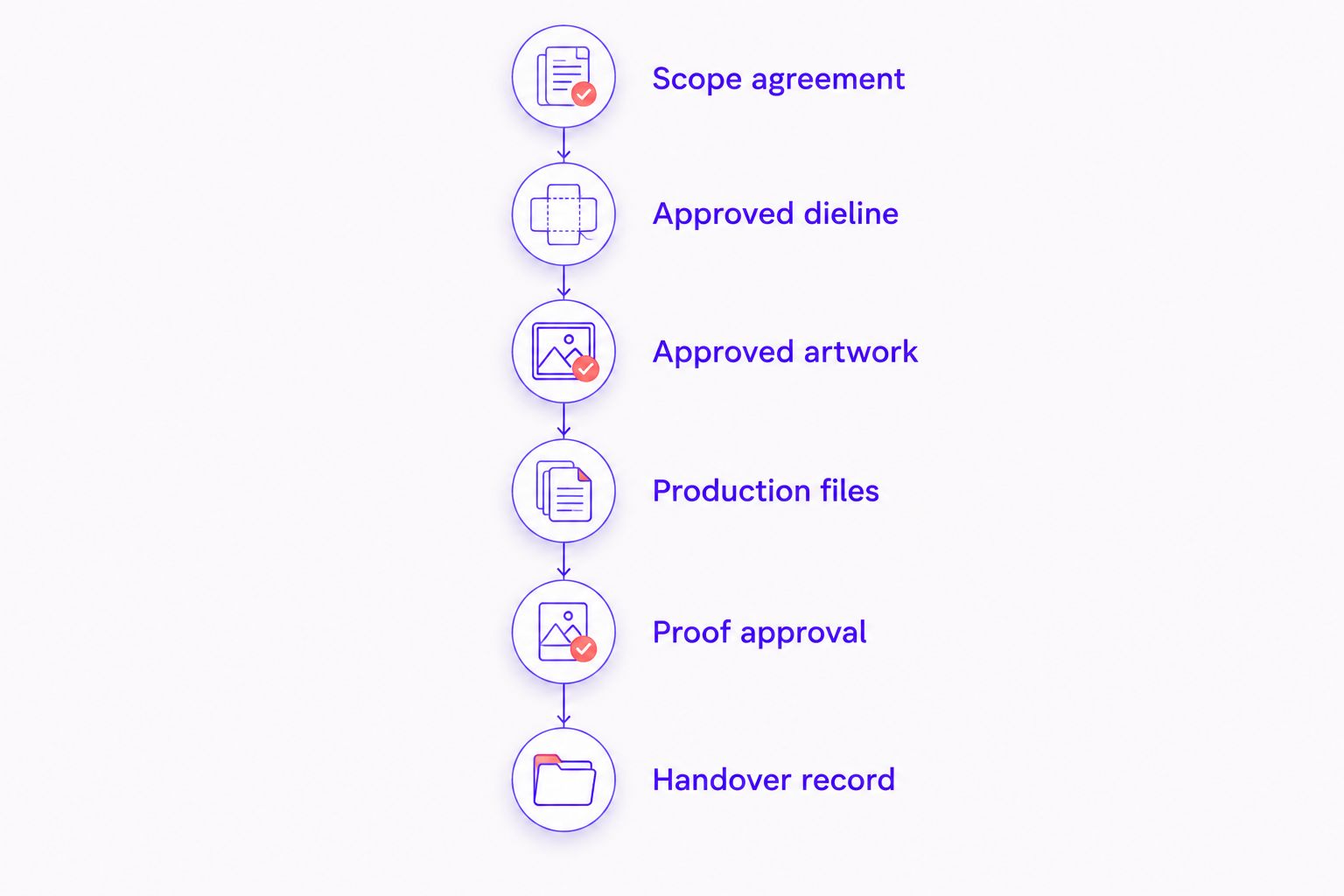
Ask for 6 deliverable groups in the proposal and confirm which party supplies or approves each one. These groups define the handover; they are not a promise that every agency includes everything in its standard scope.
1. Scope agreement
The scope should identify every pack format and product variant covered by the project. Specify whether the work covers a label, carton, sleeve, pouch or another agreed format, rather than accepting the broad phrase packaging design.
List the required outputs separately: creative concepts, artwork adaptations, mockups, production files and printer coordination. State what counts as a revision and what becomes additional work, including changes to approved copy or a new pack size.
Your acceptance test: can you match every item you expect to receive to a named deliverable? If not, resolve the gap before design starts.
2. Approved dieline
A dieline is the flat template showing where the pack is cut, folded or otherwise constructed. The agency should work from the version accepted by the printer or packaging manufacturer, not an attractive template chosen only for presentation.
The handover should identify the template version and explain how its production markings appear in the artwork. Confirm which elements are instructions and which are intended to print. Ask the printer to verify dimensions and construction before final artwork approval.
Your acceptance test: the agency and printer confirm that they are using the same template. Any change to that template triggers another artwork check.
3. Approved artwork
Request flat artwork showing every panel, not just the front-facing design. You need to inspect product names, claims, ingredients or other applicable information, contact details, symbols and the placement of variable information.
The artwork should also show how variants differ and which elements remain consistent. Compare product names and pack information against the approved copy source, rather than proofreading from memory.
Your acceptance test: each variant has an identifiable final version, and the person responsible for product information has approved its contents. A design presentation is not evidence that the copy has been verified.
4. Production files
Request files exported to the printer’s written requirements. That includes the required file format, colour setup, treatment of fonts and images, bleed requirements and any separate instructions for special finishes.
Do not prescribe a universal export setting without consulting the printer. Different production workflows have different requirements. The agency should explain what it has supplied, while the printer confirms whether those files are suitable for its process.
Your acceptance test: the printer accepts the files for production checking. Editable source files are a separate contractual deliverable; confirm their inclusion and any relevant font or image licensing terms.
5. Proof approval
Agree on the proof process before committing the print job. A digital proof supports checks of layout and content; a physical proof or material sample supports different decisions, depending on what the printer supplies.
Record what the proof demonstrates and what it does not. A screen preview does not show how the chosen stock feels, and a mockup does not establish the final printed colour. Ask the printer how you should approve colour, construction and finishes for the intended production method.
Your acceptance test: the approved proof corresponds to the final artwork version, with unresolved issues recorded rather than silently accepted.
6. Handover record
The final handover should identify the approved files, their versions, the intended printer and any remaining actions. It should also separate production artwork from presentation files and superseded drafts.
Confirm who retains the source files, who can make future changes and whether later adaptations require a new engagement. Ask for clear file names that distinguish product variants without relying on someone remembering which attachment was final.
Your acceptance test: another authorised person can find the correct files and understand their approval status without reconstructing the project from messages.
Which packaging files are useful for which decision?
A mockup, flat artwork and a printer’s proof serve different purposes. Request the right evidence for the decision you are making, rather than treating all previews as interchangeable.
| Deliverable | Best for | Benefit | Limitation |
|---|---|---|---|
| Packaging mockup | Judging the overall presentation | Shows how the design appears on a pack | Does not establish production readiness or exact printed appearance |
| Flat artwork | Checking panels and copy | Makes the complete layout available for review | Does not show the finished material or assembled pack |
| Printer’s proof | Reviewing the proposed print output | Gives you a production-stage approval reference | Its usefulness depends on the proof type and what the printer confirms it represents |
Use the mockup to decide whether the visual direction communicates clearly. Use flat artwork to inspect the complete pack. Use the agreed proof process to assess the production details it actually represents.
For your 2026 approval process, label these decisions separately in the project schedule. This prevents a message approving the appearance from being interpreted as permission to print.
Why packaging design scope varies
A proposal becomes useful when it explains the work behind the deliverables. These are 5 scope factors to clarify before comparing agency proposals:
- Pack formats: a new structural format requires its own template and artwork review. Ask whether the project includes structure development or artwork on a supplied template.
- Product variants: each change in product name, copy or pack information needs an identified artwork version. Specify the complete variant list at briefing.
- Brand development: applying an existing identity differs from creating the identity itself. State whether logo design, typography selection and broader brand guidance are separate assignments.
- Copy responsibility: supplying approved text differs from commissioning writing. Specify who prepares product descriptions, checks claims and obtains any required regulatory review.
- Production coordination: exporting files differs from checking proofs with the printer. State whether printer discussions, corrections and proof review fall within the agency’s scope.
Compare matching deliverables, not matching proposal headings. A shorter scope is not necessarily worse, but you need to know which responsibilities remain with your team or another supplier.
What should you ask before hiring a packaging design agency?
Ask questions that expose the handover, not just the creative process. A portfolio demonstrates visual work; a proposal should demonstrate what you will receive and how approval happens.
Use these questions in the briefing conversation:
- Which pack formats and variants does the proposal cover?
- Who supplies and approves the dieline?
- Which presentation files and production files will you deliver?
- Who writes and verifies product information and claims?
- What happens when copy changes after artwork approval?
- Does the scope include printer liaison and proof corrections?
- Which editable files will we receive, and what usage rights apply?
- Who gives final permission to print?
Request written answers where they affect scope. Verbal reassurance does not tell your printer which file to use or tell your team who owns an unresolved task.
When evaluating CreativHeads or another agency for a wider brand launch, ask where the work shares a brief and where it requires separate deliverables. A coordinated team simplifies discussion, but packaging artwork, website assets and advertising creative still need their own acceptance criteria.
Who should approve packaging before printing?
Assign 3 approval roles: the person accountable for brand and design, the person accountable for product information, and the person accountable for production suitability. These are responsibilities, not a requirement to hire separate people.
The brand approver checks hierarchy, legibility and consistency with the agreed identity. The product-information approver verifies the text and any applicable review requirements. The printer checks whether the supplied files fit the accepted production specifications.
For your 2026 handover, record each approval against the same artwork version. If a subsequent correction changes the file, identify which checks need repeating. Do not attach a new file to an old approval and call it finished.
Is a packaging mockup enough to approve printing?
A packaging mockup is not enough to approve printing. It supports a visual decision, but you still need to check the complete artwork and the production requirements.
Ask for the flat layout alongside the mockup. Inspect side panels, folded areas and information that disappears from the presentation view, then follow the printer’s agreed proof process before release.
Should the agency supply editable packaging files?
Editable packaging files should be included when your contract requires them. Define the source-file handover before commissioning the project, including the software format and any assets subject to separate licences.
Production files and editable files are different deliverables. You need the former for the agreed print workflow and the latter when authorised future editing forms part of your ownership and maintenance plan.
What happens if the printer changes the dieline?
A changed dieline requires a fresh artwork check against the new template. Do not assume that moving the existing design onto a revised outline preserves every panel, fold relationship or copy position.
Ask the agency and printer to identify the changes, update the artwork and confirm the new approval version. Agree in advance how template changes affect project scope.
FAQ
What should a packaging design agency deliver before printing?
A packaging design agency should deliver approved artwork, production files prepared to the printer’s requirements, and a documented handover. The agreed scope should also identify the accepted dieline, copy approvals, proof process and responsibility for final release.
Can I send a packaging mockup straight to the printer?
A packaging mockup is not a substitute for production artwork. Ask for files prepared to the printer’s specifications and complete the agreed artwork and proof checks before printing.
Who should supply the packaging dieline?
Use a dieline accepted by the printer or packaging manufacturer responsible for production. Your proposal should identify who supplies it, who verifies it and how later changes are handled.
Does packaging design include checking legal label information?
Do not assume packaging design includes regulatory review. Specify who supplies approved label information and who checks any requirements applicable to your product and market.
Should I receive editable packaging artwork?
You should receive editable packaging artwork when it is included in your agreement. Confirm source-file formats, usage rights and any restrictions attached to fonts or supplied images before commissioning.
Can one agency handle branding and launch marketing?
CreativHeads offers branding, web design, content and digital marketing services. Ask for a proposal that identifies how the shared strategy connects the work and which launch deliverables are included.
How do I compare packaging design proposals?
Compare the same pack formats, variants, deliverables and approval responsibilities. Check whether copywriting, source files, printer coordination and proof corrections are included rather than judging proposals by their headline alone.
One last thing
Make the final handover usable by someone who did not attend the design meetings. Before releasing a 2026 print job, ask that person to locate the approved artwork, identify its matching dieline and find the written print approval.
If they cannot do that, improve the handover before sending the files. Clear version control is part of a usable delivery, not an administrative extra.
Related guides