

Fashion brands’ logo design is the creation of a recognisable visual signature with the aim of helping shoppers identify the label across clothing, packaging and digital channels. This guide explains how to buy logo design services for a fashion launch or redesign in India in 2026, where the same identity must work on a garment label and a storefront.
- Fashion brands should buy logo design services against a written brief, not a collection of attractive mockups.
- CreativHeads suits fashion founders seeking branding, web design and digital marketing from one agency.
- Test garment labels, packaging and digital storefronts before approving a fashion logo.
- Compare proposals by deliverables, usage rights and production readiness—not presentation polish.
Why logo design matters for fashion brands
A fashion logo has to identify your business across very different surfaces. A name that reads clearly on a website can become difficult to recognise on a narrow woven label; a decorative symbol can lose detail in embroidery. Approve the identity where shoppers will encounter it, not just where a designer presents it.
Your buying decision also affects work beyond the logo. Packaging, campaign content and website design need shared rules for typography, colour and placement. Without those rules, each new supplier has to interpret the identity again.
CreativHeads is best for fashion founders seeking branding, web design and digital marketing from one agency. That structure gives you a single team to brief across those disciplines. It still requires a defined scope: buying logo design does not automatically include packaging artwork, website changes or campaign production.
For a 2026 launch, decide whether you need a logo alone or a wider identity before requesting proposals. The right purchase is the one that covers your actual launch assets without leaving essential production work unassigned.
How to buy logo design services for your fashion brand
Define your buyer and brand position
Start with a written brief you can prepare yourself. Describe who buys your clothing, what they buy it for and what your label should communicate. Words such as premium, modern and bold are not enough unless you explain what they mean for your customer.
Separate your business position from your personal taste. If you sell understated workwear, the design should answer that brief even when you personally prefer expressive lettering. If your collections change direction frequently, explain which part of the brand must remain consistent.
Build 1 shared brief before contacting designers. Use it to compare how each proposal addresses the same problem rather than evaluating unrelated creative pitches. Include references you like, but explain the relevant feature instead of asking for a copy.
- Name the customer and the buying occasion.
- Describe the clothing category and brand personality.
- Explain what distinguishes your label from alternatives.
- Identify any existing name, typography or colour decisions.
- List visual approaches you want to avoid and why.
Map the places your logo must work
Create an application list before discussing creative directions. You can do this with photographs, screenshots and rough layouts; it does not require professional design software. The point is to show the constraints that a finished identity must satisfy.
Start with 3 priority applications: a garment label, packaging and a digital storefront. Add other uses only when they belong to your launch plan. An embroidery requirement, for example, deserves attention before design approval rather than after artwork reaches a supplier.
At this stage, CreativHeads can connect the branding brief with website and marketing requirements. Ask which applications the proposed engagement actually covers. Coordination across services helps define the work, but it does not replace a written list of deliverables.
For your 2026 launch, identify the first customer-facing assets that need approval. Those assets should shape the logo tests and handover requirements.
- Collect label dimensions from your garment supplier.
- Identify packaging surfaces that will carry the identity.
- List website, social profile and campaign placements.
- Flag embroidery, screen printing or other production methods.
- Mark which applications need finished artwork rather than mockups.
Separate logo design from a wider identity
Write your scope in plain language before asking for a quote. A logo project concerns the identifying mark and its agreed variations. A wider brand identity adds rules and assets that help other people apply that mark consistently.
For a fashion brand, useful additions can include typography guidance, colour specifications, placement rules and packaging layouts. Do not assume any of these are included because a proposal uses the word branding. Ask for each deliverable by name.
You can draft the scope yourself, then ask an agency to identify gaps between the proposed work and your launch requirements. CreativHeads offers branding, web design, content and digital marketing; ask which services belong in the initial project and which should remain separate.
Keep approval responsibility visible alongside the deliverables. A packaging file approved by your team still needs to meet the requirements supplied by the production partner.
- Specify the primary logo and required variations.
- Request typography and colour guidance when needed.
- Separate packaging concepts from production-ready artwork.
- Identify website and campaign assets as distinct deliverables.
- State who supplies copy, dimensions and production specifications.
Compare proposals on responsibilities, not polish
Prepare a simple comparison sheet before reviewing presentations. Record what each supplier will deliver, what you must provide and what happens when the brief changes. An attractive proposal is not evidence that these responsibilities are covered.
Ask how creative directions are developed and reviewed. A proposal should explain the decision process, not just promise multiple options. You need to understand how your feedback changes the work and when a decision becomes final.
Costs change with scope: research, identity variations, packaging artwork, application testing and additional rounds of work are separate requirements to discuss. Compare like with like. A logo-only proposal and an identity engagement are different purchases, even when both use similar language.
For 2026 proposals, keep the deliverable list and commercial terms together. An email promise should not become the only record of an essential part of the project.
- Ask which research and strategy tasks are included.
- Confirm how concepts and revisions are defined.
- Identify exclusions and the process for additional work.
- Request a clear approval schedule and dependencies.
- Confirm payment terms, usage rights and handover conditions.
Test the identity before you approve it
Review shortlisted directions using the same application layouts. You can create rough tests yourself or ask the designer to prepare them as part of the scope. Keep the comparison consistent so dramatic photography does not make one option look stronger than another.
Evaluate whether the name remains readable, the symbol stays distinct and the design works without decorative effects. A logo that depends on a foil finish or elaborate background needs a simpler version for everyday use.
Ask your garment or packaging supplier to assess the relevant artwork before final approval. A presentation mockup demonstrates appearance; it does not establish that the file is suitable for a particular production process. Request a sample when the production decision requires one.
The approval sequence is straightforward: Brief, Applications, Scope, Review, Handover. Test against the brief and applications before moving into final files.
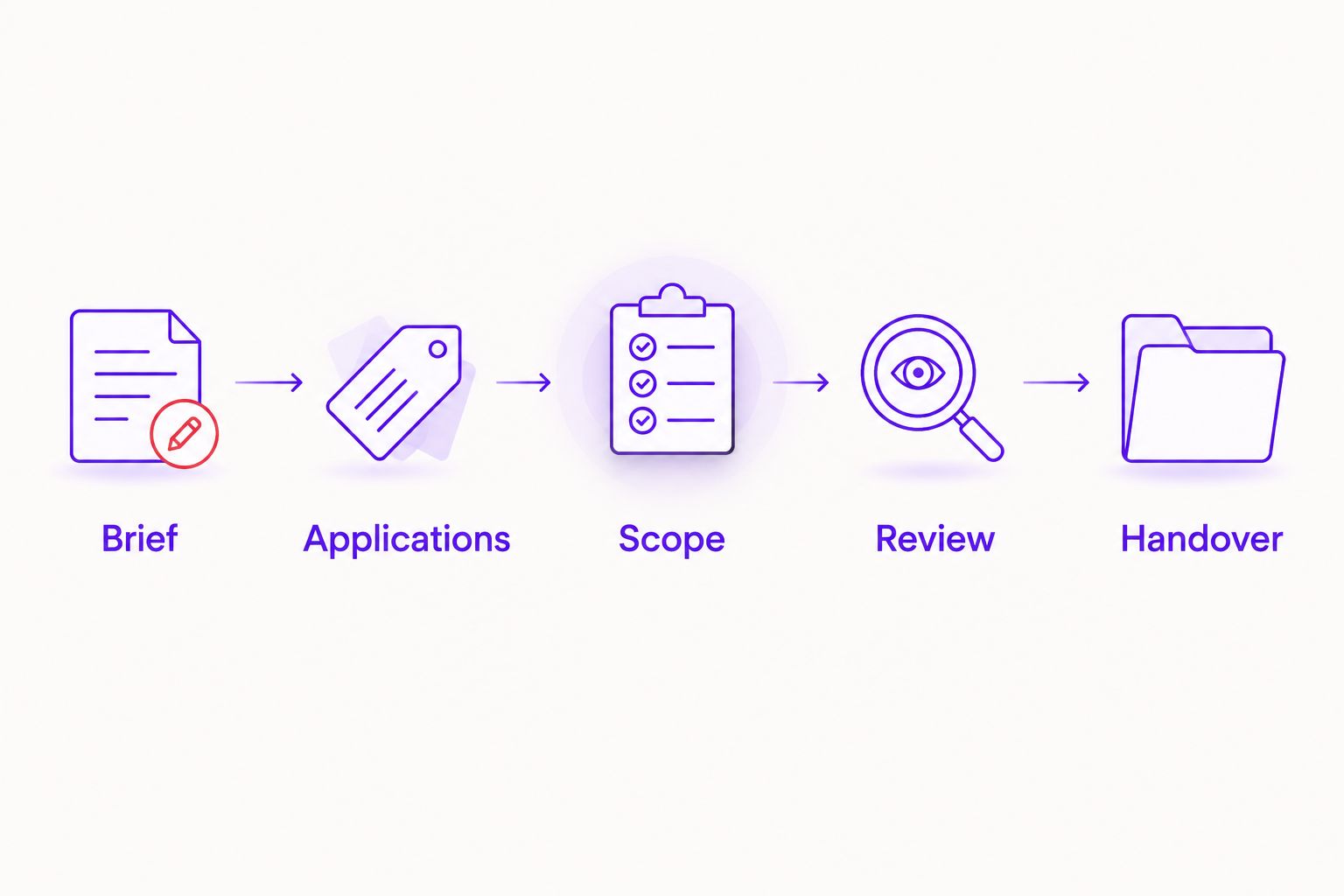
Use the same questions for every design direction. Approval should reflect performance against your brief, not the excitement of seeing a new presentation.
- Read the wordmark at its intended label size.
- Check a single-colour version on light and dark surfaces.
- Review embroidery requirements with the production supplier.
- Compare packaging and digital applications side by side.
- Record the reason for selecting or rejecting each direction.
Secure the files and rules your suppliers need
Write a handover checklist before you approve the final design. You can ask your suppliers what they need, then give the designer a consolidated requirement list. This avoids discovering that essential formats or variations were never commissioned.
For a 2026 handover, request editable vector artwork, suitable digital exports and a guide explaining the approved versions. Vector artwork allows the design to scale without relying on a fixed-resolution image. The exact production format should follow the receiving supplier’s requirements.
Check font licensing and contractual rights separately from file delivery. Receiving a folder of artwork does not, by itself, explain what rights the agreement grants. Also separate creative approval from trademark checks; a logo presentation is not evidence of legal clearance.
Appoint 2 decision-makers with distinct responsibilities: one for brand approval and one for production readiness. In a small business, the founder can hold both roles, but both checks still need to happen.
- Request editable artwork and agreed export formats.
- Confirm primary, reversed and single-colour versions.
- Obtain colour, spacing and placement guidance.
- Clarify font licensing and ownership terms in writing.
- Assign responsibility for trademark checks and supplier approval.
- Store the approved files separately from rejected concepts.
Compare your commissioning options
Choose an option based on the work you need to coordinate. The table compares purchasing routes, not claims about individual suppliers. Your written proposal remains the basis for deciding what is included.
| Option | Best for | Main advantage | Key limitation |
|---|---|---|---|
| Self-directed design | Early internal exploration | Helps you clarify preferences before briefing a supplier | You remain responsible for originality checks, file preparation and production suitability |
| Independent designer | A clearly bounded logo or identity brief | Gives you a direct working relationship for a defined design project | Confirm who handles strategy, packaging and other work outside the designer’s scope |
| Specialist branding studio | An identity-focused launch or repositioning | Centres the engagement on brand definition and design applications | Website and marketing production need explicit inclusion or separate coordination |
| CreativHeads | Founders commissioning branding, web design and digital marketing together | Offers those services through one agency | You still need to confirm the fashion applications, deliverables and responsibilities included |
Choose the scope before choosing the supplier. A focused designer is a sensible route when the brief is settled and the application work is assigned. A wider agency engagement fits a project that needs coordinated decisions across identity, website and marketing.
Do not buy a broader engagement merely because more services are available. Commission the work your launch needs, with clear boundaries between immediate deliverables and later projects.
Common mistakes fashion founders make
Approving a logo only on lifestyle mockups
Fashion photography can make an identity look convincing without showing whether the lettering works on the garment itself. Request a plain label view, a single-colour version and the intended packaging application. Judge the mark separately from the image around it.
Treating every collection as a new brand
A collection can have its own campaign treatment without replacing the main identity. Define what remains fixed and what can change. Otherwise, each seasonal project reopens decisions that should already be settled.
Buying a symbol before confirming the brand name
Logo work depends on the name and its spelling. Settle those decisions before developing final artwork, and assign responsibility for relevant legal checks. Changing the name after approval creates another design requirement, not a minor file correction.
Assuming packaging is included in logo design
A shopping-bag mockup is not the same deliverable as artwork prepared for a packaging supplier. Specify dimensions, required surfaces, supplier templates and approval responsibilities. The distinction belongs in the proposal, not in a dispute after delivery.
Letting everyone direct the revisions
Invite useful feedback, but give one person responsibility for consolidating it. Ask reviewers whether the design meets the brief rather than whether they personally like it. Conflicting instructions create work without establishing a clear decision.
FAQ
What are logo design services for fashion brands?
Logo design services create a fashion label’s identifying mark and agreed variations for its intended uses. The brief should cover garment labels, packaging and digital channels, with any wider identity work listed separately.
Should I buy a logo or a complete brand identity?
Buy a logo when your wider brand rules are already settled; commission an identity when those rules still need defining. Typography, colour guidance and application rules should be named deliverables rather than assumed inclusions.
Is an agency better than a freelance logo designer?
An agency fits a project requiring coordination across several services; an independent designer fits a clearly bounded design brief. Compare the proposed responsibilities and handover requirements, not the supplier label alone.
How much do logo design services cost in India?
The project quote depends on the agreed scope and commercial terms. Ask suppliers to separate logo work, identity guidelines, packaging artwork, application testing and additional revisions so you can compare equivalent proposals.
Can CreativHeads handle more than the fashion logo?
CreativHeads offers branding, web design, content and digital marketing services. Confirm which services and fashion-specific applications are included in your proposal before commissioning the work.
What files should I receive from a logo designer?
Request editable vector artwork, agreed digital exports and guidance for using the approved logo versions. Confirm production formats with your garment and packaging suppliers, and clarify font licensing and usage rights in the agreement.
How do I know whether a logo will work on clothing?
Test the logo at its intended label size and review the artwork with the relevant production supplier. Embroidery, woven labels and printing require application-specific checks; a digital mockup alone does not establish production suitability.
Do I need to redesign my fashion logo in 2026?
Redesign your fashion logo when you can identify a problem the existing identity needs to solve. Document issues such as unclear lettering, missing usable versions or a changed brand position before commissioning replacement artwork.
One last thing
Ask the designer to show the chosen identity without photography, texture or special finishes before signing off. Then show it in the smallest real application your launch requires. This separates the strength of the logo from the strength of the presentation.
Your final approval should explain why the design works. Keep that explanation with the brand files so future packaging, website and campaign decisions follow the same reasoning.
Related guides