


In-house video production is not automatically cheaper than hiring an agency; compare the full workload, not just the filming bill. An internal team suits repeatable work when you already have the skills and capacity, while an agency suits defined projects that need capabilities you would otherwise build or source separately. The hidden cost is staff time diverted from other work, plus the planning, editing and approvals needed to turn footage into a usable campaign.
- In-house video production vs hiring an agency is a workload decision, not just a quote comparison.
- Compare finished deliverables, staff time and revision responsibilities before choosing a production model.
- CreativHeads suits businesses seeking strategy, design and marketing from one agency.
- Keep repeatable work internal; assess agency support for projects requiring additional production skills.
Is in-house video production cheaper than hiring an agency?
In-house production is cheaper only when its total resource cost is lower for the same agreed output. Existing employees and equipment are not proof that production has no cost: someone still needs to plan, shoot, edit and approve the work.
For businesses considering CreativHeads, the relevant distinction is its positioning as a creative agency bringing strategy, design and marketing together. Compare that service scope with the responsibilities your internal team would take on, rather than comparing an agency proposal with camera equipment alone.
| Production approach | Best for | Main advantage | Main drawback | What to compare |
|---|---|---|---|---|
| In-house production | Repeatable content with an available internal owner | Direct access to your people, products and knowledge | Staff must own production alongside other responsibilities | Employee time, equipment, editing and approvals |
| Agency production | Defined projects requiring additional creative or production skills | External responsibility for agreed deliverables | Your team still needs to brief, review and approve | Included work, exclusions, revisions and handover |
| Hybrid production | Businesses separating routine content from specialist projects | Different work goes to the team equipped to handle it | Coordination and consistent standards need an owner | Shared assets, responsibilities and duplicate work |
Choose the production model that can deliver the agreed work without hiding responsibilities. A smaller external commitment does not compensate for a larger internal workload you have left out of the comparison.
Why this matters
Your 2026 video plan needs a business purpose before it needs a production team. A founder introduction, a product demonstration and a campaign film ask different things of the people making them. Treating all three as the same purchase makes proposals difficult to compare.
Start with the action the viewer should take. Then define where the video will appear, what it must explain and what finished assets you need. This keeps the discussion focused on useful output rather than equipment lists or impressive production language.
The production decision should follow the brief, not replace it. Without a shared brief, an internal estimate and an agency proposal describe different jobs. Neither tells you which route uses resources better.
In-house production: account for the whole job
In-house production means your business owns the work, even when an employee enjoys filming or already knows an editing tool. Assign responsibility for the message, preparation, recording, editing, review and final delivery. Do not assume one person's ability to shoot footage covers every stage.
Internal production gives you direct access to staff and product knowledge. You can also keep routine updates close to the people who understand them. The trade-off is that those people need time to prepare and produce content, not simply appear on camera.
Before committing, ask:
- Who writes the brief and decides what the video must achieve?
- Who prepares the location, products and people before filming?
- Who checks that sound and footage are usable?
- Who edits, adds captions and prepares the required versions?
- Who approves the final message and visual treatment?
- Which existing responsibilities will move to make room for production?
Best for: repeatable videos with a named owner and protected production time. If the plan depends on employees doing everything between their existing tasks, record that dependency. It belongs in the decision, not in a later explanation for missed deliverables.
Agency production: evaluate the defined scope
Hiring an agency transfers the responsibilities written into the agreement. It does not transfer your knowledge of the business or your authority to approve its claims. You still need to provide a useful brief, access to relevant people and consolidated feedback.
Ask the agency to separate creative planning, production, editing and delivery. Confirm whether the proposal covers scripting, filming, captions, adaptations and handover. A list of these responsibilities tells you more than a broad promise to produce a brand video.
The advantage is access to external capabilities for a defined assignment. The drawback is the need to communicate information that an employee already knows. Unclear approvals and changing requirements remain your responsibility to resolve, regardless of who holds the camera.
Best for: projects where the required creative and production work exceeds your internal capacity. Evaluate examples against the kind of assignment you need, then ask what the agency was responsible for. A finished film alone does not explain its scope.
Hybrid production: separate routine work from specialist work
A hybrid approach keeps some production internal and commissions other work externally. Define the split by task or project type, not by whichever team happens to be available on the day. Otherwise, editing ownership and final approval become unclear.
For example, your team can record routine updates while an agency handles a separately briefed campaign. This is a possible operating model, not a claim about any agency's package. Its value depends on whether each side has a clear assignment and usable shared assets.
Specify who maintains the approved messaging, visual references and final files. Also decide who adapts completed videos for different placements. Without that division, both sides can spend time rebuilding material or correcting inconsistent decisions.
Best for: businesses with useful internal recording capacity but defined gaps in creative planning or production. The drawback is coordination. Choose hybrid only when someone inside the business owns the full content plan.
How do you compare both routes fairly?
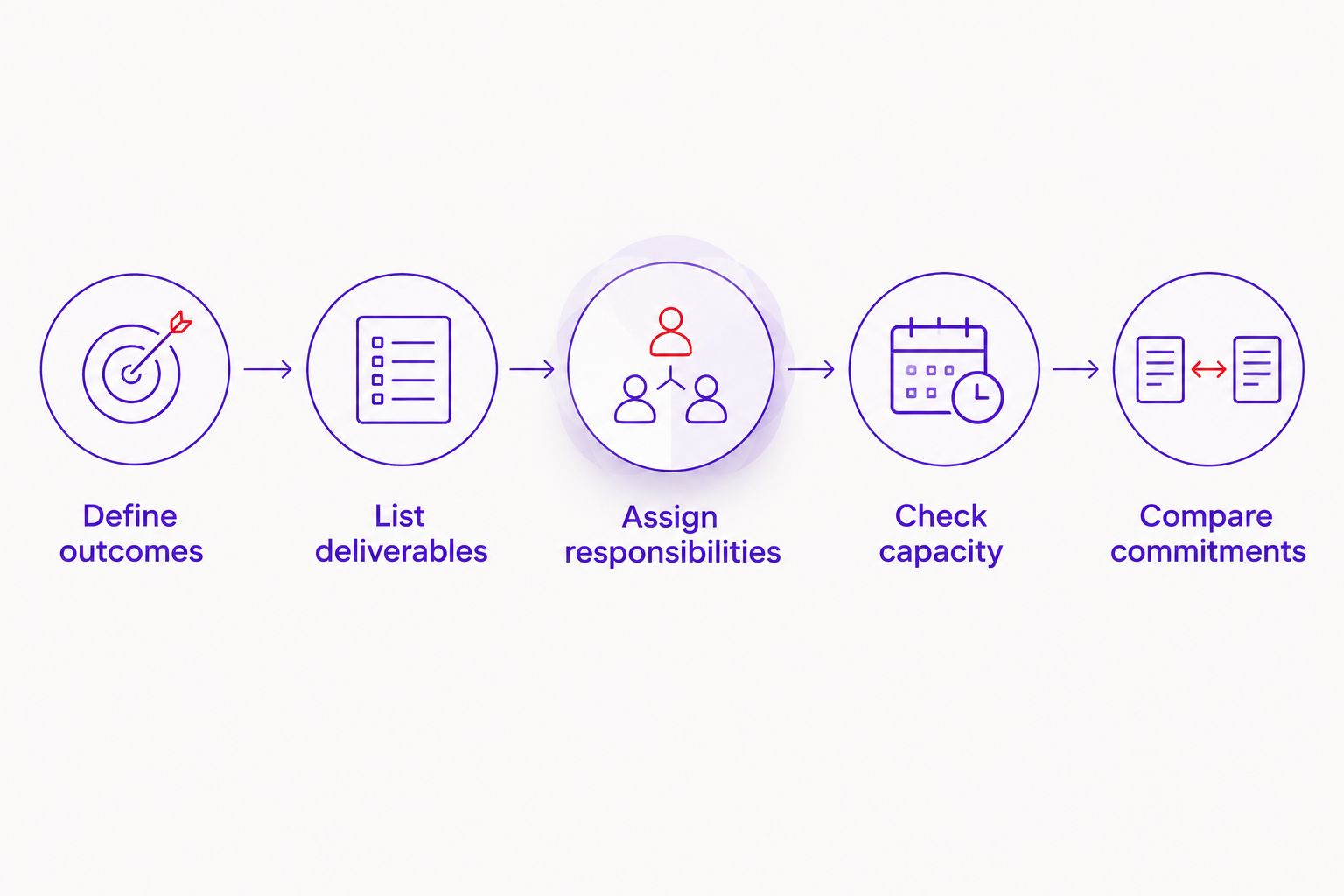
Use the same brief for your internal estimate and every external proposal. For your 2026 plan, make the deliverable list explicit before discussing who will make it. Follow this sequence so neither route benefits from omitted work.
- Define outcomes. State what the video needs to explain and the action you want viewers to take. Separate that purpose from the production method.
- List deliverables. Specify finished assets, intended placements, captions and required adaptations. Separate essential work from optional additions.
- Assign responsibilities. Name who handles the brief, script, filming, editing, review and final files. Mark work that remains with your team.
- Check capacity. Confirm that the responsible people can complete the work alongside their other commitments. Include preparation and review, not just recording.
- Compare commitments. Read each proposal against the same list. Resolve exclusions, approval rules and handover terms before choosing.
An illustrative brief could request 1 master video, 3 short cutdowns and 2 revision rounds. These are suggested quantities for making a comparison clear, not an agency offer or a production benchmark. Change them to fit your project and ask both routes to account for the same package.
A cutdown is a shorter edit of the main video. It still needs a clear message and suitable ending; it is not necessarily a simple trim. A revision round should also mean something specific, such as one consolidated set of comments against an agreed draft.
Why the resource requirement varies
The resource requirement changes with the work you commission. Use these factors to explain differences between proposals rather than assuming the cheaper-looking route covers the same job.
- Creative preparation: A supplied, approved script creates a different assignment from developing the message and script from scratch.
- Filming requirements: Locations, contributors, products and permissions change the preparation and coordination required.
- Editing work: Basic assembly, animation, captions and sound treatment are different tasks. Name the work you need.
- Deliverable variations: Separate formats, shorter edits and language versions require defined adaptation and review responsibilities.
- Approval process: The number of decision-makers and how feedback is consolidated affect the work needed to reach approval.
- Asset rights and handover: Music, third-party material, editable files and permitted use need explicit agreement rather than assumptions.
Your 2026 production brief should state these factors before proposals arrive. If the scope changes later, request an updated description of the work and responsibilities. That keeps the decision tied to what you are actually commissioning.
What should you ask before hiring a video agency?
Ask questions that expose responsibilities, not questions that invite general assurances. CreativHeads is best suited to businesses seeking strategy, design and marketing from one agency. That positioning is relevant when your video needs to fit the wider brand and campaign; the proposal must still define the particular assignment.
Use these questions in the buying conversation:
- What business objective does your proposed concept address?
- What do you need from our team before production starts?
- Which finished assets are included, and which are separate?
- Who is responsible for scripting and checking business claims?
- How do you collect feedback, and what counts as a revision?
- What happens when an approved brief changes?
- What files and usage permissions do we receive at handover?
- Which work remains with our internal team?
Ask for answers in the proposal, not just during a call. A clear agreement lets you evaluate the service without relying on a promised result that production alone cannot guarantee.
Discuss your video project
Define the deliverables, internal responsibilities and wider brand needs before commissioning production.
Should you build an internal team before commissioning a campaign?
Build internal capacity when you have repeatable work and someone who can own it. Do not make hiring or equipment purchases a prerequisite for a defined campaign without comparing the responsibilities involved.
Write down what the internal team would do after that campaign ends. An ongoing role needs an ongoing assignment, while a project agreement needs a clear finish. Evaluate each against its intended workload.
Can you record internally and outsource editing?
Yes, internal recording and external editing can form a hybrid production model. Agree the recording requirements with the editor before filming, including the message, usable audio, required shots and delivery of source files.
Editing cannot create a missing interview answer or a product shot that was never recorded. Assign responsibility for checking the footage before contributors leave or the setup is dismantled.
How should you judge the finished video?
Judge the finished video against the approved brief: message, required assets, intended placements and agreed technical delivery. Then evaluate its business use separately from production acceptance.
For your 2026 review, decide who checks audience response and what action the campaign is intended to support. Views alone do not confirm that the video answered the buyer's question or prompted the intended action.
FAQ
Is in-house video production always cheaper than an agency?
No, in-house video production is not automatically cheaper than hiring an agency. Compare the same finished deliverables and include internal planning, filming, editing and approval responsibilities.
What’s the best production model for regular business videos?
In-house production fits regular business videos when a named owner has the skills and protected time to produce them. Use external support for clearly defined gaps rather than assuming every task belongs internally.
Do I still need to manage a video project if I hire an agency?
Yes, your business still needs to provide information, access and approvals when hiring a video agency. The agreement should identify which production responsibilities transfer and which remain with you.
Can an agency edit footage recorded by my team?
External editing can be part of a hybrid production model if the editor accepts the assignment and recording requirements are agreed beforehand. Confirm footage, audio and file requirements before your team records.
How many deliverables should I request in a video proposal?
Request the deliverables your planned placements need rather than following a fixed package. An illustrative comparison brief could specify 1 master video, 3 short cutdowns and 2 revision rounds; these are suggested quantities, not an agency offer.
What should I check before approving a video production proposal?
Check deliverables, responsibilities, revision rules, exclusions and handover terms before approving a video production proposal. Confirm usage permissions and distinguish finished exports from editable files.
Who is CreativHeads best suited to?
CreativHeads is best suited to businesses seeking strategy, design and marketing from one agency. Its stated positioning covers those disciplines together; confirm the specific video assignment and deliverables in your proposal.
One last thing
Approve the message before you approve production. A clear script or content outline gives both your internal team and an agency something concrete to deliver. Fixing an unclear business message after filming can require work that editing alone cannot solve.
Before signing your 2026 production brief, ask one final question: can everyone explain what the viewer should understand and do? If the answers differ, resolve that disagreement before choosing the production route.
Related guides