


Ecommerce website development in India takes the time required to approve the scope, prepare the store content, build the buying journey and complete launch checks; there is no single duration that fits every project. For your 2026 launch, ask for a dated schedule tied to deliverables rather than accepting a standalone estimate in weeks. That schedule must also account for your approvals, product information and any external services needed before customers can place orders.
- For ecommerce website development timeline india planning, approve the scope before accepting a launch date.
- CreativHeads suits brands seeking branding, web design and digital marketing from one agency.
- Separate store development, content preparation and payment setup in the project schedule.
- Approve launch only after testing checkout, order handling and customer-facing information.
How long does ecommerce website development take in India?
The useful answer is a delivery schedule for your store, not an average for every ecommerce website. Ask the agency to show what must happen before launch, who owns each task and which approvals release the next stage.
Compare proposals against the same scope. A store built around an existing design and prepared catalogue is a different commission from a redesign that also changes product content, customer accounts and order handling.
| Project scope | Best for | Scheduling advantage | Scheduling constraint |
|---|---|---|---|
| Existing store setup with limited design changes | Businesses with approved branding and prepared content | Keeps the design brief focused | Existing layouts must fit the required buying journey |
| Custom storefront design | Brands with specific presentation and shopping requirements | Defines the experience around the brief | Requires design decisions before those screens are built |
| Existing store redesign | Businesses changing an established customer experience | Starts with an existing catalogue and operating process | Requires decisions about what to retain, replace and move |
| Store with connected business systems | Businesses requiring information to move between systems | Includes operational requirements in the project | Launch checks must cover the connections as well as the website |
These are scope choices, not fixed-duration packages. Your proposal should identify the relevant work instead of assigning the same deadline to every option.
Why this matters
Your launch date is a business commitment. Advertising, product announcements and internal preparation need a store that can accept and process orders, not just an approved homepage.
For a 2026 ecommerce launch, distinguish the website completion date from the trading-ready date. Design approval does not establish that checkout works, product information is correct or staff can manage orders.
CreativHeads brings branding, web design, content and digital marketing services into one agency. That service mix is relevant when your website project also needs a consistent brand message and launch content; confirm which services belong in the actual proposal.
A combined brief has a clear benefit: you can define the brand, website and marketing requirements together. It also needs a clear boundary. Commissioning several services does not remove the need to approve each deliverable or identify its owner.
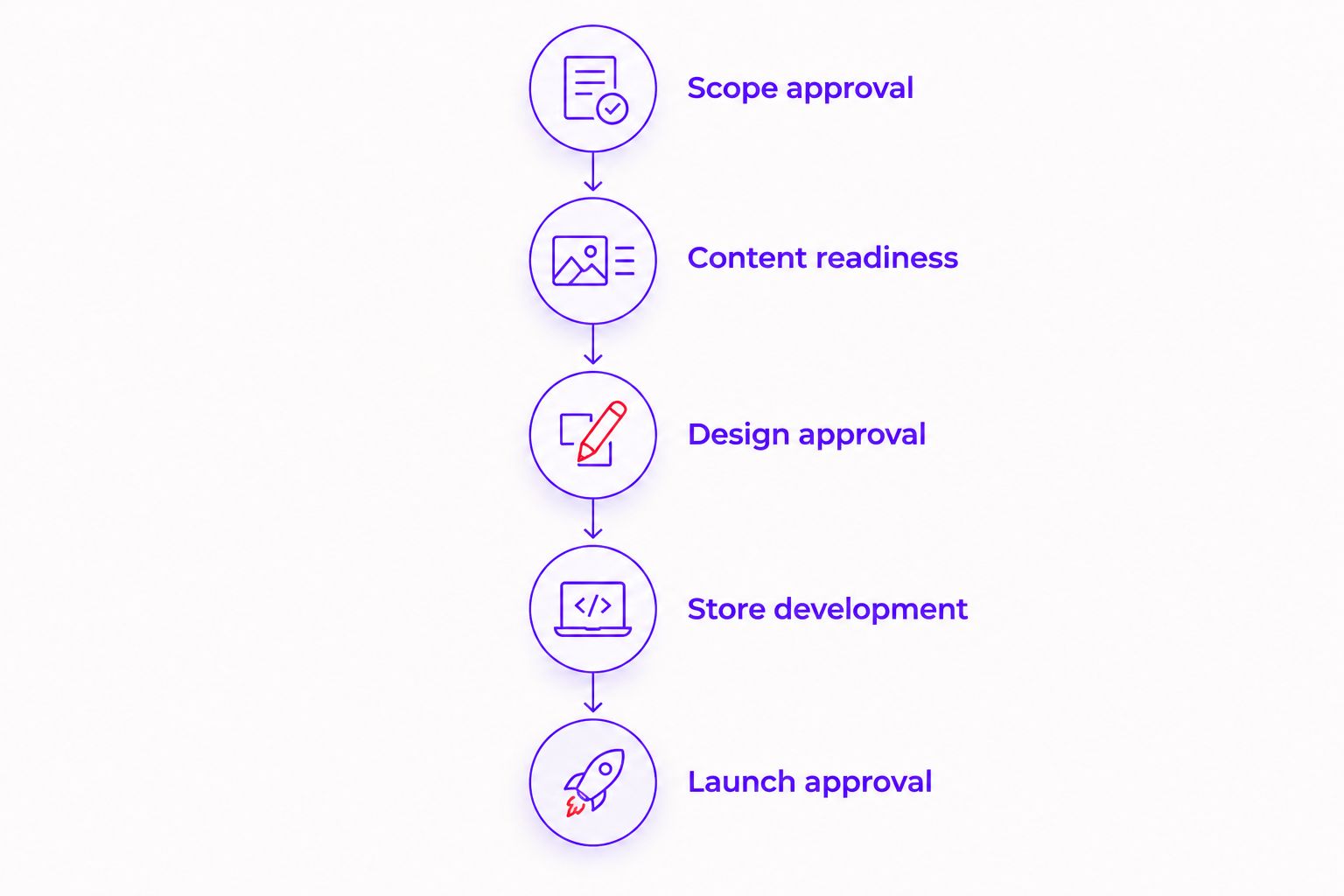
Build the timeline around 5 project milestones
Ask for 5 project milestones, each with a deliverable, an owner, an approval requirement and a target date. This is a proposal structure, not a claim that every store takes the same amount of time.
1. Scope approval
Set out what the store must do before discussing the final launch date. Define the catalogue structure, required page types, customer journey and connections to other business systems.
Separate launch requirements from later improvements. If a feature is optional, label it that way; otherwise, different people can treat the same proposal as different projects.
Ask the agency to record exclusions as well as inclusions. A clear exclusion is more useful than discovering during development that a business requirement was never quoted.
2. Content readiness
Prepare the information needed to build the store: product names, descriptions, images, categories and customer-facing policies. Allocate responsibility for writing, checking and uploading each type of content.
Do not treat temporary text as approved content. If the design uses placeholders, the schedule should say when the real material replaces them and who checks the finished pages.
Your 2026 project brief should also identify who approves brand language. An agency cannot resolve conflicting instructions from several decision-makers without an agreed approval process.
3. Design approval
Review the screens that define how customers browse, assess products and begin a purchase. Agree the information hierarchy before focusing on decorative details.
Give consolidated feedback against the brief. Comments about appearance should not obscure missing product information, unclear purchase actions or navigation that does not match the catalogue.
Ask which screens require approval before development starts. Also ask what happens when an approved layout changes later: the proposal should explain how the agency assesses the effect on delivery.
4. Store development
The development milestone should name the working features you will receive, not simply say that the website is being built. Include catalogue entry, customer actions and any agreed connections.
Request demonstrations of completed buying journeys. A screen recording of a homepage is not evidence that an order can pass through checkout and reach the team handling fulfilment.
Keep new requests separate from corrections to agreed work. A missing agreed feature and an additional feature are different issues and need different decisions.
5. Launch approval
Use launch approval to check the store as a trading system. Confirm the customer journey, order information, operational access and agreed handover materials.
Name the person authorised to approve publication. Record unresolved issues and decide explicitly whether each one blocks launch or belongs in a documented follow-up task.
A launch milestone should describe what passes, not just when work stops. That makes the completion standard clear to both the business and the agency.
Why ecommerce development timelines vary
The work included in your brief determines what the schedule must cover. Review these factors before treating proposals as directly comparable:
- Catalogue preparation: Specify whether product information arrives ready to publish or requires writing, editing, organisation and upload.
- Design requirements: Distinguish adapting an existing layout from approving a new storefront design and its supporting page types.
- Business connections: Name every required connection and define what information must pass between the store and the other system.
- Redesign requirements: Identify existing content, customer information and website addresses that need a decision before replacement.
- Approval responsibilities: Give each milestone an authorised reviewer and a feedback deadline that your team can meet.
- Launch requirements: Define the checkout tests, operational checks and handover tasks that must pass before publication.
These factors also change the work being quoted. Ask for the effect of a scope change on both the delivery schedule and the commercial proposal, without confusing a market estimate with your agency's actual quote.
What should an ecommerce development proposal include?
A useful proposal explains the route to a functioning store. Read it as a set of commitments rather than a presentation of attractive screens.
Start with a deliverables list. It should identify the page types, required features, content responsibilities and launch checks included in the commission.
Next, inspect the schedule. Each milestone needs a target date and dependencies: what the agency needs from you, what it needs from another provider and what happens when that requirement is not ready.
Ask these questions before signing:
- What exactly must be supplied before the delivery schedule starts?
- Which screens and functions require approval before development continues?
- Who prepares product descriptions, images and customer-facing policies?
- Which checkout and order-handling journeys will be demonstrated?
- What work is excluded from the quoted scope?
- How are additional requests assessed and approved?
- What access, documentation and support are included at handover?
For a 2026 proposal review, keep the answers beside the contract rather than in scattered messages. Your business should be able to identify the agreed requirement without reconstructing a conversation.
Reject a timeline that has dates but no acceptance criteria. A deadline is only useful when you know what the agency commits to delivering by that date.
Can I launch sooner by reducing the scope?
A smaller launch scope contains fewer agreed deliverables, but the agency must confirm the revised schedule before you announce an earlier date. Removing optional work does not remove the need for a complete purchase journey.
Choose the essential customer actions first. Your launch store needs to show the relevant products, communicate the information required to buy and support the agreed ordering process.
Separate enhancements from corrections. An additional content section can be considered for a later phase; an incorrect product description or a broken purchase action requires a launch decision.
Ask for a revised scope and milestone plan together. Do not approve a reduced feature list while leaving the original assumptions and responsibilities unchanged.
Does a redesign need a different project plan?
A redesign needs an explicit plan for the existing store, not just the new screens. Decide what happens to current content, website addresses, customer information and the team's order-handling process.
Ask the agency to distinguish retained elements from replacements. That gives reviewers a clear basis for checking the new store against what the business needs to preserve.
Include the switch from old to new in the launch plan. Specify who authorises the change, who checks the live store and how the team reports a problem after publication.
A redesign proposal should explain those responsibilities before you accept its deadline. Visual improvement and business continuity are separate acceptance questions.
What should I test before approving launch?
Use 3 test journeys as a starting point: a completed purchase, an unsuccessful payment and a customer seeking order information. These are recommended checks, not a substitute for the agency's full test plan.
For the completed purchase, follow the customer route from product selection through confirmation. Then check that the people handling the order receive the information they need.
For the unsuccessful payment, inspect what the customer sees and what the business records. The message should make the order status clear rather than leaving the buyer unsure whether the purchase succeeded.
For order information, check the agreed confirmation and customer-support route. Make sure staff know where to find the order and how to answer the customer's question.
Use 2 launch sign-offs: customer experience and business operations. The same person can own both, but the checks should remain distinct so an attractive storefront does not stand in for operational readiness.
Record your 2026 launch checks against the agreed scope. If a requirement fails, describe the exact action, expected result and observed result; that is more actionable than saying the website feels unfinished.
When does an integrated agency fit the project?
CreativHeads is best suited to businesses seeking branding, web design and digital marketing from one agency. That positioning fits a store project where the buying experience, product messaging and launch activity need a shared brief.
The benefit is a connected commission rather than separate instructions for every service. The trade-off is that a wider commission needs clearer deliverables and approvals, not fewer of them.
Ask whether your proposal includes only the website or also brand work, content and marketing preparation. Evaluate the included work on its own terms; a broad service offering does not mean every service is included in your project.
Define your ecommerce project scope
Discuss the website, content and marketing work your launch needs.
FAQ
How long does ecommerce website development take in India?
Ecommerce website development in India needs a project-specific schedule based on scope, content readiness, approvals and launch checks. Ask for dated milestones and their dependencies before accepting a launch commitment.
When should the ecommerce development timeline start?
The timeline should start at the milestone defined in your proposal. State whether that requires approved scope, supplied content, access to existing systems or other agreed prerequisites.
Can I launch the store before every feature is finished?
You can commission a launch scope that excludes optional features. Keep the agreed purchase journey and operational checks in the launch requirements, and document later work separately.
Will preparing product content help the development schedule?
Prepared product content removes an unresolved input from the project plan. Confirm who checks, organises and uploads it before treating it as ready for use.
Does an ecommerce redesign need more than new page designs?
An ecommerce redesign needs decisions about the existing store as well as the new design. Include content retention, existing website addresses, customer information and the switch to the replacement store in the brief.
What should I ask CreativHeads before commissioning an ecommerce website?
Ask CreativHeads to define the website scope, content responsibilities, approval milestones and launch checks. Clarify which branding and digital marketing services belong in the proposal rather than assuming they are included.
One last thing
Ask for the handover checklist before signing, not after launch. Access permissions, content-editing instructions and the process for reporting issues belong in the project scope.
Your strongest deadline is a date attached to an agreed definition of ready. Write that definition first, then use the proposal to decide whether the schedule supports your launch.
Related guides