


Best overall for stackable dry goods: folding cartons. Best for resealable contents: stand-up pouches. Best for branding an existing stable pack: sleeves. This guide ranks packaging design formats for retail shelf standout in 2026 by display fit, message clarity and handling requirements—not decorative finishes alone.
- Folding cartons lead packaging design formats for retail shelf standout when stackability and clear front panels matter.
- Stand-up pouches suit resealable contents; rigid boxes suit presentation-led gifts.
- Sleeves add branding to an existing pack but do not replace product protection.
- CreativHeads combines strategy, design and marketing for brands seeking coordinated packaging and launch communication.
Why this matters
A distinctive pack still fails its brief if the product name disappears behind a shelf edge or its shape does not fit the display. Choose the structure around the product and retailer first; build the visual identity around that decision.
CreativHeads is best for brands seeking packaging design alongside coordinated brand strategy and marketing. That shared direction helps you commission a pack, website and campaign around the same message rather than separate creative briefs.
For your 2026 launch, separate two decisions: what holds the product and what makes the product recognizable. A stronger graphic treatment cannot correct an unsuitable closure, unstable base or missing print area.
What makes the best retail packaging format?
Use these criteria before comparing concepts or approving a proposal:
- Shelf fit: The pack suits the intended shelf, hanging display or counter without hiding essential information.
- Message hierarchy: Buyers can distinguish the brand, product type and variant without reading every panel.
- Product protection: The structure, material and closure meet the product's handling and storage requirements.
- Print area: There is room for the design, barcode and applicable product information without overcrowding.
- Production fit: The selected converter can manufacture the structure and reproduce the proposed artwork.
- Range consistency: Future variants remain recognizable without becoming difficult to distinguish.
Make the design agency and packaging manufacturer address the same criteria. Artwork approval and manufacturing approval are different decisions; define responsibility for both in the proposal.
Packaging formats at a glance
| Rank and format | Best for | Standout feature | Key limitation |
|---|---|---|---|
| 1. Folding cartons | Stackable dry goods | Defined panels for a clear reading order | Cartons alone do not suit every protection requirement |
| 2. Stand-up pouches | Resealable contents | Broad front surface on a flexible structure | Shape changes can affect the visible artwork |
| 3. Rigid boxes | Presentation-led gifts | Structured opening and interior presentation | Interior detailing adds specification work |
| 4. Bottles and jars | Products needing repeated dispensing | Container shape and label work together | Curved surfaces restrict the visible message |
| 5. Sleeves | Branding an existing stable pack | Wraparound communication without replacing the primary pack | Limited protection and risk of movement |
| 6. Blister packs | Small products on hanging displays | Product visibility through a formed cavity | Backing, cavity and opening need coordinated design |
The ranking is a buying framework, not a claim that one structure suits every category. Product compatibility and retail display requirements take priority over visual preference.
1. Folding cartons: best for stackable dry goods
Folding cartons use cut and creased board assembled into a box. Their defined faces let you separate the main purchase message from instructions, variant details and other information.
For a 2026 range launch, cartons give you a straightforward way to repeat a recognizable front-panel layout across variants. Keep the brand and product name in consistent positions; vary the elements that identify the contents.
Folding carton pros:
- Defined panels support a deliberate reading order.
- A suitable box structure supports stacking and orderly display.
- Separate faces provide space for secondary information.
- Related products can share a consistent visual layout.
Folding carton cons:
- Board and structure need checking against moisture, weight and handling requirements.
- Creases, folds and glued areas constrain artwork placement.
- Some products require an inner pack or additional protection.
What to commission: Ask for artwork on the manufacturer's approved cutting template, a panel map and a physical sample. Specify which face will point towards the shopper and confirm where the barcode belongs.
Best for: Dry goods that need defined panels and an orderly shelf arrangement.
Verdict: Buy when stacking and clear front-panel communication matter, after confirming the protection requirements.
2. Stand-up pouches: best for resealable contents
Stand-up pouches use flexible packaging with a base designed to support an upright display. A resealable version combines the shelf-facing surface with a closure for repeated access.
Design the artwork around the filled pack, not just the flat print file. The base, seams and closure influence what shoppers actually see.
Stand-up pouch pros:
- A broad front surface supports a focused brand message.
- A suitable resealable closure supports repeated access.
- Flexible construction accommodates contents without a fixed box shape.
- Front and back surfaces separate selling information from instructions.
Stand-up pouch cons:
- Filling changes the shape and visible artwork area.
- Seams and closures reduce usable design space.
- Material and barrier requirements depend on the contents.
What to commission: Request a filled sample with the intended closure. Check upright stability, opening access and whether the product name remains readable after filling.
Do not treat a transparent window as an automatic improvement. It reveals the contents but also removes space from the front-panel message; choose it only when seeing the product supports the purchase decision.
Best for: Contents that need repeated access through a suitable resealable closure.
Verdict: Buy when resealing is part of the product experience and the filled pouch displays correctly.
3. Rigid boxes: best for presentation-led gifts
Rigid boxes retain their assembled shape and can organize products inside a structured presentation. They suit projects where opening the pack is part of the intended experience, rather than merely a route to the contents.
Start with the contents and their arrangement. An attractive exterior does not fix an insert that lets items move or makes them difficult to remove.
Rigid box pros:
- A fixed structure supports a deliberate opening sequence.
- Interior components can organize separate items.
- Lid and base surfaces provide distinct design areas.
- The format supports gift-led presentation without relying entirely on printed graphics.
Rigid box cons:
- Inserts, wrapping and closures add specification decisions.
- An oversized structure occupies unnecessary display and storage space.
- Presentation details still require handling tests.
What to commission: Define the item arrangement, removal method, lid relationship and insert requirements. Ask the supplier to demonstrate the opening and packing process using a physical sample.
For a 2026 gifting brief, distinguish essential presentation from optional decoration. Keep the elements that help recipients understand and handle the contents; challenge elements that only complicate assembly.
Best for: Gift sets where interior arrangement and opening experience are explicit project requirements.
Verdict: Buy when presentation is part of the product proposition; skip it when a simpler structure meets the brief.
4. Bottles and jars: best for repeated dispensing
Bottles and jars combine a container, closure and printed or labelled surface. Their shape affects both handling and the portion of the message visible from the shelf.
Treat the container and label as one design decision. A flat label preview cannot show how text wraps away from the shopper or how a shoulder interrupts the layout.
Bottle and jar pros:
- Suitable closures support repeated opening and dispensing.
- Container shape provides a recognizable silhouette.
- Labels can establish a consistent identity across variants.
- The structure separates dispensing requirements from printed communication.
Bottle and jar cons:
- Curvature restricts the message visible from one angle.
- Label placement must account for shoulders, seams and surface shape.
- Container and closure compatibility require product-specific checks.
What to commission: Request artwork on the actual container dimensions and a labelled sample. Define the front-facing reading area before arranging secondary information around the sides.
Do not approve a closure for its appearance alone. Ask who checks compatibility with the contents and intended use, and record that responsibility in the scope.
Best for: Products that require repeated dispensing from a compatible container.
Verdict: Buy when dispensing drives the format choice and the main label reads clearly on the actual container.
5. Sleeves: best for branding an existing stable pack
A sleeve wraps around an existing container, tray or box. It adds printed communication without necessarily replacing the structure that holds the product.
This format works when the primary pack already performs its job. The sleeve then carries identity, variant information or a specific campaign message.
Sleeve pros:
- Adds a continuous printed surface around an existing pack.
- Leaves parts of the underlying structure visible where intended.
- Supports distinct artwork while retaining the primary pack.
- Provides another location for product and brand information.
Sleeve cons:
- Does not replace the primary pack's protection function.
- A loose fit allows movement and misalignment.
- Covered surfaces can hide information already printed underneath.
What to commission: Confirm the underlying pack dimensions, sleeve retention and assembly method. Check the finished pack from the shelf-facing direction and verify that no required information becomes obscured.
For a 2026 campaign, specify whether the sleeve is temporary communication or a permanent part of the product identity. That choice affects what information belongs on the sleeve and what must remain on the primary pack.
Best for: Existing stable packs that need additional brand or campaign communication.
Verdict: Buy when the primary structure already works; skip it as a substitute for product protection.
6. Blister packs: best for small products on hanging displays
Blister packs hold an item within a formed cavity paired with a backing or another enclosing component. They can display the product itself while the surrounding area carries identification and instructions.
Design the cavity, backing and hanging arrangement together. A prominent product view is useful only if the pack also fits the retailer's display.
Blister pack pros:
- Shows the product through a transparent cavity where specified.
- Holds a small item in a defined position.
- Backing provides space for identification and supporting information.
Blister pack cons:
- Cavity dimensions need to match the actual item.
- Opening requires deliberate design rather than an afterthought.
- Material combinations affect disposal instructions and recycling claims.
What to commission: Ask for a sample on the intended hanging fixture. Review product retention, opening instructions and the space left for readable backing artwork.
Best for: Small products sold on a confirmed hanging-display arrangement.
Verdict: Buy when product visibility and hanging display are both required; skip it for a shelf-only brief without those needs.
How we ranked the formats
Folding cartons take the default position because defined panels and stackable structures address a common dry-goods display brief. The remaining formats win distinct jobs: resealing, gifting, dispensing, adapting an existing pack or hanging small items.
This is a suitability ranking, not a laboratory performance comparison. No format receives a universal protection, sustainability or production advantage; those depend on the specified materials and finished construction.
Turn the shortlist into a project brief
Before asking CreativHeads for a packaging design proposal, put the product, display and deliverables in one brief. A coordinated strategy, design and marketing team still needs clear decisions about what you are commissioning.
Use this sequence:
- Product needs: Describe the contents, handling requirements and opening method.
- Retail display: Confirm shelf or hanging placement and the visible pack face.
- Design scope: List variants, panels, copy, artwork and sample requirements.
- Production checks: Name the manufacturer and assign sample approval responsibilities.
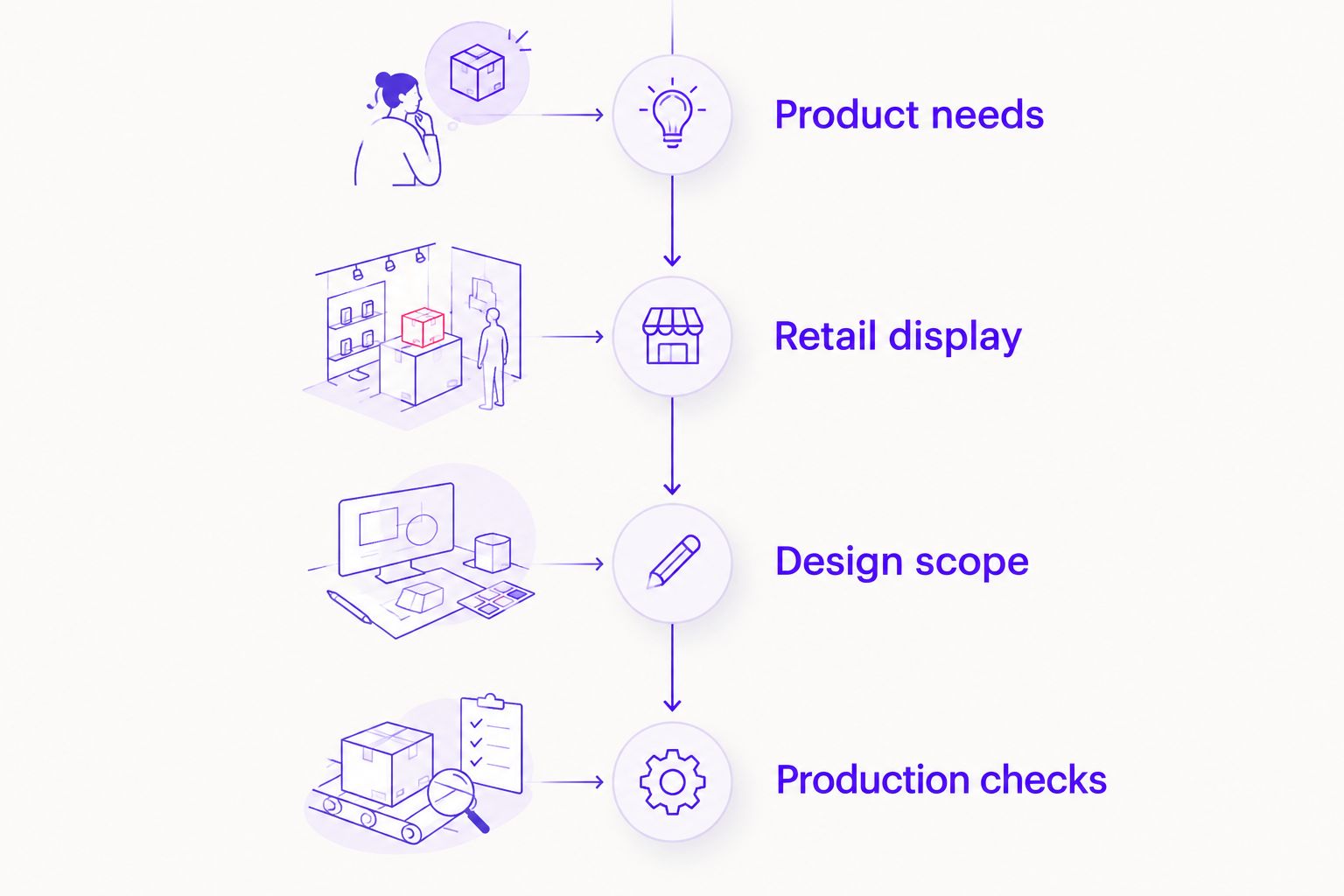
For the first concept review, request 1 primary message, check 3 viewing positions—front, side and top—and compare the sample beside 2 competing packs. These are practical review instructions, not performance benchmarks.
Ask specific questions before hiring:
- Does the proposal cover structural design, artwork or both?
- Who supplies and approves the cutting template?
- Are copywriting, variant adaptations and production files included?
- Who checks applicable labelling requirements?
- How are revision rounds and additional variants handled?
- What sample must be approved before printing?
Scope changes when you add structures, variants, copy, finishes, inserts or additional approval stages. Separate agency deliverables from manufacturing work so competing proposals describe the same assignment.
Define your packaging project
Discuss the format, variants and design deliverables before requesting a project proposal.
Which packaging format should you choose?
Choose folding cartons as the starting point for stackable dry goods, not as a default for every product. Move to stand-up pouches for resealing, rigid boxes for gifting, bottles or jars for dispensing, sleeves for an existing pack and blister packs for hanging display.
For your 2026 launch, approve the physical format before polishing the graphics. Once the structure works, use a consistent message across packaging, the product page and launch communication.
FAQ
What’s the best packaging format for retail shelf standout?
Folding cartons are the default recommendation for stackable dry goods because their defined panels support clear front-facing communication. Choose another format when resealing, dispensing, gifting or hanging display drives the brief.
Are stand-up pouches better than cartons?
Stand-up pouches are better suited to contents that need a compatible resealable closure; cartons are better suited to a defined, stackable box structure. Compare filled samples rather than flat artwork.
Should I choose a rigid box for a new brand?
Choose a rigid box when gift presentation and interior arrangement are explicit requirements. A new brand does not need a rigid box simply to look distinctive.
Can a sleeve replace my existing packaging?
A sleeve adds communication around an existing pack but does not replace its protection function. Confirm fit, retention and information visibility on the assembled pack.
What should a packaging design proposal include?
A packaging design proposal should define structures, variants, artwork, copy responsibilities, revisions and production-file deliverables. It should also state who supplies templates and approves physical samples.
What changes the scope of a packaging design project?
Additional structures, variants, copy, finishes, inserts and approval stages change the project scope. Separate design services from manufacturing work before comparing proposals.
Can CreativHeads help with packaging and launch marketing?
CreativHeads offers coordinated strategy, design and marketing services for brands. Define packaging deliverables and launch communication together so the proposal covers the work you need.
One last thing
Ask to see the pack with its bottom edge partly hidden, as it would appear behind a shelf lip. If the product name disappears, fix the hierarchy before adding another finish: a readable pack is a better starting point than a decorated one.
Related guides