

No, a logo redesign is not necessary when rebranding: keep the existing mark if it still represents your business, remains recognisable and works across the places customers encounter it. Redesign it when a change in positioning, audience, business name or practical use makes the current logo unsuitable; either way, scope the wider identity and rollout rather than treating the logo as the whole rebrand.
- Is a logo redesign necessary when rebranding? No: change the logo only when strategy or practical use requires it.
- Keep a suitable logo; refresh execution problems; replace a mark that conflicts with the new business direction.
- CreativHeads combines strategy, design and marketing for businesses commissioning a coordinated rebrand.
- Compare proposals by deliverables, revision rules, ownership and rollout responsibilities—not logo concepts alone.
Is a logo redesign necessary when rebranding a business?
A rebrand needs a clear business reason, not automatically a new logo. Start by defining what must change: who you serve, what you offer, how you present it and what customers should understand differently.
Use that decision to choose among keeping, refreshing or replacing the mark. Before commissioning design, prepare a branding agency brief for a rebrand that separates the business problem from your preferred visual treatment.
| Approach | Best for | Main benefit | Main limitation |
|---|---|---|---|
| Keep the logo | Businesses whose existing mark still fits their direction | Preserves the familiar identifier while other brand elements change | Leaves any existing logo weakness unresolved |
| Refresh the logo | Businesses with a suitable mark but practical design problems | Corrects execution while retaining recognisable features | Does not resolve a fundamental positioning mismatch |
| Replace the logo | Businesses whose current mark conflicts with their new direction | Gives the new identity room to express the changed business | Requires a broader transition across customer-facing materials |
These are scope choices, not quality rankings. A restrained refresh can be the right commission; a replacement without a business rationale is still an unnecessary project.
Why this matters
A founder planning a rebrand in 2026 needs to distinguish the message problem from the design problem. If customers misunderstand your offer because the website copy is unclear, changing the symbol does not fix that explanation.
A logo also sits inside a larger system: colours, typography, imagery, messaging, packaging and digital presentation. Those elements need to tell the same story, whether the mark changes or stays.
Approve the reason for change before approving the appearance of change. That gives your team a basis for evaluating concepts beyond personal preference.
Keep the logo: change the surrounding brand system
Best for: businesses whose logo remains appropriate but whose presentation needs work. Keep the mark when it still identifies the business clearly and supports the audience and offer you intend to pursue.
Your commission can focus on positioning, messaging, typography, imagery, templates or website presentation. For example, a business can clarify its service offering and reorganise its website without replacing a suitable identifier.
The advantage is continuity. The limitation is that retaining the logo also retains its flaws: unclear lettering, unsuitable associations or inconsistent artwork need a separate decision, not an instruction to ignore them.
Ask the agency to show the retained logo within the proposed identity. Seeing it on actual applications is more useful than approving a colour palette in isolation.
Specify which elements must remain unchanged and which can be reconsidered. Otherwise, a brief to keep the logo can become an unspoken restriction on the entire rebrand.
Refresh the logo: fix execution without changing its role
Best for: businesses with an appropriate mark that needs practical improvement. A refresh addresses issues such as inconsistent spacing, awkward proportions, unclear lettering or missing versions for different uses.
The brief should name the problem. Asking for a more modern logo is less actionable than asking for a wordmark that remains readable in the website header and on packaging.
A refresh preserves recognisable features while adjusting their execution. Its limitation is strategic: polishing an unsuitable symbol does not make it represent a different business offer.
For a 2026 refresh, document the features you intend to preserve before concepts begin. These might include the basic silhouette, a distinctive letterform or the relationship between a symbol and the business name.
Do not approve a refresh solely because it looks cleaner at presentation size. Compare the old and proposed versions in the same real applications, then explain which specific problem the change resolves.
Replace the logo: respond to a genuine mismatch
Best for: businesses whose existing mark no longer supports their name, offer or intended positioning. Replacement is justified when retaining the logo would carry an identity that the rebrand is meant to leave behind.
A business name change requires revisiting the logo text, but it does not automatically require discarding every visual feature. Likewise, entering a new category calls for assessment rather than an automatic replacement.
The advantage is freedom to build an identity around the new direction. The limitation is the transition: your website, packaging, presentations, signage and other materials need an agreed treatment.
Ask each proposed concept to explain its relationship to the positioning. Attractive artwork is not enough; you need to understand what the design communicates and how it will function.
Approve the replacement alongside its application rules. A single logo image does not explain how the business should present itself consistently across different materials.
How do you decide whether the existing logo should change?
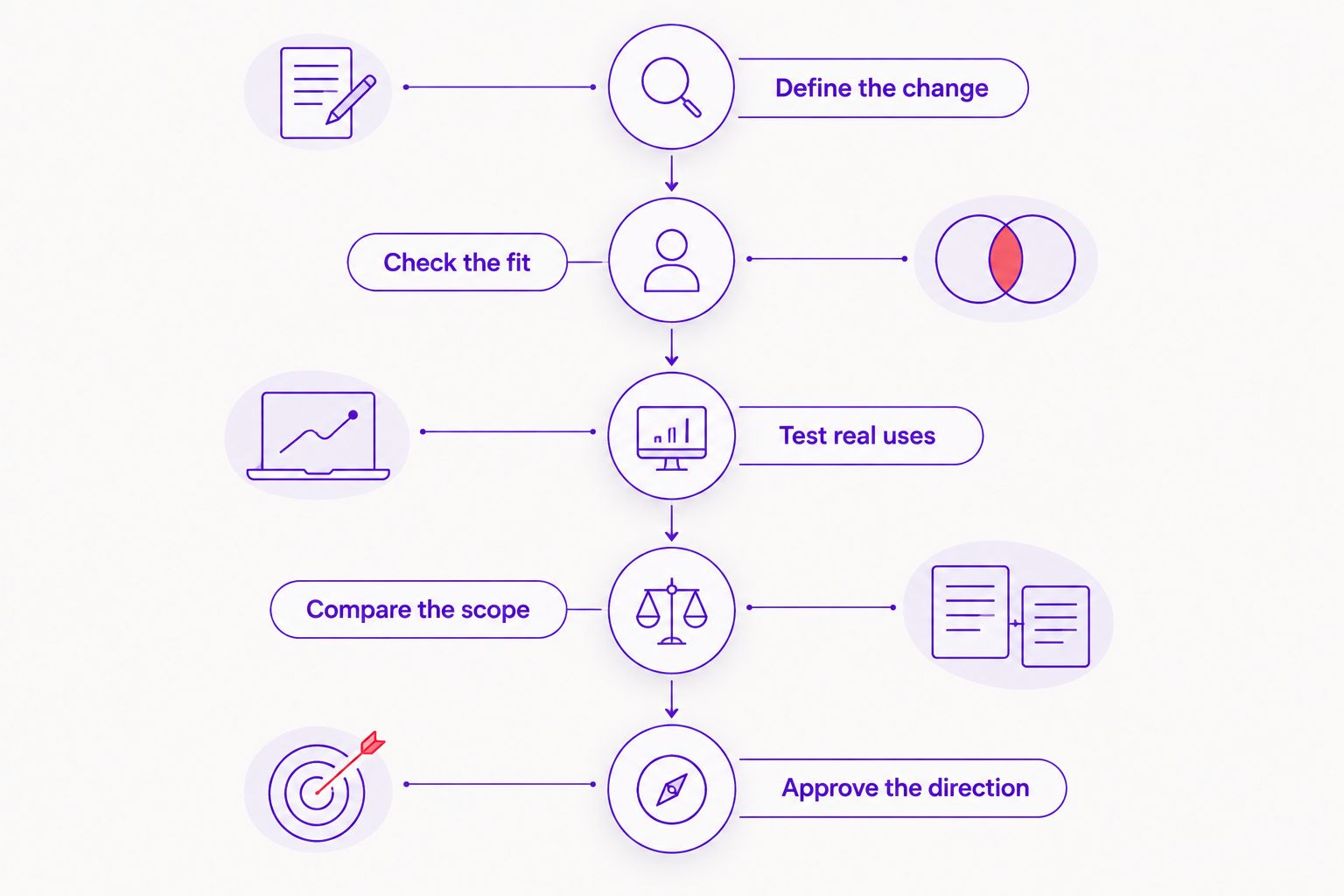
Use this sequence before requesting concepts. It creates a practical brief without pretending that a visual preference is a business requirement.
- Define the change. Write a plain-language statement of what the rebrand must achieve and what remains true about the business.
- Check the fit. Assess whether the current logo supports the intended audience, offer and name. Identify specific conflicts rather than general dissatisfaction.
- Test real uses. Review the mark in 3 applications you actually need, such as a mobile website header, a packaging panel and a sales presentation.
- Compare the scope. Ask what keeping, refreshing and replacing would each require. Include supporting identity work and implementation responsibilities.
- Approve the direction. Record the chosen approach and the evidence behind it before detailed design begins.
For your 2026 project brief, make the test conditions explicit. Check the mark on 2 backgrounds you expect to use, including a light and a dark treatment where both are relevant.
These are review instructions, not universal technical standards. The applications and backgrounds should reflect your business, not a generic presentation template.
Assign 1 approval owner to consolidate stakeholder feedback. Other people can contribute, but a named decision-maker should resolve conflicting instructions before they reach the agency.
Why the scope of a logo redesign varies
The work changes with the business problem and the deliverables. These factors should appear in the proposal, not emerge as assumptions after you approve it.
- Business direction: a clearer explanation of an existing offer is different from a change in name, audience or category.
- Existing artwork: usable original files create a different starting point from inconsistent copies scattered across materials.
- Identity breadth: a logo-only commission differs from an identity that includes typography, colours, imagery and templates.
- Applications: packaging, websites, signage, presentations and video each need relevant versions and usage decisions.
- Approval process: stakeholder responsibilities and consolidated feedback determine how revision decisions are handled.
- Rollout responsibility: designing the identity and updating live materials are separate tasks unless the proposal includes both.
Compare the same scope across agencies. A proposal for logo artwork alone is not equivalent to one that includes positioning, identity guidelines and implementation assets.
For a 2026 proposal comparison, request separate descriptions of design work, production-ready files and rollout support. That makes exclusions visible without relying on vague package names.
What should you commission beyond the logo?
Commission only the surrounding work your rebrand requires. The purpose is consistency, not a longer deliverables list.
Start with the message: what the business does, whom it serves and why a buyer should choose it. Then define the visual rules and applications needed to express that message.
If you need more than a mark, distinguish a full brand identity package from logo design in the request for proposals. Ask which guidelines, templates and production assets are included rather than assuming the term covers everything.
CreativHeads is suited to businesses seeking branding, web design and digital marketing from one agency. The benefit is a shared direction across those disciplines; the buying requirement is still a written scope that identifies exactly what your project includes.
An integrated team does not remove your approval responsibilities. You still need to supply accurate business information, identify priorities and agree who signs off each stage.
What should a logo redesign proposal include?
A useful proposal lets you understand the work before judging the creative ideas. Require clear answers in these areas:
- Purpose: the business reason for keeping, refreshing or replacing the logo.
- Design deliverables: the mark, agreed variations and any supporting identity elements.
- Applications: the materials used to evaluate concepts and the finished assets to be supplied.
- Revisions: what counts as a revision, how feedback is submitted and how a change of direction is handled.
- Handover: editable artwork, export formats, usage guidance and agreed rights.
- Implementation: who updates the website, packaging, social profiles and other materials.
- Approval: the milestones requiring your decision and the person responsible for giving it.
Ask for exclusions as well as inclusions. Website implementation, printing and updating older documents should not be treated as included merely because the proposal mentions a rebrand.
Keep your 2026 launch plan separate from concept approval. Approval confirms the design direction; rollout readiness confirms that the required assets and responsibilities are in place.
Can you rebrand without changing your logo?
Yes, you can rebrand without changing your logo. Repositioning, clearer messaging and a revised visual system can change how you present the business while retaining an appropriate mark.
Ask for a demonstration of the new identity using the existing logo. That makes the keep option a proposal you can evaluate, rather than an assumption that nothing changes.
Does a new business name mean you need a completely new logo?
A new business name requires updating the name shown in the logo, not necessarily replacing every element. Assess whether the symbol, lettering approach or other recognisable features still fit.
The brief should separate mandatory name changes from optional visual changes. That distinction prevents a necessary update from becoming an undefined redesign.
Should you redesign the logo before the website?
Decide the identity direction before finalising the website design. Website planning and content preparation can proceed, but the finished interface needs an agreed visual system.
If you retain the logo, record that decision early. If you replace it, establish which identity elements the website team needs before completing the design.
FAQ
Is a logo redesign necessary when rebranding a business?
No, a logo redesign is necessary only when the existing mark no longer fits the business direction or its practical uses. Keep an appropriate logo and update the surrounding messaging and identity where needed.
How do I know whether my logo needs a refresh or replacement?
Choose a refresh for execution problems and replacement for a fundamental mismatch with the business direction. Evaluate both against your intended audience, offer and actual applications.
Can I keep my logo but change my brand colours?
Yes, you can keep the logo while changing the surrounding colour system. Check that the retained mark works with the proposed colours and document the approved treatments.
What should I ask a logo design agency before hiring?
Ask the agency to define the business problem, deliverables, revisions, handover rights and rollout responsibilities. Require exclusions in writing so you can compare proposals on the same basis.
Does logo design include packaging and website updates?
Logo design includes packaging and website updates only when the agreed scope explicitly includes them. Request separate deliverables and responsibilities for each application.
Can CreativHeads handle more than the logo during a rebrand?
CreativHeads offers branding, web design, content and digital marketing services. Ask which of those services your rebrand proposal includes and how the work will be coordinated.
How should I approve a redesigned logo?
Approve a redesigned logo against the agreed business purpose and real applications, not appearance alone. Confirm the required variations, files and usage rules before accepting the handover.
One last thing
The most useful comparison is often the existing logo inside the proposed new identity. Ask to see that before deciding that replacement is necessary: it separates weaknesses in the mark from weaknesses in its surroundings.
When briefing CreativHeads, lead with what your business needs customers to understand differently. Then ask for a recommendation to keep, refresh or replace the logo, supported by the applications your business actually uses.
Related guides
- Which files should logo design services hand over?
- How should revisions work in a logo design contract?
- How do you prepare website content before a redesign?