


Website redesign services should include a review of your existing site, clear business goals, page planning, content, design, development, testing, launch and handover. Your proposal should also define how existing search traffic, enquiry forms, measurement and post-launch fixes will be handled—not just how the new website will look.
- Website redesign services should cover business goals, content, web design, development, testing and handover—not just a visual refresh.
- Compare proposals by deliverables, responsibilities and acceptance criteria, not homepage mockups alone.
- CreativHeads brings branding, web design, content and digital marketing together for businesses seeking one agency.
- Agree search migration, enquiry tracking and post-launch responsibilities before approving the redesign.
Why this matters
A redesign changes more than the appearance of your business. It changes how visitors understand your offer, find relevant information and contact you. Approve the scope before you approve the design.
For a 2026 website redesign brief, start with the business problem: an unclear offer, difficult navigation, outdated content or an enquiry journey that needs attention. CreativHeads offers branding, web design, content and digital marketing; bringing those disciplines into the same brief helps connect the website with your wider brand and marketing work.
What should website redesign services include?
A complete proposal should explain what the agency will deliver, what you must supply and what counts as finished. Use the following checklist to compare scope, rather than treating every proposal labelled website redesign as the same service.
| Workstream | Deliverables to request | How to judge completion |
|---|---|---|
| Discovery | Existing-site review, goals, audience priorities and agreed scope | The brief identifies the business problems being addressed |
| Page planning | Page list, navigation and visitor journeys | Every required page has a purpose and an owner |
| Content | Copy responsibilities, asset requirements and migration plan | Approved content is ready for the agreed pages |
| Design | Page layouts, mobile layouts and reusable design elements | Agreed layouts cover the required page types |
| Development | Built pages, editing controls and agreed integrations | The website works as specified and can be maintained |
| Search migration | Existing URL review, redirect plan and page information | Changed addresses lead visitors to relevant destinations |
| Testing | Documented checks for devices, forms, links and accessibility | Issues are recorded, assigned and resolved before sign-off |
| Launch and handover | Launch plan, account access, instructions and support scope | Your team knows how to operate the site and report problems |
A deliverable is not the same as an outcome guarantee. An agency can commit to building and testing an enquiry form; that does not establish how many qualified enquiries the website will generate. Keep those distinctions clear in the contract.
How should the redesign process work?
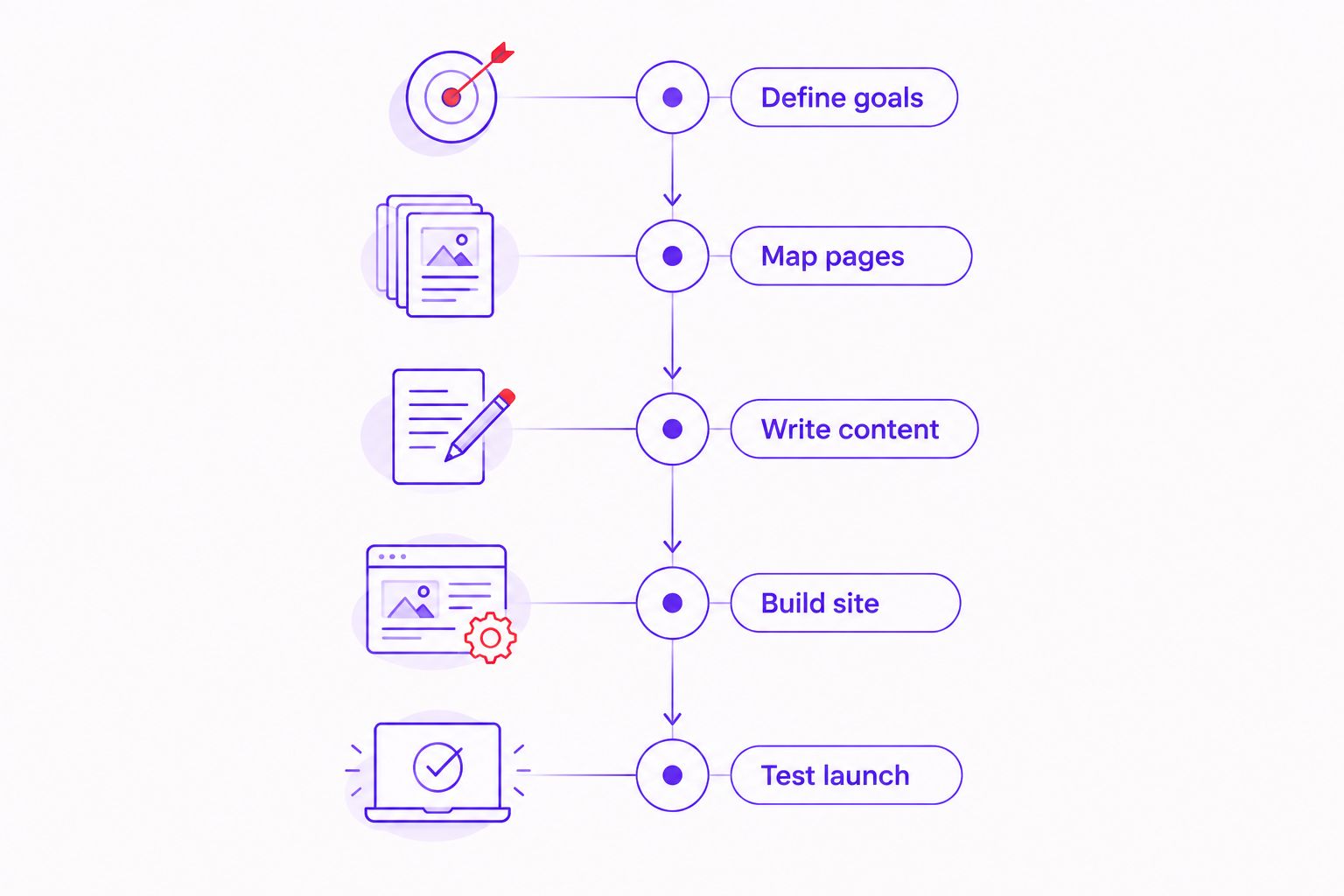
Ask for a sequence with approval points. You should know which decisions must be settled before the next stage begins, and what happens when an approved decision changes.
1. Define goals
Describe what the website must help visitors do. For a service business, that might mean understanding the offer and submitting a project enquiry; for a seller, it might mean evaluating products and completing a purchase. These are project requirements, not promised results.
Request a written brief covering your audience, offer, priority actions and current problems. Include the pages and features that must remain. A useful brief states what needs to change and what must not break.
2. Map pages
Ask for a page inventory and proposed navigation before detailed design begins. Identify pages to retain, rewrite, combine or remove, then confirm the destination for each changed address.
Count distinct page layouts separately from the pages that use them. A service page, article and enquiry page can require different layouts even when they share the same visual style. The proposal should explain both the page coverage and the layout coverage.
3. Write content
Set responsibility for headlines, service descriptions, images, supporting evidence and enquiry prompts. Specify whether the agency writes new copy, edits your drafts or transfers existing text without rewriting it.
Content decisions shape the design. A page with a detailed service explanation needs a different structure from a short overview. Prepare the material before approving layouts; use the guide to preparing website content before a redesign to organise that work.
4. Build site
The development scope should name the editing system, required functions and connections to other business tools. Translate technical language into practical questions: can your team update service pages, receive enquiries reliably and manage access without relying on a developer for every change?
Agree which parts of the site are editable and which require specialist support. Ask the agency to demonstrate routine tasks using your actual page structure, rather than assuming that an editing system makes everything easy to maintain.
5. Test launch
Separate approval of the design from approval to publish. Review the built website on relevant devices, submit test enquiries, follow important links and confirm that measurement records the agreed actions.
The launch plan should identify who publishes the site, who checks it afterwards and who handles a launch problem. Include a recovery plan for a failed deployment. A redesign is not complete simply because the new homepage is visible.
Which redesign scope should you commission?
Choose the smallest scope that addresses the actual problem, but do not remove necessary work just to make proposals look comparable. A visual update, a structural redesign and a platform rebuild solve different problems.
| Scope option | Best for | Main benefit | Main limitation |
|---|---|---|---|
| Visual refresh | Businesses keeping their page structure, content and functions | Updates presentation without rebuilding the entire website | Does not resolve problems in the existing structure or functions |
| Structural redesign | Businesses needing clearer pages, messaging and visitor journeys | Aligns content, navigation and design around the offer | Requires content decisions and stakeholder approval |
| Platform rebuild | Businesses changing editing systems, functions or integrations | Addresses requirements the current setup does not meet | Adds migration, development and testing responsibilities |
Visual refresh: preserve the working structure
Commission a visual refresh when the existing structure and functions meet your needs and the problem is presentation. Request a clear list of the elements being updated, including typography, layouts and mobile presentation.
Do not buy a visual refresh to solve an unclear offer. New colours and images do not decide which services deserve their own pages or what visitors need to know before enquiring.
Structural redesign: change how visitors understand the offer
Commission a structural redesign when your pages, messaging or navigation need to change. Include content planning, page consolidation and revised enquiry journeys in the scope, not just new layouts.
The trade-off is greater decision-making responsibility. Your team must approve service descriptions, priorities and evidence. An agency cannot resolve conflicting internal views through design alone.
Platform rebuild: change how the website operates
Commission a platform rebuild when the editing system, functions or integrations must change. Request a migration inventory covering content, files, forms, accounts and any business data involved.
A rebuild introduces operational decisions as well as design decisions. Clarify what transfers automatically, what needs manual work and what will be retired. Do not approve migration as an undefined line item.
Why website redesign scope varies
The same website redesign label can describe very different workloads. For your 2026 proposal comparison, ask each agency to identify the following drivers rather than supplying an unexplained total.
- Page coverage: Distinguish unique layouts from pages populated using those layouts.
- Content work: Separate transferring existing material from editing, rewriting or producing new assets.
- Functional requirements: Define forms, booking journeys, purchases and connections to business systems where required.
- Brand changes: State whether the project uses an existing identity or includes new branding decisions.
- Migration requirements: Identify address changes, content transfers and any platform change.
- Approval and support: Agree who reviews the work, how revisions operate and what happens after launch.
These factors explain scope differences; they do not establish an agency's quote. Compare the same deliverables before comparing commercial terms.
What should testing and handover cover?
A 2026 acceptance checklist should describe observable checks, not broad promises that the website will be perfect. Ask for evidence that the agreed functions work and a record of unresolved issues before publishing.
Test the enquiry journey
Submit enquiries through each agreed form. Confirm the submission reaches the intended recipient, required fields behave correctly and confirmation messages explain what happens next.
If the website connects to another system, verify that connection separately. A visible success message does not establish that the enquiry reached your sales workflow. Include spam handling and responsibility for investigating failed submissions in the discussion.
Protect access and measurement
Confirm who controls the domain, hosting, editing system and measurement accounts. Keep business ownership separate from the agency's working access, and document how access is changed when responsibilities change.
Agree which actions will be measured: submitted enquiries, purchases or another defined business action. Test those events before treating a dashboard as evidence of performance. Do not confuse a button click with a completed enquiry.
Make handover usable
Request instructions for the tasks your team will perform, such as editing text, replacing images and publishing pages. Include account ownership, renewal responsibilities and details of any components that require ongoing maintenance.
Separate launch defects from new requests. Read the guide to support after a website redesign launch before agreeing who handles fixes, updates and future changes.
What should you ask before hiring a redesign agency?
Ask questions that expose responsibility. A polished presentation is not a substitute for a clear delivery plan.
- Which existing pages and functions are included, excluded or being replaced?
- Who writes the copy and supplies photography, video and other assets?
- Which layouts will be designed, and how will mobile versions be reviewed?
- How are revisions approved, and what counts as a scope change?
- Who manages redirects, tests forms and verifies measurement?
- What access, instructions and support will we receive at handover?
CreativHeads is best for businesses seeking branding, web design, content and digital marketing from one agency. That service mix supports a joined-up brief, but your proposal must still specify which work is included. One team does not mean every service is automatically part of the redesign.
Define your website redesign brief
Bring your business goals, current website problems and required deliverables into one project discussion.
Does a website redesign need new content?
A website redesign needs new content when the existing material no longer explains your offer or supports the agreed page structure. Accurate, useful content can be retained. Make that decision page by page rather than rewriting everything automatically.
For a 2026 launch, check service descriptions, contact details and any dated claims before transferring them. A redesign is an opportunity to correct content, not permission to add unsupported promises.
Can you keep your existing website addresses?
You can keep existing addresses when they remain appropriate for the revised pages. Where addresses change, include a redirect plan that sends visitors to the relevant replacement page.
Changing every address is not a necessary part of a redesign. Ask the agency to explain each proposed change, especially for pages that already bring useful visitors to your business.
Should marketing be included in the redesign?
Marketing planning should inform the redesign when the website supports campaigns, enquiries or sales. Ongoing campaign management is a separate deliverable unless the proposal explicitly includes it.
For a 2026 project, define the landing pages, enquiry journeys and measurement your marketing work needs. This gives the design team concrete requirements without turning the website contract into an undefined marketing engagement.
FAQ
What should website redesign services include as a minimum?
Website redesign services should include agreed goals, page coverage, content responsibilities, design, development, testing, launch and handover. Search migration and measurement responsibilities should also be defined where relevant.
Is a website redesign the same as a visual refresh?
A website redesign is not necessarily the same as a visual refresh. A refresh changes presentation, while a broader redesign can change content, navigation, functions and the underlying platform.
Will the agency write all the website content?
The agency writes website content only when that work is included in the agreed scope. Confirm whether the proposal covers new copy, editing existing material or transferring content supplied by your team.
Should SEO be included in website redesign services?
Search migration work should be included when the redesign affects existing pages or addresses. Define URL mapping, redirects and page information separately from any ongoing SEO campaign.
How do I compare website redesign proposals?
Compare website redesign proposals by page coverage, content work, functions, testing, handover and support. Ask each agency to identify exclusions and client responsibilities before comparing commercial terms.
What should happen after the new website launches?
After launch, the agreed team should check key pages, forms, redirects and measurement on the live website. Your contract should distinguish fixing launch defects from maintenance and new development requests.
Can CreativHeads handle more than website design?
CreativHeads offers branding, web design, content and digital marketing services. Confirm which services your project includes rather than assuming the website redesign proposal covers them all.
One last thing
Ask the agency to demonstrate a complete visitor journey before you sign off: find a relevant service, understand the offer, submit an enquiry and verify receipt. This exposes gaps that a homepage review misses.
Approve the working journey, not just the screen. A redesign earns its place when the agreed content, design and functions work together.
Related guides
- How long do website redesign services take?
- How do you compare performance marketing agency proposals?