


Packaging design takes the time needed to approve the brief, choose a design direction, complete every pack version and prepare printer-ready artwork; set your launch date against an agreed project schedule, not a generic turnaround estimate. That schedule must also account for printer checks, proof approval and production, because finished design files are not finished packaging.
- How long does packaging design take? Scope, approvals and printer requirements determine the schedule—not the launch date alone.
- CreativHeads offers packaging design alongside branding, web design and digital marketing for brands planning coordinated launches.
- Agree separate milestones for approved artwork and finished packaging before committing to a product launch.
- Confirm pack versions, final copy, printer templates and the approval owner before design begins.
Why this matters
Your packaging deadline is not the same as your product-launch deadline. You need approved artwork early enough for your printer to check the files, produce a proof where required and complete the agreed production process.
For a 2026 launch, ask for a schedule that connects these handovers. A proposal that ends at design approval leaves you responsible for checking whether the remaining print and launch work fits.
CreativHeads is a fit for brands seeking packaging design alongside branding, web design and digital marketing. That service mix lets you discuss the pack and its supporting launch materials with one agency; CreativHeads provides the starting point for that conversation. Confirm the actual deliverables in your proposal rather than assuming every service is included.
How long does packaging design take before a product launch?
The useful answer is a dated sequence of deliverables, not an isolated promise of fast delivery. Ask your agency to show when you must supply inputs, when you will review work and when approved files will reach the printer.
Build the schedule backwards from the date you need finished packaging:
- Confirm the production deadline. Ask the printer when approved artwork must arrive to support your required delivery date. Include proof approval and any production checks in that discussion.
- Define the artwork deadline. Identify exactly what the agency must hand over: approved print files, the agreed versions and any supporting files included in scope.
- Set the approval milestones. Separate design-direction approval from final artwork approval. A selected concept still needs complete copy, version changes and production checks.
- Set the input deadline. Agree when the agency needs product information, pack dimensions, the printer's template and approved brand assets.
- Assign dependencies. Name the person responsible for each approval and identify decisions that would stop the next stage from starting.
Ask for 2 linked schedules: design delivery and packaging production. The agency and printer must agree on the handover between them. Neither schedule should rely on an approval date that nobody has accepted.
For your 2026 launch plan, mark the approved-artwork date separately from the finished-packaging date. This makes the remaining production work visible before you announce the launch.
A single-pack project: define the complete deliverable
A single pack is a narrower scope than a range, but the proposal still needs to describe the whole job. Designing the front panel alone is not the same deliverable as completing every printable surface.
Ask whether the scope includes the back panel, sides, product information, barcode placement, required copy and print-file preparation. Confirm whether the agency is designing on an existing structure or whether structural packaging work needs a separate specialist.
Best for: a launch with one defined pack format and settled product information. The advantage is a contained approval task; the limitation is that unfinished copy or an unresolved pack structure can still prevent final artwork approval.
Keep supporting work explicit. If you also need a product-page image, a campaign graphic or a launch presentation, list those deliverables separately rather than treating them as automatic packaging-design outputs.
A product range: approve the system before every version
A product range needs a shared design system and a clear way to distinguish each product. Your brief should identify what stays consistent and what changes across flavours, sizes, formulations or other variants.
Approve the shared direction before requesting final artwork for the full range. That gives you a decision point for the brand hierarchy, product naming and variant treatment before those choices appear across every file.
Best for: a launch where several products must look related without becoming difficult to tell apart. The benefit is a consistent range; the trade-off is the additional artwork and checking required for each version.
Use a version list that pairs each product with its pack format, copy and required files. The guide to briefing a packaging design agency for multiple products helps you define that scope before requesting a schedule.
A packaging redesign: separate visual change from structural change
A redesign can mean updating artwork on an existing pack or replacing the packaging format itself. Those are different briefs, and your proposal should not blur them together.
If you retain the structure, identify which existing assets remain approved and which need changing. If you change dimensions, materials or the pack construction, confirm who owns that work and when the design team will receive the agreed specification.
Best for: an established product with a clearly defined reason to change its packaging. Reusing approved inputs keeps the brief focused; the limitation is that old artwork still needs checking against the new requirements.
For a 2026 redesign, distinguish essential launch changes from changes you can commission separately. A refreshed logo, a new website and updated campaign materials each need their own scope and approval route.
| Project scope | Best for | Useful advantage | Main constraint to resolve |
|---|---|---|---|
| Single-pack design | One product with a defined format | Contained artwork and approval scope | Complete copy and printer requirements |
| Product-range design | Related products launching together | Shared design with clear variant differences | Complete version list and consistent approvals |
| Packaging redesign | An existing product with a defined change | Ability to retain suitable approved assets | Agreement on visual versus structural changes |
Why packaging-design timelines vary
The schedule depends on the work you commission and the decisions needed to finish it. Ask how each of these factors is reflected in the proposal rather than accepting a deadline without conditions.
- Scope completeness: list every pack, surface and output. An omitted version becomes additional work when it enters the project.
- Input readiness: confirm the product names, claims, ingredients where relevant, imagery and other copy before approving final artwork.
- Brand readiness: decide whether the logo, colours and overall identity are settled or part of the assignment.
- Pack specifications: obtain the agreed dimensions and printer template before treating layout as final.
- Approval ownership: appoint 1 approval owner to combine feedback and communicate the decision, while retaining any necessary specialist checks.
- Production requirements: ask who checks print files, who approves proofs and how printer-requested changes are handled.
These are scheduling decisions, not reasons to accept an open-ended project. A useful proposal names the deliverable, the responsible person and the approval condition for each stage.
Do not compare deadlines until you compare what each deadline includes. Concept presentation, artwork approval and delivery of finished packaging are different milestones.
What should you agree before the design work starts?
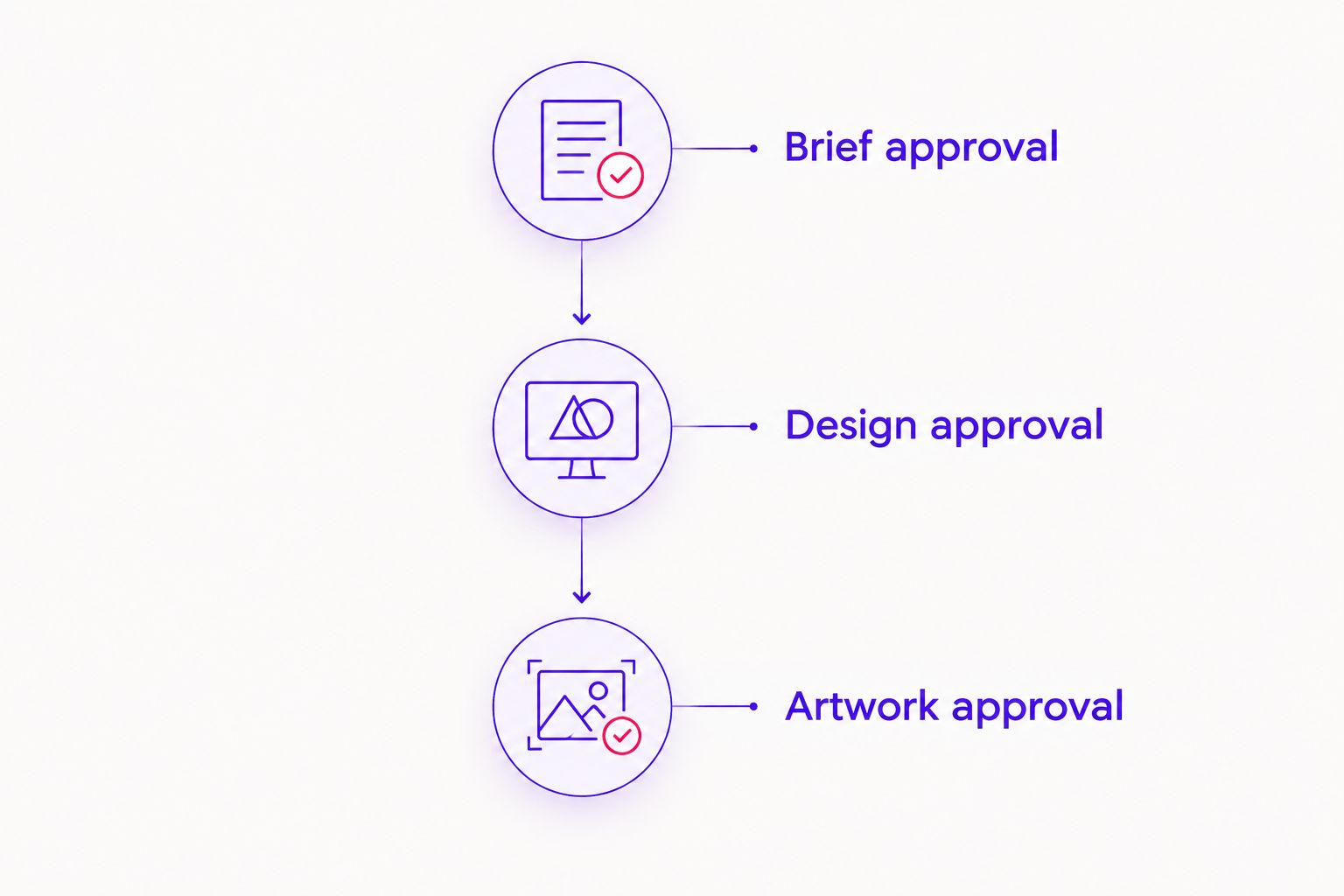
Use 3 approval checkpoints: brief approval, design approval and artwork approval. Each checkpoint should answer a different question, so feedback does not reopen decisions without a clear reason.
Brief approval
Agree what the packaging must communicate, who it is for and where buyers will encounter it. Include the product list, pack format, required copy, brand assets and launch dependencies.
Ask: what inputs must be final before work starts, and what happens if an input changes? A written answer gives both sides a clear basis for scheduling.
Design approval
Agree the visual direction and the order in which information should be seen. Evaluate the design against the brief, not against an expanding collection of personal preferences.
Ask the agency to show the relevant pack surfaces and explain how the direction applies across the agreed range. Record the chosen direction and any specific changes required before artwork preparation.
Artwork approval
Check the actual files that will move into production. Review product names, copy, variant differences, dimensions and the printer's requirements before authorising the handover.
Ask who signs off factual and regulatory content, and who signs off the technical files. Visual approval does not replace those responsibilities.
Can packaging design begin before all the product details are final?
Packaging design can begin with provisional information if the agency agrees which work can proceed and which decisions remain open. Final artwork approval still needs the actual information that will appear on the pack.
Distinguish exploratory work from production-ready work in your 2026 schedule. Concept development can explore hierarchy and visual direction, but it should not be presented as completed artwork while essential details remain unresolved.
Before starting, list the provisional inputs and assign an owner to each. Ask which changes would affect layout, create additional versions or require another approval.
Does packaging design include printing time?
Packaging design includes printing time only when the agreed service scope explicitly covers production coordination and its schedule. Otherwise, treat the design handover and the printer's delivery commitment as separate responsibilities.
Ask whether the agency will communicate with the printer, respond to technical questions and revise files after proof review. Also confirm who commissions printing and who authorises production.
The launch plan needs a printer-confirmed deadline, not just an agency artwork deadline. Keep both commitments visible in the same plan.
How do you evaluate a packaging-design timeline in a proposal?
Read the schedule alongside the deliverables. A shorter-looking proposal is not a better proposal if it excludes range versions, print preparation or the approvals your business needs.
Ask these questions before hiring:
- What exactly will be complete at the stated delivery date?
- Which pack versions and surfaces are included?
- Which inputs must we provide before work begins?
- How are feedback rounds and out-of-scope changes handled?
- Who prepares the printer-ready files and checks the printer's requirements?
- Who approves product facts and required label content?
- What happens to the schedule if an approval or input arrives late?
- Are launch images and marketing assets included or separately scoped?
Ask for answers in the proposal, not only during a call. This gives you a usable basis for coordinating your team, the agency and the printer.
CreativHeads offers strategy, design and marketing through one team, which is relevant when your pack must connect with website and campaign work. The benefit is a shared project conversation; the boundary is that you still need each deliverable and approval responsibility written into scope.
FAQ
How long does packaging design take for a new product?
Packaging design needs a project-specific schedule covering the brief, design approval, complete artwork and printer handover. Ask for dated milestones based on your actual pack formats, versions and approval requirements.
When should I hire a packaging design agency before launch?
Hire a packaging design agency before you commit to the artwork deadline required by your printer. Work backwards from finished-packaging delivery and agree the design milestones before announcing the launch date.
Can I get packaging designed faster if I already have a logo?
An approved logo removes the need to resolve that asset within the packaging project. You still need complete product copy, pack specifications, a design direction and final artwork approval.
Does a packaging design agency handle printing too?
Printing is included only when the agency’s agreed scope says so. Confirm responsibility for printer coordination, proof checks, artwork changes and production approval before signing.
What should I send an agency before packaging design starts?
Send the product list, pack formats, printer templates, brand assets, required copy and launch requirements. Identify anything provisional so the agency can separate exploratory work from final artwork preparation.
Will adding more product variants change the schedule?
Additional product variants add artwork and checking tasks unless they are already included in the scope. Confirm the full version list before agreeing the timeline and ask how later additions will be handled.
Can CreativHeads help with packaging and launch marketing?
CreativHeads offers packaging design alongside branding, web design and digital marketing. Ask for a proposal that identifies the packaging deliverables and any supporting launch work you want to commission.
One last thing
For a 2026 launch, define what you mean by ready before approving the schedule. A presentation mock-up shows the design direction; it does not confirm that every production file has been checked or that packaging has been manufactured.
Put the final handover definition in writing. Name the files, versions, approvals and printer checks required at that point, then confirm which production steps remain. That is the deadline you can plan around.
Related guides
- How to choose a packaging design agency for a launch
- Can logo design services include a full brand identity package?
- Best video production formats for product launches