
Generating leads through paid advertising can be costly when campaigns lack the right strategy and optimization. PPC Strategies help businesses reduce advertising costs, reach relevant audiences, and improve conversion rates. With effective planning, businesses can maximize their advertising budgets while attracting potential customers.
At CreativHeads, we combine creative thinking, data-driven marketing, and performance-focused solutions to help businesses achieve measurable growth. Our strategic approach helps brands improve campaign performance, connect with their target audience, and generate quality leads through digital marketing.
What Are the Best PPC Strategies to Reduce Cost Per Lead?
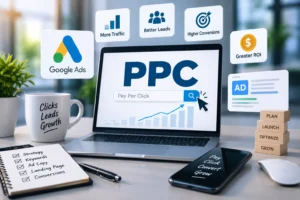
Reducing CPL requires more than lowering your advertising budget. You need to improve targeting, ad relevance, landing page experience, and conversion tracking. By integrating performance marketing with effective PPC Strategies, businesses can optimize campaigns, attract quality leads, and make better use of their advertising spend. The following PPC Strategies can help improve campaign efficiency and deliver measurable results.
1. Choose High-Intent Keywords
Keywords determine when your advertisements appear and who sees them. Targeting broad or irrelevant keywords can increase clicks without generating valuable leads.
Focus on keywords that reflect purchase intent and the services your business provides.
For example, a digital marketing agency might target:
- Digital marketing agency for small businesses
- Google Ads management services
- Performance marketing agency
- PPC agency for lead generation
Use keyword research tools to identify relevant search terms. Review search volume, competition, and user intent before adding keywords to your campaigns.
Use Negative Keywords
Negative keywords prevent your ads from appearing for irrelevant searches.
Examples include:
- Free courses
- Jobs
- Tutorials
- DIY services
Regularly reviewing search terms helps reduce wasted spending and improve lead quality.
2. Improve Your Audience Targeting
Effective PPC advertising strategies depend on reaching the right audience. Even well-written advertisements can produce poor results when shown to people who are unlikely to become customers.
Use audience targeting options based on your campaign goals and advertising platform.
Consider:
- Location: Target areas where your business operates.
- Demographics: Use relevant age groups or audience characteristics where appropriate.
- Interests: Reach users who may be interested in your products or services.
- Remarketing: Reconnect with users who have previously visited your website.
For local businesses, location targeting can help prevent unnecessary spending on clicks from areas you do not serve.
Avoid narrowing your audience too aggressively. Give the platform enough audience reach to identify and connect with potential customers.
3. Create Relevant and Compelling Ad Copy
Ensure your advertisement aligns with the user’s search intent and expectations. When the ad clearly explains what you offer, visitors are more likely to understand its value before clicking.
Strong PPC marketing strategies connect the keyword, advertisement, and landing page.
Include These Elements in Your Ad
- A clear headline that matches the user’s search.
- A benefit that explains your service.
- A relevant keyword where it fits naturally.
- A specific call to action.
- Accurate information about your offer.
Instead of using a generic headline like “Digital Marketing Services,” try a more engaging and specific alternative:
Grow Your Business With Performance Marketing
Give users a compelling reason to take action. Test different headlines, benefits, and calls to action to identify which combinations generate qualified leads.
4. Optimize Your Landing Pages
An advertisement can attract clicks, but the landing page influences whether visitors become leads.
If your landing page loads slowly, looks confusing, or does not match the advertisement, users may leave without completing the form.
Landing Page Optimization Tips
- Match the page content with your advertisement.
- Use a clear and visible headline.
- Explain your service benefits.
- Add a simple lead form.
- Include trust signals such as testimonials or relevant experience.
- Optimize the page for mobile devices.
Keep the conversion process simple. If users need to complete too many steps, they may abandon the page.
Your landing page should support the same goal as your advertisement: encouraging the right audience to take action.
5. Focus on Conversion Tracking
Without reliable tracking, you cannot accurately measure campaign performance.
Conversion tracking helps businesses understand which advertisements, keywords, and campaigns contribute to leads.
Track meaningful actions such as:
- Contact form submissions
- Phone calls
- Consultation bookings
- Product purchases
- Qualified enquiries
Google provides conversion measurement resources through Google Ads Help.
Track Lead Quality, Not Just Quantity
A campaign that generates 100 low-quality leads may be less useful than one that generates 30 relevant enquiries.
Connect your advertising data with your CRM when possible. This helps you understand which campaigns produce leads that move further through the sales process.
Accurate tracking supports informed decisions about budget allocation.
6. Test Different Ad Variations
Testing helps you discover which messages connect with your audience.
Instead of relying on a single advertisement, create different variations and compare their performance.
You can test:
- Headlines
- Descriptions
- Calls to action
- Offers
- Landing page messaging
For example, one advertisement might focus on affordability, while another highlights measurable business results.
Avoid changing too many variables at once. Testing one major element at a time can make performance differences easier to interpret.
Give campaigns enough time and data for meaningful comparisons. Results can vary based on industry, budget, audience, and competition.
7. Improve Your Quality Score
Google Ads uses several factors to evaluate ad quality and relevance. Quality Score is a diagnostic tool that can help advertisers identify opportunities for improvement.
Using relevant keywords, engaging advertisements, and optimized landing pages can improve overall campaign performance.
Ways to Improve Ad Relevance
- Organize keywords into closely related ad groups.
- Write advertisements that match search intent.
- Improve landing page relevance.
- Review expected click-through rate and other diagnostic signals.
A higher Quality Score does not guarantee a lower cost per lead. Your actual results also depend on competition, conversion rates, bidding, and other factors.
8. Adjust Bidding Based on Campaign Goals
Choose a bidding strategy that aligns with your business goals and available conversion data.
Google Ads offers different bidding approaches, including strategies designed to generate conversions or control advertising costs.
Common options include:
- Maximize Conversions: Focuses on generating conversions within your budget.
- Target CPA: Aims to achieve conversions around a target acquisition cost when eligible and supported by sufficient data.
- Manual bidding options: Offer greater control in applicable campaign types.
PPC campaign strategies should evolve as performance data becomes available.
Avoid setting an unrealistic target CPA without understanding your historical results. Start with a practical target and adjust it based on lead quality, conversion volume, and business goals.
9. Use Remarketing to Reconnect With Visitors
Not every website visitor converts during their first visit. Some users need more information before contacting your business.
Remarketing can help you reconnect with eligible audiences who have previously interacted with your website or business.
Examples include:
- Visitors who viewed a service page.
- Users who started but did not complete a form.
- Previous customers, where appropriate.
- Visitors who interacted with specific content.
Remarketing campaigns must follow applicable platform policies and privacy requirements.
Use relevant messaging rather than repeatedly showing the same advertisement. A helpful offer, useful information, or a clear next step may encourage users to return.
10. Review Campaign Performance Regularly
Campaign optimization should be an ongoing process. Performance can change as competition, audience behavior, and advertising costs shift.
Review your campaigns regularly to identify opportunities and problems.
Important Metrics to Monitor
| Metric | What It Helps You Understand |
| Cost Per Lead | Average advertising cost for each tracked lead |
| Conversion Rate | Percentage of relevant visitors who convert |
| Click-Through Rate | How frequently users click your advertisements |
| Cost Per Click | Average cost of each click |
| Lead Quality | Whether leads match your business requirements |
| Conversion Value | The value generated by tracked conversions |
Use these metrics together rather than relying on one number.
For example, a lower cost per lead may not represent an improvement if lead quality declines. Likewise, a higher CPC may be acceptable when it produces more valuable customers.
How Do PPC Strategies Support Performance Marketing for Businesses?
Performance Marketing for Businesses focuses on measurable outcomes such as leads, sales, and conversions. PPC advertising can support this approach by providing campaign data and opportunities for ongoing optimization.
Effective PPC marketing strategies work alongside other digital marketing activities. Businesses may combine paid advertising with search engine optimization, content marketing, and conversion rate optimization.
PPC vs SEO: Understanding the Difference
SEO vs PPC is an important consideration when planning a digital marketing strategy.
- PPC: Can generate paid traffic when campaigns are active and properly funded.
- SEO: Focuses on improving organic search visibility over time.
- PPC: Provides opportunities to test keywords, offers, and audience segments.
- SEO: Can support long-term organic traffic and content discoverability.
Many businesses use both approaches to support different marketing objectives.
Google Ads vs Meta Ads: Which Should You Use?
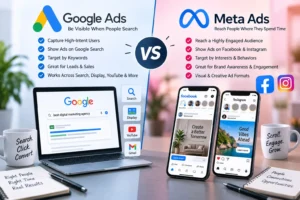
Google Ads vs Meta Ads involves different audience discovery and advertising approaches.
Google Ads can help businesses reach users who are actively searching for products or services. Meta Ads can help businesses reach audiences through interest-based, demographic, and other targeting options available on its platforms.
The appropriate platform depends on:
- Your target audience.
- Customer buying behavior.
- Campaign objective.
- Available creative assets.
- Budget and conversion data.
Businesses should test platforms based on measurable results rather than assuming one channel will work equally well for every industry.
How Can CreativHeads Help With PPC Marketing?
CreativHeads is a digital-first creative agency that provides branding, digital marketing, performance-focused solutions, and creative services. Its approach combines strategy, creativity, and data to support business growth.
Businesses looking to improve their paid advertising can explore relevant services and discuss their goals with the team through the CreativHeads website.
The agency’s work process includes discovering business objectives, developing strategies, creating solutions, and optimizing campaigns. These steps can help businesses approach marketing with clearer goals and structured execution.
Partner With CreativHeads for Smarter PPC Strategies and Business Growth
Reducing cost per lead requires relevant targeting, compelling advertisements, optimized landing pages, and consistent tracking. By implementing effective PPC Strategies, businesses can improve campaign efficiency, attract quality leads, and make informed marketing decisions.
At CreativHeads, we combine creativity, performance marketing, and data-driven strategies to support business growth. As a trusted digital marketing partner, our team helps businesses achieve measurable results through customized marketing solutions. Choose CreativHeads when looking for the best marketing agency in Kerala to strengthen your digital presence and generate quality leads.
Ready to reduce your cost per lead? Partner with CreativHeads for smarter PPC Strategies and measurable business growth.
INDIA | +91 79 9494 0202
UAE | +971 58 848 2928
FAQs
Q1. What are PPC Strategies?
A. PPC Strategies are methods used to improve paid advertising performance, control costs, and generate relevant leads.
Q2. How can I reduce my PPC cost per lead?
A. Improve targeting, optimize landing pages, test advertisements, and track conversions to identify campaign improvement opportunities.
Q3. Why is conversion tracking important in PPC?
A. Conversion tracking helps businesses measure leads, evaluate campaign performance, and make informed advertising budget decisions.
Q4. Are Google Ads or Meta Ads better for lead generation?
A. The suitable platform depends on your audience, campaign objectives, budget, and conversion performance.
Q5. Can CreativHeads help businesses with PPC marketing?
A. CreativHeads offers creative and performance-focused digital solutions. Contact the agency to discuss your specific marketing requirements.