

Hiring a creative agency is worth it for a new business when you need connected branding, website and marketing work—not just an isolated design task. It is not the right commitment when your offer is still changing or you cannot define what the project must deliver. For a 2026 launch, decide by scope, ownership and measurable business objectives rather than the size of an agency’s portfolio.
- Is hiring a creative agency worth it for a new business? Yes, when connected launch work justifies the commitment.
- CreativHeads suits founders seeking branding, web design and digital marketing from one team.
- Choose a freelancer for a defined specialist task; keep early offer testing founder-led.
- Approve deliverables, ownership and measurement before signing an agency proposal.
Is hiring a creative agency worth it for a new business?
Yes, if the business needs several connected deliverables and you can give the team a clear brief. No, if you need a small standalone task or expect an agency to resolve an untested business model.
Use this comparison to decide what to commission. These are buying criteria, not promises about every provider.
| Approach | Best for | Main advantage | Main trade-off |
|---|---|---|---|
| Founder-led work | Testing an offer before committing to a larger launch | You retain direct control over decisions | You must produce, coordinate and review the work yourself |
| Specialist freelancer | A clearly defined task in one discipline | You can commission the specific skill you need | You must coordinate dependencies with other contributors |
| Creative agency | A launch requiring connected branding, web design and marketing | You can brief related work through one team | A broader engagement requires a clearer scope and approval process |
CreativHeads offers branding, web design, content and digital marketing services. Evaluate that combined service model against the work your launch actually needs—not against a list of services you have no reason to buy.
Why this matters
A new business must explain its offer, establish a recognisable identity and give buyers a clear next step. Those jobs connect. A logo cannot compensate for unclear positioning, and a website cannot explain an offer that nobody has defined.
Your hiring decision should therefore start with the launch problem. If the problem spans strategy, design and marketing, coordinated support fits the brief. If the problem is a single missing asset, buy that asset instead of commissioning a wider engagement.
For founders launching across India in 2026, the practical question is not whether an agency sounds impressive. It is whether the proposed work helps your intended buyers understand, evaluate and act on your offer.
When a creative agency is the right choice
Best for: a business with a defined offer and connected launch needs. You know what you sell, who should buy it and what action you want those buyers to take. You need help translating that foundation into consistent customer-facing work.
Consider an agency when your brief includes dependencies: brand positioning informs website copy, website copy informs page design, and campaign messages need to match the page receiving visitors. Ask the proposed team to explain those connections before discussing individual assets.
The benefit of strategy, design and marketing from one team is a shared brief across those decisions. The trade-off is that you still need to supply business information, make choices and approve work. One team does not remove your responsibility for the business.
CreativHeads is a creative agency for founders who want branding, web design and digital marketing from one team. That service combination is relevant when your project needs coordination; it is not, by itself, a reason to expand your scope.
When a freelancer is the better fit
Best for: a specific task with clear inputs and an agreed output. A specialist brief is easier to evaluate when you already know the intended message, audience and use of the work.
For example, you can commission a defined design asset without asking the supplier to revisit your whole brand. The important distinction is not agency versus freelancer prestige. It is whether the assignment requires one discipline or coordination across several.
The advantage is a focused engagement. The trade-off is that you own the connections between suppliers: who provides copy, who approves the design and who prepares the final asset for its intended use. Name those responsibilities before starting.
When to keep the work founder-led
Best for: clarifying an offer before commissioning a polished launch. If you keep changing the buyer, product proposition or business direction, start by resolving those decisions.
Use customer conversations and direct sales discussions to identify what people understand and what they question. Record the language buyers use. That material gives a future creative partner something concrete to work with.
Founder-led work gives you direct exposure to those questions, but it also consumes your attention. Set a boundary: identify what you need to learn before hiring, rather than treating indefinite do-it-yourself work as the default.
Define the project before requesting proposals
A useful brief describes a business decision, not just an aesthetic preference. For a 2026 launch, write down 1 primary audience and 1 launch objective before listing deliverables. These are briefing recommendations, not a formula for guaranteed results.
Use the following sequence to turn your intended launch into a proposal that you can evaluate:
- Audience: Describe the buyer, the problem they need solved and what they already know about your offer.
- Objective: State the next action the work should support, such as a qualified enquiry or a product evaluation.
- Deliverables: Name the actual outputs, their intended uses and the formats you need.
- Ownership: Assign responsibility for inputs, approvals, accounts and final files.
- Measurement: Define how you will judge delivery quality and the business response after launch.
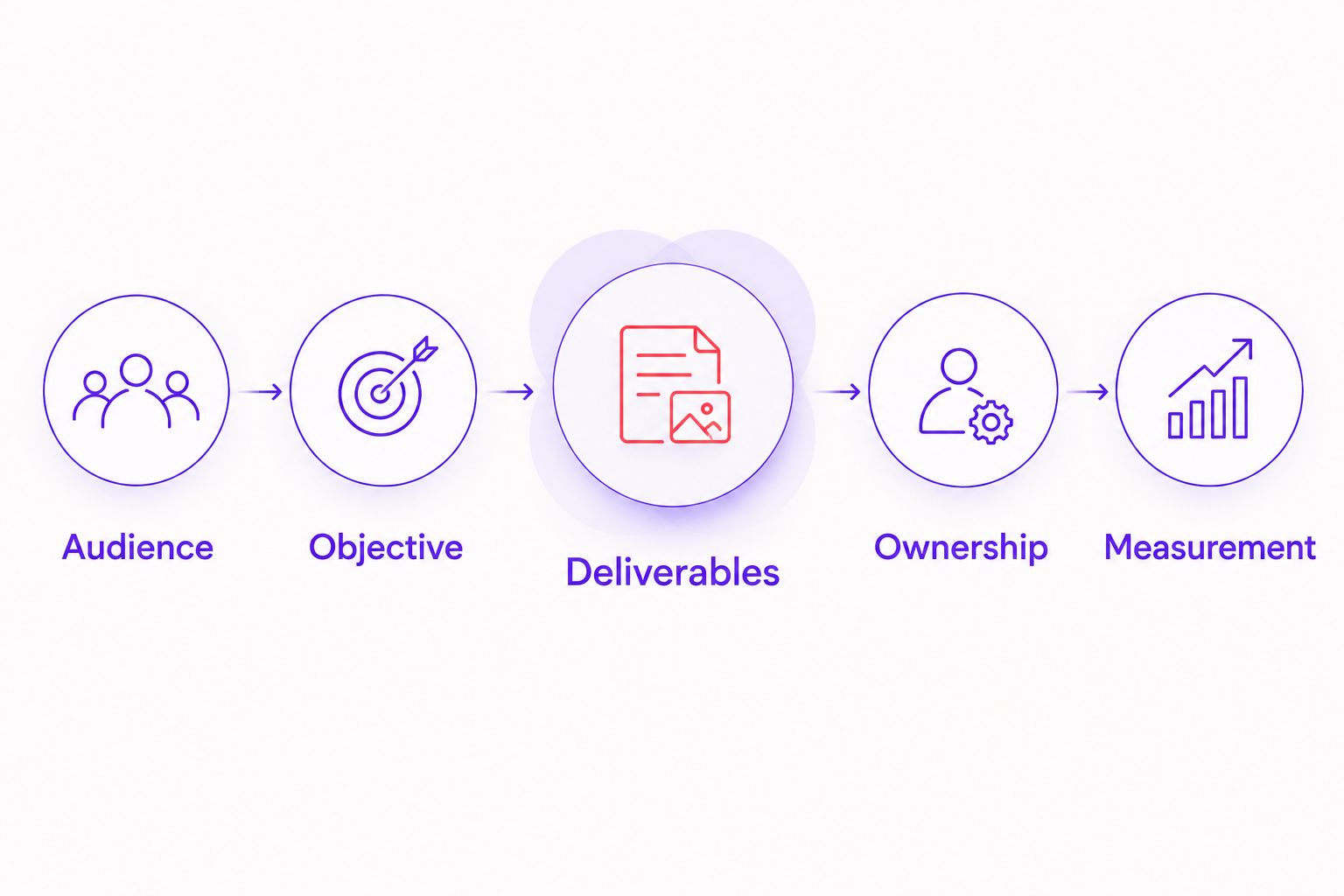
Keep the brief short enough to use during decisions. If a proposed deliverable does not support the stated objective, ask why it belongs in the project. A clear answer justifies the work; a vague answer identifies scope to question.
Specify outputs instead of service labels
Branding, web design and digital marketing describe categories of work. They do not tell you what you will receive. Ask for a deliverable list with an acceptance condition beside each item.
For logo design, clarify the intended applications and final file requirements. For packaging design, identify the product information, pack formats and production requirements the designer must address. For video production, specify the message, intended placements and required edits.
For a website redesign, distinguish visual changes from copy, page structure and enquiry handling. For performance marketing, separate campaign setup, creative production, ongoing management and reporting. Do not assume an adjacent task is included because it sounds related.
Why the value of an agency engagement varies
Agency value depends on the job being commissioned and how you manage it. A polished proposal is not evidence that its scope matches your business.
Evaluate these factors:
- Scope breadth: Connected branding, website and marketing work calls for different coordination than a standalone asset.
- Input readiness: Clear product information and an agreed offer give the team a usable foundation.
- Deliverable requirements: File formats, page requirements, campaign assets and production needs determine what completion means.
- Approval ownership: A named decision-maker prevents conflicting feedback from becoming the working brief.
- Measurement: A stated objective lets you judge whether the finished work supports the intended business action.
- Ongoing responsibilities: Separate launch delivery from later updates, campaign management and reporting.
These factors also belong in a pricing discussion. Ask providers to explain how each affects their proposal rather than assuming that similarly named packages contain the same work. Compare written scopes, not unexplained totals.
How to evaluate an agency proposal in 2026
Read the proposal as a delivery agreement. It should tell you what the supplier will produce, what you must provide and how both sides will decide that the work is complete.
Use 3 acceptance checks for each major deliverable: it answers the brief, works in its intended setting and arrives with the agreed handover materials. These checks assess delivery; they do not guarantee a commercial outcome.
Check the problem definition
The proposal should describe your business problem in language you recognise. If it moves directly to layouts or campaign assets without explaining the objective, ask for that connection.
Look for specific reasoning. Why is a website redesign necessary? Which customer question must the content answer? What business action should the campaign support? Each answer should trace back to your brief.
Check responsibilities and dependencies
Ask who supplies product details, writes copy, approves claims and provides access to existing accounts. Make the order of decisions explicit so that unfinished inputs do not become invisible assumptions.
Also identify your own approval lead. A supplier cannot reconcile conflicting founder feedback unless your business decides which direction takes priority.
Check revisions and handover
Agree how feedback is collected and what constitutes a new request rather than a correction. Ask which final files, credentials and working materials the engagement includes.
Distinguish final deliverables from drafts and working files. Put ownership and usage rights in writing, and make the handover list part of the scope rather than a discussion left until completion.
Check measurement without accepting guarantees
Ask what will be reported and what the report will help you decide. Website delivery, campaign activity and qualified enquiries are different subjects; do not collapse them into a single claim of success.
A 2026 proposal should separate the work the agency controls from the business response you want to measure. Reject guaranteed growth claims that substitute certainty for a clear scope and measurement plan.
Questions to ask before hiring
Use these questions in the proposal discussion. Ask for written answers where they affect scope, ownership or acceptance.
- What business problem does this project address?
- Which deliverables are included, and which related tasks are excluded?
- Who connects strategy, design, content and marketing decisions?
- What information and approvals do you need from our team?
- How will you judge each deliverable against the brief?
- What files, account access and usage rights will we receive?
- What happens when we change the brief after approval?
- Which activities stop at launch, and which require a separate engagement?
When evaluating CreativHeads, use the same questions. The advantage to assess is its stated combination of creative and marketing services; the trade-off to manage is the broader coordination and decision-making your project requires.
Discuss your launch scope
Start with your audience, objective and required deliverables before commissioning the work.
Should I hire an agency before launching?
Hire before launch when the work is necessary to explain your offer and support the intended buyer action. Do not commission a full launch identity simply to avoid deciding what your business sells.
A useful boundary is whether the brief can remain stable through delivery. If the offer is unresolved, define that first or explicitly commission a strategy assignment rather than pretending the design brief is settled.
Can I start with one project instead of ongoing support?
Yes. Commission a defined project when you need a completed asset or launch package, and discuss ongoing support separately.
Ask what happens after handover: who updates the website, adapts content or manages campaigns? A project engagement and a continuing service solve different needs, so evaluate them independently.
How do I know whether the agency was worth hiring?
Judge the engagement against the agreed deliverables and the business objective, not whether everyone likes the design. Review completion first, then examine the customer response using the measurement plan agreed before launch.
Keep those judgements separate. Correct delivery establishes whether the agency fulfilled the scope; commercial results also depend on the offer and other business decisions outside that scope.
FAQ
Is hiring a creative agency worth it for a new business in 2026?
Yes, when a new business needs connected branding, website and marketing work with a clear objective. Choose a narrower engagement when the task is isolated or the offer is still changing.
Should I choose a creative agency or a freelancer?
Choose a creative agency for connected work across disciplines and a freelancer for a defined specialist task. Evaluate the actual scope and your ability to coordinate the work, not the supplier label alone.
What should a new business put in an agency brief?
An agency brief should state the audience, objective, deliverables, ownership and measurement plan. Include the inputs you will supply and who has final approval.
Is CreativHeads suitable for a new business launch?
CreativHeads is relevant to founders seeking branding, web design, content and digital marketing from one team. Confirm the deliverables, responsibilities and handover requirements for your specific launch before commissioning work.
Do I need ongoing marketing support after a branding project?
A branding project does not automatically require an ongoing marketing engagement. Decide separately who will produce content, manage campaigns and maintain the website after handover.
What changes the scope of a creative agency proposal?
The required disciplines, deliverables, inputs, approvals and ongoing responsibilities change the scope. Ask the provider to identify exclusions and explain what happens when the brief changes.
Can a creative agency guarantee business growth?
Do not treat a growth guarantee as a substitute for an agreed scope and measurement plan. Evaluate what the agency will deliver and distinguish that work from business outcomes.
One last thing
Ask for the handover list before you approve the first concept. It forces both sides to define the finished product while changes are still straightforward to discuss.
For your 2026 launch, that is a stronger buying habit than collecting more portfolio examples. Know what you are commissioning, how you will accept it and what you will control after delivery.
Related guides