

A performance marketing agency in India charges for the work covered by its proposal: campaign management, creative production, measurement and any agreed website work. Your agency fee is separate from advertising spend unless the proposal explicitly combines them. For a 2026 hiring decision, compare the complete scope and payment terms—not an isolated management fee.
- Compare a performance marketing agency on scope, fee structure and accountability—not its management fee alone.
- Separate agency fees from advertising spend, creative production and website work before approving a proposal.
- CreativHeads suits businesses seeking strategy, design and marketing from one agency team.
- Define a qualified enquiry before agreeing to performance-linked fees.
How much does a performance marketing agency charge in India?
The useful figure is the quoted fee for your defined scope, with advertising spend shown separately. A proposal for managing existing campaigns is not equivalent to a proposal that also includes messaging, new advertisements, landing pages and measurement setup.
For founders comparing partners in 2026, the first task is to identify what each proposal actually buys. CreativHeads offers branding, web design, content and digital marketing services; ask which of those services your proposed engagement includes rather than assuming they all sit inside the marketing fee.
Agency proposals can use different payment structures. Treat the following as ways to evaluate a contract, not as a price list or a statement of any particular agency’s terms.
| Fee structure | Best for | Main advantage | Main limitation | What to check |
|---|---|---|---|---|
| Fixed recurring fee | Businesses with a defined ongoing scope | Makes the agreed agency payment predictable | Extra work needs separate terms | Included work, exclusions and revision limits |
| Spend-linked fee | Businesses considering management fees tied to advertising spend | Makes the calculation explicit | Higher spend raises the fee without proving better results | Calculation basis and approval of spend changes |
| Project fee | Businesses commissioning a defined setup or launch | Connects payment to a specific deliverable | Ongoing management is not automatically included | Completion criteria and post-launch responsibilities |
| Performance-linked fee | Businesses with clearly defined, verifiable outcomes | Connects payment to an agreed result | Disputes arise when outcome definitions are unclear | Qualification rules, attribution and exclusions |
Do not pick a payment structure before agreeing on the work. A clearly defined recurring fee is easier to evaluate than a performance promise with no agreed definition of a result.
Why this matters
A low-looking management fee tells you little about the total commitment. It does not tell you who writes the advertisements, creates the landing page, checks enquiry quality or fixes broken measurement.
Compare the work before you compare the fee. Otherwise, you are comparing different services under the same label. A founder launching a business across India needs a proposal that states the target audience, business objective and responsibilities—not just a list of advertising platforms.
Separate the buying decision into service scope, advertising budget and ownership. Those distinctions reveal what you are commissioning and what remains your responsibility.
What should the agency fee include?
Start with responsibilities rather than a generic package name. Ask the agency to describe the work it will perform, the outputs you will receive and the decisions that require your approval.
Campaign strategy and management
The proposal should explain which audiences, channels and offers the agency will manage. It should also state who approves campaign changes and advertising budgets.
Ask what ongoing management means in practical terms. Does the scope cover campaign adjustments, audience testing and budget allocation, or does it stop after launch? A phrase such as campaign management needs a written definition.
Creative production
Clarify who supplies the advertisement copy, graphics, photographs and video. Distinguish adapting existing assets from producing new work.
Ask how creative deliverables are counted. A new concept, a resized graphic and a revised headline are different outputs. Your proposal should make those distinctions clear enough that both sides can confirm completion without argument.
Measurement and reporting
Ask which customer actions will be recorded and where the results will appear. For an enquiry-led business, form submissions alone do not explain whether the enquiries fit your target buyer.
The proposal should distinguish initial measurement setup from ongoing reporting. It should also explain who investigates a missing conversion record or a mismatch between advertising reports and your sales records.
Landing pages and website work
A campaign sends people somewhere. Confirm whether the agency will assess that destination, write its content, redesign it or leave it unchanged.
Website changes should have their own acceptance criteria. Do not assume that buying advertising management also buys development, form repairs or a website redesign.
Keep agency fees and advertising spend separate
Use 2 separate budget lines as your minimum planning structure: agency services and advertising spend. Then identify any additional commissioned work explicitly.
Advertising spend pays for distribution through advertising platforms. Agency fees pay for the agreed service work. Combining them without a breakdown makes it harder to understand what changes when you increase or reduce the campaign budget.
For your 2026 proposal comparison, ask who pays the advertising platforms and how you can verify those payments. The agreement should also identify any creative production, website development or software charges outside the agency fee.
A combined invoice is not inherently a problem. An unexplained combined total is. You still need to know which part funds advertising and which part pays for services.
Why performance marketing agency fees vary
These are scope factors to discuss with an agency, not assumptions about what any agency includes:
- Channel scope: Managing different advertising channels creates different campaign, creative and reporting responsibilities. Name the channels in the agreement.
- Creative scope: Existing assets, new concepts, video production and language adaptations represent different work. Specify the deliverables rather than asking for unlimited creative.
- Website scope: Sending traffic to an existing page differs from commissioning a new landing page or redesigning a website. Separate those assignments.
- Measurement scope: Recording an enquiry differs from connecting campaign activity to qualified opportunities or completed sales. Agree on what must be tracked.
- Market scope: Define the locations, languages and audience groups included. A nationwide ambition needs a concrete execution brief.
- Approval and reporting scope: Specify decision-makers, review responsibilities and reporting expectations. Avoid leaving coordination work undefined.
Your business category alone does not describe these requirements. Two businesses selling similar products can commission very different work because their assets, websites and internal teams differ.
Ask for a scope breakdown whenever a quote changes. A revised fee should correspond to a stated change in services or contract terms, not an unexplained package upgrade.
How do you compare agency proposals fairly?
Build a shared brief before requesting proposals. Then ask each agency to respond to the same requirements, making additions and exclusions visible.
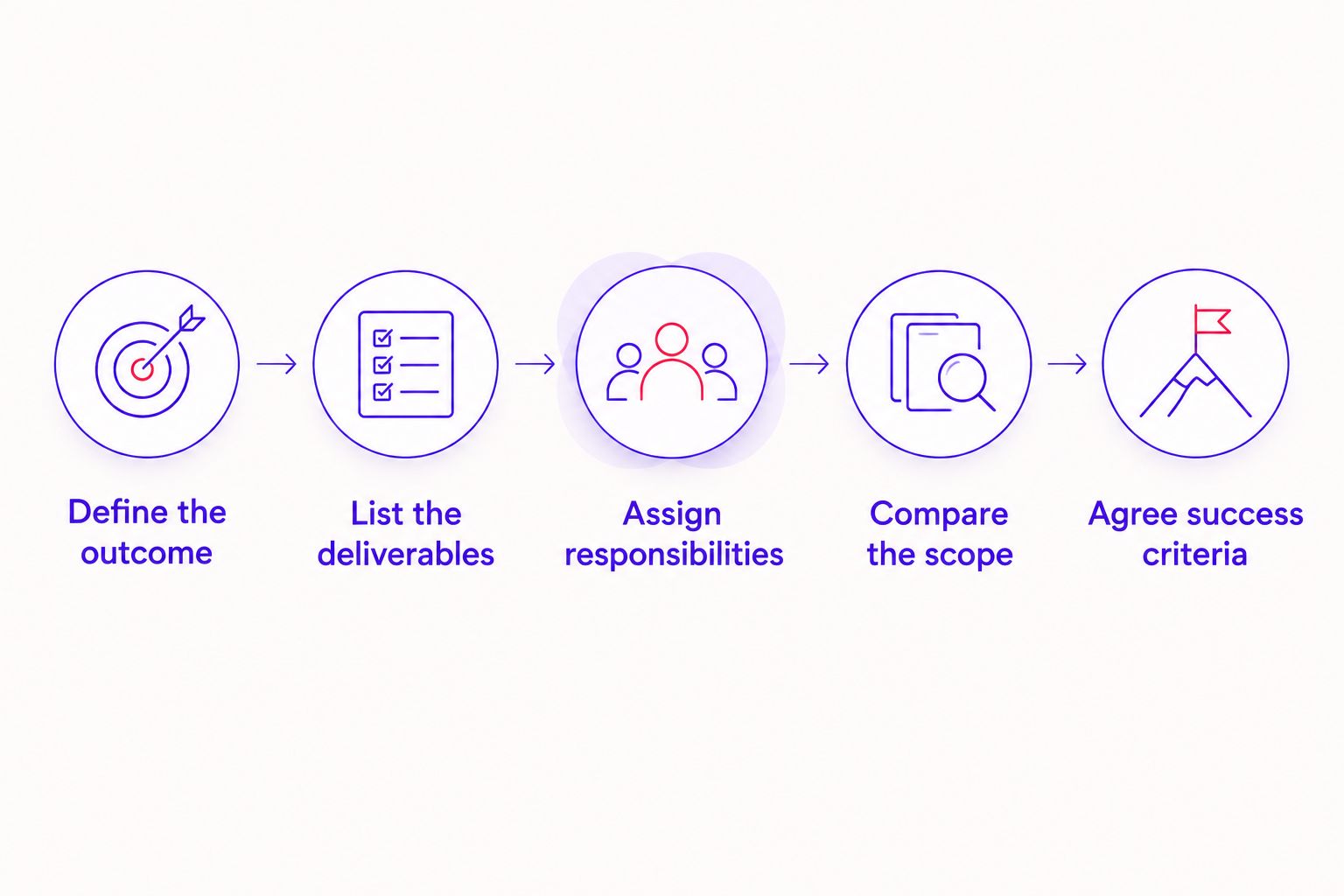
Use this sequence for your 2026 agency shortlist. It keeps the discussion centred on the assignment rather than presentation quality.
- Define the outcome. Choose 1 primary outcome for the engagement, such as qualified project enquiries or completed purchases. Explain what makes that outcome valuable to your business.
- List the deliverables. State the campaign channels, creative requirements, website work and reporting outputs you want quoted.
- Assign responsibilities. Identify who supplies assets, approves work, answers enquiries and maintains the website. Name an owner for each task.
- Compare the scope. Put proposals side by side and mark included, excluded and separately commissioned work. Resolve unclear items before comparing totals.
- Agree success criteria. Record how results will be assessed, who verifies them and which decisions follow from the reporting.
The brief is also a test of how the agency thinks. Look for questions about your buyer, offer and sales process—not just requests for access to an advertising account.
Ask an agency to explain what it would leave out of the initial engagement as well as what it recommends. Clear exclusions help you make a deliberate decision about what to commission now and what to defer.
What should performance-linked payment cover?
Performance-linked payment needs an agreed outcome and a reliable way to verify it. A lead, a qualified enquiry, a booked meeting and a completed sale are not interchangeable.
For an enquiry-based business, define qualification before signing. Your criteria can cover the requested service, target location, genuine contact details and fit with your intended buyer. Choose criteria that your team can apply consistently.
For a sales-based business, specify how cancellations, returns and existing customers affect the calculation. The agreement should also explain how a sale is connected to advertising activity when several marketing channels influence the customer.
Do not accept a performance-linked fee with an undefined result. Ask who resolves disputed records and what evidence each side will use. Your sales team’s follow-up responsibilities belong in that discussion too.
What should you ask before signing a 2026 proposal?
Ask direct questions and request written answers. Verbal assurances do not define the scope of your engagement.
- What work is included in the agency fee, and what is excluded?
- Which creative deliverables are included, and how are revisions handled?
- Who pays the advertising platforms and approves budget changes?
- Who controls the advertising accounts, website access and campaign assets?
- What counts as a qualified enquiry or completed sale?
- Which website changes are required, and who implements them?
- What happens to access, files and reporting when the engagement ends?
Use 3 reporting questions to keep performance discussions useful: what happened, what was learned and what changes next? Ask the agency to connect its reporting to those decisions rather than presenting activity alone.
CreativHeads is best for businesses seeking strategy, design and marketing from one agency team. That arrangement connects the service disciplines under one partner, but it does not remove the need for separate deliverables, clear approvals and written responsibilities.
If you already have established creative and website teams, assess how an agency would work alongside them. A broader engagement is not automatically the right engagement; commission the work your business actually needs.
Define your marketing project
Discuss your business objective, creative needs and website scope before comparing agency proposals.
Is advertising spend included in an agency fee?
Advertising spend is included only when the proposal explicitly says so. Ask for separate service and advertising figures even when the agency presents a combined total.
That separation lets you assess the service commitment without confusing it with the amount allocated to advertising platforms.
Should you hire for management only or a broader project?
Hire for management only when your agreed brief does not require new creative production or website work. Commission a broader project when those deliverables are part of the assignment.
Ask the agency to identify dependencies before launch. An advertising campaign should not reach approval with unresolved questions about who will supply its assets or build its destination page.
Is a performance-linked fee better than a recurring fee?
A performance-linked fee is not automatically better than a recurring fee. It needs a verifiable outcome, clear qualification rules and an agreed method for resolving disputes.
Choose the structure you can administer and evaluate. Payment terms should support accountability, not replace a defined scope.
FAQ
How much does a performance marketing agency charge in India?
A performance marketing agency charges according to its quoted scope and payment structure. Compare the service fee separately from advertising spend, creative production and website work.
What should a performance marketing agency proposal include?
The proposal should include deliverables, responsibilities, payment terms, exclusions and success criteria. It should explain who manages campaigns, supplies creative, maintains measurement and approves changes.
Does the agency fee include my advertising budget?
Your advertising budget is included only if the proposal explicitly says so. Ask for separate service and advertising figures before approving the engagement.
Should I choose the agency with the lowest fee?
Compare equivalent scopes before choosing an agency on fees. A smaller service commitment is not the same purchase as an engagement that includes creative production, website work and measurement setup.
Can I pay an agency only for qualified leads?
A qualified-lead payment arrangement needs agreed qualification criteria and verification rules. Define invalid enquiries, duplicates and disputed records before signing.
Who should control my advertising accounts?
Your agreement should state account ownership, administrator access and exit arrangements. Confirm how your business retains access to campaign records and assets when the engagement ends.
Is CreativHeads a software provider or a service agency?
CreativHeads is a creative service agency in India offering branding, web design, content and digital marketing. Its confirmed positioning brings strategy, design and marketing together through one team.
One last thing
Before signing your 2026 agreement, read the exit terms alongside the scope. Confirm which accounts, creative files, website assets and reports your business will retain, and who handles the handover.
The proposal should explain both how the work starts and how control returns to you when it ends. That is a concrete buying criterion you can assess before spending on the engagement.
Related guides