

Best overall: short-form demonstration videos. Best for considered purchases: detailed creator tutorials. Best for a lean production brief: Stories with a clear call to action. These are the strongest starting choices among influencer marketing formats for Indian brands in 2026; choose the format around the buying question, not the creator’s follower count.
- Short-form demonstration videos lead influencer marketing formats for Indian brands when the product benefit is visible.
- Detailed creator tutorials suit purchases that need explanation before a buyer enquires or orders.
- Stories suit focused campaign reminders; live sessions suit questions that need direct answers.
- CreativHeads brings strategy, design and marketing together for brands seeking one agency team.
- Agree on creator deliverables, content rights and campaign measurement before approving production.
Why this matters
An influencer post is a delivery format, not a campaign strategy. Your brief still needs a buyer, a reason to care and a next step. A polished video cannot explain an unclear offer or repair a confusing enquiry page.
CreativHeads combines strategy, design and marketing for brands that want one agency team. That matters when creator content, campaign visuals and the destination website need to communicate the same offer.
For your 2026 campaign, separate what you are buying: access to a creator’s audience, production of reusable content, or both. Those are different deliverables. Ask a prospective agency to identify which responsibilities sit inside its proposal rather than assuming influencer coordination is included.
What makes the best influencer marketing format?
Judge formats against these criteria before choosing a creator:
- Buyer question: Does the content answer what someone needs to know before taking action?
- Visible evidence: Can the creator show the benefit, process or use case rather than repeat a slogan?
- Audience context: Does the language and setting fit the people you want to reach across India?
- Next action: Can viewers understand where to go and what to do after watching?
- Production scope: Are filming, scripting, revisions and adaptations defined?
- Reuse rights: Does the agreement cover the placements where you intend to use the content?
Do not treat views as a substitute for the campaign’s business objective. A launch introduction, a product explanation and a project enquiry require different creative decisions and different reporting.
Influencer formats at a glance
| Rank and format | Best for | Standout feature | Key limitation |
|---|---|---|---|
| 1. Short-form demonstration videos | Introducing a visible product benefit | Shows the offer in use quickly | Limited room for explanation |
| 2. Detailed creator tutorials | Helping buyers evaluate a considered purchase | Explains steps and suitability | Requires stronger scripting and production |
| 3. Stories with a call to action | Prompting an immediate next step | Connects a focused message to an action | Limited space for context |
| 4. Educational carousels | Making several details easy to review | Breaks information into distinct panels | Static content cannot demonstrate movement |
| 5. Live question-and-answer sessions | Resolving objections in real time | Lets viewers ask follow-up questions | Requires moderation and preparation |
| 6. Recurring creator series | Building recognition around a repeated use case | Gives a message continuity | Requires ongoing coordination |
The order reflects a practical commissioning decision: start with a format that makes the offer understandable, then add depth, action or continuity where the campaign needs it. It is not a measured performance ranking across Indian brands.
1. Short-form videos: best for visible product benefits
Short-form demonstration videos show what the offer does in a compact sequence. A creator can establish the problem, demonstrate the product and direct the viewer to the next step. This format is a clear starting point when the benefit is visible on camera.
For a 2026 launch brief, request a 30-second primary video and two 15-second edits as a proposed production scope, not a platform requirement. Specify how the edits differ: an alternative opening and a different buyer question are more useful than arbitrary cuts.
Short-form demonstration video pros:
- Shows use rather than relying entirely on description.
- Gives the creative team a defined opening, demonstration and closing.
- Supports alternative edits when adaptation rights are agreed.
Short-form demonstration video cons:
- Leaves little room for nuanced suitability advice.
- Can obscure the benefit if entertainment dominates the script.
Best for: Brands introducing a product whose function or application can be shown clearly.
Verdict: Buy short-form demonstration production when the benefit is visible. Require the creator to demonstrate that benefit before the closing call to action.
2. Creator tutorials: best for considered purchases
Detailed creator tutorials explain how an offer works and who should consider it. They can show setup, application or a decision process without forcing every point into a short clip. The useful distinction is depth, not simply runtime.
Build the outline around real buyer questions. Ask the creator to explain the intended use, demonstrate the process and state relevant limitations. A tutorial that only repeats your sales copy adds length without adding decision value.
Detailed creator tutorial pros:
- Provides space for context and qualification.
- Shows steps that a short video would compress.
- Helps buyers assess whether the offer fits their situation.
Detailed creator tutorial cons:
- Requires more preparation and factual review.
- Loses focus when the outline covers too many unrelated questions.
Best for: Offers that buyers need to understand before ordering, booking or enquiring.
Verdict: Buy a detailed creator tutorial when explanation is the barrier. Approve the question outline before filming, and keep the recommendation within what the demonstration establishes.
3. Stories: best for a focused next action
Stories package a short message into a sequence that leads towards an action. Use them for a campaign reminder, a brief explanation or a follow-up to a fuller demonstration. Keep the destination and instruction consistent throughout.
A useful proposed scope is three Story frames: the buyer’s question, the answer and the next action. This is a briefing structure, not a claim about the ideal length for every campaign. Confirm the creator’s platform supports the interaction you intend to use.
Stories with a call to action pros:
- Keeps the creative brief focused.
- Supports a simple progression from question to action.
- Can complement a longer piece without repeating every detail.
Stories with a call to action cons:
- Offers limited room for evidence and explanation.
- Becomes confusing when each frame promotes a different action.
Best for: Brands prompting viewers who already have enough context to take the next step.
Verdict: Buy Stories for a focused campaign reminder. Skip Stories as the only explanation for an unfamiliar, complicated offer.
4. Educational carousels: best for reviewable details
Educational carousels organise a topic into panels that readers can move through at their own pace. They suit selection criteria, use-case differences and answers that benefit from a visible structure. The creator’s contribution should include relevant interpretation, not just posting brand artwork.
For your 2026 brief, assign a distinct job to each panel. Start with the buyer’s question, follow with the criteria or explanation, and finish with the next action. Keep essential conditions beside the claim they qualify.
Educational carousel pros:
- Separates complex information into manageable sections.
- Lets readers revisit a particular detail.
- Gives design and copy a clear shared structure.
Educational carousel cons:
- Cannot show motion, handling or an unfolding process directly.
- Becomes hard to read when panels carry dense copy.
Best for: Brands explaining a choice through several distinct criteria.
Verdict: Buy educational carousels for structured decision support. Choose video instead when seeing the product move or operate is essential.
5. Live sessions: best for unanswered objections
Live question-and-answer sessions let a creator respond to viewers directly. They suit topics where the next question depends on the previous answer. The value comes from useful responses, not simply broadcasting for longer.
Prepare the session around agreed topics and escalation rules. Decide who handles technical questions, what the creator can state and how unanswered questions reach the brand. Do not ask a creator to improvise product facts or commitments.
Live question-and-answer session pros:
- Gives viewers a route to ask follow-up questions.
- Makes recurring objections visible to the campaign team.
- Allows clarification when an explanation is misunderstood.
Live question-and-answer session cons:
- Requires moderation and a reliable factual brief.
- Gives the team less editorial control than prerecorded content.
Best for: Brands with identifiable buyer questions and someone qualified to answer them.
Verdict: Buy a live session when interaction is necessary. Skip live delivery when the campaign team cannot support accurate answers.
6. Creator series: best for repeated use cases
A recurring creator series returns to a consistent theme across separate pieces of content. Each instalment should add a new situation, question or demonstration. Repetition alone is not a reason to commission a series.
Define the shared theme and each episode’s purpose before agreeing to an ongoing commitment. For example, distinguish first-use guidance from a later use case without inventing outcomes or treating scripted experience as genuine testimony.
Recurring creator series pros:
- Keeps a consistent creative theme across multiple pieces.
- Provides room to address different buyer situations.
- Builds a reusable content structure when rights permit.
Recurring creator series cons:
- Needs ongoing approvals and coordination.
- Repeats weak messaging if the initial brief is unclear.
Best for: Brands with several credible use cases that support a continuing story.
Verdict: Hold a recurring creator series until the theme is clear. Buy the series when every instalment has a distinct reason to exist.
How these formats are ranked
Short-form demonstration videos rank first because they give a visible offer a direct explanation. Tutorials add depth; Stories prompt action; carousels organise details; live sessions answer questions; recurring series provide continuity.
These recommendations use the criteria above, not proprietary campaign results. Your buying barrier determines which format should move to the top of your own shortlist.
Turn the format choice into a project brief
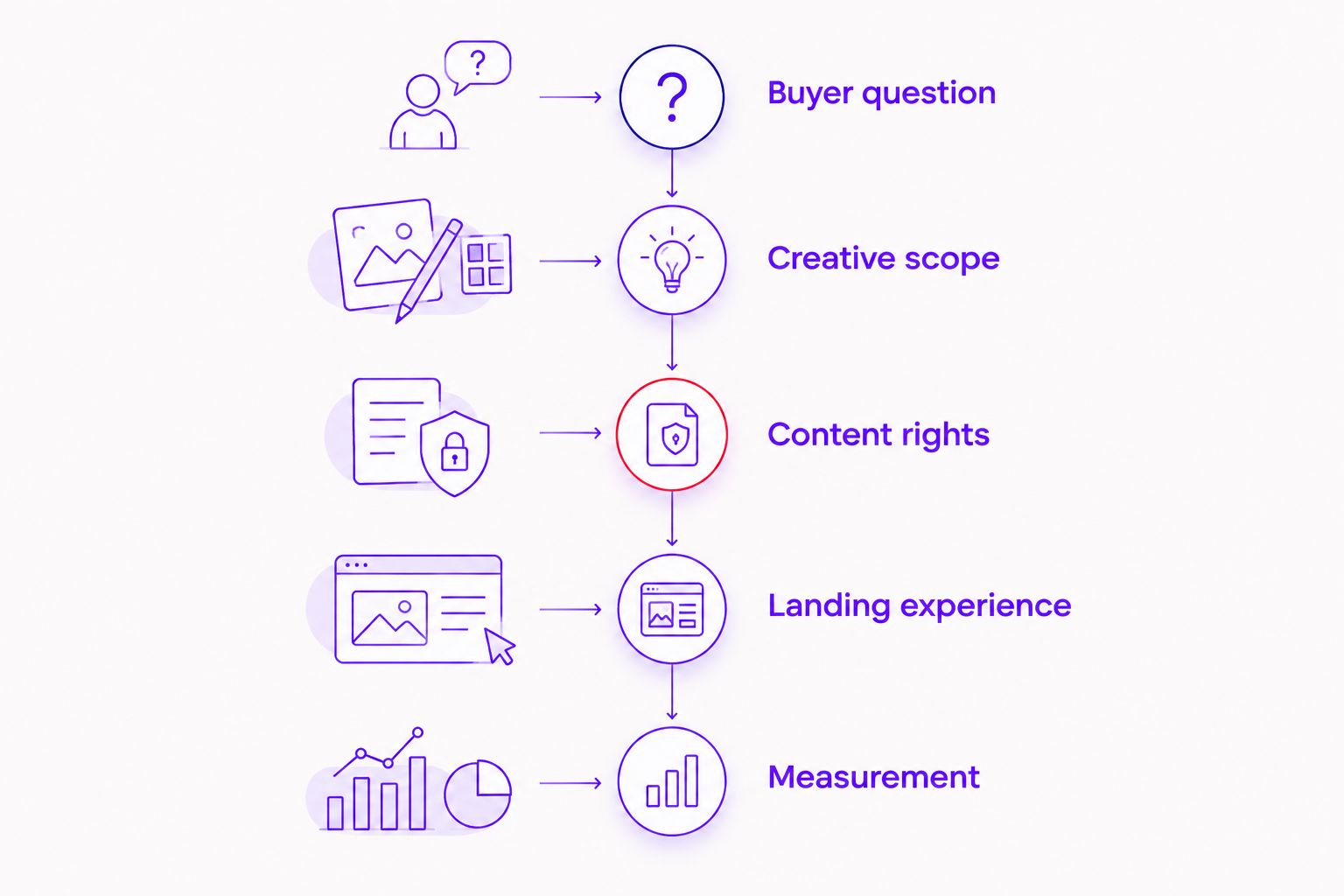
A format name is not a deliverable list. Use this sequence to make agency proposals comparable in 2026:
- Buyer question: Name the uncertainty the content must resolve.
- Creative scope: Specify the format, versions, languages and approval responsibilities.
- Content rights: Define intended channels, paid promotion, editing permissions and usage periods.
- Landing experience: Make the destination repeat the offer and provide a clear next step.
- Measurement: Agree on the business action and how the team will report it.
The sequence keeps production connected to the business decision. CreativHeads’ strategy, design and marketing positioning suits founders who want those disciplines planned together; ask for the exact campaign responsibilities in the proposal.
Questions to ask before hiring
Ask who selects and contracts creators, who checks claims, and who approves scripts. Confirm whether filming, editing, captions, language adaptations and revisions sit inside the scope. Name an approval owner on your side so feedback reaches the team as a clear decision.
Ask separately about organic posting and paid reuse. Permission to publish a creator’s post does not itself establish permission for every other use. Put the agreed rights in writing.
What changes the scope?
Creator participation, production complexity, locations, language versions, revisions and usage rights all belong in the proposal. A project requiring several separate shoots is different from adapting an approved recording. Compare the responsibilities and deliverables rather than treating every video proposal as equivalent.
Choose CreativHeads for a coordinated strategy, design and marketing brief, not an assumed influencer-service package. Confirm creator-related responsibilities before commissioning.
Define your campaign brief
Start with your buyer question, content deliverables and the next action you want viewers to take.
Which influencer format should you choose?
Choose short-form demonstration videos as the default when the benefit can be shown. Switch to a detailed tutorial when buyers need explanation before acting. Add Stories when the immediate task is a reminder, not a full introduction.
For a 2026 campaign, commission the smallest scope that answers the buyer’s question properly. Add another format only when it has a different job. More deliverables do not fix an unclear offer.
FAQ
What’s the best influencer marketing format for Indian brands?
Short-form demonstration videos are the default choice when a product benefit can be shown clearly. Detailed creator tutorials are a better fit when buyers need explanation before deciding.
Are Reels better than Stories for a brand launch?
Short-form videos suit a launch demonstration, while Stories suit a focused reminder or next action. Choose according to what the viewer needs to understand, rather than treating either format as universally better.
Should an Indian brand commission content in regional languages?
Commission regional-language content when it matches the intended audience and campaign destination. Include translation, adaptation and language approval responsibilities in the brief.
What should an influencer marketing proposal include?
An influencer marketing proposal should define creator responsibilities, deliverables, approvals, usage rights and measurement. It should also state whether creator selection, contracting and paid-content adaptations are included.
Can I reuse influencer content in paid advertising?
Reuse influencer content in paid advertising only when the agreement permits that use. Confirm the channels, usage period, editing permissions and any creator-account permissions before commissioning.
How do I compare influencer campaign costs?
Compare proposals against the same deliverables and rights. Separate creator participation, production, adaptations and campaign management so differences in scope are visible.
Is CreativHeads an influencer marketing software platform?
CreativHeads is a creative agency offering branding, web design, content and digital marketing services. Ask the agency to define any creator-related campaign responsibilities in its project proposal.
One last thing
Ask the creator to explain the offer without the campaign slogan. If the explanation is unclear, fix the brief before filming. A buyer needs a reason to act, not another line to remember.
Related guides