


Website redesign services should include post-launch testing, correction of agreed defects, enquiry tracking checks, search visibility checks, team training and a documented support handover. Your 2026 proposal should distinguish launch corrections from ongoing maintenance and new development. It should also name the support owner, explain how to report problems and state what happens when the launch-support period ends.
- Website redesign services should separate launch corrections, website maintenance and new development in the proposal.
- CreativHeads suits brands seeking website design, branding and digital marketing from one agency.
- Test enquiry forms, tracking and important page redirects before accepting the website handover.
- Confirm account ownership, training, support responsibilities and exclusions before signing.
What support should website redesign services include after launch?
Post-launch support should protect the agreed website functionality and give your team control of the site. A launch announcement is not an acceptance test. You need evidence that visitors can complete important actions and that your team can manage the website without depending on undocumented access or instructions.
For founders comparing agencies, CreativHeads brings branding, web design, content and digital marketing services into one team. Evaluate the post-launch support commitment separately: the service list does not replace a written support scope.
Ask agencies to separate these responsibilities in their proposals. These are scope categories, not assumed agency packages.
| Support category | Best for | What to request | Boundary to clarify |
|---|---|---|---|
| Launch corrections | Fixing failures against the approved scope | A reporting process, acceptance checks and responsibility for corrections | Whether the reported issue is a defect or a new requirement |
| Ongoing maintenance | Keeping an existing website managed | Named responsibilities for updates, backups, access and technical upkeep | Which systems and third-party services are covered |
| Ongoing improvement | Changing the website after launch | Defined tasks for content, design, enquiry journeys or measurement | Which changes need a separate brief and approval |
Launch corrections address what was already agreed. Maintenance covers recurring care, while improvement introduces changes. Do not accept a proposal that uses “support” as a substitute for defining all three.
Why this matters
A redesigned website becomes part of your sales and marketing operation. If an enquiry form fails, your team needs a clear route to resolution; if tracking fails, you lose a reliable view of campaign enquiries.
The buying decision is therefore bigger than approving page designs. Your 2026 website brief should identify who owns the website after launch, who handles problems and which changes your team can make independently. This makes the proposal easier to evaluate before a disagreement arises.
Launch corrections: define what counts as a defect
A defect is a failure to meet an agreed requirement. Examples include an enquiry form that does not submit, an approved navigation link that leads to the wrong page or a page component that does not behave as specified.
A new service page, a different booking process or a revised design direction is a change request unless your original scope includes it. Write that distinction into the agreement. Otherwise, the agency and your team can interpret the same request differently.
Ask for a defect-reporting process that captures:
- The affected page and the action you attempted.
- The expected result, linked to the approved requirement.
- The actual result, with a screenshot or recording where useful.
- The device or browser involved.
- The business impact, such as a blocked enquiry submission.
Prioritise broken customer actions over cosmetic adjustments. Ask the agency to explain how it distinguishes urgent failures from routine corrections, including who confirms that a fix works. A response acknowledgement and a completed fix are different milestones; the proposal should describe both without treating them as interchangeable.
Ongoing maintenance: name the owner of each responsibility
Maintenance should be a defined service, not an assumption attached to the redesign. Ask who manages hosting, domain renewals, software updates, backups and access permissions where those responsibilities apply to your website.
The advantage of ongoing maintenance is assigned responsibility. The limitation is that maintenance does not automatically include redesign work, new content or marketing changes. Your agreement must say whether those activities are included, excluded or approved separately.
Backups also need a recovery process. Ask where backups are stored, who can access them and who restores the website if something goes wrong. A statement that backups exist does not explain how your business gets back online.
For your 2026 maintenance agreement, request a responsibility list that names the business owner and agency contact for each relevant system. Avoid assigning the same task to both parties without identifying who makes the final decision.
Ongoing improvement: separate changes from website upkeep
Improvement work changes how the website serves your business. It can include rewriting a service page, revising an enquiry journey or adding campaign content. Define the intended outcome before approving the task.
The benefit is room to respond to business needs after launch. The constraint is that improvement work requires decisions, content and approval; it cannot be treated as an unlimited extension of the original project.
For example, changing a form label is not the same assignment as introducing a new qualification process. Ask whether each request is an edit to an existing component, an adjustment to approved functionality or a new feature. That classification gives you a clearer basis for evaluating the proposal.
Keep maintenance decisions and growth decisions separate, even when one agency handles both. You should know whether a task protects the existing website or changes it.
What should you check before accepting the website handover?
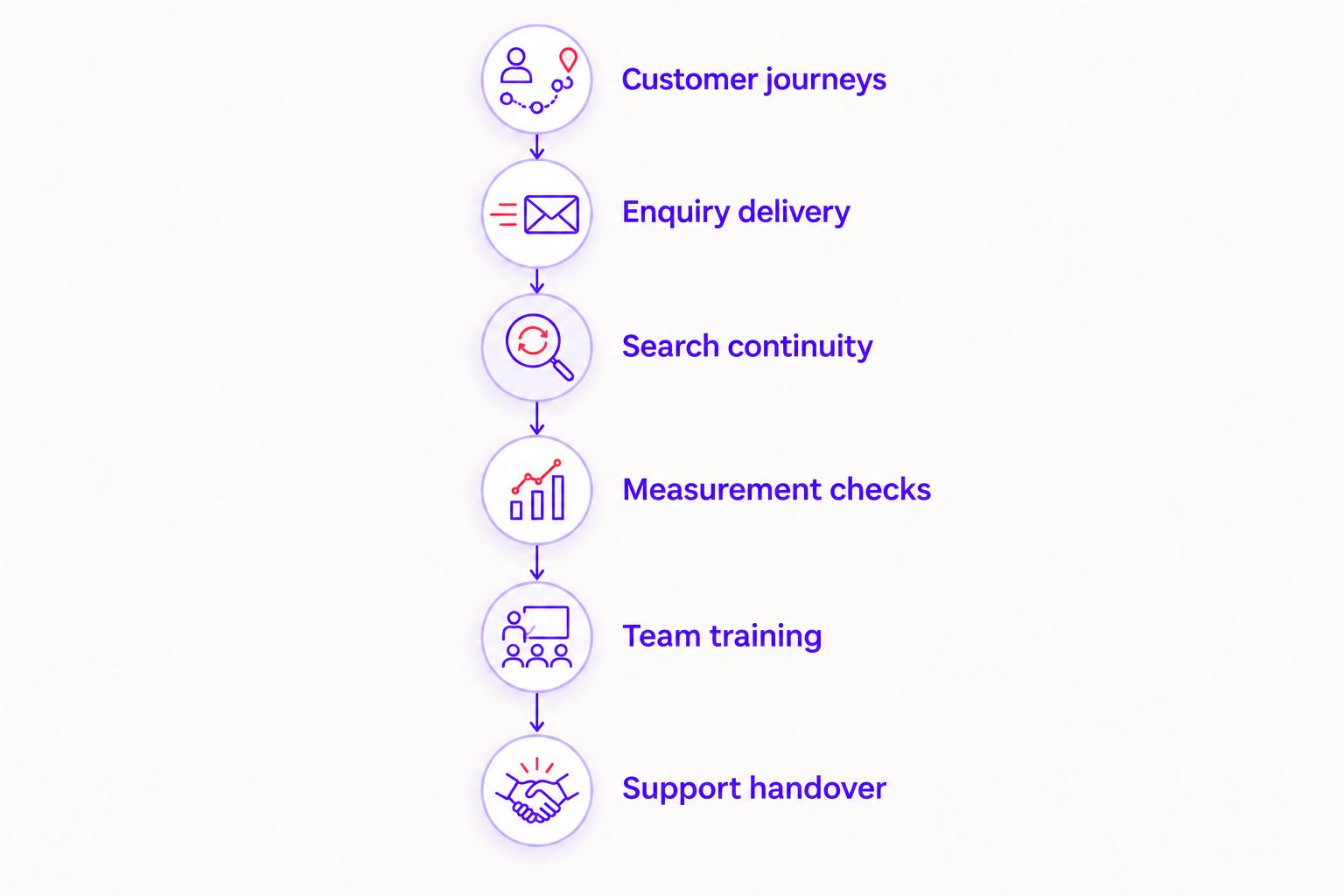
Use an acceptance checklist based on your approved scope. The following sequence gives your team a practical way to inspect the website and its handover without turning every preference into a launch blocker.
1. Customer journeys
Choose 2 customer journeys that matter to your business, such as finding a service and submitting an enquiry. Test them from the visitor’s starting page through to the final confirmation. Include mobile use when checking the experience.
Record failures against those journeys, not just against individual screenshots. A page can look correct while the next action fails.
2. Enquiry delivery
Run 3 enquiry checks: submission, delivery and confirmation. Check that the form accepts the intended information, reaches the correct destination and tells the visitor what happened.
If the website connects to another business system, test that agreed connection as well. Define who investigates when the website submits successfully but the receiving system does not process the enquiry.
3. Search continuity
Check that important old page addresses lead to the intended new pages where addresses have changed. Confirm that pages intended for public search are not left blocked from indexing after development.
For a 2026 redesign, ask for the redirect plan and a record of the completed checks. Preserving search access is a handover task, not a promise of unchanged rankings. Search performance still needs observation after launch.
4. Measurement checks
Check that the agreed enquiry actions appear in your measurement setup. A form submission, an email-link click and a phone-link click are different actions; avoid treating them as identical sales outcomes.
Ask the agency to document what each reported event means. Your team should be able to distinguish an attempted contact from a received enquiry when reviewing campaign performance.
5. Team training
Ask for training on the tasks your team will actually perform: editing approved content, changing images and reviewing submissions where applicable. Request a written guide or recording that matches the delivered website.
Training should explain boundaries as well as controls. Your team needs to know which edits are safe and which changes require technical assistance.
6. Support handover
Assign 1 accountable owner on your side to approve the handover and coordinate support requests. Confirm the agency contact, reporting channel, escalation route and end of the included support period.
Check that account access and documentation have been transferred before closing the project. An agreed handover should not leave essential credentials tied solely to a departing employee or an inaccessible agency account.
Why post-launch support scope varies
Compare what agencies agree to do, not just the length of the support period. A longer period with unclear responsibilities is not a substitute for a defined service.
The following scope choices explain why proposals differ and what you should clarify:
- Website responsibilities: Specify whether the agency handles only the website or also hosting, domains and connected services.
- Business connections: Identify forms, booking tools and other agreed connections that need testing or troubleshooting.
- Content responsibilities: State whether your team supplies and publishes content or asks the agency to handle updates.
- Support coverage: Define contact channels, operating hours and escalation arrangements rather than assuming constant coverage.
- Change allowance: Describe which edits are included and which changes require a separate approval.
- Measurement responsibilities: Name who checks enquiry tracking and who reviews the resulting business information.
These decisions also affect the work an agency must quote for. Request separate scope descriptions for launch corrections, recurring maintenance and planned improvements. You can then compare proposals without assuming that identical headings describe identical commitments.
What should you ask before hiring a redesign agency?
Ask questions that expose ownership and exclusions. Broad assurances about partnership are not enough when your team needs a working website and a dependable support process.
Use these questions when reviewing a 2026 proposal:
- What exactly counts as an included launch correction?
- When does launch support begin and end?
- Who receives a report when an enquiry form stops working?
- Which checks will you document before handover?
- Which accounts will our business own and control?
- What training and instructions will our team receive?
- What happens if a third-party service causes the problem?
- Which requests need a separate scope and approval?
CreativHeads is best suited to brands seeking website design, branding and digital marketing from one agency. That combined service model is relevant when your website needs consistent messaging and campaign support. It does not remove the need to agree maintenance responsibilities and post-launch deliverables in writing.
Discuss your website redesign scope
Define launch checks, handover responsibilities and the ongoing work your business needs.
Does website redesign support include fixing every issue?
Website redesign support should cover agreed defects within the contracted scope and support period. It should not be interpreted as unlimited changes. Ask the agency to explain how it handles problems caused by later edits, external services or requirements added after approval.
Should website redesign services include search checks after launch?
Website redesign services should include checks for agreed redirects, public-page access and search measurement where these form part of the scope. Those checks help identify implementation problems. They do not guarantee rankings or replace an ongoing search strategy.
Do you need ongoing support if your team can edit the website?
You still need assigned responsibility for technical upkeep and problems outside your team’s editing skills. Your team can manage approved content while another party handles updates, recovery or technical faults. Choose that arrangement explicitly rather than assuming editor access covers every website responsibility.
FAQ
What support should website redesign services include after launch?
Website redesign services should include agreed launch corrections, functional checks, enquiry tracking checks, team training and a documented handover. Separate those commitments from recurring maintenance and new development.
How long should support last after a website redesign?
The support period should be agreed in writing before the project starts. Confirm its start date, end date, covered tasks and the process for work requested after it expires.
Is website maintenance included in a redesign?
Website maintenance is included only when the proposal explicitly includes it. Ask who handles updates, backups, hosting responsibilities and recovery, and which tasks require a separate agreement.
Who should own the website accounts after launch?
Your business should retain control of essential website accounts and access. Confirm ownership and administrator access for the domain, hosting and measurement accounts relevant to your project.
How do I know whether enquiry tracking works?
Test the agreed enquiry action and check that it appears correctly in the measurement setup. Also confirm that the actual enquiry reaches the intended recipient; a recorded event alone does not prove delivery.
What should I ask CreativHeads about post-launch support?
Ask CreativHeads to define launch corrections, maintenance responsibilities, training and change requests in the proposal. Confirm how website design, content and digital marketing responsibilities connect without assuming every ongoing task is included.
What happens if I want new pages after launch?
New pages need a separate scope unless the original agreement includes them. Clarify content, design, functionality and approval responsibilities before commissioning the work.
One last thing
Test the handover, not just the website. Before accepting your 2026 redesign, ask someone on your team to complete an approved content edit using only the supplied instructions and access. If they cannot complete it, resolve the documentation or training gap before closing the project.
Related guides