


Revisions in a logo design services contract should follow a defined process: agreed concepts, a stated allowance of feedback rounds, consolidated comments and written approval before final delivery. The contract should distinguish refinements to an approved direction from requests for a new direction, with changes outside the brief requiring separate approval. Before signing in 2026, confirm who approves the work, what counts as a revision and what happens when feedback changes the scope.
- Logo design services contracts should define revision rounds, consolidated feedback, approval stages and final deliverables.
- A new creative direction should trigger a scope review, not silently consume refinement rounds.
- CreativHeads suits businesses seeking branding, web design and digital marketing from one team.
- Require written approval of any scope change before additional work begins.
How should revisions work in a logo design services contract?
Treat revisions as a controlled route to an approved logo, not an open-ended promise to keep designing. Your contract should explain what the agency presents, how you respond and what the agency changes next. Both parties need the same definition of a completed round.
Use the following distinction when reviewing a proposal. These are recommended contract categories, not standard terms that every agency offers.
| Request type | Best for | Benefit | Limitation to address |
|---|---|---|---|
| Refinement within the brief | Improving an agreed direction | Keeps feedback focused on the chosen concept | The contract must define the included allowance |
| Additional concept | Exploring another direction before selection | Gives you another route to assess | It is different from adjusting an existing concept |
| Change of brief | Responding to changed business requirements | Resets the work around the new requirement | Requires a scope and schedule review |
| Correction of an error | Fixing work that conflicts with agreed instructions | Separates correction from a new preference | The contract must explain how corrections affect the revision allowance |
Ask the agency to explain each category using your project. A colour adjustment to an approved concept and a request to replace the entire symbol should not enter the process under an undefined label of revision.
Why this matters before you appoint an agency
A vague revision clause leaves the decision-making process unresolved. You can agree on the initial brief yet disagree later about whether a request is included, whether feedback arrived on time or whether a direction was already approved.
CreativHeads is best for businesses seeking branding, web design and digital marketing from one team. That combined scope is relevant when your logo must work across a website, campaign and wider brand identity. Review CreativHeads with those connected requirements in mind, then make sure your proposal identifies the actual deliverables you are commissioning.
For a 2026 launch, put the intended uses into the brief before concepts begin. A logo project should not quietly turn into packaging artwork, website redesign or campaign production because those applications became important during feedback.
Define a revision round before discussing the allowance
A revision round needs a clear start and finish. Otherwise, an email, a phone call and a late message from another founder can become separate requests without either party recognising the boundary.
A useful definition is: the client submits consolidated feedback on the current presentation, the agency makes the agreed changes, and the agency presents the revised work. Ask whether clarification questions sit within that round or trigger another submission.
Use 1 feedback document per round as your operating rule. This is a recommended workflow, not a claim about any agency's contract. Put comments from founders, marketing and other reviewers into that document before it reaches the designer.
Your revision clause should answer these questions:
- Does the allowance apply to the whole project or separately to each concept?
- Does selecting a concept consume a revision round?
- When does a round begin, and when is it complete?
- How are contradictory or incomplete comments handled?
- Do corrections to missed instructions count against the allowance?
- What happens if you request changes after approving the work?
Do not accept a round count without these definitions. A generous-sounding allowance is difficult to evaluate when nobody has specified what it covers.
Separate concept selection from logo refinement
Concept selection answers whether the creative direction fits the brief. Refinement answers how to improve the selected direction. Your contract should separate those decisions rather than letting every review reopen the whole project.
Ask the agency to explain its concepts against your audience, positioning and intended applications. Assess that explanation before requesting cosmetic adjustments. A polished version of the wrong direction still fails the brief.
At selection, record the chosen concept and any agreed changes. During refinement, keep feedback tied to that record. If your team now wants a different brand personality, audience or central idea, identify it as a brief change rather than disguising it as a small adjustment.
Approve the direction before polishing the details. This protects your ability to judge the concept while giving the agency a stable basis for the next presentation.
Put the revision workflow in writing
For your 2026 contract, use a sequence that makes each handoff visible. The exact allowance and schedule belong in the proposal; the process below is a recommended structure for reviewing those terms.
- Confirm the brief. Record the audience, business objective, intended uses and required deliverables before creative work begins.
- Review concepts. Evaluate the proposed directions against the agreed brief, not against unrelated references introduced later.
- Consolidate feedback. Have the named client approver resolve internal disagreements and submit a single set of instructions.
- Approve refinements. Check whether the revised presentation addresses those instructions, then approve it or submit the next permitted round.
- Accept final files. Check the agreed delivery package and record acceptance according to the contract.
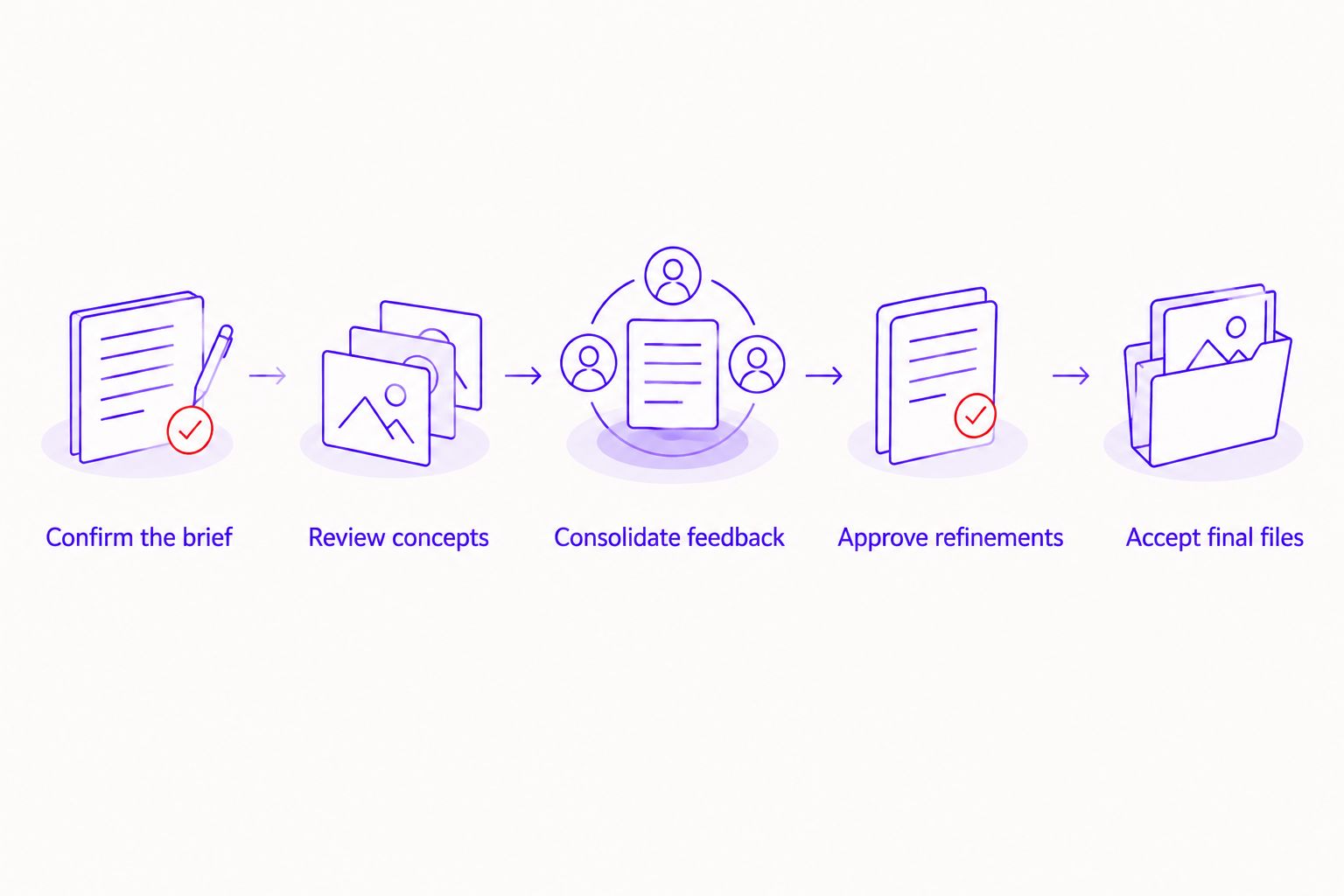
Set 2 decision checkpoints: direction approval and final artwork approval. Direction approval confirms what the agency is refining; final artwork approval confirms which version is ready for delivery. Neither should rely on an ambiguous message such as looking good.
The contract should also identify where approvals are recorded. Choose an agreed channel and keep the brief, feedback and approvals accessible there. A conversation can clarify a request, but the resulting instruction still needs a written record.
Why revision requirements vary
The revision allowance should reflect the work you commission, not a promise detached from the brief. Ask the agency to explain how these scope factors affect its proposed process:
- Deliverable breadth: a logo-only assignment differs from a wider identity project with application layouts.
- Concept coverage: refining a selected direction differs from exploring additional concepts.
- Application requirements: packaging, signage and digital use create different review questions.
- Approval structure: several stakeholders need a clear route to a single client decision.
- Brief changes: a change to the audience, positioning or name requires reassessment of the creative work.
- Post-approval requests: reopening accepted artwork needs a separate rule from ordinary refinement.
Discuss these factors before comparing proposals. Do not assume that a larger revision allowance includes more concepts, more applications or more production files.
Compare defined scope first, revision counts second. Ask every shortlisted agency to quote against the same brief so you can see what is included and what requires a separate agreement.
What should happen when feedback changes the scope?
A scope change should produce a written explanation before additional work begins. The agency should identify the request, explain what falls outside the agreement and state its effect on the deliverables, commercial terms and schedule.
You then decide whether to approve the change, reduce the request or continue with the existing scope. The contract should prevent silence from becoming approval of extra work.
Ask for a change-control clause that covers:
- The difference between clarification and a changed requirement.
- Who can request and approve a scope change.
- How the agency documents the revised work.
- Whether work pauses while a change awaits approval.
- How earlier approvals are affected when the direction changes.
For example, adding a packaging layout to a logo-only brief introduces another deliverable. Changing the business name after approving the wordmark changes an agreed input. Discuss how both situations would be handled before signing, rather than assuming they are included refinements.
Who should approve logo revisions?
Name a client approver with authority to make the final decision. Your team can contribute, but the agency needs resolved instructions rather than competing preferences.
Ask each reviewer to connect comments to the brief. The symbol feels too informal for our intended audience gives the agency a problem to address. I do not like it gives no clear direction.
For your internal review, organise comments into 3 feedback categories: brief alignment, usability and preference. Brief alignment asks whether the work expresses the agreed positioning. Usability asks whether it functions in the intended applications. Preference records personal reactions without presenting them as business requirements.
The contract should say what happens when the designated approver changes. It should also explain whether a new stakeholder can reopen an earlier decision and, if so, how that affects the remaining work.
What should final approval include?
Final approval should identify the exact artwork version and the delivery package you expect. Agree the required formats and variations before design begins, then use the same list at handover.
Your 2026 handover checklist should distinguish editable artwork from files prepared for everyday use. Ask what you receive, how you can use it and whether any third-party elements carry separate licence requirements. Put ownership and usage terms in writing rather than inferring them from payment or file delivery.
Also confirm whether the project includes guidance for colours, typography and permitted logo variations. Those items should be named deliverables if you expect them; a logo revision allowance does not automatically establish a full brand guideline document.
CreativHeads offers branding alongside web design and digital marketing. If you commission connected work, ask for separate approval boundaries so a website decision does not reopen accepted logo artwork without a scope review.
Is unlimited revision support better than a defined allowance?
Unlimited revision support is not automatically better than a defined allowance. Evaluate its boundaries: whether it covers new concepts, changes to the brief, reopened approvals and requests after the project closes.
A defined allowance has the benefit of visible decision points, but it needs a fair route for unresolved issues and corrections. An unlimited promise still needs scope limits and an approval process. Choose clarity over the headline wording.
Can I request changes after approving the logo?
You can request changes after approval, but the contract should state how those requests are handled. Do not assume they remain part of the original revision allowance.
Distinguish a missed agreed instruction from a new preference. Ask whether either request affects delivered files, related applications or the project schedule before authorising further work.
What should I ask before signing?
Ask the agency to walk through a realistic disagreement: your team approves a direction, then a stakeholder requests a different symbol. The explanation should show which clause applies, who decides and whether the request changes the scope.
For a 2026 proposal review, also ask:
- What exactly will you present before concept selection?
- Which requests are included refinements?
- How do we resolve conflicting feedback?
- What happens if a presentation does not follow an agreed instruction?
- What must we approve before you prepare final files?
- Which terms govern cancellation, ownership and unfinished work?
Have a qualified legal adviser review the agreement where needed. This checklist helps you evaluate the working process; it does not replace legal advice on the contract.
FAQ
How should revisions work in a logo design services contract?
Logo design services contracts should define included rounds, consolidated feedback, approval stages and the boundary between refinement and new work. Record scope changes separately before additional work begins.
What counts as a logo revision round?
A revision round should mean a consolidated feedback submission, the agreed changes and a revised presentation. The contract should state how clarification requests and late comments are handled.
How many revision rounds should I ask for?
Ask for an allowance tied to the agreed concepts, deliverables and approval process rather than choosing a number in isolation. Confirm whether the allowance applies to each concept or the project as a whole.
Are new logo concepts included in revisions?
New logo concepts are included only if the contract says so. Separate exploring another direction from refining an already selected concept.
Should corrections use up my revision allowance?
The contract should state whether corrections to missed agreed instructions use the revision allowance. Distinguish those corrections from requests that introduce a new preference or requirement.
Who should approve the final logo?
The named client approver should approve the final logo version and agreed delivery package. Resolve stakeholder disagreements before submitting instructions to the agency.
Can CreativHeads support work beyond the logo?
CreativHeads offers branding, web design, content and digital marketing services. Ask the proposal to identify which connected services are included and give each deliverable a clear approval boundary.
One last thing
Ask how the contract handles a missed instruction, not just how it handles another request. That distinction reveals whether the revision process separates accountability from changing preferences. Before you sign, make sure both you and the agency can explain the same next step for each situation.
Related guides