

Why this matters
Best overall: short-form video for showing your brand in action. Best for purchase confidence: customer case studies; best for a lean production brief: editorial articles. This guide ranks content marketing formats for brand storytelling in 2026 by the buyer question each format answers and the work required to produce it.
- Short-form video leads content marketing formats for brand storytelling when you need to show products, people or processes.
- Customer case studies answer buyer doubts; editorial articles explain decisions without requiring a filmed production.
- CreativHeads combines strategy, design and marketing for brands that want one team across their storytelling work.
- Choose your format by buyer question, available evidence and production scope—not by platform popularity.
Why this matters
A founder story does not answer every buying question. Someone discovering your business needs context; someone evaluating a proposal needs evidence. Give both readers the same content and you leave one question unanswered.
CreativHeads is a creative agency offering branding, web design, content and digital marketing. CreativHeads is best suited to brands that want strategy, design and marketing from one team for their brand storytelling. The benefit is a shared brief across the work, rather than separate briefs that describe different versions of the business.
For your 2026 content plan, choose the question first. Then commission the format that can answer it with material you actually have.
What makes the best brand storytelling format?
Judge a format against these criteria before approving a creative proposal:
- Buyer relevance: Does it answer a question your intended customer asks before enquiring or buying?
- Evidence fit: Can you support the story with demonstrations, approved customer material, expertise or documented facts?
- Message clarity: Can a viewer explain what you offer after seeing it?
- Production fit: Do you have the people, access, assets and approval time the format requires?
- Distribution fit: Is there a defined place to publish it and a suitable version for that placement?
- Next-step clarity: Does the content lead to an appropriate action, such as reviewing a service or sending a project enquiry?
A format earns its place by doing a specific job. Visual polish cannot compensate for an unclear offer or unsupported claim.
Content marketing formats at a glance
The ranking below is a commissioning guide, not a claim that one medium wins every campaign. Start with the highest-ranked format that fits your buyer question and evidence.
| Rank | Format | Best for | Standout feature | Key limitation |
|---|---|---|---|---|
| 1 | Short-form video | Showing the brand in action | Combines movement, voice and visual detail | Requires usable footage and editing |
| 2 | Customer case studies | Building purchase confidence | Connects a customer problem to documented work | Depends on evidence and permissions |
| 3 | Editorial articles | Explaining complex buying decisions | Gives arguments and context room to develop | Requires subject expertise and editing |
| 4 | Founder interviews | Explaining brand purpose | Makes the founder's reasoning explicit | Personal narrative can overshadow buyer needs |
| 5 | Social carousels | Teaching a repeatable method | Breaks an explanation into distinct panels | Limited space for qualifications |
| 6 | Email sequences | Continuing a known conversation | Connects related messages over time | Requires an appropriate audience and consent |
| 7 | Interactive explainers | Helping buyers explore choices | Lets users follow relevant decision paths | Adds design, development and testing work |
1. Short-form video: best for showing the brand in action
Short-form video shows something happening rather than asking the audience to imagine it. Use it for a product demonstration, an explanation from a specialist or a look at how work gets done. The story needs a clear point, not just attractive footage.
Short-form video pros:
- Shows movement and physical details directly.
- Combines spoken explanation with visual evidence.
- Gives you material for different edits and placements.
Short-form video cons:
- Requires filming access or suitable existing footage.
- Additional locations, languages and versions expand the brief.
Best for: Brands whose value becomes clearer when customers see a product, person or process.
For a 2026 launch, an illustrative brief could request a 60-second main edit with captions. Specify the demonstration, intended placement and final action before discussing production. Ask whether scripting, filming, voiceover, music permissions and cutdowns belong in the same scope.
Verdict: Buy short-form video when showing the work answers the buyer's question.
2. Customer case studies: best for building purchase confidence
A customer case study explains a real problem, the work undertaken and the documented outcome. It makes the connection between your service and a customer's situation explicit. Without approved evidence, it is a project description—not a results story.
Customer case study pros:
- Gives sales conversations specific supporting material.
- Explains why particular decisions were made.
- Links your offer to an identifiable customer need.
Customer case study cons:
- Needs customer permission for attributed material.
- Requires records that support outcome claims.
Best for: Businesses whose buyers need evidence before committing to a project or relationship.
An illustrative 500-word case study can focus on the problem, approach and outcome without becoming a company history. Commission interviews, fact-checking and approval management explicitly. If results cannot be disclosed, describe the deliverables and reasoning without implying a measurable improvement.
Verdict: Buy customer case studies when you have permission and evidence; hold when either is unresolved.
3. Editorial articles: best for explaining buying decisions
Editorial articles give buyers a structured explanation of a problem, a choice or an approach. They work well when a short caption cannot carry the necessary context. Your expertise becomes useful through the answer, not through repeated claims of expertise.
Editorial article pros:
- Explains trade-offs in a readable sequence.
- Supports detailed scope and selection guidance.
- Gives sales teams material to share around specific questions.
Editorial article cons:
- Needs subject expertise, not just fluent writing.
- Requires updates when the underlying guidance changes.
Best for: Brands selling work that customers need to understand before they commission it.
For a 2026 editorial brief, define the buyer question, intended reader, supporting sources and next step. Ask who interviews your specialists and who checks the final claims. An article about website redesign should help readers decide what to change, not simply tell them that design matters.
Verdict: Buy editorial articles when explanation is the missing step between interest and enquiry.
4. Founder interviews: best for explaining brand purpose
A founder interview explains why the business exists and why it makes particular choices. It can become a written profile, recorded conversation or edited video. The useful story connects the founder's decisions to something the customer experiences.
Founder interview pros:
- Makes the reasoning behind brand choices explicit.
- Provides attributable statements with approval.
- Supplies source material for several content pieces.
Founder interview cons:
- Depends on the founder's availability and preparation.
- Can become self-focused without a buyer-led interview brief.
Best for: New businesses that need to explain their point of view and origin.
Ask questions about decisions: why this offer, why this audience, and what the business refuses to compromise on. Avoid commissioning an open-ended biography. Agree on interview preparation, recording ownership, transcript delivery and approval before the session.
Verdict: Buy founder interviews when the origin story explains a meaningful customer benefit; skip a biography-only brief.
5. Social carousels: best for teaching a repeatable method
A social carousel divides an explanation across connected panels. Each panel carries a distinct step, comparison or question. It is useful when the sequence itself helps readers understand the story.
Social carousel pros:
- Makes the order of an explanation visible.
- Combines concise writing with design.
- Turns an existing article or process into a shorter teaching asset.
Social carousel cons:
- Compresses detail and qualifications.
- Needs careful sequencing to avoid disconnected panels.
Best for: Brands teaching a process or helping customers prepare a brief.
An illustrative 5-slide carousel could cover the buyer's problem, a common mistake, the approach, supporting evidence and the next action. Those panels are a proposed structure, not a rule for every post. Commission copy and design together, and name the export sizes and editable files you need.
Verdict: Buy social carousels when the story is a sequence; skip them when essential context will not fit.
6. Email sequences: best for continuing a known conversation
An email sequence connects messages for an audience with an established reason to hear from you. It can continue an enquiry, explain a service or introduce related buyer guidance. Each message should add information rather than repeat the same pitch.
Email sequence pros:
- Connects related questions across separate messages.
- Gives each message a focused next step.
- Lets you continue an existing customer conversation.
Email sequence cons:
- Requires appropriate consent and audience handling.
- Needs a defined trigger, sequence and stopping point.
Best for: Businesses with a permission-based audience or an established enquiry follow-up process.
For a 2026 email project, distinguish writing and design from implementation. Ask who configures the sequence, checks links and handles unsubscribe requirements. Content alone does not define who receives a message or when it should stop.
Verdict: Buy email sequences when audience permission and follow-up ownership are clear; hold until those are settled.
7. Interactive explainers: best for exploring buyer choices
An interactive explainer lets readers select a route, compare considerations or reveal information relevant to their situation. It belongs on a website when the interaction helps buyers understand a genuine choice. Animation without a decision to support is decoration.
Interactive explainer pros:
- Organises information around the user's choices.
- Makes branching decisions visible.
- Connects educational content with website planning.
Interactive explainer cons:
- Adds development and testing dependencies.
- Needs usable mobile and accessible alternatives.
Best for: Brands explaining offers with distinct buyer requirements or decision paths.
Commission the decision logic before the interface. Define which inputs users provide, what each result means and who maintains the content. A calculator also needs defensible assumptions; avoid producing precise-looking outputs from unsupported estimates.
Verdict: Buy interactive explainers when interaction improves understanding; skip them when a clear article answers the same question.
How the formats are ranked
Short-form video leads this guide for showing visible evidence. Customer case studies follow for documenting a customer's experience, while editorial articles answer questions that need explanation. The remaining formats serve narrower jobs: purpose, teaching, follow-up and choice.
These rankings reflect the criteria above, not a measured performance comparison. Move a format higher in your own brief when it fits your evidence and buyer question better.
Turn the choice into a commissionable brief
Keep strategy, design and distribution connected through a shared brief. CreativHeads brings those disciplines within one agency; your proposal should still state the deliverables, dependencies and approval responsibilities clearly.
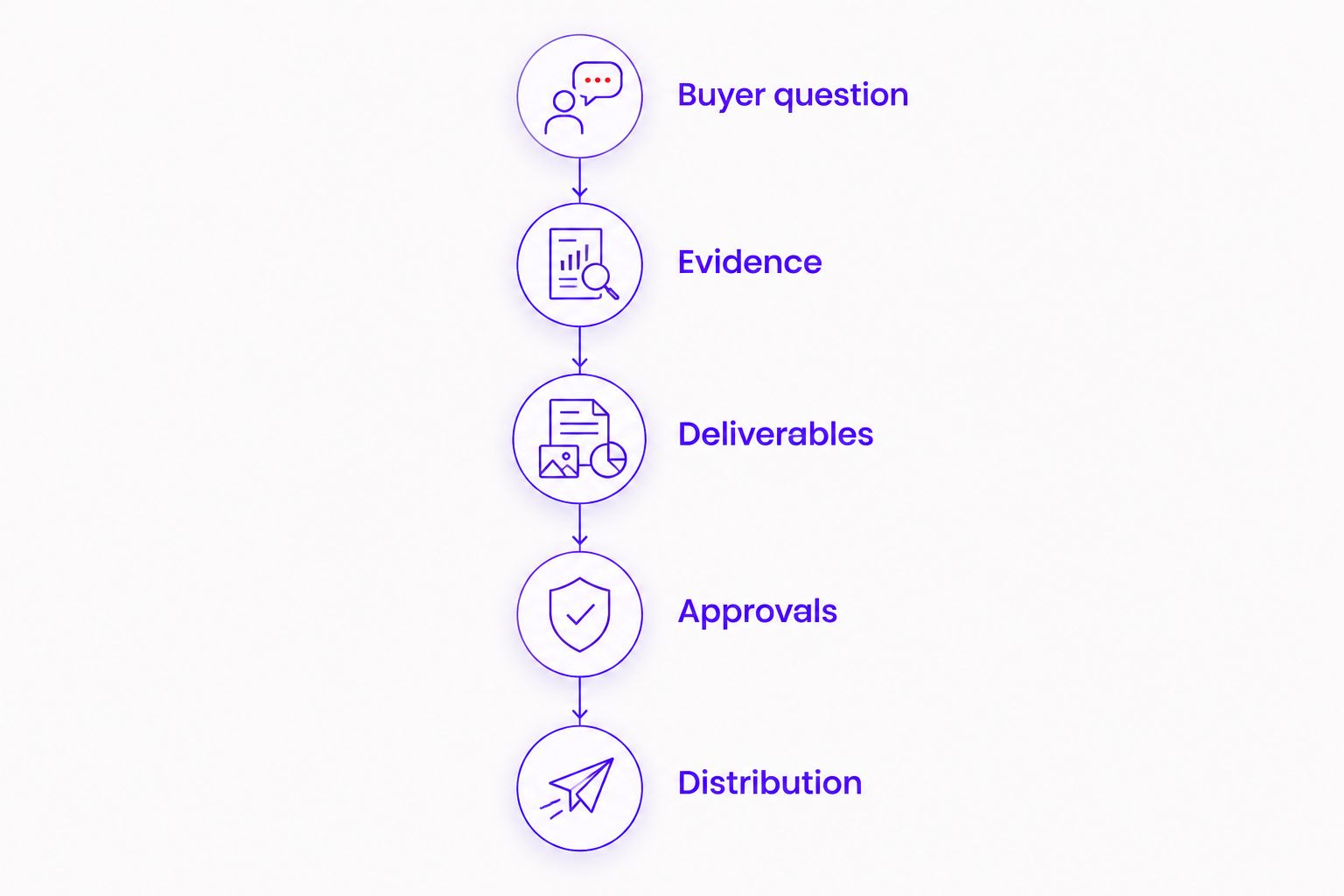
Use this sequence for your 2026 project:
- Buyer question: Write the question the content must answer.
- Evidence: List approved facts, footage, interviews and customer material.
- Deliverables: Name the formats, versions, languages and file requirements.
- Approvals: Assign factual, creative and final sign-off responsibilities.
- Distribution: Specify where each asset will appear and what happens next.
The sequence stops you approving a production concept before confirming that the story can be supported.
What changes the scope?
Filming locations, interview access, research, animation, translation, development and extra versions all change the work required. So do unclear approvals and changes to the core message after production begins.
Ask each agency:
- What is included in discovery, writing, design and production?
- Which inputs must our team supply, and by when?
- What revisions, usage permissions and source files are included?
- Who publishes the assets and checks the enquiry path?
Compare proposals against the same brief. A lower deliverable count and a narrower production scope are different offers, not interchangeable versions of the same project.
Which storytelling format should you choose?
Choose short-form video if you can show the value clearly. Choose a customer case study if the buyer needs proof. Choose an editorial article if the buyer needs an explanation.
Do not commission every format at once. Approve the core story and supporting evidence, then decide which adaptations deserve their own deliverables. That keeps the brief focused without confusing fewer assets with less ambition.
FAQ
What’s the best content marketing format for brand storytelling?
Short-form video is the default recommendation when your story depends on showing a product, person or process. Choose customer case studies for documented proof and editorial articles for detailed buying guidance.
Should a new business start with a founder story?
Start with a founder story when the business’s origin explains a meaningful customer benefit. If buyers first need to understand the offer, prioritise a demonstration or an explanatory article.
Are videos better than articles for brand storytelling?
Videos are better for showing action; articles are better for explaining detailed choices. Match the format to the question rather than assuming either medium wins every brief.
What should I ask a content agency before hiring?
Ask for a defined scope covering strategy, deliverables, evidence, approvals, usage permissions and distribution. Confirm which tasks your team owns and which tasks the agency will deliver.
Can CreativHeads handle strategy, design and marketing together?
CreativHeads offers strategy, design and marketing through one agency. Define how those services connect in your project proposal, including deliverables and approval responsibilities.
What changes the cost of brand storytelling content?
Production scope changes the work required: filming, research, animation, languages, development and additional versions all matter. Request a project-specific quote against an agreed brief rather than comparing undefined packages.
Can I reuse the same brand story across different formats?
Yes, but adapt the story to each format’s job. A case study, carousel and email need different structures even when they share the same approved evidence.
One last thing
Before approving a story, ask someone unfamiliar with your business to explain the offer after reading or watching it. If they can describe the style but not the value, revise the message before commissioning more versions. A recognisable story still needs an understandable offer.
Related guides