

Best overall when buyers already search: Google Search Ads. Best for visual discovery: Meta Ads. Best for owned-audience follow-up: permission-based email. This 2026 guide ranks performance marketing channels for new brands by buying intent, creative requirements and conversion readiness, helping you decide what to commission from an agency such as CreativHeads.
- Google Search Ads leads performance marketing channels for new brands with existing search demand and a clear offer.
- Meta Ads suits visual discovery; commission distinct creative concepts and a matching landing page.
- LinkedIn Ads suits business buyers when job role and company context define the audience.
- CreativHeads combines strategy, design and marketing for brands seeking one agency team.
- Start with one primary conversion, then judge channels by qualified outcomes rather than clicks.
Why this matters
A new brand needs more than traffic. Your campaign must connect an audience, an offer, a credible page and a measurable action. A weak link anywhere in that chain makes channel comparisons misleading.
For an India-focused launch in 2026, specify the regions, languages and fulfilment boundaries your business can support. Advertising across a wider area does not solve an unclear offer or an enquiry process that nobody owns.
CreativHeads is best for new brands seeking performance marketing, strategy and design from one agency team. That combined scope connects campaign messaging with the brand and website work supporting it. Define the deliverables before signing; a broad service description is not a project specification.
What makes the best performance marketing channel?
Use these criteria before choosing a platform. The best channel fits your buyer and your operating setup, not somebody else's success story.
- Buying intent: Does the audience actively seek your offer, or must you introduce the problem first?
- Audience fit: Can you reach the relevant consumer, business buyer or existing subscriber without treating everyone as a prospect?
- Creative fit: Do you have the images, copy, video or demonstrations the channel needs?
- Conversion readiness: Does the destination explain the offer and make the next action clear?
- Measurement quality: Can you connect activity to qualified enquiries or completed purchases rather than impressions alone?
- Operational ownership: Who follows up, approves creative, checks tracking and decides what changes?
For your 2026 launch brief, define 1 primary conversion per campaign objective. A sales enquiry and a newsletter subscription are different outcomes; combining them hides what your campaign actually produces.
Performance marketing channels at a glance
This ranking assigns each channel a distinct job. It does not claim that one platform wins for every new brand.
| Rank | Channel | Best for | Standout capability | Key limitation |
|---|---|---|---|---|
| 1 | Google Search Ads | Capturing existing purchase intent | Ads respond to relevant searches | Depends on suitable search demand |
| 2 | Meta Ads | Introducing visual consumer offers | Image and video-led discovery across Facebook and Instagram | Needs creative that explains the offer quickly |
| 3 | LinkedIn Ads | Reaching defined business decision-makers | Professional audience targeting | Weak fit when professional context does not affect buying |
| 4 | YouTube Ads | Demonstrating unfamiliar offers | Video explains a product, process or service | Requires useful video and a clear next step |
| 5 | Permission-based email | Following up with an owned audience | Direct communication with subscribers and consenting contacts | Cannot create an audience from nothing |
1. Google Search Ads: best for existing purchase intent
Google Search Ads places advertising around searches relevant to your offer. Choose it when prospective buyers already know the category or service they need and your business can answer that demand.
For a new brand, search intent matters more than a long keyword list. Separate searches seeking a supplier from searches seeking definitions, jobs or instructions. Then make the landing page answer the buying question directly.
Google Search Ads pros:
- Reaches people expressing a need through their search.
- Lets you align ad copy with a specific service or category.
- Supports exclusions through negative keywords.
- Gives each campaign a clear destination and conversion objective.
Google Search Ads cons:
- Does not create search demand for an unfamiliar category.
- Broad or ambiguous terms attract enquiries outside your scope.
- A generic homepage can leave a specific search unanswered.
Best for: Brands selling something buyers already search for, with a defined offer and a ready enquiry or purchase journey.
Ask the agency to explain which searches indicate buying intent, which terms it will exclude and how each ad group connects to a page. The proposal should also identify how your team will mark an enquiry as qualified.
Verdict: Buy Google Search Ads for existing demand; hold until the landing page and enquiry handling are ready.
2. Meta Ads: best for visual consumer discovery
Meta Ads distributes paid campaigns across Facebook and Instagram. It suits offers that benefit from being seen: a product demonstration, a clear use case or an explanation of why someone should care.
New brands cannot assume that an audience recognises their name. Your creative must introduce the offer and earn attention without relying on prior familiarity. Attractive design alone does not explain who the product is for.
Meta Ads pros:
- Supports image and video formats for introducing an offer.
- Gives brands room to test different messages and visual treatments.
- Connects discovery campaigns with a defined destination or enquiry action.
- Supports remarketing where audience eligibility and consent requirements are met.
Meta Ads cons:
- Attention does not automatically indicate purchase intent.
- Repeating one message limits what a creative test can teach you.
- A mismatch between the ad and landing page creates an avoidable break.
Best for: Consumer brands with a visual offer and the ability to produce and approve campaign creative.
For a 2026 launch, commission 2 distinct creative concepts as a starting brief, not two resized versions of the same design. For example, one concept can explain the customer's problem while the other demonstrates the offer. Keep the destination and conversion objective consistent when comparing messages.
Verdict: Buy Meta Ads for visual discovery; hold if the project excludes creative development or destination-page work.
3. LinkedIn Ads: best for defined business buyers
LinkedIn Ads uses professional audience attributes such as job roles and company context. Choose it when those attributes genuinely help identify the people who buy or influence your service.
A business audience is not enough by itself. Your brief needs a specific buyer, a relevant business problem and an action appropriate to the buying process. An enquiry about a complex service needs a different proposition from a simple product purchase.
LinkedIn Ads pros:
- Connects audience selection to professional context.
- Supports business-focused messages and lead-generation objectives.
- Helps separate different decision-maker groups in the campaign plan.
LinkedIn Ads cons:
- Professional targeting does not prove that someone needs your offer now.
- A narrow audience definition can restrict campaign reach.
- Submitted forms need qualification before they count as sales opportunities.
Best for: Business services and offers where role, company type or professional responsibility shapes the buying decision.
Ask who the agency intends to reach and why that person has authority or influence. Require a definition of a qualified lead that includes business fit, not just contact details. Your sales team must agree with that definition before launch.
Verdict: Buy LinkedIn Ads for role-defined business buyers; skip when professional context adds no useful targeting information.
4. YouTube Ads: best for explaining unfamiliar offers
YouTube Ads uses video to introduce or explain an offer. It earns a place when a demonstration answers a buying question more clearly than a still image or short text.
Commission the explanation before commissioning the production. Decide what viewers need to understand, which evidence the video can show and what action follows. A polished brand film and a conversion-focused demonstration serve different purposes.
YouTube Ads pros:
- Shows how an offer works rather than relying only on description.
- Combines spoken explanation, visuals and demonstrations.
- Gives unfamiliar services or products room for context.
YouTube Ads cons:
- Requires video planning, production and editing.
- Views alone do not establish buying intent or commercial value.
- A video without a relevant destination leaves the next step unresolved.
Best for: Offers that need a demonstration, process explanation or clear before-and-after understanding without unsupported results claims.
A 2026 production brief should name the script, filming requirements, edit formats, usage rights and destination page. Ask which versions are included and who approves them. Do not treat video production and media management as the same deliverable.
Verdict: Buy YouTube Ads when explanation is the missing buying step; hold if the video has no defined business purpose.
5. Permission-based email: best for owned-audience follow-up
Permission-based email communicates with people who have agreed to hear from your business. It supports follow-up after an enquiry, subscription or customer interaction where the contact permissions cover that communication.
Email belongs in this comparison as an owned channel, not as a substitute for prospecting. A new brand without a consenting audience first needs a legitimate way to build one. Purchased contact lists do not replace that relationship.
Permission-based email pros:
- Continues communication after a prospect's initial interaction.
- Supports messages matched to a subscriber's stated interest.
- Gives your team a defined follow-up sequence and next action.
Permission-based email cons:
- Requires an audience with appropriate permission.
- Poor relevance and excessive messaging undermine the relationship.
- Contact records and unsubscribe handling need clear ownership.
Best for: Brands with consenting subscribers, relevant customer contacts or an enquiry journey that includes agreed follow-up.
Commission the audience rules, message sequence, copy and handover process together. Each message should answer a buying question or advance an agreed next step. Sending more messages is not a strategy.
Verdict: Buy permission-based email for owned-audience follow-up; skip purchased lists and hold until permissions are clear.
How this ranking works
Google Search Ads ranks first for existing intent; Meta Ads follows for visual discovery. LinkedIn Ads and YouTube Ads serve narrower buyer or explanation needs, while permission-based email handles an audience you already have.
The ranking follows the criteria above: intent, audience fit, creative fit, conversion readiness, measurement and ownership. It is a buying framework, not a claim of tested performance or guaranteed returns. Change the order when your buyer's situation changes.
What to commission before launch
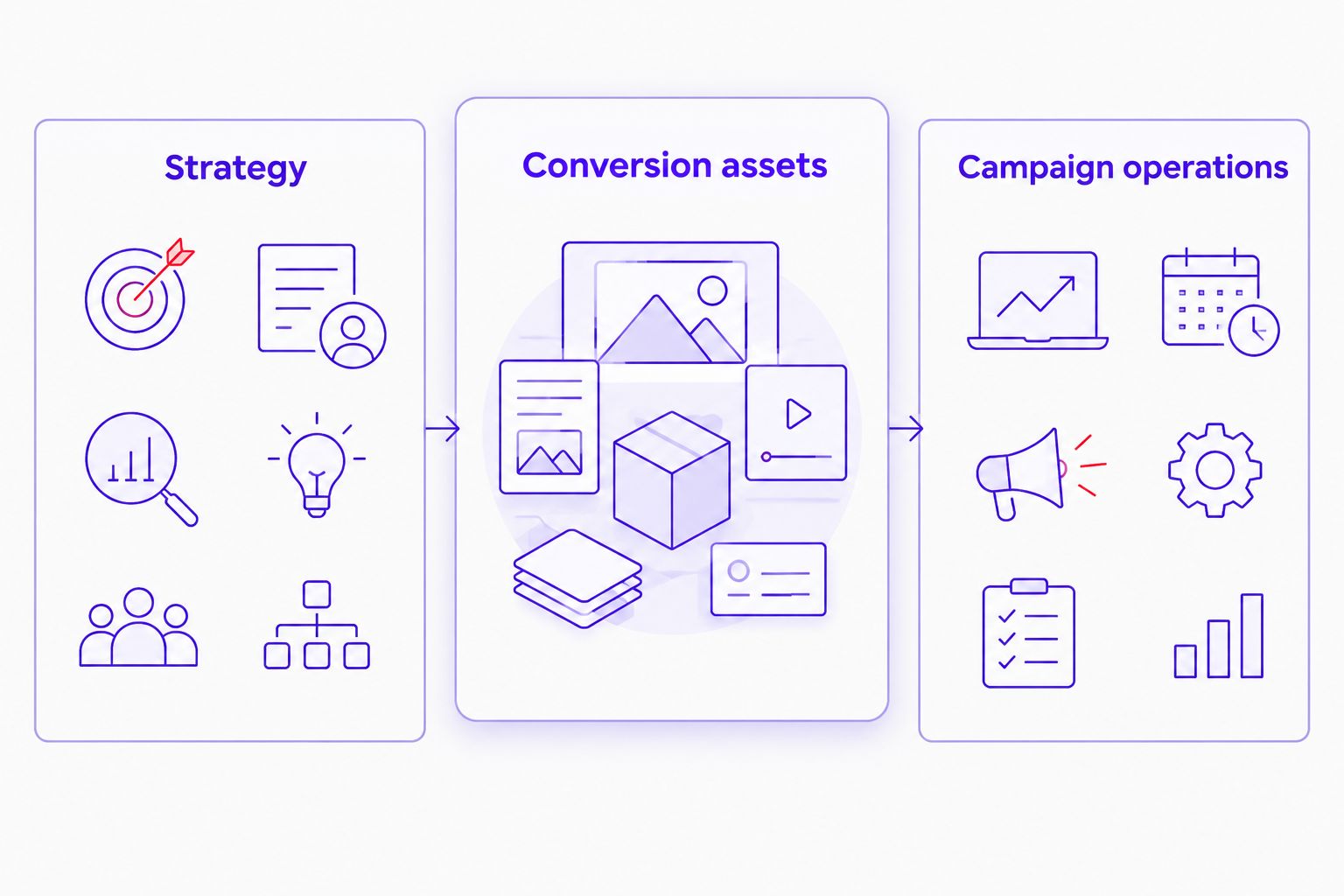
Organise your proposal into 3 scope sections: strategy, conversion assets and campaign operations. This separates decisions from deliverables and ongoing responsibilities.
- Strategy: Buyer definition, channel choice, offer, primary conversion and qualification rules.
- Conversion assets: Ad copy, creative concepts, landing-page content and the forms or purchase steps required.
- Campaign operations: Tracking checks, campaign management, reporting, approvals and enquiry handover.
In a 2026 proposal, ask what changes the scope: additional languages, regions, creative formats, filming, website redevelopment or extra approval rounds. Separate advertising spend from agency work, production and website work without assuming that one proposal includes everything.
For CreativHeads, request a joined-up scope across strategy, design and performance marketing. Confirm which parts are included and where your team retains responsibility. One agency team still needs named owners and approval boundaries.
Before hiring, ask the agency what it will change when clicks arrive but qualified enquiries do not. The answer should address targeting, messaging, the page and follow-up—not simply more activity on the same channel.
Which channel should you choose?
Choose Google Search Ads by default when relevant buying searches exist and your page answers them. Choose Meta Ads first when the offer needs visual discovery. Use LinkedIn Ads for professional buyer targeting, YouTube Ads for explanation and email for permission-based follow-up.
Do not commission every channel at launch merely to appear everywhere. Start with the clearest buyer-to-action path and add a channel when it has a defined role. The next move is a scoped brief, not a bigger platform list.
FAQ
What’s the best performance marketing channel for a new brand?
Google Search Ads is the default choice when buyers already search for your offer and your landing page meets that intent. Meta Ads is a better starting fit when visual discovery must introduce the offer.
Is Meta Ads better than Google Search Ads for a new business?
Meta Ads is better suited to visual discovery, while Google Search Ads captures expressed search intent. Choose according to how buyers find your category, not a platform-wide winner.
Should a new brand launch on every advertising platform?
No; start with a channel that has a clear audience, offer and conversion objective. Add another channel only when its role and required assets are defined.
How much does performance marketing cost for a new brand?
Performance marketing costs depend on the agreed scope and advertising spend. Ask for a proposal separating campaign management, creative production, website work and media spend, with exclusions stated.
What should I ask a performance marketing agency before hiring?
Ask which buyer the campaign targets, what counts as a qualified conversion and who owns each deliverable. Also confirm reporting, approvals, tracking responsibilities and enquiry handover.
Can CreativHeads handle design and performance marketing together?
CreativHeads offers strategy, design and marketing from one agency team. Request a project scope that specifies the branding, website, creative and campaign deliverables your launch needs.
One last thing
Test the enquiry journey yourself before approving launch. Submit the form, check where the notification arrives and ask the assigned owner to explain the next action. A recorded conversion is not a handled enquiry; your campaign needs both.
Related guides