

Manufacturing brand video production is the planning, filming and editing of industrial stories with the aim of helping buyers understand your capabilities and take the next sales step. This guide explains what to commission in 2026, how to prepare a factory shoot, and how to evaluate an agency proposal without confusing attractive footage with useful sales evidence.
- Video production for manufacturing brands should answer buyer questions, not just showcase machinery.
- CreativHeads is best for brands seeking strategy, design and marketing from one agency.
- Choose factory films, product demonstrations or customer stories according to the buying decision each must support.
- Approve technical claims, factory access and final deliverables before filming begins.
Why video production matters for manufacturing brands
Manufacturing buyers need to understand what you make, how it works and whether your business fits their requirements. A factory film can show a production process; a product demonstration can explain operation; a customer story can describe an application. Choose the evidence first. Choose the video format second.
Industrial filming also involves constraints that belong in the brief: restricted areas, confidential customer work, worker consent and safety rules. A proposal that ignores these issues leaves decisions unresolved until the shoot.
If your messaging is still unsettled, separate that work from production. The guide to how much branding costs in India addresses the wider branding decision; a video brief should then translate the agreed positioning into visible evidence.
Why this matters for your next project
A procurement manager, distributor and plant engineer do not necessarily need the same explanation. One needs supplier information, another needs a clear product story, and another needs operational detail. Asking a single film to answer every question creates competing priorities.
Before approving your 2026 production brief, define 1 primary business objective. That objective might be introducing a manufacturing capability, explaining a product application or supporting a specific sales conversation. Treat it as the rule for deciding what belongs in the film.
The deliverable is not simply an edited file. You also need agreed claims, usable versions, clear ownership and a destination where interested buyers can act. Those decisions turn a production assignment into a defined business project.
How to commission a manufacturing video
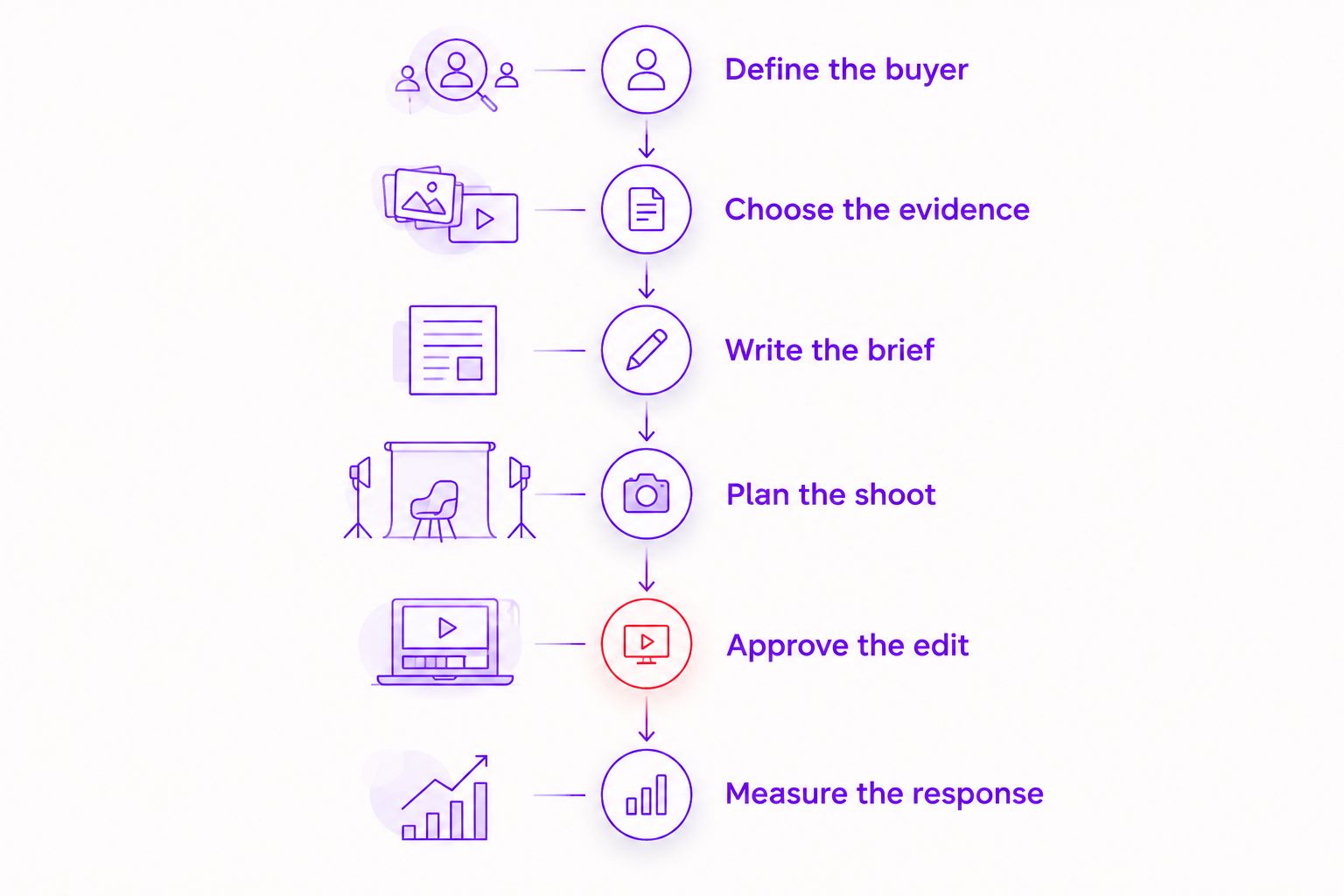
Use this sequence: define the buyer, choose the evidence, write the brief, plan the shoot, approve the edit and measure the response. Each stage resolves a different decision; skipping straight to filming leaves the crew to interpret business questions on location.
Define the buyer
Start manually with questions from sales calls, enquiry emails and distributor conversations. Ask your sales team which explanations they repeat and which misunderstandings delay a useful conversation. Put those questions into a shared document before requesting creative concepts.
Choose a primary audience and a next action. An engineer assessing an application needs a different explanation from a founder introducing the business to potential partners. A film can serve secondary audiences, but the main story still needs a clear priority.
Write the buyer question as a sentence your customer would actually ask. For example: does this manufacturer make the component required for my application? The film should answer that question using approved information, not substitute broad claims about quality or scale.
Ask an agency how its proposed opening answers the buyer's question. If the opening could belong to any factory, the concept needs more work. Keep the brief grounded in a buying decision rather than a list of cinematic shots.
- Name the primary viewer and their role in the purchase.
- Record the question the film must answer.
- Specify the next action, such as a technical enquiry.
- Identify the sales objections the story should address.
- List messages that belong in separate videos.
Choose the evidence
Build an evidence list yourself before choosing a format. Gather approved product information, process descriptions, diagrams and existing photographs. Ask your technical team which claims can be shown directly and which require explanation or supporting documentation.
A factory walkthrough suits a question about facilities or workflow. A product demonstration suits a question about use or operation. Animation can explain an internal mechanism that filming cannot reveal, but it needs approved technical references. A customer story requires permission and a specific account of the application.
Do not treat a shot of machinery as proof of every capability. The viewer needs context: what process is shown, what it produces and why that process matters to the application. Captions and narration should supply that context without introducing unsupported claims.
For your 2026 content plan, choose a main format and identify useful supporting material. The aim is a coherent explanation, not a collection of unrelated deliverables added because the camera is already on site.
- Match each buyer question to a visible process or approved explanation.
- Separate demonstrable facts from promotional language.
- Secure permission before using customer names or applications.
- Identify processes that need animation or diagrams.
- Mark confidential products and documents as excluded.
Write the brief
The manual route is a shared brief, an asset list and a written approval process. You can prepare these internally before speaking to a supplier. A clear brief gives every proposal the same problem to solve and makes differences in scope easier to spot.
For an agency-led route, CreativHeads brings strategy, design and marketing into one team. That gives you a single agency to discuss the message, its presentation and its use across marketing channels. Ask the proposal to specify the production responsibilities rather than assuming every task is included.
CreativHeads is best for brands seeking strategy, design and marketing from one agency. The trade-off is that a broader brief requires decisions beyond filming, including messaging, channel versions and the destination for enquiries. Keep those decisions explicit so coordination does not become an undefined project.
When comparing 2026 proposals, ask what changes the scope: locations, filming complexity, animation, languages, travel, revisions and additional edits. These are buying questions, not reasons to accept an unexplained estimate. Compare equivalent deliverables before choosing a supplier.
- State the audience, objective and approved core message.
- Specify filming, editing, graphics and language requirements separately.
- List every final version and its intended channel.
- Define revision rounds, exclusions and change-request handling.
- Confirm usage rights, source-file handover and third-party permissions.
Plan the shoot
Prepare the location internally before paying for a filming day. Walk through the proposed route with operations and safety staff. Check whether the process will actually be running, whether the relevant product will be present and whether filming would interrupt production.
A shot list should connect scenes to the approved story. It should not simply name every department in the building. Ask what each scene proves, what permission it needs and who can explain it accurately. Remove shots that add no useful information.
Appoint 1 named internal approver to consolidate feedback and permissions. That person can gather input from sales, technical, operations and leadership without asking the crew to reconcile separate instructions. Technical sign-off still belongs with the person qualified to approve the claim.
Safety takes priority over the desired camera angle. The production team must work within your site's access and operating rules; the script must not require workers to bypass them. Ask how the crew will handle noise, restricted positions and sensitive material before confirming the schedule.
- Approve the filming route with operations and safety staff.
- Confirm machinery, products and authorised participants for each scene.
- Identify confidential areas, screens, labels and paperwork.
- Assign a site contact for access and operational questions.
- Prepare interview prompts and approved technical talking points.
- Agree how disruption or unavailable processes will be handled.
Approve the edit
You can manage approvals with a shared review document that records the scene, issue, requested change and decision owner. Consolidate comments before sending them to the editor. Conflicting instructions create extra work without making the story clearer.
Use 3 approval gates: script approval, technical review and final delivery approval. Script approval checks the intended story before filming. Technical review checks that the edit represents the process and product accurately. Final approval checks presentation, permissions and the promised deliverables.
Evaluate the edit as a buyer, not only as a brand owner. Can you understand the application? Are captions legible? Does the narration explain unfamiliar processes? Does the ending tell an interested viewer what to do next? Music and transitions do not answer those questions.
For a 2026 project involving multiple languages, approve the meaning before approving the presentation. Technical terminology needs an authorised review in each language used. Do not assume a fluent translation preserves the intended product claim.
- Approve technical terms, demonstrations and on-screen claims.
- Check captions, pronunciation and translated meaning.
- Review customer permissions and identifiable confidential material.
- Compare delivered versions against the agreed asset list.
- Confirm the final call to action and enquiry destination.
Measure the response
Start with the manual method: ask sales staff to record when they use the video and what happens next. Did the buyer request specifications, clarify an application or ask for a discussion? That feedback connects the content to the task it was commissioned to support.
For website use, connect the video to a relevant enquiry action and check that the action works. For distributor use, make the approved version easy to identify and share. For paid campaigns, separate the video creative from the audience and landing-page decisions when reviewing performance.
Views describe exposure; they do not establish the quality of an enquiry. Assess whether responses come from the intended buyers and concern the intended application. A video used during a sales conversation also needs different evaluation from a film published mainly for awareness.
Review your 2026 video library when products, processes or approved claims change. An edit can remain visually polished while its information becomes outdated. Assign an owner to check accuracy and replace obsolete versions wherever they are used.
- Record the intended channel and action for each version.
- Check enquiry forms and contact instructions before publishing.
- Capture sales feedback about recurring buyer questions.
- Review enquiries for audience and application fit.
- Assign responsibility for updates and version control.
Compare production routes before hiring
Choose the route that matches the work you need someone else to own. Internal production gives you direct control but leaves planning and quality management with your team. A filming specialist answers a production brief; an integrated agency also addresses the wider message and marketing context.
| Option | Best for | Main advantage | Key limitation or scope check |
|---|---|---|---|
| Internal production | Simple updates and straightforward process explanations | Direct access to staff, products and facilities | Your team owns planning, recording quality, editing and approvals |
| Independent production crew | A defined film with an approved script and distribution plan | Focused filming and editing support | Specify who owns strategy, technical scripting and channel adaptations |
| Integrated agency: CreativHeads | Brands seeking strategy, design and marketing from one team | Connects the message with design and marketing decisions | Confirm filming responsibilities, technical review and asset handover in the proposal |
Ask each supplier to explain what is included, what requires a separate decision and what would trigger a scope change. A detailed proposal is more useful than a polished showreel alone. Request examples relevant to the type of explanation you need, then discuss the supplier's actual role in producing them.
Discuss your manufacturing video brief
Define the buyer, message and deliverables before choosing a production scope.
Common mistakes manufacturing brands make
Commissioning a factory tour without a buyer question
Footage of buildings, machines and employees does not automatically explain your offer. Define what the buyer should understand after watching, then remove scenes that do not support that answer. Keep a general company introduction separate from a detailed application demonstration when their purposes differ.
Approving claims only after filming
An unsupported claim in the script can shape interviews, graphics and shot choices. Obtain technical approval before production, then check the finished edit against that approval. Do not ask an editor to decide what your manufacturing process proves.
Treating every deliverable as the same edit
A website explanation, exhibition display and sales presentation have different viewing conditions. State where each version will appear and whether viewers will have sound. Ask the proposal to distinguish a simple export from an edit that needs a different opening or explanation.
Forgetting permissions and ownership
Customer logos, employee appearances, music, footage and project files need clear terms. Agree what your business can reuse and what the supplier will hand over. An attractive film is not a complete delivery if your team cannot establish its permitted uses.
Measuring only public views
A manufacturing video can support a direct sales conversation without generating a large public audience. Review whether it answers the intended question and supports relevant next steps. Do not claim revenue impact from views alone.
FAQ
What’s the best video format for a manufacturing brand?
The best format answers the buyer’s specific question. Choose a factory film for facilities and workflow, a product demonstration for operation, or animation for a mechanism that cannot be filmed clearly.
How much does manufacturing video production cost in India in 2026?
A manufacturing video needs a project-specific quote based on its scope. Compare locations, filming requirements, animation, languages, revisions and final versions before comparing proposals.
Should we hire a production crew or an agency?
Hire a production crew when your message, script and distribution plan are already defined; consider an agency when those decisions need work too. CreativHeads combines strategy, design and marketing, but your proposal should still specify production responsibilities.
Can we film inside a working factory?
Film inside a working factory only after the site authorises access and approves the filming plan. Confirm safety requirements, confidential areas and production conditions before scheduling the shoot.
What should a manufacturing video brief include?
Include the buyer, business objective, core message, evidence, filming requirements and final deliverables. Also define approvals, revisions, permissions, usage rights and source-file handover.
Do manufacturing videos need multiple languages?
Use the languages your intended buyers need to understand the information. Have an authorised reviewer check technical meaning in each version rather than approving translation on fluency alone.
How do we know whether a manufacturing video is working?
Judge the video against its intended business task and next action. Review relevant enquiries, sales feedback and buyer questions; public views alone do not establish commercial impact.
One last thing
Before you approve the 2026 shoot, ask your sales team to describe a conversation in which the finished film would be useful. Name the buyer, their question and the evidence the video would show. If the team cannot describe that conversation, revise the brief before adding equipment or locations.
Bring that brief to CreativHeads when you want strategy, design and marketing considered together. Commission an answer to a buyer's question, not simply a video of your factory.