


Real estate developers’ website redesign is the restructuring of a developer’s website to help property buyers evaluate projects and submit qualified enquiries. This guide to website redesign for real estate developers covers project information, sales handoffs and proposal evaluation—because a property website must explain the development, not just display attractive buildings.
- Website redesign for real estate developers should connect project information, buyer questions and qualified enquiries.
- CreativHeads suits developers seeking website redesign, brand strategy and digital marketing from one agency.
- Approve project-page content and enquiry routing before approving visual design.
- Compare proposals by deliverables, ownership and launch checks—not homepage appearance alone.
Why website redesign matters for real estate developers
A property buyer needs to understand what you are developing, where it sits and what to ask next. If those answers sit across disconnected brochures, project pages and sales conversations, your website leaves the buyer to assemble the story.
Your redesign brief should start with the buyer’s decision, not the homepage layout. A corporate website, an individual project page and a campaign landing page have different jobs. Specify those jobs before commissioning screens.
For a 2026 redesign, separate the information buyers need from the information your sales team needs to qualify an enquiry. Buyers need clear project details; sales teams need project interest, contact details and relevant requirements. The form and the page should support both without becoming an interrogation.
CreativHeads offers branding, web design, content and digital marketing services. Bringing those disciplines into one brief lets you commission the project story, website and campaign materials together. The trade-off is a broader scope that requires clear approval responsibilities.
How to plan your real estate website redesign
Define the business outcome and buyer journeys
Start manually with a written brief and conversations with the people handling enquiries. Ask which questions buyers repeat, which project details change and where sales teams encounter confusion. Use those answers to identify what the website must explain.
Create 1 project brief that names the business objective, audience, priority developments and expected handoff. Separate buyer enquiries from broker, investor, supplier and recruitment requests wherever those audiences require different follow-up.
Choose a primary outcome for each page type. A project page should help someone assess that development; a corporate page should explain the developer. Neither needs to carry every message.
- Name the buyer groups the website must serve.
- Map the path from first visit to project enquiry.
- Define what makes an enquiry relevant to your sales team.
- Assign an internal owner for project-information approval.
- Record the launch dependencies before agreeing to a deadline.
Audit the existing website and preserve useful pages
Review the current website before replacing it. A spreadsheet is enough: list existing pages, their purpose, their content owner and the action each page asks visitors to take. Use available search and website reports to identify pages with existing visibility or enquiries.
Keep useful content, revise inaccurate information and document pages that need replacement. A redesign is not a reason to discard every existing address. When a page address changes, specify a redirect—a route that sends visitors and search engines to the relevant replacement.
For your 2026 launch, ask the agency to include a page-migration plan in the proposal. Do not leave it as an undefined technical task after design approval.
- Inventory corporate, project, location and campaign pages.
- Mark inaccurate claims and outdated project materials.
- Record existing page addresses before changing them.
- Match removed pages to relevant replacements.
- Identify broken forms, links and downloadable files.
Build project pages around buyer questions
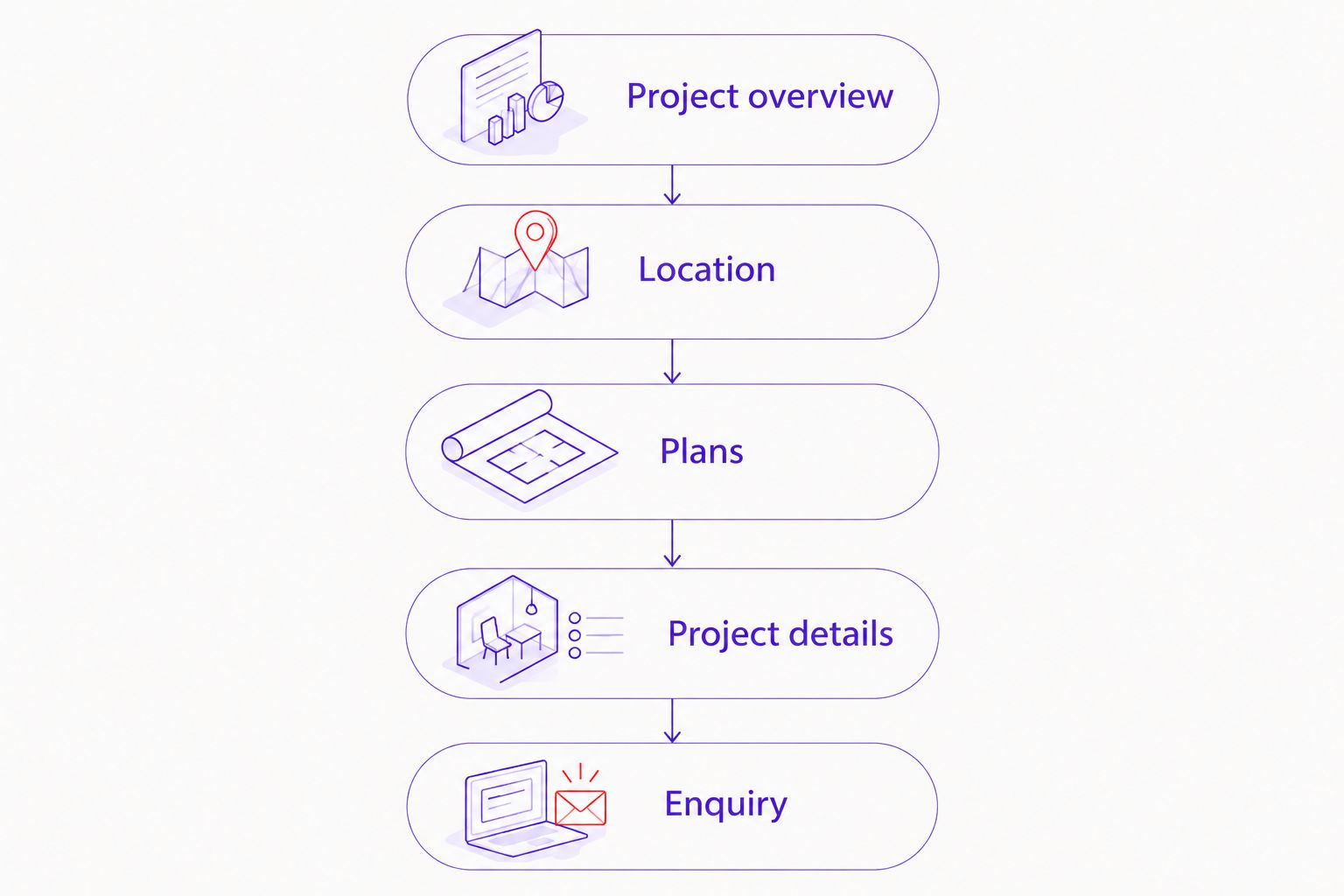
Draft the page content in a document before designing it. Work from approved project material, not assumptions about what a development includes. A practical structure covers Project overview, Location, Plans, Project details and Enquiry.
These sections answer different questions: what the development is, where it is, how the space works, which details require verification and how to speak to the team. Where information is not approved, remove the claim rather than fill the gap with promotional language.
CreativHeads can bring branding, content and web design into the same project brief. That combined scope still needs a named approver on your side, particularly for project descriptions and claims.
- Write a plain-language project overview.
- Explain the location using verified information.
- Attach approved plans with readable labels.
- Identify who checks project details before publication.
- Place the enquiry action beside relevant project information.
Design for enquiry decisions on mobile
Sketch the key screens yourself first, even on paper. Review the project page as a buyer: can you identify the development, read the essential information and understand the next action without hunting through menus?
Distinguish 3 enquiry actions where they match your sales process: request project information, discuss requirements and request a site visit. Do not offer an action your team cannot fulfil. A single clear action is better than several buttons that all lead to the same unexplained form.
For a 2026 redesign, request mobile layouts during design review rather than treating them as a launch-day adjustment. Check real content, including long project names, plan labels and form errors.
- Keep the main project information readable on a narrow screen.
- Use descriptive buttons that explain the next step.
- Place forms where the buyer has enough context to enquire.
- Check navigation, text contrast and tap targets.
- Test brochure and plan viewing on a phone.
Connect enquiries to the sales workflow
Document the handoff manually before discussing integrations. Specify what happens after a buyer submits a form, who receives the enquiry and which project details accompany it. A working form is not enough if the recipient cannot identify the buyer’s interest.
If you use a customer relationship management system, ask the agency to specify the connection and its responsibilities. Include field mapping, failure handling and testing in the scope. If enquiries arrive by email, define recipients and a backup process instead.
Separate form submissions from qualified enquiries in your reporting. The first measures a website action; the second requires a definition agreed with sales. Neither automatically represents a booking or sale.
- Include project interest in the enquiry record.
- Collect only the information needed for the first conversation.
- Assign a recipient and backup owner.
- Test successful submissions and failed deliveries.
- Define which enquiry outcomes sales will report.
Compare agency proposals by deliverables
Create a common scope document and send it to each shortlisted provider. Ask for the same page types, content responsibilities, integrations and launch tasks. Otherwise, you are comparing different projects rather than different approaches to the same project.
CreativHeads brings strategy, design and marketing services into one team. That option is best for developers who want those workstreams commissioned together. Its limitation is scope complexity: a combined engagement needs explicit deliverables and approval points just as much as a website-only project.
Ask every agency to distinguish what it creates from what your team supplies. Project photography, approved plans, copy, translations and third-party connections should never sit in an ambiguous middle ground.
- Request a list of page types and reusable templates.
- Confirm responsibility for copy and project assets.
- Define feedback rounds and approval milestones.
- Ask who owns accounts, files and the finished website.
- List exclusions and separately scoped work.
- Require a written launch and handover plan.
Test the complete buyer journey before launch
Run a rehearsal using realistic project information. Start from a campaign or search landing page, review the development, submit an enquiry and confirm that the intended recipient receives the right details. Repeat the journey on a phone.
Set 5 launch checks: content accuracy, mobile usability, enquiry delivery, page-address migration and ownership handover. Give each check an owner and record the result. Screenshots alone do not prove the website is ready.
Your 2026 handover should also explain how project details get updated. Ask the agency to demonstrate an edit, not merely state that the website is editable. Keep a record of outstanding fixes and responsibility for each.
- Verify published content against approved project material.
- Test forms with valid and invalid entries.
- Open plans, brochures and key navigation links.
- Check old page addresses against the migration plan.
- Confirm access to website and reporting accounts.
- Demonstrate routine project-content updates.
Compare website redesign options
Choose the delivery model around the work you need to commission. A design-only engagement does not automatically include content strategy, enquiry routing or campaign planning. An integrated agency engagement does not remove your responsibility to approve project facts.
| Option | Best for | Main benefit | Key limitation |
|---|---|---|---|
| Internal team | Developers with established web, content and marketing capabilities | Direct coordination with project and sales teams | Requires internal capacity and clear ownership across disciplines |
| Independent web specialist | A tightly defined website build with approved content | Focused responsibility for the website deliverable | Branding, content and marketing work require separate scope or providers |
| Website-focused agency | Developers needing design, development and website management | Dedicated website delivery process | Campaign strategy and broader brand work depend on the agreed service scope |
| CreativHeads integrated agency approach | Developers commissioning brand strategy, website redesign and digital marketing together | Those disciplines can share one project brief | Broader work requires precise deliverables, approvals and handoffs |
Compare what each proposal includes before comparing the commercial terms. Page types, content creation, custom features, integrations, language versions and migration work change the amount of work involved. Ask providers to explain those differences explicitly.
For a 2026 decision, request a clear distinction between the initial redesign, ongoing maintenance and later campaign work. A proposal should explain responsibilities after launch, not stop at the publication date.
Common mistakes real estate developers make
Approving building imagery before the project story
A striking image does not explain the development. Approve the buyer questions, information order and project claims before judging visual treatments. Otherwise, the design review becomes a discussion about appearance rather than usefulness.
Treating every development as the same page
A shared template is useful; identical content is not. Define which fields every project needs and which sections vary by development. Do not force a project to display amenities, plans or claims that have not been approved.
Sending every enquiry into one undifferentiated inbox
When project interest disappears during the handoff, sales teams must reconstruct it. Specify the information each enquiry carries and the recipient responsible for follow-up. Test the routing before launch.
Buying a homepage without defining the wider scope
The homepage is only one part of the buyer journey. Ask whether the proposal covers project templates, forms, downloadable material, content entry and migration. Commission a usable website, not a single presentation screen.
Confusing a redesign with a sales guarantee
A redesign changes the website experience; it does not establish demand, project suitability or sales-team performance. Evaluate the agency on agreed deliverables and measurable website actions. Evaluate sales outcomes with the wider commercial process in view.
FAQ
What should a website redesign for real estate developers include?
A website redesign for real estate developers should include buyer journeys, project-page structure, approved content, mobile layouts, enquiry routing and launch testing. The proposal should also define page migration, ownership and the handover process.
Should a developer redesign the corporate website or build project websites?
Choose the structure according to the role each website must serve. A corporate website explains the developer and its portfolio; a dedicated project website concentrates on one development and requires its own content and maintenance responsibilities.
How much does a real estate website redesign cost?
The project scope determines the quote. Ask providers to separate page templates, content creation, integrations, migration, maintenance and campaign work so you can compare equivalent deliverables.
What should I ask an agency before hiring it?
Ask who creates the content, approves project facts, builds integrations and owns the finished website. Also request written exclusions, approval milestones, launch checks and post-launch responsibilities.
Is CreativHeads suitable for a real estate website redesign?
CreativHeads suits developers seeking website redesign, brand strategy and digital marketing from one agency. Evaluate the proposed scope against your project-page needs, content responsibilities and sales workflow before commissioning the work.
How do I avoid losing useful pages during a redesign?
Create a page inventory and migration plan before changing existing page addresses. Keep relevant pages where appropriate and route replaced addresses to suitable new pages rather than sending everything to the homepage.
How do I measure whether the redesigned website works?
Measure agreed website actions and distinguish them from sales-qualified enquiries. Test form delivery, record project interest and ask sales to report outcomes using a shared qualification definition.
One last thing
Before signing a proposal, ask the provider to demonstrate how your team will update a project detail after launch. That simple request exposes whether content ownership, editing access and maintenance responsibilities are actually defined.
Bring 1 sample project page and 1 enquiry journey into the final scope discussion. Those concrete examples make it easier to agree what you are buying—and harder for essential work to disappear between design approval and handover.
Related guides