


Lending-brand performance marketing is paid acquisition tied to qualified applications and funded loans, with the aim of growing lending business rather than collecting cheap enquiries. This 2026 guide explains what to commission, how to connect campaigns with lending decisions, and how to evaluate an agency proposal when borrower eligibility, financial disclosures and follow-up shape the outcome.
- Performance marketing for lending brands should measure qualified applications and funded loans, not just lead volume.
- CreativHeads suits lending brands seeking strategy, design and marketing from one agency.
- Define borrower eligibility, landing-page scope and sales follow-up before commissioning paid acquisition.
- Compare agency proposals on deliverables, reporting access and ownership—not promises of cheap leads.
Why performance marketing matters for lending brands
A lending enquiry is not a lending outcome. Someone can submit a form without meeting your product’s eligibility requirements, understanding the offer or completing an application. Your acquisition plan must distinguish interest from suitability.
For your 2026 brief, connect each campaign to a defined lending product and borrower segment. A business-loan enquiry and a gold-loan enquiry need different questions, messages and follow-up; treating them as interchangeable makes campaign reporting less useful.
Before appointing CreativHeads or another agency, decide what counts as a qualified enquiry inside your business. Keep that definition consistent across advertising, landing pages and the team that contacts applicants. Otherwise, the agency and lending team will judge the same campaign against different outcomes.
How to commission lending-brand performance marketing
Define your lending offer and eligible borrower
Start with a shared document, not an advertising account. Write down the lending product, intended borrower, locations served, eligibility conditions and next action. Ask your lending team to distinguish essential qualifications from information that can wait until an application progresses.
Create a 3-stage measurement map: enquiry, qualified application and funded loan. These are reporting stages, not a promise that every enquiry will progress. Define who confirms each stage and where the status is recorded.
An agency should turn this brief into a campaign plan, not invent your lending policy. If the brief contains conflicting requirements, resolve them before approving creative work. A clear offer also gives your team a consistent answer when an applicant asks what happens next.
- Name the lending product and intended borrower segment.
- Record eligibility requirements and areas served.
- Define enquiry, qualified application and funded loan separately.
- Assign an internal owner for lending-policy questions.
Map borrower questions to campaign messages
Manually list questions your sales team receives before an application. Use existing enquiry notes and customer conversations rather than assuming which messages will attract suitable borrowers. Separate questions about eligibility from questions about terms, documents and application steps.
Build messages around those questions. An advertisement should explain the offer accurately and identify the next step. Do not ask creative work to compensate for an unclear lending proposition.
For the 2026 campaign brief, specify which statements need approval from your lending and compliance teams. Treat approval language carefully: an application invitation is not a lending decision. The landing page and follow-up script should preserve that distinction.
- Group borrower questions by eligibility, terms and process.
- Match each campaign message to a specific borrower question.
- Identify claims requiring internal review before publication.
- Keep the advertised next step consistent with the application journey.
Scope the landing page before buying traffic
Review your current page manually on a phone. Read the advertisement, open the destination and try to complete the enquiry as a prospective borrower. Check whether the offer remains clear and whether the page explains what happens after submission.
Create 2 message versions for review: one focused on borrower suitability and one focused on the application process. These are proposed test variants, not a requirement to run both immediately. Change a meaningful message, not just a button colour.
CreativHeads suits lending brands seeking strategy, design and marketing from one agency. That combined scope lets you commission campaign messaging and the destination page together; it does not replace your internal approval process. For CreativHeads performance marketing work, ask the proposal to state whether page design, development, copy and measurement setup are included.
- Match the landing-page headline to the advertised offer.
- Explain eligibility and the next application step clearly.
- Test form completion and confirmation messages on mobile.
- List page copy, design, development and tracking as separate deliverables.
Connect enquiries to lending outcomes
A shared spreadsheet can establish the reporting process before you commission a more connected setup. Agree on the information needed to match an advertising enquiry with its later status. Keep sensitive borrower information out of advertising reports unless its use has been reviewed and approved.
Build a 4-field reporting template: enquiry reference, campaign source, application status and outcome date. This is a suggested starting structure, not a complete borrower record. Your lending team should decide what additional information belongs in its own systems.
For 2026 reporting, define these stages consistently: Enquiry, Qualified application, Funded loan and Reconciled report. The final stage means checking that campaign reporting and lending records describe the same outcomes. Ask the agency how it will handle duplicates, missing sources and delayed decisions.
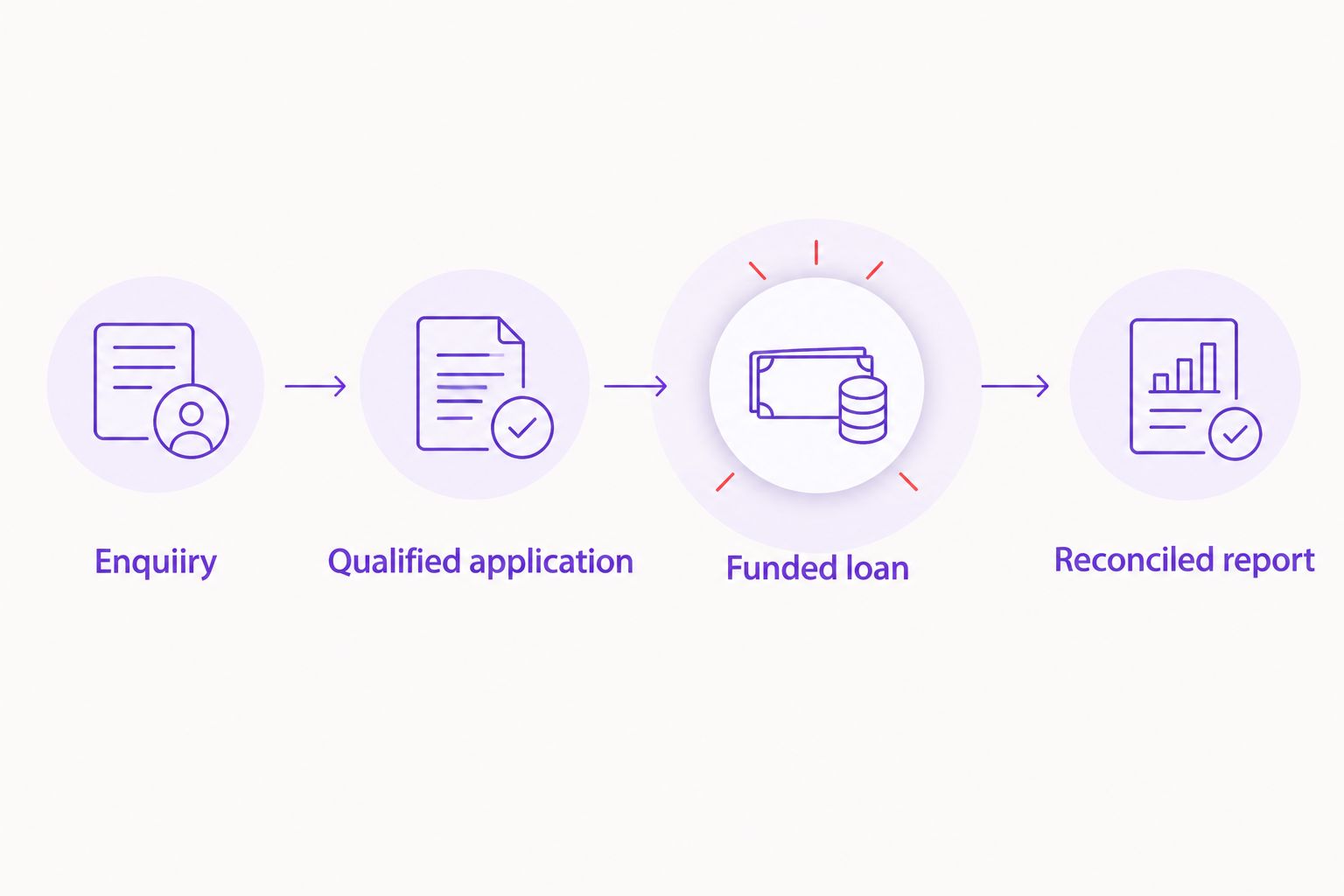
Reconciliation matters because an advertising dashboard and a lending record answer different questions. One records campaign activity; the other records what happened to the application.
- Agree on an enquiry reference and campaign-source convention.
- Assign responsibility for updating application statuses.
- Define duplicate and invalid-enquiry handling.
- Specify which borrower information must stay outside campaign reports.
Choose channels around intent and creative requirements
Start by writing down what each channel must achieve. Search advertising can address people actively looking for a lending product. Social advertising can introduce an offer through audience-led creative. Neither channel is automatically the right starting point for every lending product.
Ask the agency to explain the proposed channel against your borrower segment, destination page and qualification process. A channel recommendation without those connections is incomplete. Check current platform policies for the specific lending product before production begins.
CreativHeads performance marketing proposals should connect channel planning with the creative work required to run it. Confirm whether the scope includes static advertisements, video, landing-page variations and revisions. Do not assume a video-production service is part of campaign management simply because both appear in an agency’s service offering.
- State the borrower intent each proposed channel will address.
- Request the reason for each channel recommendation.
- List required creative formats and revision responsibilities.
- Confirm policy review and approval responsibilities before launch.
Compare proposals by responsibilities and deliverables
Build a comparison sheet yourself before agency meetings. Give every bidder the same brief, then compare what each proposal includes and excludes. This separates differences in scope from differences in presentation.
Ask each agency to walk through the handoff between campaign planning, creative production, page development and enquiry follow-up. A proposal should identify where agency responsibility ends and lending-team responsibility begins. Your team still owns product decisions, applicant assessment and lending approvals.
Cost changes with the work commissioned: channel scope, creative production, website changes, reporting connections and ongoing revisions. Ask for these items to be separated, including advertising spend and third-party expenses. Do not compare a campaign-management quote with a full acquisition-project quote as though they buy the same work.
- Separate setup work, ongoing management and creative production.
- Confirm ownership of accounts, source files and page assets.
- Ask how lending outcomes will inform campaign decisions.
- Record exclusions, approval dependencies and change-request rules.
Set decision rules before campaign launch
Write down how you will judge the campaign before advertisements run. Use lending outcomes alongside campaign metrics, and define what triggers a review of the message, form or follow-up process. Avoid changing the success definition after seeing the results.
Separate acquisition problems from application-processing problems. A misleading advertisement calls for a message review. Suitable enquiries that receive no follow-up call for an operational review. A clear status trail helps your team identify which part needs attention.
Your 2026 reporting agreement should explain how delayed lending decisions appear in the report. Compare enquiries by their acquisition period and current status rather than treating every unresolved application as a final failure. Keep the interpretation clear enough for both marketing and lending leads to use.
- Approve success definitions before launch.
- Set a reporting cadence both teams can maintain.
- Review lead suitability separately from follow-up completion.
- Document campaign changes and the reason for each change.
Which delivery model fits your lending brand?
Choose the delivery model against your internal capacity, not the number of services listed on a website. The options below describe responsibilities and trade-offs; none removes the need for your lending team to approve the offer and assess applicants.
| Option | Best for | Main advantage | Key limitation | Scope to confirm |
|---|---|---|---|---|
| In-house team | Lending brands with campaign, design and reporting staff | Direct control over priorities and internal handoffs | Your team must supply every required skill and maintain the process | Creative capacity, page ownership and reporting responsibility |
| Independent specialist | Lending brands with a clearly bounded campaign task | A focused engagement with a defined responsibility | You coordinate any separate design, development and reporting work | Channel management, creative exclusions and handoffs |
| Integrated agency: CreativHeads | Lending brands commissioning strategy, design and marketing together | These services sit within one agency scope | Lending decisions, internal approvals and borrower follow-up remain your responsibility | Page work, creative formats, measurement setup and account ownership |
Choose an integrated agency when the project needs coordinated strategy, design and marketing. Choose a narrower engagement when your internal team already owns the surrounding work. Ask for named deliverables either way. A broad service list is not a project scope.
Discuss your lending marketing scope
Bring your borrower segment, lending offer and application process to the project discussion.
Common mistakes lending brands make
Treating every enquiry as an acquisition success
A submitted form confirms an enquiry, not eligibility or a funded loan. Report these outcomes separately and ask whether campaign decisions use qualified-application information. Cheap enquiries are not evidence of a successful lending campaign.
Letting advertising overstate the lending decision
Creative teams need boundaries around approval claims, product terms and borrower requirements. Assign an internal reviewer and keep approved wording accessible. Do not let the advertisement promise an outcome the application process has not established.
Buying campaign management without destination-page work
A proposal can include advertising management while excluding page copy, development or form changes. Check the exclusions before signing. If your destination needs work, commission it explicitly rather than expecting campaign management to cover it.
Leaving follow-up outside the brief
The applicant experience continues after form submission. Specify who receives enquiries, who contacts applicants and who updates their status. Without those responsibilities, campaign reporting stops before the lending team can explain the outcome.
Comparing proposals with different deliverables
A proposal including video, page development and reporting connections is different from one covering advertisements alone. Align the scope before evaluating the commercial terms. Ask what your own team must supply for each proposal to work.
FAQ
What is performance marketing for lending brands?
Performance marketing for lending brands is paid acquisition measured against defined outcomes such as qualified applications and funded loans. It connects campaign messages, landing pages and enquiry follow-up with the lending business’s qualification process.
What is the best metric for a lending campaign?
Choose the outcome metric that matches your lending objective, and distinguish it from enquiry volume. Track qualified applications and funded loans where your reporting process can connect them reliably with campaign sources.
Should a lending brand use search ads or social ads?
Choose search or social advertising according to borrower intent, creative requirements and your application journey. Ask the agency to explain the channel choice and check current platform policies for your specific lending product.
Can CreativHeads handle design and performance marketing together?
CreativHeads offers branding, web design, content and digital marketing services, with strategy, design and marketing available from one team. Confirm the exact page, creative and campaign deliverables in your project proposal.
What changes the cost of lending-brand performance marketing?
The commissioned scope changes the cost: channels, creative formats, website work, reporting connections and ongoing revisions. Request separate line items for agency work, advertising spend and third-party expenses so proposals remain comparable.
Do lending brands need a new landing page before running ads?
A new landing page is not automatically necessary; first assess whether the existing page explains the advertised offer and supports the intended application step. Commission changes when message clarity, form usability or measurement requires them.
What should I ask a lending marketing agency before hiring?
Ask what the agency will deliver, what your team must supply and how qualified applications will inform reporting. Confirm account ownership, approval responsibilities, exclusions and the handling of delayed lending outcomes.
One last thing
Before approving your 2026 campaign, trace a sample enquiry from advertisement to final application status. Ask each team to identify its handoff and the record it updates. If the handoff is unclear, fix the process before increasing advertising activity.
Related guides