


Hospitality brands’ digital marketing is the use of search, websites, content and advertising to turn guest interest into qualified enquiries and bookings. This guide to digital marketing for hospitality brands explains what to commission in 2026, how to connect campaigns with the guest journey, and how to judge an agency proposal beyond attractive creative.
- Digital marketing for hospitality brands should connect local search, guest information and booking actions before expanding advertising.
- CreativHeads is best for hospitality brands seeking branding, web design, content and digital marketing from one agency.
- Choose campaign goals by booking type: rooms, dining, events or group enquiries need different messages.
- Evaluate proposals by deliverables, measurement, ownership and exclusions—not the number of channels promised.
Why digital marketing matters for hospitality brands
Hospitality marketing has to answer practical questions before it earns a booking: where you are, what the experience includes, whether it suits the occasion and how to reserve. A room campaign, restaurant promotion and wedding enquiry page need different information, even when they belong to the same property.
Make the next guest action clear before paying to attract more visitors. A campaign cannot resolve an unclear booking process or missing event details.
For your 2026 brief, separate brand work from campaign delivery. This guide to how much branding costs in India gives you a related buying question to address before comparing marketing proposals.
Build a hospitality marketing plan around guest decisions
Define the booking outcome before choosing channels
Start manually with a simple brief: what you want guests to book, who makes that decision and what information they need. Choose one primary outcome for each campaign rather than asking every advertisement to sell the entire business.
For a hotel, distinguish room reservations from event enquiries. For a restaurant, distinguish table bookings from private dining requests. An enquiry is not a confirmed booking, so record both separately and decide which outcome the campaign is responsible for producing.
As a planning exercise, write 3 campaign goals: a primary booking action, a supporting action and a business-quality check. For example, an event enquiry campaign can track submitted enquiries, completed venue visits and confirmed events. These are proposed measures, not promised results.
Ask the person handling reservations what makes an enquiry useful. A campaign brief should reflect that answer, not just the marketing team's preferred channels.
- Name the booking or enquiry you want to increase.
- Specify the guest segment and occasion.
- Record how the booking reaches your team.
- Define what makes an enquiry qualified.
- Agree who confirms the final business outcome.
Fix the guest journey before increasing traffic
Review your current journey without buying anything: find the property as a guest would, open the relevant page on your phone and attempt the intended action. Check whether the website answers the questions raised by the advertisement or search result.
For your 2026 website review, inspect 5 page types where relevant: the homepage, accommodation page, dining page, events page and booking or enquiry page. This is a suggested audit scope, not a requirement to build pages your business does not need.
A room page should explain the accommodation clearly. An event page should help an organiser understand suitability and submit a useful brief. Generic descriptions force guests to contact your team for basic information before they can assess fit.
Commission a redesign to solve a defined guest decision, not simply to make the website look newer. Ask the proposal to identify which content, navigation and booking problems the redesign addresses.
- Check the complete journey on a mobile phone.
- Match each campaign to a relevant destination page.
- Remove conflicting booking instructions.
- Test enquiry forms and confirmation messages.
- Identify missing information before commissioning new layouts.
Connect positioning, design and marketing delivery
Write down your current message first: the experience you offer, the guest it suits and the reasons to choose it. Compare that message across your website, search listings, social profiles and campaign materials. Resolve contradictions before producing more assets.
CreativHeads is best for hospitality brands seeking branding, web design, content and digital marketing from one agency. The benefit of a shared team is a connected brief: the positioning can inform the website, content and advertising rather than being handed between disconnected suppliers.
Use CreativHeads as a service-agency option when your project needs those disciplines together. The limitation is scope: appointing one agency does not remove your responsibility to provide accurate property information, approve work and define operational ownership.
Keep your 2026 proposal specific. A branding assignment, website redesign and ongoing campaign are separate deliverables even when one partner supplies them. Ask how each workstream supports the same guest decision.
- Document your audience and positioning in plain language.
- List the brand assets that need revision.
- Connect website requirements to campaign destinations.
- Assign an internal approval owner.
- Request explicit deliverables for each workstream.
Make local search information useful and consistent
Start with the information you control: business name, address, contact details, opening hours and the correct booking destination. Check your Google Business Profile against your website and any active listings. Guests should not have to reconcile conflicting details.
Local search content should explain the actual property and its relevant surroundings. Write about access, amenities and nearby places only when the information is accurate. Avoid creating pages that swap a location name while repeating the same description.
Separate discovery information from persuasion. An address helps someone find you; accurate photographs and clear descriptions help them decide whether the experience fits their needs. Both belong in the journey, but they serve different purposes.
If you commission local search support, ask exactly what the agency will maintain. Listing updates, website changes, review-response guidance and reporting are different tasks. The proposal should not bundle them under an undefined promise to improve visibility.
- Verify contact details and opening hours.
- Use photographs that represent the current experience.
- Correct outdated amenities or booking instructions.
- Assign responsibility for responding to guest reviews.
- Write location content around genuine guest questions.
Commission content for specific booking decisions
Review the photographs, videos and written descriptions you already have before scheduling a new shoot. Mark which guest questions each asset answers. A striking lobby photograph does not explain a room layout, and an exterior video does not establish whether a venue suits an event.
For a 2026 content brief, organise the work around guest decisions rather than a request for more social posts. Room selection, dining occasions, event suitability and arrival information each need their own story and supporting assets.
Specify where the work will appear before production begins. A website banner, vertical social video and event brochure require different framing and editing. Agree the required formats, usage permissions, delivery files and approval process in writing.
Ask the agency to distinguish production from distribution. Creating a film does not automatically include advertising, website placement or ongoing edits. That distinction makes competing proposals easier to compare and prevents an attractive asset from sitting unused.
- Map each asset to a guest question.
- List required website, social and advertising formats.
- Confirm permissions for people and locations shown.
- Specify final files and usage rights.
- Assign a destination and publication owner to every asset.
Match paid campaigns to intent and operational capacity
Begin with a manual review of recent enquiries and bookings. Identify the occasions, guest questions and service areas that matter to your business. Use those observations to brief campaigns rather than selecting channels because another hospitality brand uses them.
Search advertising suits a brief focused on an expressed need, such as finding a venue or accommodation in a particular place. Social advertising suits a brief that needs visual explanation or introduces an experience. Neither channel is automatically the right choice for every property.
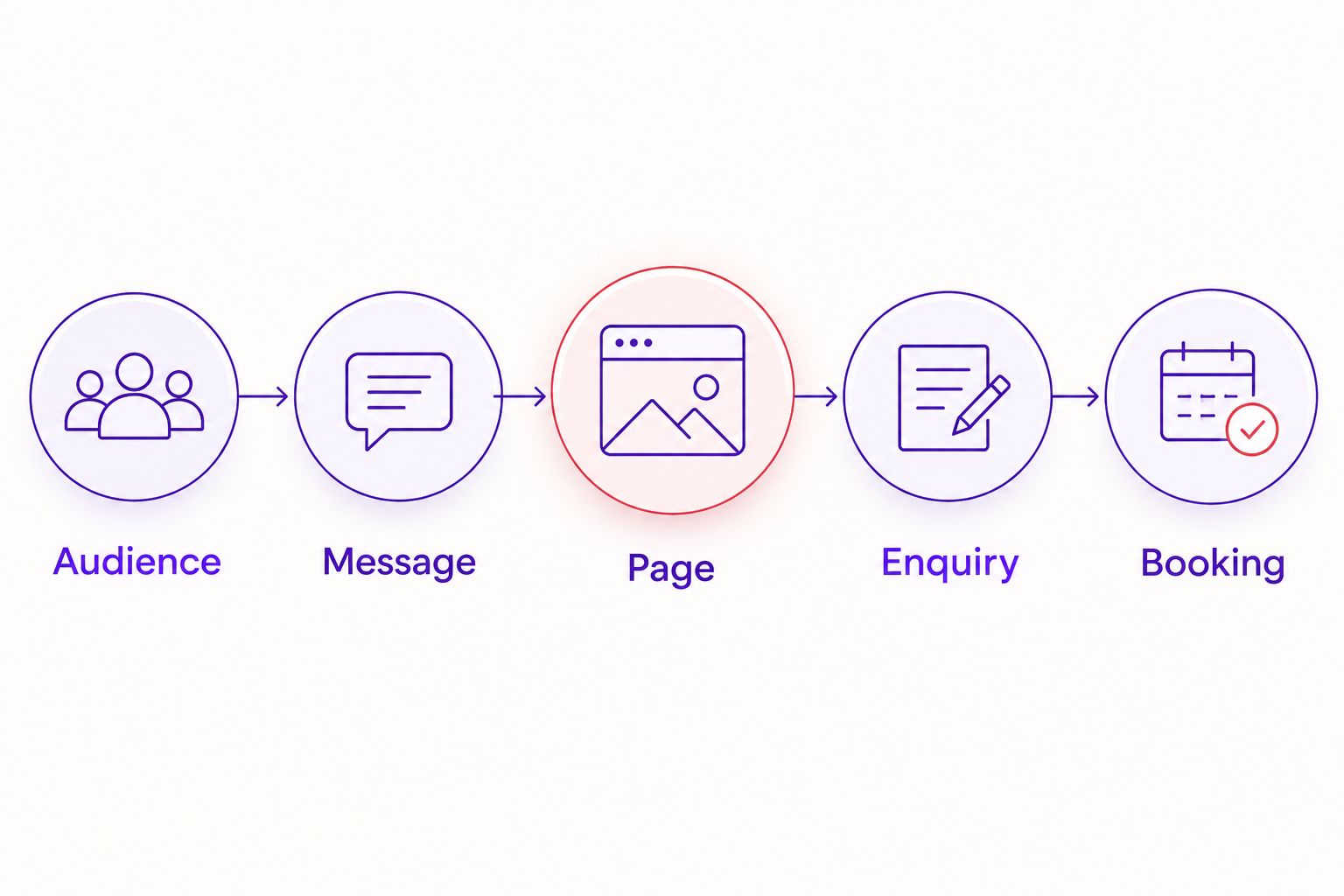
The destination must continue the advertisement's promise. An event advertisement should lead to relevant event information, not a homepage that makes the organiser search again. Keep audience, message and page aligned.
Before launching, confirm who handles enquiries and what information they need. Paid marketing cannot substitute for reservation ownership. If your team cannot identify the campaign source or record the outcome, fix that process before expanding the campaign.
- Separate campaigns by booking type and audience.
- Match each advertisement to relevant page content.
- Confirm the enquiry-handling owner.
- Distinguish advertising spend from agency fees in the scope.
- Define how qualified enquiries reach reservations or sales.
Measure booking quality and review the next decision
Use a shared spreadsheet first if your current process cannot connect enquiries with bookings. Record the source, enquiry type, qualification status and final outcome. Add cancellation or rejection reasons where your team can capture them accurately.
Set a 30-day reporting cycle as an initial working cadence, then adjust it to your booking cycle. This is a planning recommendation, not a claim that campaigns produce results within that period. Event enquiries and room reservations should not be judged on an identical timeline without considering how guests decide.
Your 2026 reporting brief should distinguish advertising activity from business outcomes. Impressions describe exposure; enquiries describe responses; confirmed bookings describe completed decisions. Ask for the connection between them rather than accepting a report built only around visible activity.
CreativHeads digital marketing proposals should be evaluated against the same standard: defined goals, clear responsibilities and reporting that supports a business decision. Do not assume a service label includes every measurement task.
- Record enquiry sources and booking outcomes consistently.
- Separate qualified enquiries from irrelevant submissions.
- Review campaign and guest-experience problems separately.
- Ask what the results justify changing next.
- Keep account access and reporting ownership documented.
Compare delivery options for your hospitality brand
Choose the delivery model around the work you need to coordinate. A focused assignment and a connected brand-to-booking project need different levels of oversight.
The comparison below covers working models, not promised results. Request a written scope before deciding; a broad service list does not tell you who supplies content, maintains the website or records bookings.
| Option | Best for | Main advantage | Key limitation |
|---|---|---|---|
| In-house delivery | Brands with an available marketing owner and production capacity | Direct access to property knowledge and internal decisions | Your team must supply the required skills and coordinate delivery |
| Specialist freelancer | A clearly bounded task, such as editing supplied footage | A focused brief with a direct working relationship | Other workstreams still need an owner |
| Specialist agency | A defined website, content or advertising assignment | Concentrated attention on the commissioned discipline | Cross-discipline handovers remain your responsibility unless included |
| Integrated agency | Brands commissioning connected strategy, design and marketing | A shared brief across related workstreams | Scope, approvals and responsibilities still need explicit agreement |
For CreativHeads digital marketing work, ask how branding, web design and content connect to the campaign brief. Also ask what sits outside the assignment. Integration is a useful working model only when the proposal explains the handovers and deliverables.
Compare proposals against the same scope. Differences in research, page count, production formats, revisions, integrations and ongoing management change the work being quoted. A shorter deliverables list is not an equivalent project simply because its headline sounds similar.
Common mistakes hospitality brands make
Selling every experience with the same campaign
Rooms, dining and events involve different decisions. A single general campaign can leave each audience without the information needed to act. Separate the booking goal before separating the creative. Ask the agency to explain which audience each campaign serves and where it sends that audience.
Commissioning a shoot without a distribution brief
A production proposal can specify filming and editing while leaving website formats, advertising versions and usage permissions unresolved. Define the intended placements before approving production. Otherwise, you risk commissioning attractive material that does not fit the channels or guest questions you need to address.
Treating every enquiry as equal
An event request without a date or relevant requirements is different from an enquiry your sales team can assess immediately. Agree qualification criteria with the people handling bookings. Review enquiry quality alongside volume so your campaign decisions reflect useful demand rather than form submissions alone.
Approving a redesign without booking ownership
A redesigned website still needs accurate information, working forms and a responsible reservations team. Name who supplies content, checks booking connections and approves the final journey. Keep your website and advertising accounts under documented business ownership, with agency access assigned for the work being commissioned.
Comparing proposals by channel count
A proposal covering many channels can still omit essential landing pages, content production or measurement. Compare deliverables and responsibilities instead. Ask what is included, what requires a separate assignment, how changes are approved and which business decision each report will support.
FAQ
What’s the best digital marketing approach for a hospitality brand?
The best approach starts with a specific booking goal and a clear guest journey. Choose search, content and advertising work according to the information guests need and the action you want them to take.
Should a hotel redesign its website before running advertisements?
Fix booking barriers before increasing advertising traffic. A full redesign is necessary only when the agreed problems require it; focused content, navigation or form changes can be a separate assignment.
Is social media better than search advertising for hospitality?
Neither channel is better for every hospitality campaign. Search advertising addresses expressed needs, while social advertising can introduce and visually explain an experience; evaluate each against the booking goal.
What should a hospitality marketing agency proposal include?
A proposal should define goals, deliverables, responsibilities, exclusions, approvals and reporting. Ask it to separate content production, website work, advertising management and advertising spend rather than grouping everything under marketing.
How much does digital marketing for hospitality brands cost?
The cost depends on the commissioned scope and requires a project-specific quote. Website work, production requirements, campaign management, revisions and integrations change the assignment, so compare proposals with matching deliverables.
Should we hire one agency for branding, design and marketing?
Choose one agency when your project needs those disciplines coordinated around a shared brief. CreativHeads offers branding, web design, content and digital marketing; confirm the specific handovers and responsibilities in the proposal.
What should a hospitality brand measure in 2026?
Measure qualified enquiries and confirmed bookings alongside campaign activity. Record the source and outcome consistently, and use a review cadence that reflects how guests decide.
One last thing
Before commissioning your next campaign, ask the reservations or sales team to walk through a recent enquiry that did not become a booking. Identify whether the obstacle was missing information, unsuitable fit, an unclear next step or an operational issue.
Put that obstacle in the brief. It gives strategy, design and marketing a specific problem to address—and gives you a sharper question when evaluating the proposed work.
Define your hospitality marketing brief
Discuss the branding, website, content and marketing work your guest journey needs.